See also
- George MURRAY's parents: Alexander MURRAY (1677-1735) and Elizabeth STIRLING (bef1683-1756)
- George MURRAY's siblings: Elizabeth MURRAY (1701-1748), Patrick MURRAY (1703-1778), Alexander MURRAY (1704-1705), Anne MURRAY (1708-1793), Gideon MURRAY (1710-1776), John MURRAY (1711-1711), Alexander MURRAY (1712-1778), Mary MURRAY (1714-1772), Helen MURRAY (1716-1809), James Patrick 1 MURRAY (1721-1794), Barbara MURRAY ( -1773) and Janet MURRAY (1723- )
Admiral George MURRAY 6th Lord Elibank (1706-1785)
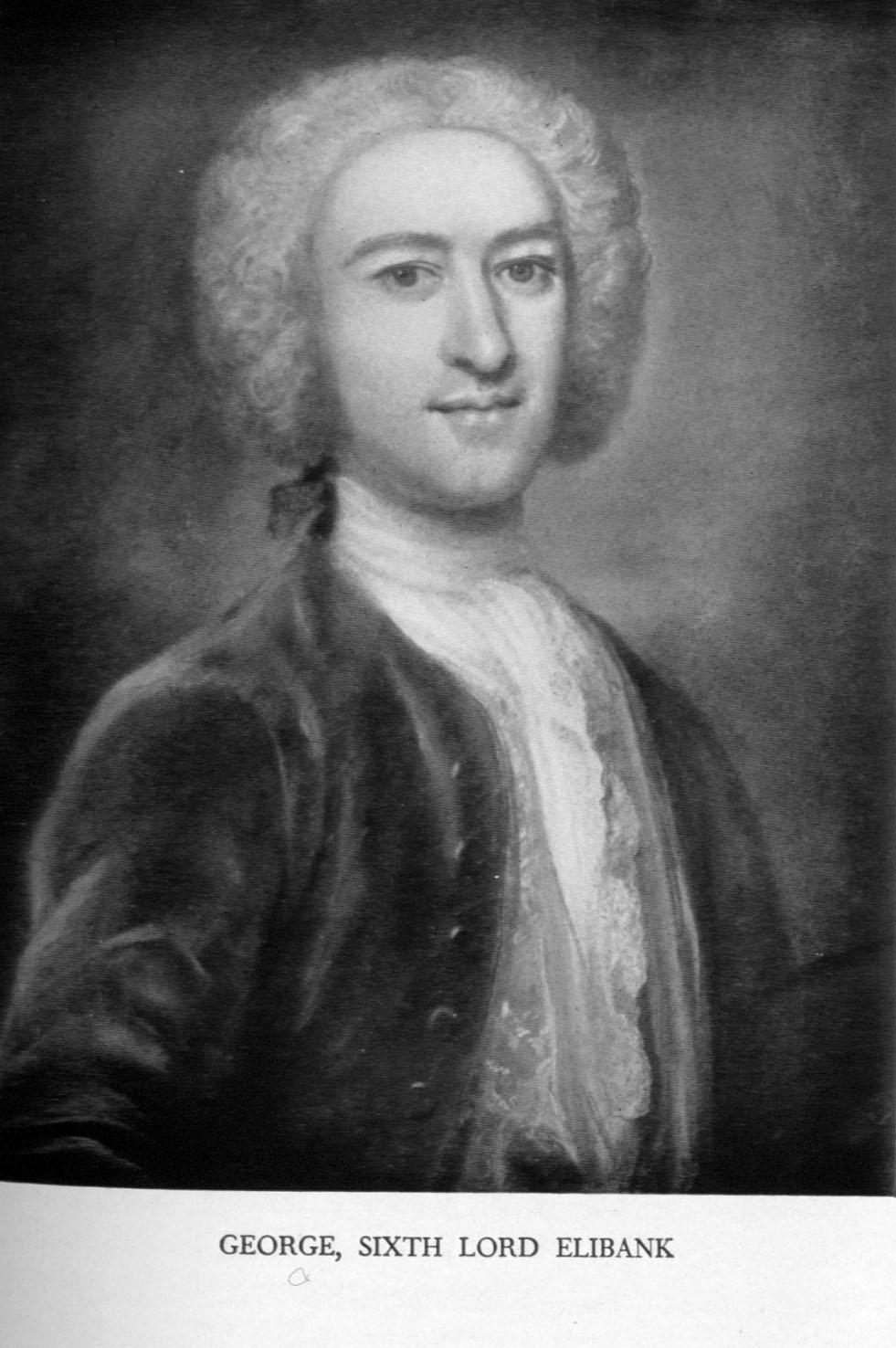
1. Admiral George MURRAY 6th Lord Elibank, son of Alexander MURRAY 4th Lord Elibank (1677-1735) and Elizabeth STIRLING (bef1683-1756), was born on 14 May 1706 in Aberlady. He was an Admiral in the Navy. He had the title 'Admiral, 6th Lord Elibank'. He married Isabella MCKENZIE on 8 January 1760. He died on [Julian] 12 November 1785 in Ballencrieff.
George had a distinguished career in the Royal Navy serving under Admiral Anson, whom he accompanied in part of his famous voyage around the world, although some controversy surrounded the fact of Murray's separation from Anson's fleet in very difficult and dangerous circumstances in waters around Cape Horn, although Murray's position has been fully explained and his conduct completely exonerated by the Hon. Arthur C. Murray in his book "An Episode in the Spanish War". Geroge Murray commanded various ships including HMS Tryal,Wager,Pearl, Hampshire,and Revenge. He left the navy in 1756 and suceeded his brother Patrick as 6th Lord Elibank in 1788.
Pilot Darrell’s Square is named for Pilot James Darrell who was one of three slaves chosen to work with
Lieutenant Thomas Hurd when he surveyed the channels and harbours around Bermuda in the 1790s. In May
1795, James Darrell piloted Admiral George Murray’s ship, the 74-gun HMS Resolution, through the Narrows
Channel into the newly charted Murray’s Anhorage. Admiral Murray was so impressed with James Darrell’s
skill that he recommended to Governor James Craufurd that Pilot Darrell be granted his freedom. James
Darrell was owned by Frances Darrell of St. George’s, and when the latter died, James Darrell was purchased
by the Governor who gave him his freedom in accordance with Admiral Murray’s request. Pilot James Darrell
received his freedom in March 1796 at 47 years of age and became the first black man to purchase a house
in Bermuda. The house, which was renovated in 1992, still stands at Pilot Darrell’s Square and is owned by
James Darrell’s descendents. From Pilot Darrell’s Square there is a superb view of the bell tower at the
western end of St. Peter’s Church. This view is framed by Taylor House, one of the prettiest and most
photographed houses in St. George’s and by a massive chimney which is one of seven beautiful chimneys at
Stewart Hall.
Rear Admiral George Murray
In May 1794, after war was again declared in 1793 between Britain and France, more British naval vessels were needed in the western Atlantic to deter French privateers. Rear Admiral George Murray sailed from Plymouth, England, with a Royal Navy squadron. It reinforced the few frigates based at Halifax under Commodore Rupert George. Cruising that summer off the Chesapeake Bay and the Carolinas in search of French vessels, Murray needed a base for his patrols during the winter.
Lieutenant Thomas Hurd RN, A marine surveyor, had charted the waters of Canada's Atlantic and Gulf of St. Lawrence. He was sent to Bermuda, to sound existing channels through the reefs and find new ones prior to the building of a British naval base in Bermuda. He began his surveys in the late 1780s and completed them in 1792.
In early October that year, on his flagship HMS Resolution off the American coast, Murray was told of Lieutenant Hurd's surveys and findings in Bermuda and dispatched the 32 gun frigate Cleopatra, under Captain Penrose, to Bermuda to bring back a report and charts from Hurd. What they revealed impressed Murray so much that he called at Bermuda himself before his return to Halifax in the spring. Murray sent Penrose and the Cleopatra back to Bermuda in February, 1795, to pick up French prize crews, during which time Penrose made his own glowing report of the facilities Bermuda could offer. Murray ordered Penrose to rendezvous with him at Bermuda in May, 1795 and was so further impressed with what he saw personally, as well as in the reports of Captains Penrose and Pender (of HMS Resolution) and Lieutenant Hurd, that he enclosed them with his own report to the Admiralty dated May 27, 1795.
Isabella MCKENZIE, daughter of George MCKENZIE ( - ), died on [Julian] 28 December 1801 in Ross. She and George MURRAY had the following children:
| +2 | |
| +3 |
Second Generation
2. Maria MURRAY, daughter of Admiral George MURRAY 6th Lord Elibank and Isabella MCKENZIE, married Edward HAY.
Edward HAY of Newhall, co. Haddington was the son of unk HAY ( - ). He and Maria MURRAY had the following children:
| +4 |
3. Isabella MURRAY was the daughter of Admiral George MURRAY 6th Lord Elibank and Isabella MCKENZIE.
Third Generation
4. John Hay MACKENZIE of Newhall and Cromarty, son of Edward HAY of Newhall, co. Haddington and Maria MURRAY, married Annie GIBSON-CRAIG.
Annie GIBSON-CRAIG was the daughter of Sir James GIBSON-CRAIG Baronet ( - ). She and John Hay MACKENZIE had the following children:
| 5 | Anne MACKENZIE ( - ). Anne had the title 'Countess of Cromartie and Viscountess of Tarbat'. |