See also
- William BADNALL's parents: Christopher BADNALL (c. 1674-1723) and Sarah WHIELDEN (c. 1673-1734)
- William BADNALL's siblings: Joseph BADNALL (1700-c. 1740), John BADNALL (1702-1703), Mary BADNALL (1704-1727) and Sarah BADNALL (c. 1707-1713)
William BADNALL (1699-c. 1760)
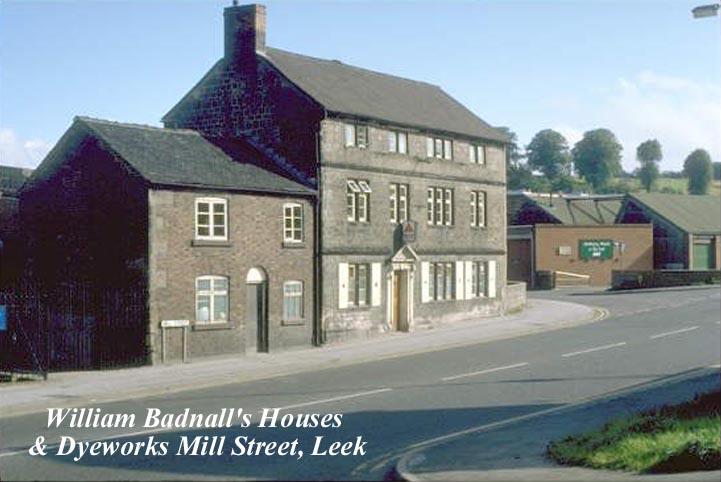
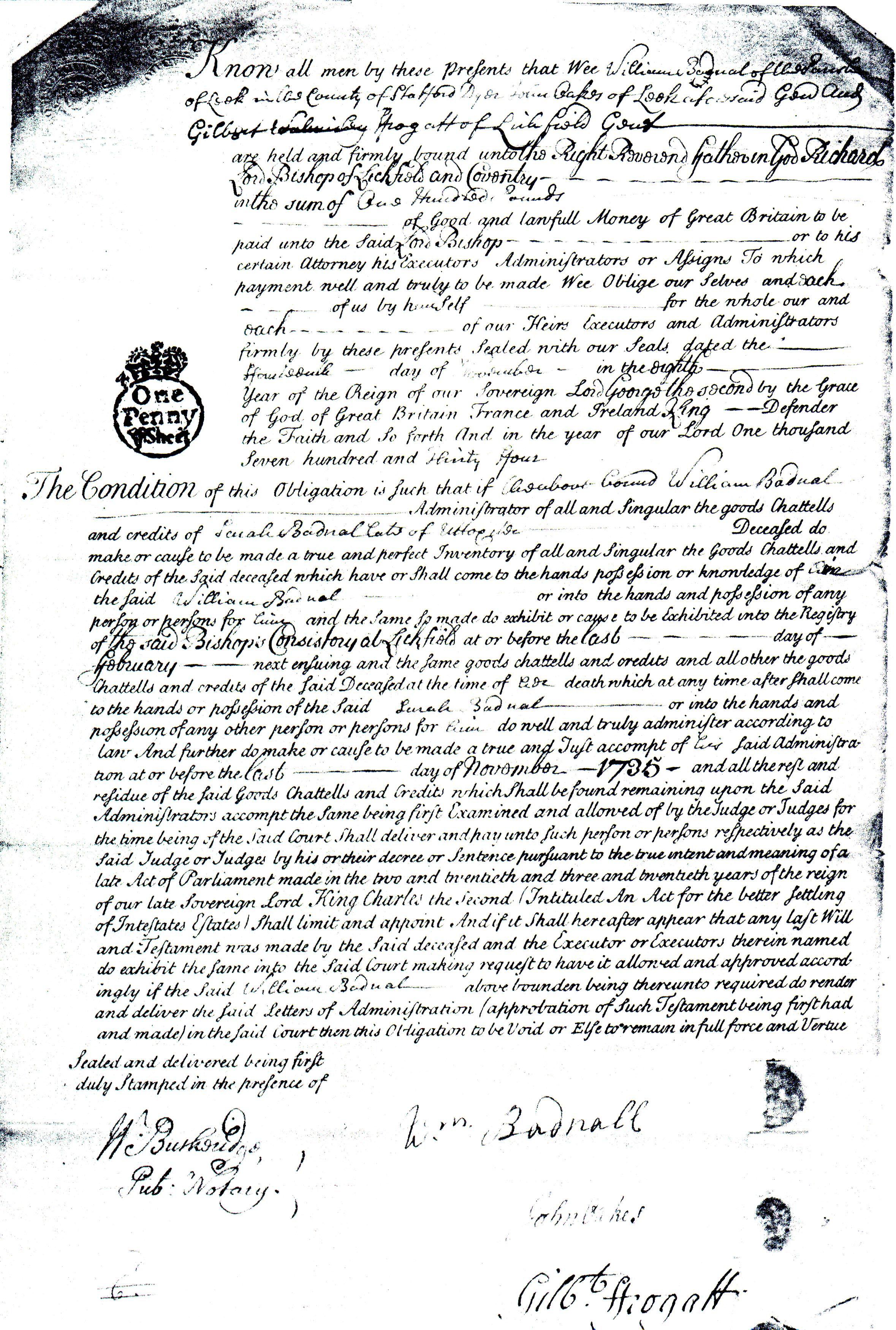
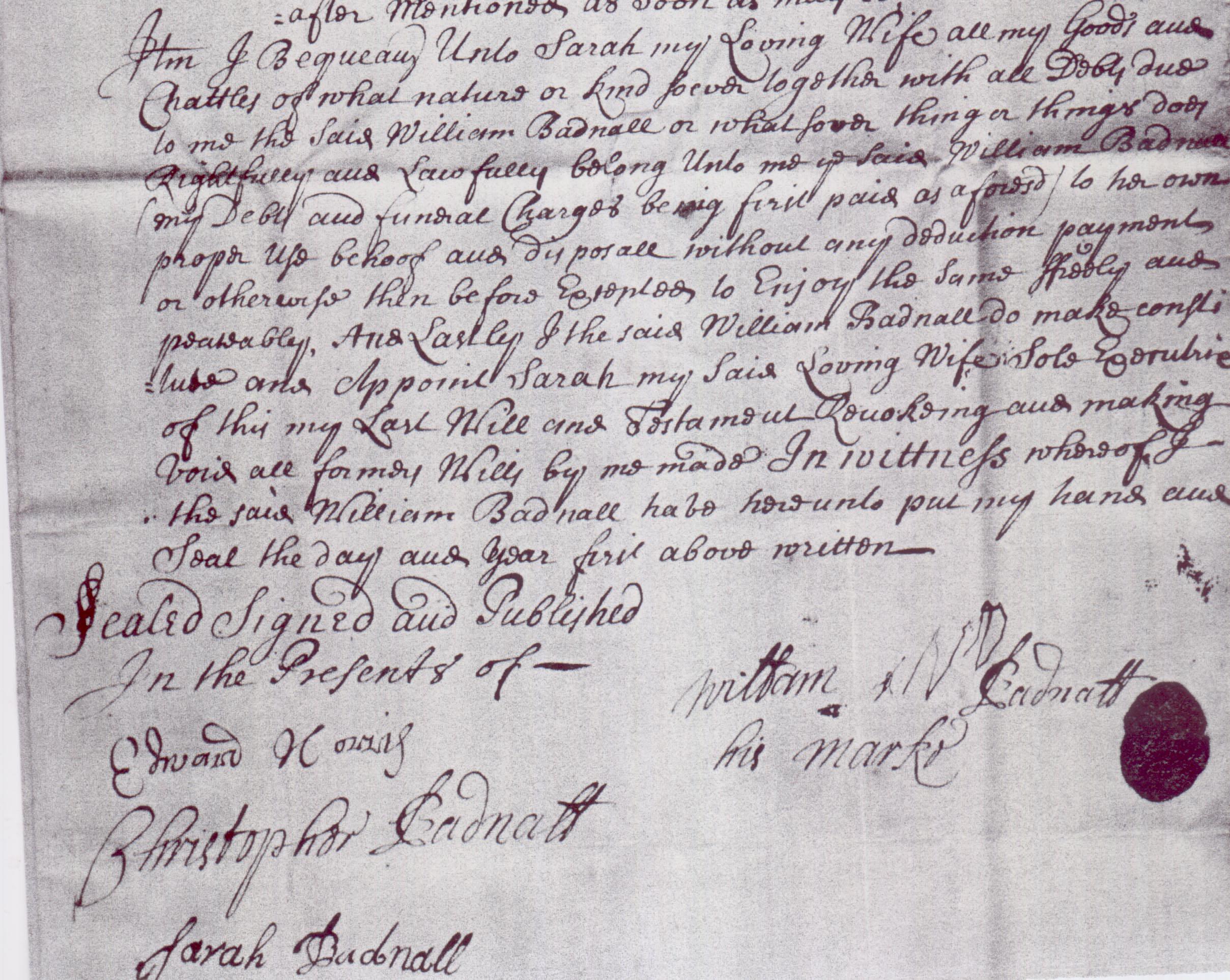
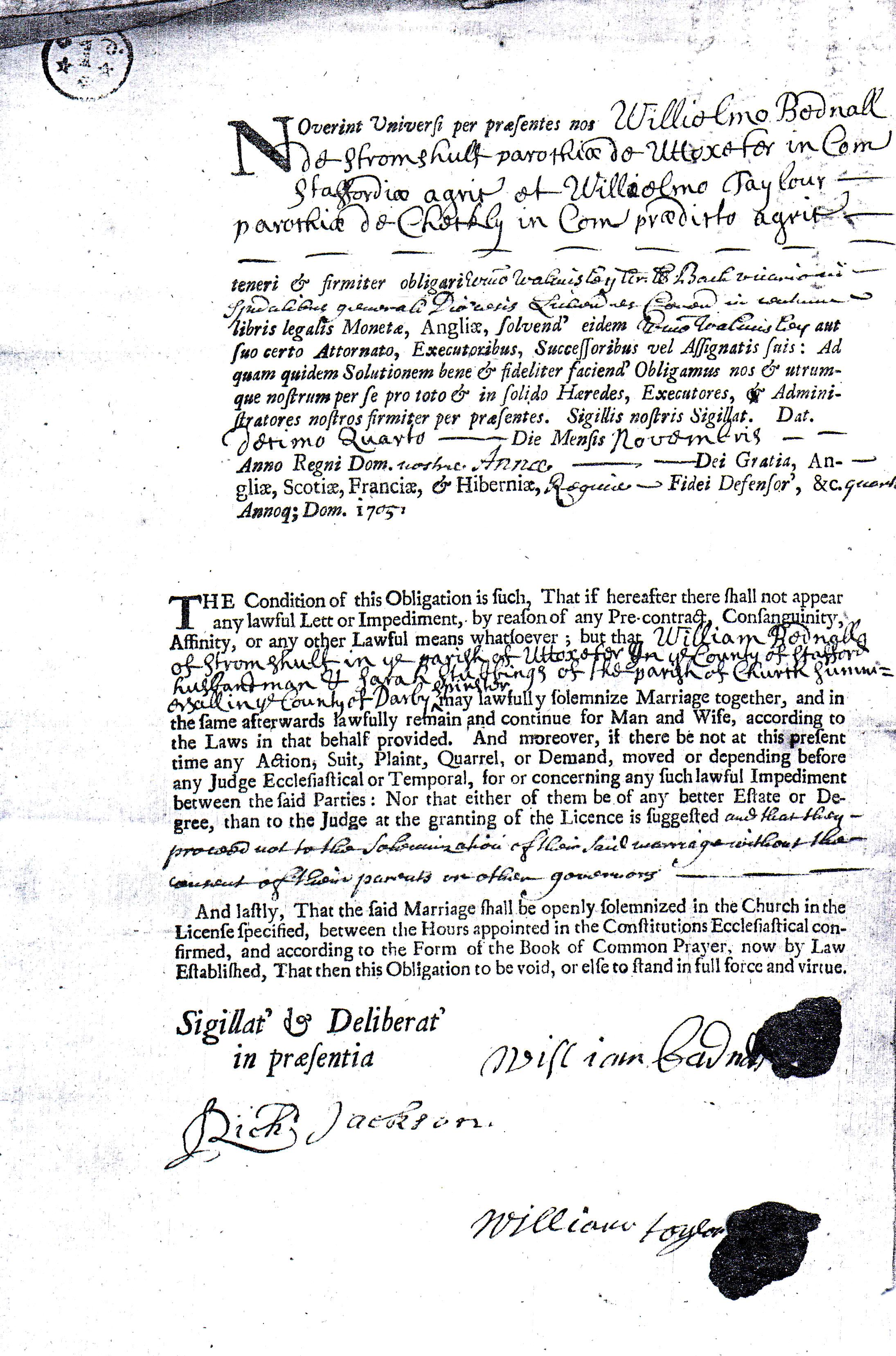
1. William BADNALL, son of Christopher BADNALL (c. 1674-1723) and Sarah WHIELDEN (c. 1673-1734), was born on 30 July 1699 in Uttoxeter. He was baptised in July 1699 in St. Mary's, Uttoxeter, Staffordshire. He was a Mohair and silk dyer. He married Sarah WOLRICH on 25 November 1723 in Madeley, Staffordshire. He married Esther BOSTOCK on 31 July 1733 in St. Edward's, Leek, Staffs. He died circa December 1760 in Mill Street, Leek, Staffs. He was buried on 13 December 1760 in St. Edwards Churchyard, Leek.
William Badnall (d. 1760) of Mill Street worked as a dyer by 1734 and possibly by 1725, with dyehouses by the Churnet in Abbey Green Road at its junction with Mill Street. He was described as a mohair dyer in 1736. In 1758 he bought the bankrupt Richard Ferne's linen-thread works on the opposite side of Abbey Green Road, which included a dyehouse by Ball Haye brook. It is not known that he ever engaged in silk dyeing.
The Badnall family's works was engaged in silk dyeing by the 1780s under the management of William's son Joseph.
In 1818 there was only one factory, and that had only a few looms. It stood in Mill Street and was run by Richard Badnall and William Laugharn, who appear to have been using steam power by 1816. A foreign visitor in 1826 described it as a 'fine factory building, at the end of the town, quite new, most splendid position in the whole place';
When Joseph Badnall died in 1803, his dyeworks was taken over by his son William and brother James. On William's death in 1806 a partnership was formed between James and his brother Richard and son Joseph. James died in 1813. By 1826 the works was run by a partnership consisting of Richard's son Richard, F. G. Spilsbury, and Henry Cruso; the partners also manufactured silk and silk machinery. The partnership was dissolved that year. The business was bought by James Badnall's son Joseph, on whose death in 1830 it passed to his sister Ann. She let the works to John Clowes, who died in 1833.
The Commercial Bank, also in Market Place, was opened in 1825 by a partnership consisting of Richard Badnall of Highfield House in Leekfrith, his son Richard of Ashenhurst in Bradnop, R. R. Ellis, Henry Cruso, and F. G. Spilsbury; all, except apparently Ellis, were connected with the silk industry. The partners were reduced in 1826 to the elder Badnall and Ellis. In 1827 the partnership was dissolved, and Ellis was left to close the bank at a heavy loss to himself.
His eldest son William (d. 1896) and another son Joseph (d. 1908) went into partnership in 1850 or 1851 with William Beaumont Badnall; William was then living at Pickwood, Joseph at the Derby Street house, and Badnall in Church Lane. In 1854 Badnall became the son-in-law of Francis Cruso, and he apparently took over most of the Cruso practice.
William Badnall, a Leek silk dyer (d. 1806), was also a philanthropist, and on his death left the interest on ?,000 to be distributed in blankets, quilts, clothing, and other necessities such as coal but not food or drink on 5 November to 20 poor widows aged 60 or over; half the widows were to be residents in Leek town and half in Lowe. Because an insufficient number from Lowe were eligible, the number of town widows who benefited in the earlier 1820s was 13.
(Sponsor: Victoria County History
Publication: A History of the County of Staffordshire: Volume VII
Year published: 1996).
Leek, also known as the Queen of the Moorlands is a historic North Staffordshire market town, situated close to the head of the River Churnet and on the southern edge of the Peak District National Park. The town is full of character and charm with a wealth of interesting buildings, a lively shopping centre with speciality shops and restaurants and an open air
market every Wednesday. Leek flourished in the 19th Century following the Industrial Revolution with the advent of the textiles industry and also had strong links with the Arts and Crafts Movement. The houses at Churnet Manor each pay homage to four integral pioneers associated with Leek and its textiles: William Morris, William Badnall, Thomas Wardle and Richard Norman Shaw.
Sarah WOLRICH, daughter of Thomas WOLRICH ( - ) and Anne SMITH ( - ), was born circa 1705. She was born circa 1705. She died in 1731 in Leek. She died in 1731 in Leek, Staffordshire. She was buried on [Julian] 20 March 1731 in St. Edwards, Leek, Staffs. She and William BADNALL had the following children:
| +2 | |
| +3 | |
| +4 | |
| +5 |
Esther BOSTOCK, daughter of John BOSTOCK ( - ), was born circa [Julian] 1709 in Congleton, Cheshire? She was born circa 1709 in Congleton. She died in June 1760 in Leek. She was buried on 19 June 1760 in St. Edwards, Leek, Staffs.. She and William BADNALL had the following children:
| +6 | |
| +7 | |
| +8 | |
| +9 | |
| +10 | |
| +11 |
Second Generation
2. Thomas BADNALL, son of William BADNALL and Sarah WOLRICH, was born circa 1725 in Mill Street, Leek, Staffs. He was christened on 20 August 1725 in St. Edward's, Leek, Staffs.. He died in 1725 in Leek, Staffs.. He was buried on 29 November 1725 in St. Edward's Leek, Staffs.
3. John BADNALL (also known as [unnamed person]), son of William BADNALL and Sarah WOLRICH, was born circa October 1726 in Mill Street, Leek, Staffs. He was baptised on 5 November 1726 in St. Edward's P.C. Leek, Staffs. He was a silk merchant. He married Elizabeth JACKSON circa 1757. He died in October 1793 in Leek, Staffordshire. He was buried on 20 October 1793 in In the church of St. Edwards, Leek.. There is a plaque in the tower.
Elizabeth JACKSON, daughter of unk JACKSON of Congleton ( - ), was born circa 1735. She was born before [Julian] 1756. She died after [Julian] 1793. She died after 1793. She was buried after 1793.
4. Sarah BADNALL, daughter of William BADNALL and Sarah WOLRICH, was baptised on 28 August 1729 in St. Edward's P.C. Leek. She married Thomas SMITH on 1 January 1751 in Wybunbury, Cheshire. She died in February 1805 in Leek. She was buried on [Julian] 11 February 1805. She was buried on 11 February 1805 in St. Edwards, Leek.
Thomas SMITH was born circa [Julian] 1729. He was born circa 1729. He was an Ironmonger 1751. He died on [Julian] 11 August 1751 in Wybunbury. He died on 11 August 1792 in Leek. He was buried in August 1792 in St. Edward's P.C. Leek, Staffs.. He and Sarah BADNALL had the following children:
| +12 | |
| +13 | |
| +14 | |
| +15 | |
| +16 | |
| +17 |
5. Elizabeth BADNALL, daughter of William BADNALL and Sarah WOLRICH, was born circa 1731 in Leek. She was baptised on 10 December 1731 in St. Edward's P.C. Leek. She died circa 1758. She was buried circa 1758 in St. Edward's P.C. Leek.
6. Joseph BADNALL, son of William BADNALL and Esther BOSTOCK, was born circa 1736 in Mill Street. He was baptised on 2 April 1736 in St. Edward's P.C. Leek. He was a Silk Dyer. He married Martha PRATT on 17 November 1764 in St. Edwards, Leek, Staffs. He died on 24 April 1803 in Leek. He was buried in April 1803 in St. Edwards churchyard, Leek.
Martha PRATT, daughter of Thomas PRATT (1709-1791) and Isabella LANCELLOT ( - ), was born circa 1741 in Leek, Staffs. She was baptised on 25 April 1741 in St. Edward's P.C. Leek. She died on 8 April 1775 in Leek. She was buried in April 1775 in St. Edward's P.C. Leek. She and Joseph BADNALL had the following children:
| +18 | |
| +19 | |
| +20 |
7. Esther BADNALL, daughter of William BADNALL and Esther BOSTOCK, was born circa 1738 in Leek. She was baptised circa 1738 in St. Edward's P.C. Leek. She married Richard PRATT on 10 July 1762 in St. Edward's P.C. Leek. She died in August 1765 in Leek. She was buried on 1 September 1765 in St. Edward's P.C. Leek.
Richard PRATT was born in May 1736 in Leek. He was christened on 27 May 1736 in St. Edward's P.C. Leek. He was baptised on 27 May 1736 in St. Edward's P.C. Leek. He died circa June 1778. He was buried circa June 1778.
8. William BADNALL, son of William BADNALL and Esther BOSTOCK, was born in February 1743 in Mill Street. He was baptised on 15 February 1743 in St. Edward's P.C. Leek. He was a Thread Manufacturer. He died on 2 April 1777 in Leek. He was buried on 4 April 1777 in St. Edward's P.C. Leek.
9. James BADNALL, son of William BADNALL and Esther BOSTOCK, was born on 10 January 1745 in Leek. He was baptised on 12 January 1745 in St. Edward's P.C. Leek. He was a button merchant, later a silk dyer. He married Martha BARNETT in August 1767 in Cheadle, Staffs.. He died in January 1813 in Mill Street, Leek, Staffordshire. He was buried on 14 January 1813 in St. Edwards.
Martha BARNETT was born circa 1746. She died on 22 January 1822 in Leek. She was buried in January 1822 in St. Edward's P.C. Leek. She and James BADNALL had the following children:
| +21 | |
| +22 | |
| +23 | |
| +24 | |
| +25 | |
| +26 |
10. Charles Bostock BADNALL, son of William BADNALL and Esther BOSTOCK, was baptised on 29 July 1734 in St. Edward's P.C. Leek. He died in September 1735 in Leek. He was buried on 12 September 1735 in St. Edwards.
11. Ann BADNALL, daughter of William BADNALL and Esther BOSTOCK, was baptised on 26 July 1740 in St. Edward's P.C. Leek.
Third Generation
12. Charles SMITH, son of Thomas SMITH and Sarah BADNALL, married Susannah FRANCIS.
13. Christopher SMITH was the son of Thomas SMITH and Sarah BADNALL.
14. William SMITH was the son of Thomas SMITH and Sarah BADNALL.
15. Joseph SMITH was the son of Thomas SMITH and Sarah BADNALL.
16. John SMITH was the son of Thomas SMITH and Sarah BADNALL.
17. Thomas SMITH, son of Thomas SMITH and Sarah BADNALL, was born in [Julian] 1762. He was born in 1762. He was christened in 1762. He was baptised in 1762. He died on [Julian] 17 October 1786 in Leek. He died on 17 October 1786 in Leek, Staffordshire. He was buried in St. Edwards, Leek. He was buried in October 1786 in St. Edward's Church., Leek, Staffs..
18. William BADNALL, son of Joseph BADNALL and Martha PRATT, was born circa 1766 in Leek, Staffs. He was baptised on 21 September 1766 in St. Edward's P.C. Leek, Staffs. He was a Silk Dyer. He died on 22 April 1806 in St.Edward's churchyard, Leek, Staffs.. The family grave is near the church door. He was buried in April 1806 in St. Edward's P.C. Leek. He married Mary SMITH.
William Badnall, a Leek silk dyer (d. 1806), left the interest on £1,000 to be distributed in blankets, quilts, clothing, and other necessities such as coal but not food or drink on 5 November to 20 poor widows aged 60 or over; half the widows were to be residents in Leek town and half in Lowe. Because an insufficient number from Lowe were eligible, the number of town widows who benefited in the earlier 1820s was 13.
Mary SMITH was born before 1770. She and William BADNALL had the following children:
| 27 | Diana BADNALL (1783-1870). Diana was born in September 1783 in Leek. She was baptised on 14 September 1783 in St. Edward's P.C. Leek. She died in 1870 in Leek. She was buried in 1870 in St. Edward's P.C. Leek. |
19. Thomas BADNALL, son of Joseph BADNALL and Martha PRATT, was born circa March 1768. He was baptised on 26 March 1768 in St. Edward's P.C. Leek. He died on 10 June 1769 in Leek. He was buried in June 1769 in Near church door. St.Edward's Leek, Staffs..
died as an infant.
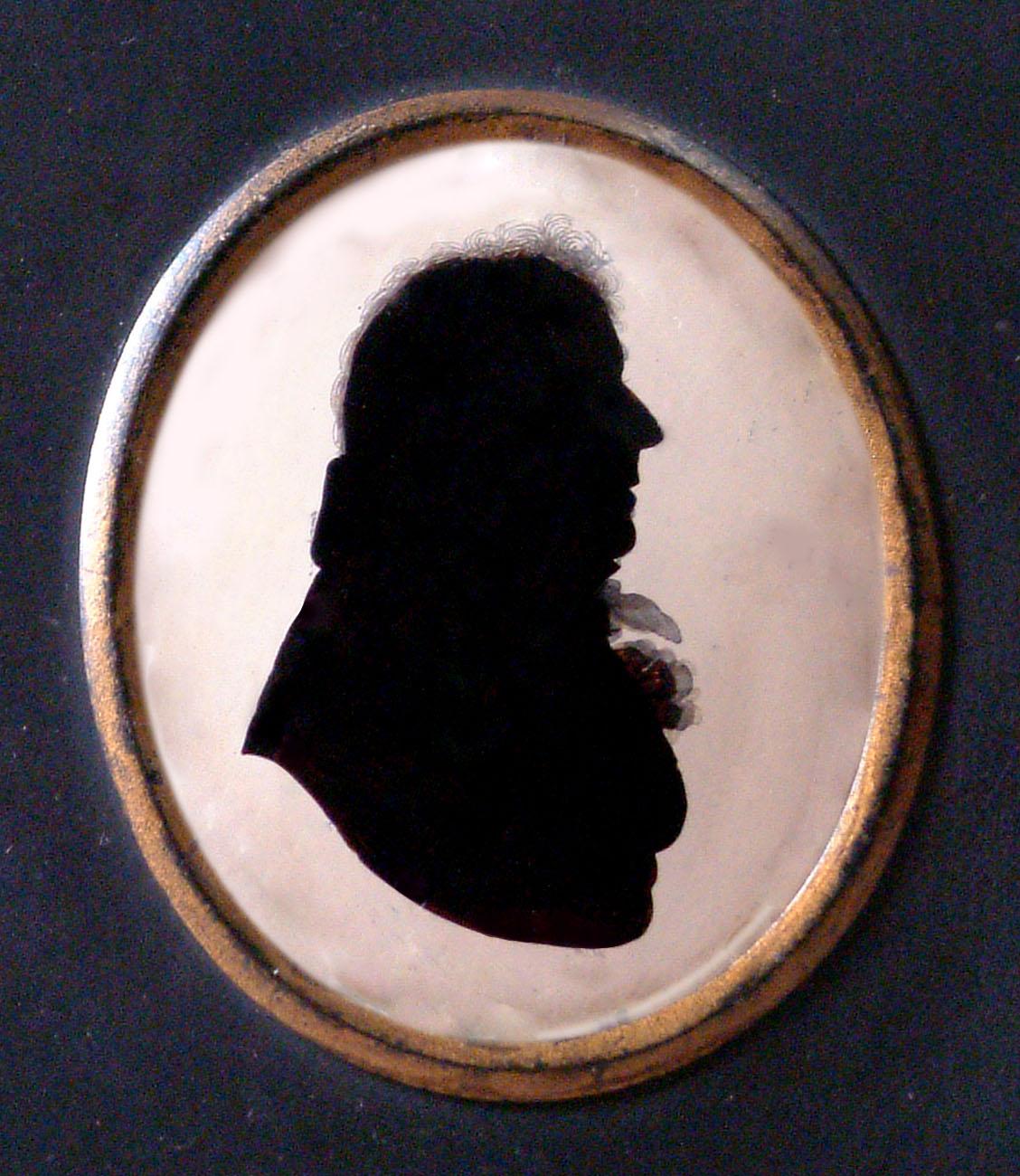
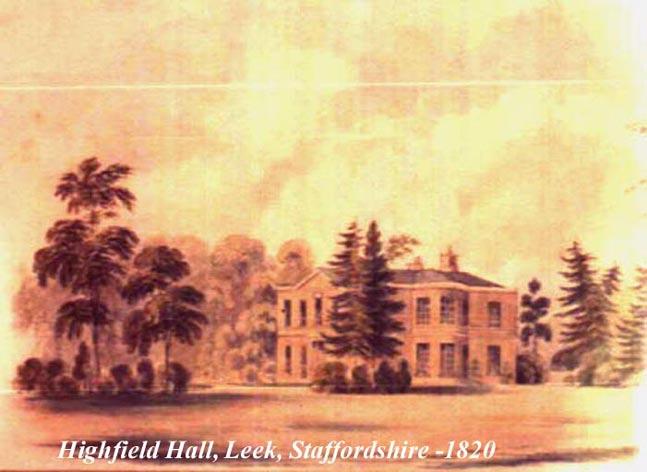
20. Richard Snr BADNALL (also known as Richard BADNALL of Highfield), son of Joseph BADNALL and Martha PRATT, was born on 28 February 1770 in Leek. He was a Silk Manufacturer, Magistrate. He was educated at 28 Jan 1784 Entered Manchester Grammar School. He married Harriet HOPKINS on 20 June 1793 in Prestbury Parish Church, Cheshire. He married Sarah JOHNSON on 21 October 1821 in Harbourne, Staffordshire. He died on 28 February 1838 in Pythian Street. Liverpool. He was buried in March 1838 in the family vault, St. Edwards churchyard, Leek, Staffs..
... of Highfield (House in Leekfrith). Richard Badnall was educated at Manchester Grammar School (entered 28/1/1784). He was a Silk Manufacturer and Magistrate.
Richard Badnall Senior, a silk dealer, banker and magistrate, prospered in the first quarter of the 19th century and became increasingly involved in Leek affairs - amongst other things through his appointment as a Commissioner under the Town Improvement Act of 1825.
When his first wife died in March 1820 he re-married. In 1824 he retired from active involvement in business, transferring much of his interest in the firm to a new partnership (Badnall, Spilsbury and Cruso) formed by his son Richard Jnior, his son-in-law Henry Cruso and the Walsall inventor, Frances Gybbon Spilsbury. Unfortunately the new partnership was formed just prior to a banking crisis and a depression in the silk trade, compounded by the abolition of protective duties on the importation of silks. The firm got into difficulties and in December 1826 were declared bankrupt. The bankruptcy of the Badnall, Spilsbury & Cruso partnership led to the bankruptcy of Richard Badnall, senior, who had mortgaged his home, Highfield, to obtain a ?0,000 loan from the Bank of England to help "these young men" through the difficult period.
Following the bankruptcy and the subsequent sale of his property in Leek, Mary Elizabeth's father moved to 1 Pythian Street, Liverpool. He became involved in shipping for a time but his living was precarious and in 1837 his son by his second wife, Thomas Pratt Badnall, wrote to his uncle John Cruso Junior suggesting that his father could "use a few pounds" (6th August 1837). Richard Badnall Senior had three other children by his second wife: Joseph, Henrietta and James Rathbone; he and his family remained in Liverpool until his death, on his 68th birthday, in 1838.
Richard Badnall was educated at Manchester Grammar School. He was a Silk Manufacturer and Magistrate who prospered in the first quarter of the 19th century and became increasingly involved in Leek affairs - amongst other things through his appointment as a Commissioner under the Town Improvement Act of 1825. In 1824 he retired from active involvement in business, transferring much of his interest in the firm to a new partnership (Badnall, Spilsbury and Cruso) formed by his son Richard Jnior, his son-in-law Henry Cruso and the Walsall inventor, Frances Gybbon Spilsbury. Unfortunately the new partnership was formed just prior to a banking crisis and a depression in the silk trade, and the firm were declared bankrupt in 1826, which led to the bankruptcy of Richard Badnall, senior, himslef, who had mortgaged his home, Highfield, to obtain a loan from the Bank of England to help "these young men" through the difficult period. Later, he became involved in shipping for a time but his living was precarious and in 1837 his son by his second wife, Thomas Pratt Badnall, wrote to his uncle John Cruso Junior suggesting that his father could "use a few pounds" (6th August 1837). Richard and his family remained in Liverpool until his death, on his 68th birthday, in 1838.
Harriet HOPKINS, daughter of Revd. John William HOPKINS (1734-1780) and Mary WORRALL (c. 1738-1826), was born on 15 October 1773 in Upminster, Essex. She was born circa 1774. She died on 7 March 1820 in Leek. She was buried on 14 March 1820 in Family Vault, St. Edwards churchyard, Leek, Staffs.. She and Richard Snr BADNALL had the following children:
| 28 | Mary Elizabeth BADNALL (1795-1850). Mary was born on 2 February 1795 in Leek, Staffs. She married John CRUSO on 23 May 1816 in St. Edwards Church, Leek, Staffs.. She died on 17 August 1850 in Leek. She was buried on 25 August 1850 in Cruso Family Vault, St. Edwards churchyard, Leek, Staffs.. |
| 29 | Richard Jnr. BADNALL (1797-1839). Richard was born on 16 February 1797 in Leek. He was a Silk manufacturer, railway engineer and poet. He was educated at Ashbourne Grammar School and Chaddesley, Worcs., He married Sarah HAND on 19 August 1819 in Uttoxeter Parish Church. The vicar was the Revd. HB Fowles. He died on 2 August 1839 in Weston near Bath. He was buried circa 7 August 1839 in the family vault. |
| 30 | Martha BADNALL (1798-1879). Martha was born on 9 October 1798 in Leek. She died in 1879 in Nottingham. She was buried in 1879. |
| 31 | William BADNALL (1803-1859). William was born on 13 October 1803 in Leek. He was baptised on 27 April 1804. He was Vicar of Wavertree and Chaplain to the Duke of Cambridge, Queen's. He was educated at Kings School, Macclesfield and Brasenose College, Oxford. He married Elizabeth Rose PARR on 16 July 1833 in Childwall, Lancashire. He died on 28 July 1859 in Wavertree, near Liverpool. He was buried in July 1859 in Wavertree nr. Liverpool. |
| 32 | Harriet BADNALL (1806-1812). Harriet was born on 20 January 1806 in Leek. She died on 16 October 1812 in Leek. She was buried in October 1812 in the family vault. |
Sarah JOHNSON of Harbourne (also known as [unnamed person]) was born before 1800. She married on 16 October 1821 in Harbourne, Staffs. She was buried circa 1848. She died circa 1849 in Liverpool, Lancashire. She and Richard Snr BADNALL had the following children:
| 33 | James Rathbone BADNALL ( - ). James was born in Wavertree, Lancashire? |
| 34 | Thomas Pratt BADNALL (c. 1824-1854). Thomas was born circa 1824 in Highfield Hall, Leek, Staffs. He was baptised on 18 July 1824 in St. Edward's P.C. Leek. He was a Banker. He died on 27 August 1854 in New York, USA. |
| 35 | Joseph BADNALL (1827-aft1837). Joseph was born on 10 December 1827 in Leek, Staffs.? He was baptised on 2 May 1829 in St. Edward's P.C. Leek. He died after 1837. |
| 36 | Sarah Henrietta BADNALL (c. 1834-1900). Sarah was born circa 1834 in Tottenham, London. She died on 10 February 1900 in Leigh Cottage, Red Hill, Arnold, Nottingham. |
21. Martha BADNALL, daughter of James BADNALL and Martha BARNETT, was born circa 1772. She was baptised on 20 March 1772 in St. Edward's P.C. Leek. She died in August 1790 in Leek. She was buried on 12 August 1790 in St. Edwards, Leek, Staffs..
22. Mary BADNALL, daughter of James BADNALL and Martha BARNETT, was born circa 1774. She was baptised on 22 April 1774 in St. Edward's P.C. Leek. She died in May 1789 in Leek. She was buried on 27 May 1789 in St. Edwards.
23. Fay BADNALL, daughter of James BADNALL and Martha BARNETT, was born circa 1776. She was baptised on 28 May 1776. She died in May 1786 in Leek. She was buried on 10 May 1786 in St. Edwards.
24. Elizabeth BADNALL, daughter of James BADNALL and Martha BARNETT, was born circa 1779 in Leek. She died on 10 April 1820 in Leek. She was buried on 13 April 1820 in St. Edwards, Leek, Staffs.
25. Joseph BADNALL, son of James BADNALL and Martha BARNETT, was christened on 22 December 1781 in St. Edward's Leek, Staffs.. He was born circa 1782. He was a Silk Dyer. He married Mary CHALLINOR on 1 September 1827 in St. Edwards. He died in October 1830 in Leek. He was buried on 12 October 1830 in St. Edwards.
Mary CHALLINOR was born circa 1786. She was christened on 4 April 1786 in St. Edward's Leek. She was baptised on 4 April 1786 in St. Edward's P.C. Leek. She died on 8 January 1838 in Leek. She was buried in January 1838.
26. Ann BADNALL, daughter of James BADNALL and Martha BARNETT, died on 16 April 1837 in Mill Street, Leek, Staffs.. She was buried in April 1837 in Leek.