logo 
www.whobegatwhom.co.uk www.familyhistoryofphilipwilson.co.uk
See also

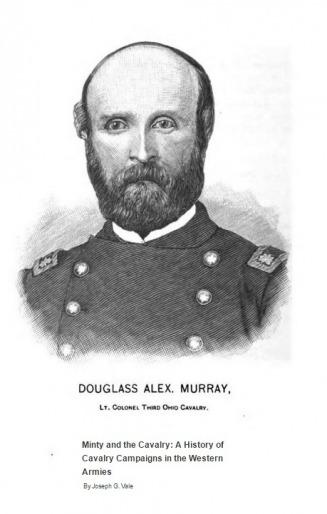
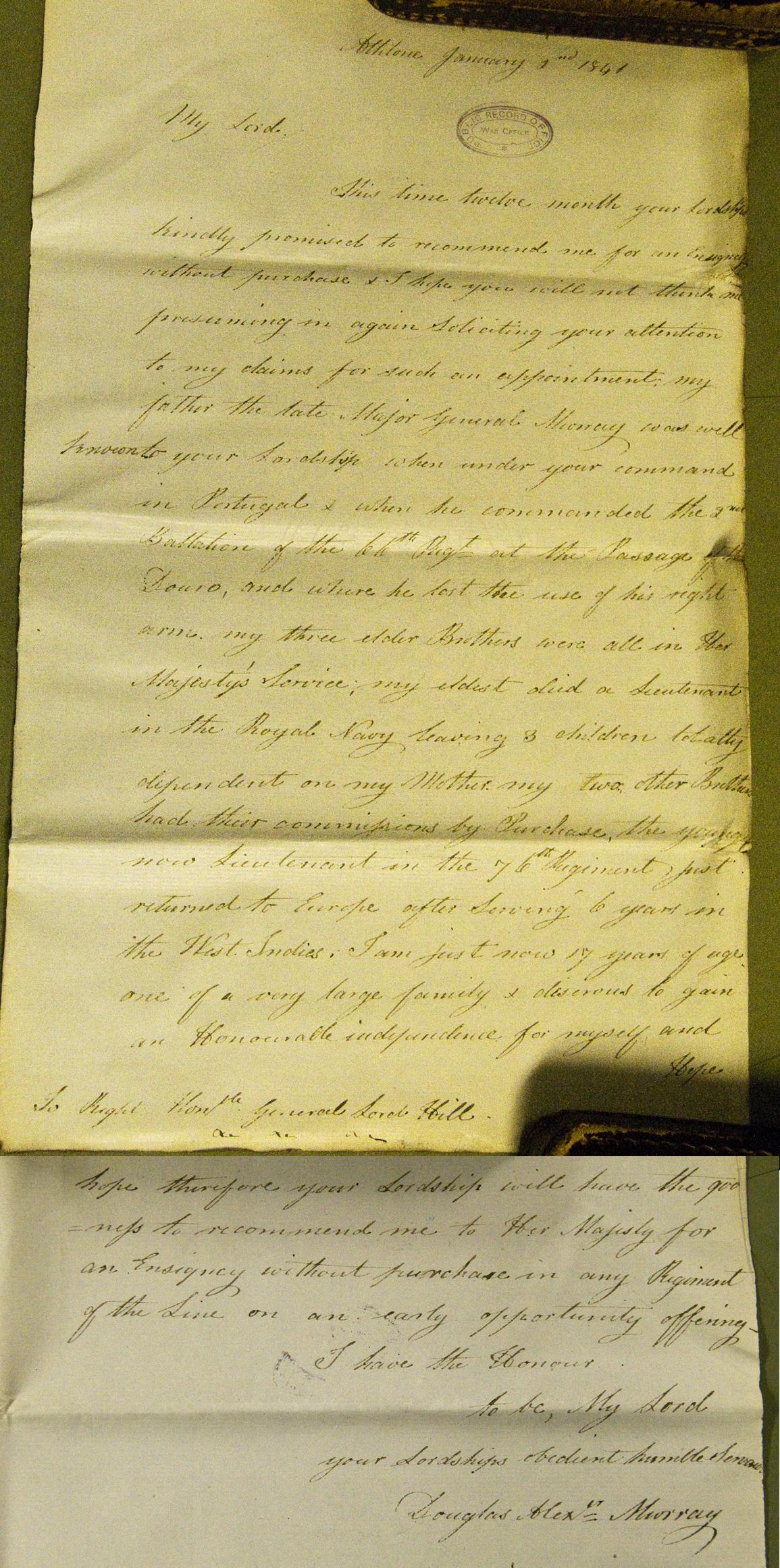
Lieutenant Colonel Douglas Alexander MURRAY (1824-1866)

      picture     picture     picture     picture
                 
 
      picture     picture     picture     picture
                 
 
      picture     picture    
             
 
Name: Douglas Alexander MURRAY
Sex: Male
Name Prefix: Lieutenant Colonel
Father: James Patrick 2 MURRAY (1782-1834)
Mother: Elizabeth RUSHWORTH (1783-1865)

Individual Events and Attributes

Birth 2 Jan 1824 Killinure House, Westmeath, Ireland
Death 19 Jul 1866 Washington DC
Burial Carlyle, Pennsylvania

Marriage (1)

Spouse Mary Anne MURPHY ( -1851)
Marriage 10 Nov 1848 St. Louis, Missouri

Marriage (2)

Spouse Mary Ann BELTZHOOVER (1830-aft1880)
Children James Patrick MURRAY (1856- )
Catherine Beltzhoover MURRAY (1857- )
Elizabeth Rushworth MURRAY (1859- )
Susan Douglas MURRAY (1861- )
Marriage 8 Nov 1855 (First Evangelical Lutheran Church) Carlyle, Pennsylvania

Individual Note 1

Douglas joined the U.S. Army and commanded the 3rd Ohio Cavalry.He fought in several battles of the Civil War and was severely wounded, losing his left arm. He received the rank of Lieutenant Colonel on October 10, 1861. He resigned June 7th, 1863, but it is not known whether this was on account of his injuries.


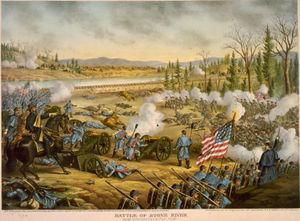
The Battle of Stones River or Second Battle of Murfreesboro (in the South, simply the Battle of Murfreesboro), was fought from December 31, 1862, to January 2, 1863, in Middle Tennessee, as the culmination of the Stones River Campaign in the Western Theater of the American Civil War. Of the major battles of the Civil War, Stones River had the highest percentage of casualties on both sides. Although the battle itself was tactically indecisive, the Union Army's repulse of two Confederate attacks was a much-needed boost to U.S. morale after the defeat at the Battle of Fredericksburg, and it dashed Confederate aspirations for control of Middle Tennessee.

Individual Note 2

THIRD REGIMENT, OHIO VOLUNTEER CAVALRY.


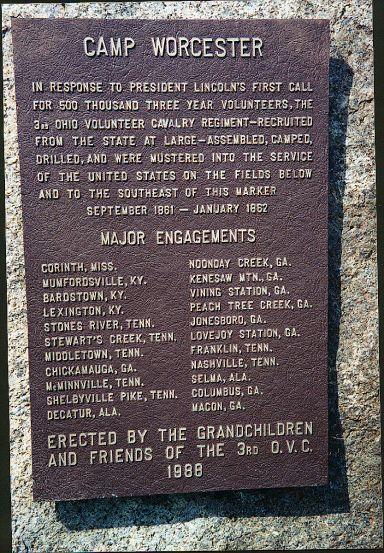
This Regiment was organized in September, 1861, at Camp Worcester, Monroeville, Huron County, and January 14, 1862, moved to Camp Dennison. In February it proceeded to Jeffersonville, Indiana, and thence to Nashville, Tennessee, arriving there March 18th, and leaving on the 29th for Pittsburg Landing. On the march (April 4th) General Buell detached the First Battalion, sending it to Lawrenceburg, Tennessee, against Biffle's Rebel Cavalry, which was met and driven from the town. The Battalion rejoined the Regiment at Savannah, whence that force moved in advance of Buell's Army, reaching Pittsburg Landing April 25th, going into camp four miles from the River. May 4th the First Battalion went on reconnoissance, marching as far as Monterey, and was ordered to cross Chamber's Creek, where the enemy was met and driven back to its main force. The Regiment then moved within 10 miles of Corinth, where a brisk engagement took place between the First Battalion and a Rebel force, resulting in the retirement of the Battalion. May 27th the Regiment discovered the enemy in force on the railroad west of Corinth, engaged and routed them.


June 1, 1862, the First Battalion was detached to join General T. J. Wood's Division, leaving the balance of the Regiment at Corinth. The Regiment was re-united June 19th, at Tuscumbia, lying there in camp until the 30th, when it went to Mooresville, via Courtland and Decatur. It lay there until July 9th, when the Second and Third Battalions were ordered to Woodville, 30 miles east of Huntsville. July 13th the First Battalion marched to Huntsville, going into camp there on the 14th. On the 15th the Battalion went to Shelbyville, to defend that Town from apprehended attack ; and on the 18th returned to Winchester. July 29th, Major Foster, with the Battalion and two companies of Infantry, went to Salem, and there captured from the enemy 89 head of cattle.


Leaving Winchester August 14th, the Division and Regiment moved to McMinnville, via Manchester. On the 29th the First Battalion was ordered to cross the Cumberland Mountains to Dunlap, to ascertain the enemy's position. On the way Rebel messengers were captured, bearing dispatches from Bragg to Wheeler, then north of McMinnville. The force then returned to its Division. September 3d the Division marched to Nashville, arriving there the 6th, and the 7th marched to Gallatin. Leaving that point on the 9th on a forced march for Bowling Green, Kentucky, to get there ahead of Bragg's forces, it arrived there on the 10th, after marching 34 miles per day. The 16th it marched for Munfordsville, encamping at Cave City the 20th. On the 21st the First Battalion had a sharp engagement at Munfordsville with a Rebel force three times its number, and in three charges drove them into their works, losing two killed and 12 wounded, while the enemy lost 38 killed and 60 wounded. Among the Rebel killed was Lieutenant-Colonel Brown. September 22d, the Division marched for Louisville, arriving on the 25th. October 1st the pursuit of Bragg's Army was resumed, and near Beardstown the First Battalion of the Third Cavalry, re-enforced by two Companies of Second and Third Kentucky Cavalry, attacked the enemy 1,200 strong, but without success, losing six killed, 20 wounded and 17 captured, Major Foster being among the disabled.


The Second and Third Battalions, under Colonel Zahm, during a portion of the Summer of 1862, were stationed at Woodville, Alabama, guarding a railroad. Repeated attacks by Rebel guerrillas made this duty one of great activity and fatigue. An expedition under Major Paramore, to Guntersville, on the Tennessee, resulted in driving the Rebel guerrillas from that section, with a loss to the command of six men killed and several wounded, the enemy suffering more severely. For about four months this portion of the Regiment was daily engaged in scouting and skirmishing with the enemy.


The Second and Third Battalions were now attached to the Second Brigade of Cavalry, under Colonel Lewis Zahm, and went into camp at Murfreesboro, Tennessee. This Brigade formed the rear guard of Buell's Army, and guarded its transportation in the pursuit of Bragg to Louisville. Colonel Zahm was highly complimented by General Buell for his tact in bringing his trains safely through. At Shelbyville the Brigade engaged the advance of Cavalry of Colonel Smith's Rebel Army, drove them from the Town, capturing many prisoners. During the battle of Perryville the Third Cavalry was engaged with the enemy a the fording of the Kentucky River near Paris and after that battle it went into camp near Danville. October 19th a detachment of the Regiment under Major Charles Seidel, with portion of Fourth Ohio Cavalry, in all numbering 250, was sent, under special orders from General McCook, to escort special couriers to Lexington and Covington, a forced march of 40 miles. The force encamped near the old plantation of Henry Clay at Ashland. A daylight, October 20th, the camp was completely surrounded by John Morgan's force, and made desperate resistance, but were compelled to yield to superior numbers. After being stripped of their valuables and dismounted, they were immediately paroled, sent into the Union lines and thence to Camp Chase, Ohio. Private Thomas Crofts, in a letter to his parents, stated that in the fight he was not more than 50 feet from the Rebel ranks. Nearly every horse in the Company was killed or disabled. Edwin E. Carr, of East Toledo, and Charles H. Colerain, of Toledo, and F. M. Kent, of Bryan, were killed in battle. The forces engaged were 250 Union Cavalry, and Morgan's 3,400 men and eight mountain howitzers. The number of men paroled was 198, beside officers. After the surrender Private Weis, of the Third Cavalry, asked to be shown General Morgan, when one among the Rebels was pointed out as the man. Whereupon Weis at once drew up his carbine, and, before he could be disarmed, took aim and shot down the supposed guerrilla leader, who proved to be Charlton Morgan, a cousin of John. Weis was immediately killed by the infuriate Rebels.


The remaining portion of the two Battalions moved from Danville to Bowling Green, and were stationed on the Railroad, with headquarters at Fountain-Head Station. Morgan's force then occupied Gallatin. Colonel Zahm ordered out a detachment on a reconnaissance toward Gallatin, to learn the enemy's strength and position, when Rebel pickets were captured and the required information obtained. The next morning Morgan's camp was attacked and his camp equipage and a large number of prisoners captured, Morgan hastily retreating across the Cumberland to Lebanon, Tennessee. Here after a separation of seven months, the three Battalions of the Third Cavalry met under novel circumstances. Colonel Zahm, not aware that the First Battalion was in the vicinity, on approaching Gallatin from the North, was attacked by a Cavalry a force which turned out to be his own First Battalion, which mistake was probably the m cause of Morgan's escape and the failure of the expedition, the firing between the two forces giving him notice of the presence of Union troops. From Gallatin the Regiment moved to Hartsville, Tennessee, there going into camp. A detachment, under Captain E. M. Colver, went up the Cumberland River to Carthage to intercept a large drove of mules and Rebel stores ; and after a chase of 26 miles-fording the River four times-they captured the train and drove off 146 mules, killing three and capturing 17 of the Rebel escort, including two quartermasters and a paymaster. In December this portion of the Regiment moved to near Nashville and were incorporated into the Second Brigade of Cavalry, First Cavalry Corps, Army of the Cumberland, under General D. S. Stanley.


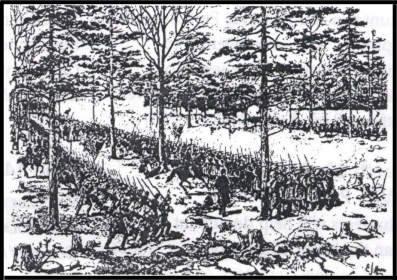
The First Battalion of the Third now rejoined the Regiment. December 26th the Regiment moved up with its Brigade and took position on the extreme right of Rosecrans's Army, near Franklin. On the 27th an attack was made on Franklin, resulting in completely routing the Rebel force remaining at that place. On the 28th the Brigade engaged the enemy on Wilkerson Turnpike beyond Triune, and drove them with severe loss, the Brigade losing a few prisoners. At 2 A. M., December 31st, the First Battalion, being on picket duty, appraised Colonel Zahm of the advance of Bragg's Rebel forces. At four o'clock the skirmish-line was driven in and the Brigade attacked by Wheeler's Rebel Cavalry. After two hours' fighting, the enemy, through superiority of numbers, forced the main portion of the Brigade from the field, that command suffering severely in both officers and men. The enemy had captured McCook's Corps ammunition-train, when the Second and Third Battalions, Third Ohio, after withstanding the shock of battle, remained at their posts, made a gallant dash and recaptured the train, killing a number of Rebels and horses, and taking 140 prisoners. On that day the Regiment lost 13 men killed and a large number wounded. January 1, 1863, the Third Cavalry bore an active part in escorting a train of 4,000 wagons from Franklin for Nashville, in doing which fierce contests occurred with Wheeler's Rebel Cavalry.


After the battle of Stone River, the Third Cavalry was sent in pursuit of the enemy, and near Middleton, Tennessee, attacked his rearguard and captured one of his trains. While in camp at Murfreesboro, a detachment of the Third Battalion, while on a scout, under Lieutenant F. Bernard, was surrounded by Rebels, when they cut their way out, with slight loss, and taking with them a number of prisoners. About that time the Regiment was in affairs at Milton, Liberty, Readyville, Franklin, Snow Hill, Smithville, Auburn, Manchester and McMinnville, suffering in men killed and wounded and loss of horses.


The Regiment bore an active part in the advance of Rosecrans's Army from Murfreesboro, in July, 1863. During the battle of Chickamauga, it was at Lafayette, where it was attacked and forced back to Charleston, Tennessee. After the battle, the Third Cavalry moved as the advance of General Crook's forces in pursuit of Wheeler's Cavalry, with which a handsome and successful fight took place at Farmington, the enemy being completely routed, with loss of large numbers in killed and captured. The Third Cavalry lost two men killed and 23 captured. In November, 1863, a portion of the Regiment, under Colonel Seidel, scouted through the mountains of East Tennessee. Another detachment, under Captain Richard D. Wood, was engaged about Dalton, Georgia, when Captain Wood was killed. About this time an incident occurred which illustrates both the character of the guerrilla warfare which the Union troops were called to meet and the spirit and manner in which it was met. The circumstances of the incident were given at the time, as follows:


Lieutenant-Colonel Howland was then Post Commander at Decherd, Tennessee. A band of about 50 guerrillas suddenly pounced on a Union man's store at Winchester, three miles West, completely emptying it of its contents, which afforded a handsome prize to them. As soon as word of the robbery was received at Decherd, a detail from the Third Cavalry was sent after the plunderers ; but in consequence of deceptive information given of the route taken by them, they escaped. Not long afterwards, a force, increased to 150, appeared in the neighborhood, when Lieutenant-Colonel Howland sent Company A, Captain Terry, and Company F, Captain George Williams, of Fremont, in pursuit of them. Coming in sight of them, the scamps, using spurs instead of weapons, incontinently fled. The race was a hard one, during which Captain Williams was thrown by his horse and disabled, but Captain Terry and 15 men soon overtook 60 of them, including Colonel Holman, the Rebel officer in command. The enemy made a stand to receive their pursuers; on perceiving which Captain Terry called on his men to prepare for a sabre-charge, which was no sooner said than done, when the Rebel force of four times their number wheeled and ran, again pursued by the little band. It happened that Colonel Holman's more immediate pursuer was Sergeant Paul Deal, of Fremont, and of Captain Williams's Company. The race between these was long and earnest. The speed of their horses was very nearly equal, and although Deal got so near he could touch Holman, he could not get near enough to hit him a fair blow. While thus near, and both horses at their highest speed, the Rebel Colonel drew his revolver and turning around in his saddle fired three times at Deal, the latter each time parrying the weapon with his sabre so as to divert the shot and save himself from injury. Finally, Holman and several others of the band were captured and returned to Decherd. The Rebel leader was warm in his admiration of Sergeant Deal, pronouncing him the bravest and coolest man he had met, and insisting that his (Holman's) revolver should be presented to Deal and he be promoted. These suggestions were so just, that they were strictly carried out, and Sergeant Deal returned to Ohio with Holman's revolver, and on arriving at Columbus received a Lieutenant's commission for his gallantry.


In January, 1864, while at Pulaski, Tennessee, the Third Cavalry re-enlisted. Of the original 1,300, only 400 effective men were then left. On the 4th of February, it left Nashville for Ohio, reaching Camp Worcester, Monroeville, after an absence of two years. Of the Company which left Toledo, only 30 returned, many of them being on detached service when these left Nashville. Owing to a misunderstanding as to the time of their arrival at Toledo, the contemplated reception of the Veterans did not take place ; but impromptu steps were taken by the Mayor ; a dinner was provided at the McKenster House; a procession of citizens escorted the heroes to the hotel, where the dinner was partaken of.


March 2, 1864, its furlough having expired, the Third Cavalry re-assembled at Monroeville, with nearly 1,000 recruits secured for it, and making its total force over 1,500 men. Proceeding again to the field, it was re-equipped and went into camp at Columbia, Tennessee, with charge of the line of road from Nashville to Huntsville. About the 1st May, as part of Long's Second Brigade of Cavalry, at Decatur, and also at Courtland, Alabama, the Regiment was engaged with the Rebel General Roddey's command, which was routed, with the loss of a Lieutenant-Colonel, a Major and upwards of 30 men killed and wounded. At Moulton, Alabama, the Regiment was attacked by the same force in camp before daylight ; and although partly surprised it rallied, drove the enemy from the field with slaughter, and pursued it, capturing 25 or 30 prisoners. At Rome, it was given position on the left flank of Sherman's Army, and participated in the engagements at Etowah, Kenesaw Mountain, Noonday Creek, and the crossing of the Chattahoochie River. Being sent to Roswell, Georgia, to destroy Rebel stores and factories, it there captured 400 factory-girls, who were sent through the lines by General Sherman. At McAfee Bridge (or Shakerock), July 9th, four Companies of the Regiment, under command of Captain E. M. Colver, engaged a superior force of Texan Cavalry, killing a Lieutenant and seven men and capturing prisoners and horses. Subsequently the Regiment took part in the battles of Peachtree Creek and Decatur, and in raids to Covington and Stone Mountain. In the Kilpatrick raid, the Third Cavalry was with the Brigade in the advance to the rear of Atlanta, and destroyed a portion of the Railroad from Atlanta to West Point, losing thereby 48 men. It also took part in the Stoneman raid, under General Kenner Garrard. In each of these raids it suffered severely. In the flanking movement on Jonesboro, the Regiment was in Garrard's Division of Cavalry. After the occupation of Atlanta, it went into camp near Decatur, Georgia, and when Hood's dash was made, the Regiment was sent in pursuit as far as Gadson.


In the first battle of Franklin, the Regiment was on the left of Thomas's forces, and was engaged with the Rebel Cavalry. A portion of the Regiment was engaged in the battle before Nashville. After Hood's retreat, it followed him across the Tennessee into Alabama. It was then engaged in the Wilson raid through Alabama and Georgia ; and in the battles of Selma and Montgomery, Alabama ; and of Macon and Griffin, Georgia. In the capture of Selma, Captain Archibald J. Eyster, now of Toledo, was in command of the advance-guard. The Rebel defense consisted of 6,000 troops inside fortifications, General Forrest being in command. The assault was made by 1,600 Union Cavalry under Colonel Long, commanding the Division. Lieutenant-Colonel H. N. Howland, of Third Ohio, commanded the Second Brigade. He subsequently was made Colonel and Brigadier-General by brevet. The Regiment also took part in the chase after Jeff. Davis, in Wilson's command, in which pursuit a detachment went through to the Gulf. At Selma it lost heavily in killed and wounded. Lieutenant D. C. Lewis and other officers were taken prisoners. Lieutenant Lewis, afterwards paroled, was killed by the explosion of the boiler of the Steamer Sultana, near Memphis. At Macon, Georgia, while on duty, Captain J. S. Clock was murdered by one of the Fourth United States Cavalry.


Under orders from General Geo. H. Thomas, the Third Cavalry turned over its horses and arms at Macon, and was then ordered to report at Nashville for muster out. Proceeding home via Louisville, the Regiment reached Camp Chase, where it was paid off and discharged August 14, 1865, after an active and efficient service of four years, lacking 20 days.

Individual Note 3

O.R.-- SERIES I--VOLUME XVI/1 [S# 22] AUGUST 4-7, 1862.--Attack on Union pickets near Woodville, Ala. (4th), and reconnaissance from Woodville to Guntersville, Ala. (5th-7th).


Reports of Lieut. Col. Douglas A. Murray, Third Ohio Cavalry.

HEADQUARTERS THIRD OHIO CAVALRY,

Woodville, Ala, August 4, 1862.


COLONEL: I have the honor to inform you that between the hours of 3 and 4 our outward pickets on the Guntersville road were fired at from the bushes by a party of 10 guerrillas or bushwackers. One of the men was shot dead--the sergeant, a most worthy, good man, mortally wounded through the head, who died shortly afterward; the two other men were both dangerously wounded, only one of five escaping uninjured, who, being driven by the murderers, was forced to fall back. He describes the scene above as follows:

"The party, consisting of a sergeant and 4 privates, belonging to Company G, Third Ohio Cavalry, who were in the advance of the rest of the company at the outpost of the line of pickets on the road, about a mile and one-fourth distant from the camp, between the hours of 3 and 4: o'clock p.m., were fired on by a party of 10 or 12 armed men. The first intimation they had of their approach was a volley of ball and buckshot. He, being the only one of the party who escaped its fatal effects, fired his carbine and revolver upon the party, but being so hardly pressed by the entire number had to retire. All this was so quickly done that the other pickets had not time to come to the assistance of the unfortunate man. The murderers turned into the bushes, which just at that place were thick, the mountain steep and rocky. Lieutenant Hefiebower, the officer in charge of the picket, dismounted some of the men and searched all over for them without success."


Hearing the firing in camp from the line of pickets I immediately sent out a squadron to scour the country in the neighborhood of the scene. After much trouble, found the tracks of the murderers up and across the mountain; taking a circuitous route to some houses about 1 ½ miles from where the firing took place, finding 4 men who could not account for themselves and from their contradictory statements were arrested. Finding any further efforts to make discoveries fruitless the command returned to camp. I brought each of the prisoners separately before the wounded men, then in the regimental hospital, one of whom, N.J. Fletcher, was identified immediately by Private [Lewis H.] Palmer, who is positive that he is the man that fired on him. Private Steckel, the only one of the party uninjured, also identified him, Fletcher, and one other, John Peters, jr., as being two of the men of the party of ten. The other two state that they were in company with Fletcher and Peters all day, and further their statements are both contradictory and changeable, and I have no doubt that each and all of them are guilty of the murders committed.


I had to use, assisted by the other officers of the regiment, the most strenuous efforts to prevent the men from lynching them, their guilt being so palpable. I hear from good authority that three of the ten men that are now in this vicinity bushwhacking are of those I have sent down to headquarters and who have been recently released, and are now boasting of being Union men.


Very respectfully, I have the honor to be, your obedient servant,


D. A. MURRAY,

Lieutenant-Colonel Third Ohio Cavalry, Commanding.


P. S.--Since writing the above Private Steckel has recognized Lewis Turner, another of the prisoners, also John Peters, as being two that were of the party. Private William Smith, Company C, recognizes one of the prisoners, Fletcher, as being one that fired upon him a few days since; Private Smith is now lying in hospital from wounds received, he states, by his hands.

Respectfully, yours,

D. A. MURRAY,

Lieutenant-Colonel Third Ohio Cavalry, Commanding.


(Col. J. B. FRY, Chief of Staff, Army of the Ohio.)


HEADQUARTERS THIRD OHIO CAVALRY, In Camp, Woodville, Ala., August 7, 1862.


COLONEL: I have the honor to report for your information that the squadron of the Third Ohio Cavalry that left these headquarters on the morning of the 5th instant on a reconnaissance to the river opposite to Guntersville returned this day at noon.


The officer in command of the squadron reports that the encampment of the enemy has been moved back from the river about 2 miles, and there appears to be a larger force there now than when our troops, accompanied by artillery and infantry, were there. The enemy have dug rifle pits, and have also mounted two pieces of artillery to command the old ferries at that point. The ferry-boats destroyed by our troops are being repaired, and I have heard from good authority will be ready for use this day or to-morrow. It is rumored that they, the enemy, will cross with the intention of destroying the bridges on the railroad as soon as they possibly can. If not too great a liberty, might I suggest that two pieces of artillery may be sent to this point or the bridge near by. I have no doubt if artillery were here and could be spared they would render good service. The country being so miserably adapted for cavalry being as effectual as they otherwise would be on more suitable ground might be obviated by having the assistance of artillery. If artillery cannot be spared, two companies of infantry would, I have no doubt, prevent any damage being done to railroad in our vicinity.

The squadron arrested Mr. Hornbuckle, a noted bushwhacker, who attempted after his arrest to escape, and did succeed in getting off some distance; would have made good his escape but for the steps taken to prevent it.


Very respectfully, I have the honor to be, your obedient servant,

D. A. MURRAY,

Lieutenant-Colonel Third Ohio Cavalry, Commanding.


(Col. J. B. FRY, Chief of Staff.)


O.R.-- SERIES I--VOLUME XX/1 [S# 29]

DECEMBER 26, 1862-JANUARY 5, 1863.--The Stone's River or Murfreesborough, Tenn., Campaign.

No. 178.--Report of Lieut. Col. Douglas A. Murray, Third Ohio Cavalry, including skirmishes at Franklin, December 26-27, and Overall's Creek, December 31.

HEADQUARTERS THIRD OHIO CAVALRY,

In Camp near Murfreesborough, Tenn., January 6, 1863.


COLONEL: In compliance with instructions received from your head quarters, I have the honor to report, for your information, the part taken by the Third Ohio Cavalry in the several engagements in which the regiment was engaged since leaving Nashville, Tenn., on December 26 last, on which day we proceeded to Franklin, driving the enemy therefrom and taking possession of the town; took some 10 prisoners. Remaining in town some time, we recrossed the river, and marched across the country to Wilson Creek pike, about 14 miles from Nashville, and encamped, arriving in camp at about 10 p.m.

On the 27th, the Third Battalion of the regiment moved toward Franklin, and found that the enemy had in strong force again taken possession of the town; the battalion drove in their pickets under a heavy fire, killing 3 of them. Seeing that the enemy were in such force, the commander deemed it prudent to retire, and rejoined the regiment, which picketed the roads, &c., in the vicinity of its camp.

On the 28th ultimo, proceeded to Triune and encamped, leaving early next morning across the country toward Murfreesborough, proceeding about 5 miles in that direction, when attacked by the enemy's pickets in force, which we drove, skirmishing, they frequently making a stand, which we each time broke, and still drove them about 5 miles.

The 30th ultimo, ordered to proceed to Stone's River; proceeded but a short distance when attacked by the enemy's pickets; the enemy were in force in our front with artillery. We therefore retired, forming on the high ground in our rear to receive them, their pickets, or patrol, advancing, which we repulsed. In the evening our brigade was re-enforced by one battery of artillery and three regiments of infantry, and proceeded in reconnaissance to the left of the enemy's lines, where we found General Hardee's corps d'armée ready, in line of battle, to receive us. We retired, and encamped in the woods, about 2 miles in front of the enemy's lines.


On the morning of the 31st we formed; shortly after the enemy appeared in large force, both on our left, center, and right, evidently endeavoring to cut us off. The brigade of infantry to our left gave way, retreating in confusion through our lines, letting the whole force of the enemy's artillery, cavalry, and infantry fall upon us, which compelled us gradually to retire toward the main body of our army. The regiment covering the entire rear of the brigade, supporting one infantry regiment on our right, drove back, with heavy loss, a large force of cavalry which charged upon us, under cover of a piece of artillery, firing well-directed shells, which passed over us. The enemy being in such force, we had to retire about three-fourths of a mile, when an aide-de-camp of General McCook rode Up, informing us that the train close by was General McCook's entire ammunition train, which must be saved at all hazards; on intimation of which the regiment was immediately formed for its protection, holding the enemy in check until the entire train, with the exception of a few disabled wagons that could not be moved, was safely withdrawn. The regiment then moved between the enemy and train as far as the Murfreesborough pike, where we found the enemy making a fierce attack upon General Thomas' train, when we again repulsed them at several points, taking many prisoners and saving that entire portion of the train. The attack of the enemy was furious and desperate, which required the greatest firmness and bravery to resist. Colonel Kennett was an eye-witness to the determined bravery of a portion of the regiment rescuing the train from the enemy, which were in force at the hospital on the Murfreesborough pike. The regiment then formed in the field near the hospital, where the brigade soon assembled and reformed, and advanced toward the enemy's left. Soon came up to the enemy's cavalry, supported by artillery, when several other skirmishes ensued during the evening, the enemy's entire object seeming to be to take the train.


On the 1st instant, received orders to proceed to Nashville in charge of train, consisting of some 200 or 300 wagons. When about 2 miles on the Nashville side of La Vergne, we were attacked by General Wheeler's brigade of cavalry, which made several dashes on the train, and were repulsed. They then attacked our rear in force. After a well-contested fight, our regiment put them to flight in disorder, killing 9 of them and wounding several, and arrived in Nashville at 9 p.m. and encamped.


The 2d instant, remained in Nashville and procured forage for our horses, furnishing working party and escort to forage train.

The 3d instant, left Nashville for Murfreesborough in charge of hospital and ammunition trains. Attacked again in force by Wheeler's brigade of cavalry on the Nashville side of La Vergne, which was repulsed with a loss of 15 on their side and some 8 or 9 prisoners taken; among the latter the adjutant of the Third Alabama Cavalry. Two of our non-commissioned officers, I regret to inform you, were severely and dangerously wounded, whom we had to leave in a house on the roadside.

Arrived at camp, near Murfreesborough, at I a.m., 4th instant, with the train all safe, with the exception of one wagon of the regiment that was cut off by the enemy, and is now supposed to have returned to Nashville.


On the evening of the 4th, proceeded with brigade toward Murfreesborough as far as Stone's River, and returned to camp.

On the 5th instant, proceeded again with brigade to Murfreesborough, and beyond it about 4½ miles, where we halted, taking several prisoners, and returning to camp about 7 p.m.


I have much pleasure in informing you that the conduct and behavior of both officers, non-commissioned officers, and privates of the regiment have been highly creditable, with not a single instance to the contrary in the regiment.


Inclosed please find list of casualties that have occurred since December 26, 1862, to January 5, 1863.(*)

I have the honor to be, very respectfully, your obedient servant,


D. A. MURRAY,

Lieutenant-Colonel Third Ohio Cavalry, Comdg. Regiment.

Individual Note 4

Lt. Col. Douglas A. Murray


Freemason


Just previous to the battle of Shiloh, the 3rd. Ohio cavalry, commanded at the time by Lt. Col. Murray, took possession of Lawrenceburgh, Tennessee. The people of the place were understood to be all Secessionists, and the Lt. Col. Ordered his men to search all the houses, arrest all the men, and take possession of all guns and other arms…being careful to protect the women and children from all harm and insult. While this was going on, Col. Murray rode down the street, and while in front of the Masonic Hall, noticed that some of his men had been in the Lodge-room and taken possession of some articles belonging to the Lodge. Immediately ordered them to return every article to its place, and then placed a guard at the door to protect the hall from future violation.


During the Battle of Shiloh, the Third Ohio Cavalry captured a Confederate Surgeon. The Surgeon asked Lieutenant Colonel Murray if he was not the officer who had saved the Masonic Lodge at Lawrenceburgh, TN from being ransacked and was informed that he was. The doctor then told Lieutenant Colonel Murray that it was that fact alone that had saved him from being ambushed. A Confederate Mason who had witnessed his generous act at Lawrenceburgh had recognized him and ordered his men to lower their guns and let him pass.

Individual Note 5

"On October 22 [1861?] our lieutenant colonel, Douglas A. Murray, joined the regiment, promoted from the Second United States Cavalry. A man of fine appearnace, he was to be our authority on cavalry tactics. As his name indicates, he was a Scotchman and had a very peculiar brogue, rolling his r's in a wonderful fashion. He gave his commands in a sharp, crisp way, and while it was difficult to understand his words, the men soon learned to know what he meant, although that singular accent afforded us infinite amusement. He conducted our dress parade at 4 pm, the music being furnished by a drum corps composed of three drummer boys and two Mexican veterans as fifers...."


"June l0th [1863]...Colonel Paramore was superseded by Colonel Eli Long as commander of the brigade. Lieutenant Colonel Murray left the regiment.


His farewell address was read at dress parade. Most of the boys were

sorry to see him go. The men liked him in spite of his fondness for old

Scotch but he would allow it to get the best of him sometimes."


SECOND UNITED STATES CAVALRY. The Second United States Cavalry, one of four new regiments approved by Congress on March 4, 1855, was organized specifically for service on the Texas frontier. It was an elite organization. The troopers rode the finest horses and were issued the latest equipment and firearms. The officers were handpicked by Jefferson Davis,qv secretary of war for President Franklin Pierce. Thus the regiment was known as "Jeff Davis's Own." Most of the officers, like Davis, were West Point graduates and southerners. The regiment was known for the outstanding quality of the sixteen general officers it produced in the 6½ years of its existence. Eleven of these became Confederate generals, and the Second Cavalry supplied one-half, or four, of the full generals of the Confederate Army - Albert Sidney Johnston, Robert E. Lee, Edmund Kirby Smith, and John Bell Hood.qqv Although Pierce had first promised the command to Benjamin McCulloch,qv Davis named Johnston the first commander of the Second Cavalry, which was commanded at various times by George H. Thomas, Earl Van Dorn,qv and Robert E. Lee. Lee commanded the regiment on three occasions-first during the spring of 1855, when the unit was organizing; second during the fall of 1857, when Colonel Johnston was reassigned to campaign against the Mormons in Utah; and finally in the winter of 1860-61. The Second Cavalry was Robert E. Lee's last command in the United States Army. The regiment left Jefferson Barracks, near St. Louis, Missouri, on October 27, 1855, and after riding through Missouri, a corner of Arkansas, and the Indian Territory, crossed the Red River into Texas near the Preston Supply Depotqv on December 15, 1855. When the unit reached Fort Belknap in Young County the command was divided; Maj. William J. Hardee took a detachment of four companies to establish Camp Cooper on the Clear Fork of the Brazos in what is now Throckmorton County, and the rest of the regiment continued south to establish regimental headquarters at Fort Mason in January 1856.


The Second Cavalry remained in Texas until the Civil War.qv During its stay in the Lone Star State, companies of the regiment were involved in some forty engagements along the western and northern frontiers of Texas and along the Rio Grande, fighting Apaches, Comanches, Kiowas, and Mexican marauders. Various companies of the regiment also conducted scores of scouting expeditions into West and Northwest Texas, some of five and six weeks' duration. Companies of the Second Cavalry were stationed at forts Belknap, Chadbourne, Clark, Inge, Mason, McIntosh, and McKavett, and camps Colorado, Cooper, and Verde. Using Texas as a base of operations, the Second Cavalry staged two major raids against the Comanche villages north of the Red River in Kansas Territory, one in October 1858 and the other in May 1859. The most significant engagement fought by the regiment in Texas was the battle of Devils River, July 20, 1857. On that date Lt. John Bell Hood, with a detachment of twenty-five men from Company G, fought a combined force of Comanches and Lipan Apache warriors. It was estimated that of a party of fifty warriors nine Indians were killed and at least double that number injured. The cavalrymen counted seven casualties. Hood himself suffered a painful wound when an arrow pinned his hand to his saddle. As a result of the secessionqv crisis the regiment was ordered out of Texas in late February 1861 and left the state via Indianola during March and April. Upon its return north the Second Cavalry, now under the command of Maj. George H. Thomas, was assigned to Carlisle Barracks, Pennsylvania. When the mounted units of the United States Army were reorganized in the fall of 1861, the Second Cavalry became the Fifth Cavalry, the designation by which it is known today. The Second Cavalry had five years of distinguished service on the Texas frontier and border. It had driven the Indians far beyond the fringes of settlement and had attacked and defeated the Comanches deep in their heartland. It had also helped the Texas Rangers to combat Juan N. Cortina,qv and to bring peace to the lower Rio Grande valley. Thorough in reconnaissance, persistent in pursuit, and successful in battle, the Second United States Cavalry made a significant contribution to Texas frontier history.

Individual Note 6

Rosecrans' Campaign with the Fourteenth Army Corps, Or, the Army of the ...

By William Denison Bickham


BATTLE OF THE RIGHT WING...

The Third Ohio, Lieutenant Colonel D. H. Murray, when the Right broke, also made a handsome dash, and drove the enemy from McCook's ammunition train. Subsequently they charged, saved the train of the Center, drove off the rebels, recaptured a hospital, and captured many prisoners under Colonel Eennett's eye. Two companies of this regiment were rallied by Colonel Eennett, who carried them into action, driving the enemy from the pike, recapturing a gun by a dashing charge, saving a train, and rescuing many of our men. Lieutenant Murray distiaguished himself in this affair. Colonel Kennett himself had a hand to hand encounter with a rebel horseman. The result was doubtful. The rebel had leveled his carbine, the Colonel had his pistol leveled, and both were about to fire, when Farrish, an orderly of Kennett, threw his revolving ,rifie into the scale. The rebel delivered his arms and himself. In the charge of the Third Ohio, Farrish killed two rebels, and Jaggers, another orderly, rode down two gray-jackets, and released two of the Fourth Ohio Cavalry who had surrendered. Colonel Zahn, of the Third Ohio Cavalry, commanding brigade, had been fighting incessantly from the beginning of the disaster up to this period. He was compelled to retire before the rebel infantry, but a charge of rebel cavalry was handsomely repulsed by the First Ohio Cavalry, Colonel Minor Millikin, and the Third Ohio Cavalry. Major A. B. Moore, of the former regiment, fell mortally wounded in this charge. The enemy charged Zahn twice in succession, and were again and again repelled, Zahn now went to the rescue of McCook's ammunition train, which was again in jeopardy. The enemy appeared in heavy force. After a gallant stand by the First, Third, and Fourth Ohio Cavalry, Zahn was compelled to retire, the dashing Colonel Millikin and his Adjutant, Lieutenant Condit, being fatally hurt. Millikin had been surrounded, but by his courage and his prowess with his saber, he cut his way through, and was escaping, when a rebel sharpshooter brought him down. There was no more gallant rider in that field. His sorrowing soldiers bore him to the rear, where he soon breathed his last, lamented by hosts of friends.

Individual Note 7

O.R.-- SERIES I--VOLUME X/1 [S# 10]

APRIL, 4, 1862.--Skirmish at Lawrenceburg, Tenn.

Report of Brig. Gen. Milo S. Hascall, U.S. Army.

HDQRS. FIFTEENTH BRIGADE, ARMY OF THE OHIO,

Field of Shiloh, April 12, 1862.

Agreeably to the order of General Wood, I proceeded on the morning of the 4th instant from our camp, 23 miles beyond Waynesborough and about 60 miles from this place, with two regiments of my brigade, to wit, the Twenty-sixth Ohio and the Seventeenth Indiana, together with a detachment of about 600 of the Third Ohio Cavalry, under Lieutenant-Colonel Murray, of that regiment, and marched for Lawrenceburg. The general had been informed that about 500 of the enemy's cavalry were at that point, with the intention of making a descent upon our train after the troops had passed. My instructions were to proceed cautiously to Lawrenceburg, a distance of about 14 miles from our camp, and capture the enemy, if possible, and to disperse him at all events. It happened that the day was very rainy and exceedingly bad for the infantry to make the march, on account of the swollen streams and mud. I proceeded very cautiously, leaving a couple of cavalry at every house we passed, to prevent any one taking information to Lawrenceburg of our approach, but when getting about 2 miles from there we had to pass over a succession of hills, in full view of the town, so that further precaution in this respect was useless.

By this time I had learned that there were not more than from 50 to 100 cavalry there at furthest, and being desirous of saving the infantry as much as possible for the forced march that was still before them, before reaching this point I ordered the infantry to halt, and, after getting their dinner, to return to the camp they left in the morning and join the other two regiments of my brigade. I then proceeded with the cavalry as fast as the roads would permit, and, when getting within about one-fourth of a mile from town, ordered a charge upon the town, which was splendidly executed by Lieutenant-Colonel Murray at the head of his men. I learned that there were 50 to 75 cavalry in town, but as soon as they observed our approach put themselves in readiness to leave. They <ar10_88> left principally in the direction of Florence and Mount Pleasant, and, their horses being fresh, but few could be overtaken, though they were pursued some 8 miles in both directions by our cavalry. Two of the enemy were severely wounded, as evidenced by the blood upon their horses which fell into our hands. The result of the expedition was the breaking up of the secession rendezvous at that point, the capture of 6 cavalry horses and saddles, about 4,000 pounds of fine bacon, a dozen or two shot-guns and squirrel rifles, and 2 drums.

I take great pleasure in reporting that a strong Union sentiment seemed to pervade the whole country through which we passed going and returning, my command being everywhere received (except at Lawrenceburg) with every demonstration of joy and treated with the utmost kindness and consideration.

Fearing that that portion of the rebel cavalry that fled toward Mount Pleasant might be part of a larger band in that direction, and might seriously embarrass, if not capture, portions of our train, I dispatched Major Foster, of the cavalry, with two companies, to scout the country as far as Mount Pleasant, and then to join his regiment at Savannah; since which time I have received no tidings from him, but presume he has joined his regiment some time since.

The remainder of the cavalry, with myself and staff, bivouacked near Lawrenceburg the night of the 4th, and having procured wagons in the neighborhood with which to transport the captured bacon, started early the next morning, and about noon overtook the infantry of my brigade, who were en route for this place. The next day (6th) we began to hear the fire of the gunboats, and presuming an engagement had taken place, we took three days' rations in our haversacks, and leaving our train in charge of the brigade quartermaster, with a sufficient guard, we pushed ahead by forced marches, and made our way to Savannah and Pittsburg Landing at 12 o'clock on the night of the 7th, and early the next morning I had my whole brigade in its present position, in the advance, ready to fight the enemy should he again attack, or for any other duty that might be assigned it.

When the general considers that two regiments of my brigade thus made a detour some 30 miles out of the way, and that for 20 miles back of Savannah the road was completely blockaded by the teams of the other divisions of General Buell's army that had preceded his own, and that notwithstanding all this my brigade arrived on the battle-field only twelve hours after the other portions of his division, I think he will unite with me in saying that it is entitled to as much credit as any that took part in the glorious achievements of the 6th and 7th instant. This latter part concerning the march after the affair at Lawrenceburg, though not strictly speaking part of this report, I have nevertheless thought that justice to my brigade, under all circumstances, demanded this statement from me in this connection, and its indorsement by the general commanding the division, who is aware of all the circumstances.

It is proper for me to add here that in all my operations after being detached for the Lawrenceburg affair to the time of my arrival here I received most efficient aid and co-operation from all my field and staff officers.

All which is respectfully submitted.

MILO S. HASCALL,

Brigadier-General, Commanding Fifteenth Brigade.

Captain SCHLATER,

Assistant Adjutant-General, Sixth Division.


O.R.-- SERIES I--VOLUME XVI/2 [S# 23]

CORRESPONDENCE, ORDERS, AND RETURNS RELATING TO OPERATIONS IN KENTUCKY, MIDDLE AND EAST TENNESSEE, NORTH ALABAMA, AND SOUTHWEST VIRGINIA FROM JUNE 10 TO OCTOBER 31, 1862.

UNION CORRESPONDENCE, ETC.--#6

HEADQUARTERS ARMY OF THE OHIO,

Camp near Huntsville, Ala., July 12, 1862.

Lieutenant-Colonel MURRAY, Third Ohio Cavalry:

SIR: The commanding general directs that you send two companies of your regiment on an expedition toward Winchester, passing up Paint Rock River by Lawrence Forks Post. Office.

The object of the expedition will be to endeavor to apprehend marauding parties of the enemy's cavalry, and to get information of his movements and of the country. It will go to or in the vicinity of Winchester and will be gone but three or four days. The general directs that you use the corn at Woodville only in case you fail to supply yourself from the surrounding country.

Very respectfully, your obedient servant,

J. M. WRIGHT,

Assistant Adjutant-General.


O.R.-- SERIES I--VOLUME XVI/2 [S# 23]

CORRESPONDENCE, ORDERS, AND RETURNS RELATING TO OPERATIONS IN KENTUCKY, MIDDLE AND EAST TENNESSEE, NORTH ALABAMA, AND SOUTHWEST VIRGINIA FROM JUNE 10 TO OCTOBER 31, 1862.

UNION CORRESPONDENCE, ETC.--#9

Woodville, Ala., July 23, 1862--10 a.m.

Col. J. B. FRY:

I have the honor to report that I have just now been informed by Mr. Douglas, a respectable and reliable citizen of this neighborhood, that there is a force of 4,000 rebels with artillery on the south bank of the Tennessee River in the vicinity of Gunter's Ferry and Ford, and their intention is to take possession of and destroy the railroad east of Huntsville. He believes they will cross the river this day for that purpose. I am informed by Major McMynn, Tenth Wisconsin Infantry, that Mr. Douglas is a person in whose word confidence can be placed.

Very respectfully, I have the honor to be, your obedient servant,

D. A. MURRAY,

Lieutenant-Colonel, Commanding Third Ohio Cavalry.


A battalion of the First Ohio Cavalry will move on the morning of the 10th instant for the same point as the above, about 3 or 4 miles from New Market. The object of the move is, first, to destroy guerrillas, and no pains must be spared to accomplish this object. If negroes are found who can act as guides to guerrilla parties or camps they must be used for the purpose and brought in. Second, to produce an effect upon the community, by arresting all men of bad character in the vicinity where General McCook was shot, and let them see such outrages cannot be unnoticed. But to do this in such a way as they will understand it is by authority, and not the acts of individuals, every able-bodied man of suspicious character or suspicious disloyalty or hostility within a circuit of 10 miles around the place where McCook was shot, 3 miles east of New Market, will be arrested and brought to Huntsville; and all horses fit for service within that circuit will be taken by the officer in command and brought in with the men, receipts being given in due form in each case and payment to be determined on hereafter.

When the troops get together near New Market the senior officer will take command, and see that the orders are executed and that the men behave in an orderly and soldierly manner. As soon as the arrests are made the companies of the First Ohio will return to Decherd, and companies of the Third Ohio and Third Kentucky come to this place, with prisoners and horses.

Bushwhackers actually caught in arms should not be leniently dealt with, and the first and most important object is to pursue and destroy them. The general commanding trusts the officers in command to execute this order without permitting plunder or outrages of any kind on the part of the men.

Four days' rations should be taken and forage procured on the road.

JAMES B. FRY,


O.R.-- SERIES I--VOLUME XXIII/1 [S# 34]

APRIL 2-6, 1863.--Reconnaissance from near Murfreesborough to Auburn, Liberty, Snow Hill, Cherry Valley, Statesville, Cainsville, and Lebanon, and skirmishes (April 3) at Snow Hill, or Smith's Ford, and Liberty, Tenn.

No. 3.--Report of Col. James W. Paramore, Third Ohio Cavalry, commanding Second Cavalry Brigade.

HEADQUARTERS SECOND CAVALRY BRIGADE,

Camp Stanley, April 7, 1863.

SIR: I have the honor to forward, for the information of the general commanding cavalry, the following report of the part taken by the Second Cavalry Brigade in the recent scout through Auburn, Liberty, Alexandria, and Lebanon:

We left camp on the morning of the 2d instant, at 6 o'clock, with about 400 men, 150 of the Third Ohio and 250 of the Fourth Ohio, the balance of the brigade being on detached and picket duty or dismounted. The portion of the Third Ohio was under the immediate command of Lieut. Col. D. A. Murray, and the Fourth was commanded by Colonel Long.

We marched on the Liberty pike, in rear of the First Brigade, till we came to Prosperity Church, 3½ miles beyond Auburn. There a body of Confederate cavalry was encountered by the First Brigade, and, after a short skirmish, the rebel cavalry moved over to the left of the position occupied by the First Brigade, and crossed the river toward their flank. I was then ordered by Colonel Minty to take my brigade across the river and dislodge them from that position, which I did after a short skirmish, in which we killed I and wounded 2 or 3 others. We drove them about 1½ miles, when darkness closed the pursuit, and we foraged for our horses, and, returning to the vicinity of the church, encamped for the night; furnished three companies for picket.

On the morning of the 3d instant, in accordance with instructions received, I moved on a by-road about 1½ miles to the left of the Murfreesborough and Liberty pike, and parallel with it (with a line of skirmishers covering the front of my column and connecting with those of the First Brigade), until I reached the Lebanon and McMinnville pike. I then moved down that pike, toward Liberty, coming in the rear of the First Brigade. When we arrived at Liberty, I received orders to cross the river to the right and dislodge the enemy's sharpshooters, that were occupying a high hill to the east of the town, and opposing the advance of the First Brigade. I did so, by dismounting a squadron of my command and sending them up the hill as skirmishers, who soon gained its summit and dispersed the rebels. It was accomplished with difficulty, however, as it was a rough, rugged hill, and almost impassable even for footmen. I moved the column over through a kind of a gap through the mountain till I struck a cove leading down to the pike. I followed that down to the pike, where I met the First Brigade moving up, and there I received orders to again move to the right across another mountain and occupy a ravine to the right of Snow Hill, where we expected the rebels would make a stand. I accomplished that also in safety by climbing the mountain in single file (there being no road), and leading our horses. After we had gained that position and closed up in line of battle, the First Brigade moved up along the pike and formed in the ravine to our left. During this time skirmishing was going on between the rebels and our infantry and artillery moving up the pike, but with what success I could not learn, as they were then concealed from my view. About this time I learned from Lieutenant [W. L.] Hathaway, of the First Middle Tennessee, that there was a path accessible for horsemen, by which we could gain the summit of the hill and get around to the rear of the rebels "14 R R--VOL XXIII, PT I" <ar34_210> and cut off their retreat. Thinking that another dose of flank movements might do them good, I determined to make the trial, and started, which, I am happy to state, proved an entire success. "Bonaparte crossing the Alps" was an insignificant affair to our passage over that mountain. But we gained the summit in safety, and shortly met the advance of the enemy coming to drive us back, as it appears they had observed us ascending the mountain. We drove them steadily before us till we came within about 1 mile of the pike, where they had concentrated their whole force, consisting of seven regiments, numbering between 2,500 and 3,000 men, commanded by Colonel Duke, who had just arrived from McMinnville. Colonels Gano and Breckinridge were also present.

Here was a place that required nerve, as well as plenty of ammunition. To have retreated down that mountain would have been exceedingly disastrous, and almost an impossibility. After canvassing the ground, and observing that it was a narrow passage or backbone, with a deep ravine on each side, thus preventing them from getting around to our rear, I determined to attack them vigorously, making as much show of force as I could; also feeling confident that we could whip any force that could get in our front. Accordingly, after consultation with Colonel Long and other officers, we opened the attack by dismounting the Fourth Ohio, and sending them on under shelter of logs, trees, &c., to within easy carbine range, when they opened the most terrific fire upon the enemy for so small a number of men that I ever heard. I then placed the led horses in rear, and brought up the Third Ohio, and kept them mounted in rear of the dismounted men, ready for pursuit in case they should retreat.

Inch by inch the foe gave ground, stubbornly striving to resist our progress, but our men fought with determined spirit, and never once faltered. So rapid was their firing that in twenty minutes I found many of the Fourth were out of ammunition, having fired some sixty shots in that time. But the rebels had now begun to retreat more rapidly, and many of them dropping their guns and cartridge.boxes, I gave orders to fill the exhausted boxes from these. A concentration of three soon became apparent on the enemy's right, and I extended my left and strengthened it from the center and right. The firing again became fierce on both sides, but the advantage was with us, and after slowly pressing them some 600 yards farther through dense timber and thick chaparral, an exultant shout of victory was carried along our lines, and the enemy wheeled and fled precipitately. I immediately ordered the Third to charge, and they rapidly followed the retreating column, pressing close upon its rear and pouring in rapid volleys from their carbines. The Fourth Ohio were well-nigh exhausted from the severe work they had had, dismounted, but mounted their horses as soon as they were brought up, and followed. The enemy's cavalry had meantime reached the Liberty and McMinnville pike, which runs over Snow Hill, and struck to the right toward Smithville. A few hundred yards from where we gained the pike, the latter inclines to the left, and here the rear guard of the pursued party attempted to hold the Third in cheek, firing one volley, and wounding 2 men, a sergeant and private of the Third Ohio, but they were quickly driven from their position and were then pursued for about 1 mile. Our horses were much worn or the chase would have been continued farther. As it was, we overtook and captured some 12 of the enemy: belonging to the Second and Third Kentucky Regiments. During the fight and the chase we lost none killed and had but 3 wounded, the two above referred to and 1 man of the Fourth, while the rebels lost, in killed and wounded, at least 20, and my opinion is <ar34_211> that the number was greater, though it was almost impossible to obtain accurate information. Several of their wounded were picked up in the road and in the thicket, and carried to neighboring houses by the Tenth Ohio, which had now come up and reported to me through the commanding officer. The consternation of the enemy must have been as great as his flight was rapid, for the route was strewn with arms, and accouterments, and clothing, and I am the more convinced that a large number was wounded from the quantity of saddles we found scattered in every direction.

After halting on the hill for an hour, to rest my horses, and also in expectation of further orders from the general commanding, I returned toward Liberty to join the main command, and went into camp this side the intersection of the Auburn road. Picketed my front and left flank with two companies.

On the 4th, I moved forward with the column, passing through Alexandria, where I found and seized a Government wagon, which had been captured from the Union forces some time since. From Alexandria, having the right of the column, I moved out the Carthage road, according to orders received, a distance of about 3 or 4 miles, when a portion of Colonel Wilder's command was met, coming from Carthage, and orders then reached me to countermarch and return to Alexandria. From the latter place I moved in rear of the First Cavalry Brigade, on the Lebanon pike, and camped, about 5 p.m., 1½ miles from the village of Cherry Valley, where was found an abundance of forage, belonging to a rebel family. Threw out two companies to my front at the village, and one company on the bluff to my left, as picket.

On the morning of the 5th, I moved my command shortly after daylight, and prepared to scout the country between this pike and the Lebanon and Murfreesborough pike, with the consent and approval of the general commanding, who added to my command for this purpose the Fourth Michigan and Seventh Pennsylvania Regiments. The Seventh Pennsylvania was then sent across the country to the left, to move through Statesville and Painesville [Cainsville?]. They were ordered to throw out a line of skirmishers to their front, to arrest all guerrillas and suspicious parties, and to take serviceable horses and mules wherever found. The Fourth Michigan was ordered to move to the right of the Seventh Pennsylvania, with similar instructions, their line of skirmishers to connect on the left with those on the right of the Seventh Pennsylvania. After moving down the pike about 1 mile farther, I sent out the Third Ohio, their skirmishers connecting with the Fourth Michigan on the left, and their right to move on a line with the left of the Fourth Ohio, whose column was to move in parallel line about 2 miles nearer Lebanon. By this disposition of forces my line of skirmishers took in some 12 miles of country, and each column was in supporting distance of the others, in case of trouble. I myself, with staff, accompanied the Third Ohio Regiment, Lieutenant-Colonel Murray commanding. All were instructed to regulate their movements so as to be able to report in the evening at Baird's Mills, 9 miles from Lebanon, not having the official reports of commanding officers of the two regiments of the First Brigade, I am unable to give the result of their expedition. The Third and Fourth Ohio Regiments, of my brigade, succeeded in capturing and seizing 110 horses, most of them known to have belonged to guerrillas or other parties in the Confederate service, 33 mules, and 22 prisoners. Some of the latter were afterward released, nothing appearing against them, and the remainder were, by the brigade provost-marshal, turned over to the infantry. Encamped near Baird's Mills. <ar34_212>

On the 6th instant, we moved with the entire command toward Mur-freesborough, crossing Stone's River by easy ford. Arrived at camp at 2 o'clock p.m.

Respectfully submitting the above, I am, captain, your obedient servant,

J. W. PARAMORE,

Colonel, Commanding Second Cavalry Brigade,

Per WM. E. CRANE,

Lieutenant and Acting Assistant Adjutant-General.

Capt. W. H. SINCLAIR,

Assistant Adjutant-General and Chief of Staff.


O.R.-- SERIES I--VOLUME XXIII/1 [S# 34]

APRIL 2-6, 1863.--Reconnaissance from near Murfreesborough to Auburn, Liberty, Snow Hill, Cherry Valley, Statesville, Cainsville, and Lebanon, and skirmishes (April 3) at Snow Hill, or Smith's Ford, and Liberty, Tenn.

No. 4.--Report of Lieut. Col. Douglas A. Murray, Third Ohio Cavalry.

HEADQUARTERS THIRD OHIO CAVALRY,

Camp Stanley, Tenn, April 7, 1863.

SIR: I have the honor to report, for the information of the colonel commanding, that, in compliance with instructions received, the regiment left camp on the morning of the 2d instant, with five days' rations, and proceeded with the brigade on the Liberty pike as far as Prosperity Church, the advance of the First Brigade driving in the enemy's pickets. When the Third Ohio arrived at the church, they were ordered to the left, throwing out a line of skirmishers, the enemy being supposed endeavoring to come around on that flank. I formed the line with the left thrown back, advancing obliquely to the front, pushing the enemy's pickets on their reserve, about a mile distant, drawn up in line of battle to receive us. I ordered the left of my line of skirmishers forward, thereby advancing our entire line and reserve direct upon the enemy, who, I should judge, numbered from 100 to 150. As we advanced they fell back, not attempting to offer fight. The regiment still advancing, I received orders to halt and keep my position, if possible, which we did, till ordered to forage and return to camp.

April 3, left camp, scouring the country to the left of the pike for about 4 miles, when we turned to the left, getting upon the Alexandria and Lebanon pike leading into the Liberty pike, on which we proceeded some distance; then turned to the right, and scoured the country on the right of Liberty to within 2 or 3 miles of Snow Hill. From this point we kept still more to the right, availing ourselves of a bridle-path to the summit of a high hill, which, after descending, brought us on a flat to the left and front of Snow Hill, where we halted and formed, the enemy firing a few shots from the top of the hill opposite.

From this point we crossed the McMinnville road, mounted another high and steep hill, which really was achieved with difficulty. Now being in rear of Snow Hill, we advanced toward the Liberty pike to the rear of the enemy, proceeding but a short distance, when our advance was attacked in force. The Fourth Ohio Cavalry, being in advance, was immediately ordered to fight on foot and advance, which it did well. The Third Ohio was ordered to the front as a reserve, mounted. The enemy retiring, we were ordered to the front, charging and pursuing them fully a mile, killing some (number unknown) and taking 12 prisoners.

During the pursuit the enemy made two stands, but of no effect; we drove them as before. They getting behind a very thick cover, in which <ar34_213> they were entirely concealed from view, and there being a large field between ourselves and them, with fences between at each end of it, and they, from ambush, keeping up a heavy fire upon us, I withdrew, hoping it would draw them out, which, however, did not succeed as I expected. I left a small rear guard, on which a few of them advanced, who, when they turned upon them, fell back to their former position. The balance of our command then coming up, we formed with them.

During the pursuit 2 of our men were wounded, one severely, Sergeant [William] Van Wormer, Company C, and Private Saltzgaher, Company I, slightly.

We fell back to Liberty, and encamped about 4 miles this side of it. April 4, left camp and proceeded to Alexandria, and from there about 1 mile on the Carthage road, when we countermarched and returned to Alexandria, and took the Lebanon pike and encamped. Remaining there about three hours, again resumed the line of march, about 5 miles farther on, where we encamped.

From this place I set out, in compliance with instructions, in pursuit of some guerrillas who had fired at the advance guard and fled. The officer commanding the squadron sent Captain [J. B.] Luckey, who made every search possible for them, but without success, and returned to camp, after four hours' hard riding.

April 5, left camp and proceeded on the Lebanon pike but a short distance, when we were ordered to the left, to scour across the country in search of guerrillas, meat, provisions, horses, mules, &c., toward Baird's Mills. I deployed three companies as skirmishers to the right and left, connecting with the Fourth Ohio on their right and the Fourth Michigan on their left. We made several captures; in all 29 prisoners, 53 horses, and 17 mules. The prisoners, on our arrival at camp, I turned over to the brigade provost-marshal, several of whom have been released, whom no charges could be brought against. Encamped on the night of the 5th at Baird's Mills.

April 6, returned to camp. Stone's River fordable, with not over 2 feet of water at the deepest part of the ford.

During the scout our horses had ample forage, and I am happy to state that the conduct of both officers and men of the regiment was highly creditable to them.

Respectfully submitted.

D. A. MURRAY,

Lieutenant-Colonel Third Ohio Cavalry, Comdg. Regiment.

ACTING ASSISTANT ADJUTANT-GENERAL,

Second Cavalry Brigade, Camp Stanley, Tenn.


O.R.-- SERIES I--VOLUME XXIII/1 [S# 34]

APRIL 2-6, 1863.--Reconnaissance from near Murfreesborough to Auburn, Liberty, Snow Hill, Cherry Valley, Statesville, Cainsville, and Lebanon, and skirmishes (April 3) at Snow Hill, or Smith's Ford, and Liberty, Tenn.

No. 4.--Report of Lieut. Col. Douglas A. Murray, Third Ohio Cavalry.

HEADQUARTERS THIRD OHIO CAVALRY,

Camp Stanley, Tenn, April 7, 1863.

SIR: I have the honor to report, for the information of the colonel commanding, that, in compliance with instructions received, the regiment left camp on the morning of the 2d instant, with five days' rations, and proceeded with the brigade on the Liberty pike as far as Prosperity Church, the advance of the First Brigade driving in the enemy's pickets. When the Third Ohio arrived at the church, they were ordered to the left, throwing out a line of skirmishers, the enemy being supposed endeavoring to come around on that flank. I formed the line with the left thrown back, advancing obliquely to the front, pushing the enemy's pickets on their reserve, about a mile distant, drawn up in line of battle to receive us. I ordered the left of my line of skirmishers forward, thereby advancing our entire line and reserve direct upon the enemy, who, I should judge, numbered from 100 to 150. As we advanced they fell back, not attempting to offer fight. The regiment still advancing, I received orders to halt and keep my position, if possible, which we did, till ordered to forage and return to camp.

April 3, left camp, scouring the country to the left of the pike for about 4 miles, when we turned to the left, getting upon the Alexandria and Lebanon pike leading into the Liberty pike, on which we proceeded some distance; then turned to the right, and scoured the country on the right of Liberty to within 2 or 3 miles of Snow Hill. From this point we kept still more to the right, availing ourselves of a bridle-path to the summit of a high hill, which, after descending, brought us on a flat to the left and front of Snow Hill, where we halted and formed, the enemy firing a few shots from the top of the hill opposite.

From this point we crossed the McMinnville road, mounted another high and steep hill, which really was achieved with difficulty. Now being in rear of Snow Hill, we advanced toward the Liberty pike to the rear of the enemy, proceeding but a short distance, when our advance was attacked in force. The Fourth Ohio Cavalry, being in advance, was immediately ordered to fight on foot and advance, which it did well. The Third Ohio was ordered to the front as a reserve, mounted. The enemy retiring, we were ordered to the front, charging and pursuing them fully a mile, killing some (number unknown) and taking 12 prisoners.

During the pursuit the enemy made two stands, but of no effect; we drove them as before. They getting behind a very thick cover, in which <ar34_213> they were entirely concealed from view, and there being a large field between ourselves and them, with fences between at each end of it, and they, from ambush, keeping up a heavy fire upon us, I withdrew, hoping it would draw them out, which, however, did not succeed as I expected. I left a small rear guard, on which a few of them advanced, who, when they turned upon them, fell back to their former position. The balance of our command then coming up, we formed with them.

During the pursuit 2 of our men were wounded, one severely, Sergeant [William] Van Wormer, Company C, and Private Saltzgaher, Company I, slightly.

We fell back to Liberty, and encamped about 4 miles this side of it. April 4, left camp and proceeded to Alexandria, and from there about 1 mile on the Carthage road, when we countermarched and returned to Alexandria, and took the Lebanon pike and encamped. Remaining there about three hours, again resumed the line of march, about 5 miles farther on, where we encamped.

From this place I set out, in compliance with instructions, in pursuit of some guerrillas who had fired at the advance guard and fled. The officer commanding the squadron sent Captain [J. B.] Luckey, who made every search possible for them, but without success, and returned to camp, after four hours' hard riding.

April 5, left camp and proceeded on the Lebanon pike but a short distance, when we were ordered to the left, to scour across the country in search of guerrillas, meat, provisions, horses, mules, &c., toward Baird's Mills. I deployed three companies as skirmishers to the right and left, connecting with the Fourth Ohio on their right and the Fourth Michigan on their left. We made several captures; in all 29 prisoners, 53 horses, and 17 mules. The prisoners, on our arrival at camp, I turned over to the brigade provost-marshal, several of whom have been released, whom no charges could be brought against. Encamped on the night of the 5th at Baird's Mills.

April 6, returned to camp. Stone's River fordable, with not over 2 feet of water at the deepest part of the ford.

During the scout our horses had ample forage, and I am happy to state that the conduct of both officers and men of the regiment was highly creditable to them.

Respectfully submitted.

D. A. MURRAY,

Lieutenant-Colonel Third Ohio Cavalry, Comdg. Regiment.

ACTING ASSISTANT ADJUTANT-GENERAL,

Second Cavalry Brigade, Camp Stanley, Tenn.

Individual Note 8

Douglas A, Murray Lt. Col. Age:36 Entered service: Oct. 10, 1861 length of service: 3 yrs.

Individual Note 9

3rd Regiment Cavalry Organized at Camp Worcester September 4- December 11, 1861. Moved to Camp Dennison, near Cincinnati, Ohio, January 14, 1862 and Jefferson Ind., February 21. Moved to Nashville, Tenn., March 2. Attached to 6th Division, Army of Ohio, to June, 1862.Cavalry Brigade, Army Ohio, to September, 1862. 2nd Brigade, Calvary Division, Army Ohio, to November, 1862. 2nd Brigade, Cavalry Division, Army of the Cumberland, to January, 1863.2nd Brigade, 1st Cavalry Division, army of the Cumberland, to March 1863. 2nd Brigade, 2nd Cavalry Division, Army of the Cumberland, to October 1864. 2nd Brigade, 2nd Division, Wilson's Cavalry Corps, Military Division Mississippi, to August 1865.


March with 6th Division, Army Ohio, from Nashville to Savannah Tenn. March 29-April 6, 1862. Action at Lawrenceburg April 4 (1st Battalion). Advance on and siege of Corinth, Miss, April 29-May 30. Guard duty along Memphis & Charleston Railroad June to August. Near Woodville Ala, August 4. Expedition from Woodville to Guntersville, Ala. (3rd Battalion). Guntersville and Law's Landing August 28 (3rd Battalion). Expedition to Dunlap August 29-31. Old Deposit Ferry August 29 (3rd Battalion). March to Louisville, Ky., in pursuit of Bragg September 3-25. Glassgow, Ky., September 18. Munfordsville September 20-21 (1st Battalion). Pursuit of Bragg into Kentucky October 1-15. Bardstown Pike October 1. Near Bardstown October 4. Battle of Perryville October 8. Lexington October 17-18. Pursuit of Morgan to Gallatan, Tenn. March to Nashville, Tenn, and on duty there until December 26. Tunnel Hill November 19. Advance on Murfreesboro December 26-30. Franklin December 26-27. Battle Stone's River December 30-31, 1862, and January 1-3, 1863. Overall's Creek December 31. Stewart's Creek and Lavergne January 1 1863. Conduct trains to Nashville and return. Insane Asylum January 3. Shelbyville Pike January 5. Near Woodbury January 19 (Cos. A,D,E and F). Bradysville Pike, near Murfreesboro, January 23. Expedition to Liberty, Auburn and Alexandria February 3-5. Vaught's Hill, Milton, February 18. Bradysville March 1. Expedition toward Columbia March 4-14. Chapel Hill March 5. Rutherford Creek March 10-11. Woodbury Pike March 27 (2nd Battalion). Expedition from Readyville to Woodbury April 2 (2nd Battalion). Smith's Ford April 2. Expedition from Murfreesboro to Auburn, Snow Hill, Liberty, etc, April 2-6. Snow Hill, Woodbury, April 3. Liberty April 3. Franklin April 9-10. Schoeppe House May 9. Reconnaissance from Lavergne May 12. Middleton May 21-22. Scout to Smithville June 4-5. Snow Hill June 4. Smithville June 5. Middle Tenn. or Tullahoma Campaign June 23-July 7. Morris Ford, Elk River, July 2. Occupation of Middle Tenn till August 16. Expedition to Huntsville July 12-22. Passage of Cumberland Mountains and Tennessee River, and Chickamauga (Ga.) Campaign August 16-September 22. Reconnaissance from Winston's Gap to Broomtown Valley September 5. Alpine September 3 and 8. Reconnaissance from Alpine to Lafayette September 10. Battle of Chickamauga, Ga., September 19-21. Operations against Wheeler and Roddy September 30-October 17. McMinnville October 4. Garrison's Creek, near Fosterville, October 6 (1st Battalion). Wartrance October 6 (1st Battalion). Farmington October 7. Sim's Farm, near Shelbyville, October 7. Chattanooga-Ringgold Campaign November 23-27. Raid on East Tennessee & Georgia Railroad, November 24-27. Charleston November 26. Cleveland November 27. March to relief of Knoxville November 28-December 8. Near Loudoun December 2. Philadelphia December 3. Expedition to Murphey, N.C. December 6-11. Regmt. re-enlisted January 1864. Demonstration on Dalton, Ga., February 22-27. Near Dalton February 23. Tunnel Hill, Buzzard's Roost Gap and Rocky Faced Ridge February 23-25. Atlanta (Ga.) Campaign May 1- September 8. Courtland Road Ala, May 26. Pond Springs near Courtland, May 27. Moulton May 26-29. Operations about Marietta and against Kenesaw Mountain June 10-July 1. Rosswell June 10. McAffee's Cross Roads June 11. Noonday Creek June 15-19 and 27. Powder Springs June 20. Near Marietta June 23. Assault on Kenesaw June 27. Nickjack Creek July 2-5. Big Shanty June 3. Rottonwood Creek July 4. On line of the Chattahoochie River July 5-17. Garrard's Raid to Covington July 22-24. Covington July 22. Siege of Atlanta July 24- August 15. Garrard's raid to South River July 27-31. Flat Rock Bridge July 28. Peach Tree Road August 15. Kilpatrick's Raid around Atlanta August 18-22. Red Oak, Flint River and Jonesborough August 19. Lovejoy Station August 20. Jonesborough August 22. Operations at Chattahoochie River Bridge August 26-September 2. Occupation of Atlanta September 2. Florence September 17. Operations against Hood and Forrest in North Georgia and North Alabama September 29 November 3. Near Lost Mountain October 4-7. New Hope Church October 5. Dallas October 7. Rome October 10-11. Narrows October 11. Coosaville Road near Rome, October 13. Near Summersville October 18. Little River Ala., October 20. Lessburg and Blue Pond, October 23. King's Hill, near Gadsden, Ala., October 23. Ladiga, Terrapin Creek, October 28. Ordered to Louisville Ky., and on duty there until December. Ordered to Gravelly Springs, Ala. December 28, and on duty there till March 1865. Wilson's Raid to Macon, Ga. March 22-April 24, Selma April 2. Montgomery April 12. Pleasant Hill April 18. Double Bridges, Flint River, April 18. Macon, Ga., April 20. Duty at Macon and in Dept. of Georgia till August. Mustered out August 14 1865.

Individual Note 10

From the carelessness of the men having charge of the horse equipage, etc., it is necessary that steps be taken to put a stop to it. Each article a man receives is to be immediately charged to him so that if lost he be charged on the subsequent payroll the full value of it. When anything he is so charged with becomes worn out it will be replaced by his producing the article he wishes to exchange.32 As the previously quoted orders aimed at officers indicate, the failure of the men to take proper care of their horses was an ever-recurring problem. The constant repetition of orders requiring an officer to be present with each company at stable calls was part of a futile effort to get the men to groom their horses. The equally constant repetition of orders requiring an officer to be present with each company as it marched its horses to water, evidenced an effort, equally futile, to stop the men from galloping their horses to water even though they knew that watering an overheated horse nearly always meant a disabled animal.33 The tremendous wastage of horses is well accounted for by a multitude of orders, of which the following is an example: Orders from Division Headquarters direct that any man caught ill treating his horse or neglecting to take good care of him shall be transferred to some Infantry Regiment to serve the remainder of his time . . . One Regiment of this Corps has already been dismounted and made to perform the service of infantry and if proper care is not taken of the horses this Regiment may be next . . . Any person caught galloping his horse unless under orders will immediately be arrested and punished. These instructions will be made known to the men that they may not ignorantly disobey them.34


31. Order No. 26, March 9, 1862.

32. Orders No. 94, March 14, 1863.

33. Orders No. 22, February 20, 1862; General Orders No. 46, August 24, 1863; General Orders No. 8, December 6, 1864.

34. Circular, December 22, 1864. It is an indication of the popularity of the cavalry service, notwithstanding its special hardships and dangers, that whenever cavalrymen were ordered to do duty as infantry, a near-mutiny resulted; but with a single exception, infantry regiments eagerly accepted offers to be converted to cavalry or mounted infantry. The wastage of horses was not always the fault of the officers and men. For example, Lieutenant-Colonel Douglas A. Murray, commanding the Third Ohio Cavalry in Zahm's absence, reported on one occasion that "many of my horses are in a suffering condition from want of Shoeing. Of shoes I have an abundance. Nails...

Individual Note 11

Report of Colonel John Kennett, 4th Ohio Cavalry, commanding First Cavalry Division.


On December 31, 1862, we were posted as reserves on the flanks, throwing out our skirmishers and videttes, watching the movements of the enemy. We performed a variety of duty, as scouts on the different avenues leading to our camp and connecting with the roads centering upon Nashville, Tenn., flankers, videttes, couriers, engaging the enemy daily on the right flank. For the details of each engagement, I beg leave to refer you to the reports herewith. Some few incidents which could not well have fallen under the eye of the brigade commanders, having occurred under my immediate notice, I beg leave to append.


When the enemy charged upon our right wing, scattering a few regiments, which stampeded to the rear, I received orders from Major-General Rosecrans in person to collect all the cavalry at my command, and proceed to rally the right wing and drive the enemy away. I found Colonel Eli H. Murray, of the 3rd Kentucky, in command of about a squadron of men. With that we made our way to the right. We found a complete stampede-infantry, cavalry, and artillery rushing to the rear, and the rebel cavalry charging upon our retiring forces on the Murfreesborough pike.


Colonel Murray, with great intrepidity, engaged the enemy toward the skirts of the woods, and drove them in three charges. His men behaved like old veterans. Between his command and the field the space was filled with rushing rebel cavalry, charging upon our retreating cavalry and infantry, holding many of our soldiers as prisoners. I rallied the 3rd Ohio, some two companies, which was falling back, and formed it in the rear of a fence, where volley after volley had the effect of driving back the rebels upon the run, they (the 3rd Ohio) charging upon them effectually, thereby relieving the pike of their presence, saving the train, one piece of artillery, and rescuing from their grasp many of our men taken as prisoners. One of my staff, Lieutenant Rilley, being a prisoner in their hands, was released.

Individual Note 12

October 25, 1861

Lewis Zahm, Colonel, 3rd Regiment, Ohio Volunteer Cavalry, Camp Worcester, Monroeville, Huron County, Ohio. To Governor William Dennison. Letter stating that early last week, when Major [John H.] Foster called on Dennison, he left recommendations for appointments for one Adjutant and three Battalion Quartermasters for the 3rd Regiment, Ohio Volunteer Cavalry, and that not hearing of the appointments, he was afraid that the memorandum of names might have been mislaid; providing a list of the names; requesting that the appointments be made out and forwarded to Camp Worcester; and stating that as regarded the other two Adjutants which Dennison had appointed, he would not say anything more about it, but would submit to Dennison's wishes, that the Adjutants had not reported to him yet, that Major Jones had not made his appearance, that Lieutenant Colonel [Douglas A.] Murray had reported himself and was on duty, that he was highly pleased with Murray, and that Murray was a gentleman and a thorough soldier.

1 p. [Series 147-14: 219]

Individual Note 13

OHIO THIRD CAVALRY (Three Years)


Third Cavalry. - Cols., Louis Zahm, James W. Paramore, Charles B. Seidel, Horace N. Howland; Lieut.-Cols., Douglas A. Murray, Darius E Livermore; Majs., John H. Foster, James S. Brisbin, Charles W. Skinner, Leonard Adams, Thomas D. McClel- land, Martin Archer, Francis P. Gates. This regiment was or- ganized from the state at large, at Monroeville, Huron county, from Sept. 4 to Dec. 11, 1861, to serve for three years. In March, 1862, it was ordered to Nashville, Tenn., and arrived there on the 18th. In September the 1st battalion of the regi- ment had a sharp engagement at Munfordville, Ky., with three times its own number and drove them into their works in three separate charges. It lost 2 killed and 12 wounded, and the en- emy lost 38 killed and 60 wounded. Near Bardstown the same battalion, reinforced by two companies of the 2nd Ohio and 3d Ky. cavalry, attacked the enemy 1,200 strong, but without success, the battalion losing 6 men killed, 20 wounded and 17 captured. In October a detachment of the regiment, with a portion of the 4th cavalry, numbering in all 250 men, was completely surrounded near Lexington by John Morgan's forces and after an obstinate resistance was compelled to yield to superior num- bers. During the first day's fight at Stone's river the regi- ment was actively engaged and suffered considerable loss. On the second day it left the field to escort a train of 4,000 wagons to Nashville for supplies. The train was attacked at Stewart's creek by Wheeler's Confederate cavalry and the regi- ment, supported by the 10th Ohio infantry, repulsed the Confed- erates with severe loss. After the battle of Stone's river the regiment was sent in pursuit of the enemy, and near Middleton, Tenn., attacked his rear-guard, capturing one of his trains. During the battle of Chickamauga it occupied a position at Lafayette, on the extreme left of the Federal lines, where it was attacked by the Confederates and forced back to Charleston, Tenn. After the battle the regiment moved as the advance of Gen. Crook's forces in pursuit of Wheeler's cavalry through Tennessee, engaging them at McMinnville and on the Shelbyville pike. The latter engagement was a handsome and successful cav- alry fight, in which Wheeler's forces were completely routed and demoralized, large numbers of the Confederates being killed and captured, while the regiment lost but 2 men killed and 23 captured. In Jan., 1864, the regiment re-enlisted and on the expiration of the 30-days' furlough returned to duty. Through the efforts of Maj. Charles W. Skinner and Capt. E. M. Colver nearly 1,000 recruits were enlisted and on its return to the front at Nashville, the regiment numbered over 1,500 strong. In May it was engaged at Courtland, Ala., with the Confederate Gen. Roddey's command, the Confederates being routed with the loss of upward of 30 men killed and wounded. At Moulton the regiment was attacked by the same force in camp before day- light, and although partially surprised, it rallied, drove the enemy from the field, and pursued him. Reaching Rome, the regi- ment was assigned to a position on the left flank of Sherman's army and participated in the engagements at Noonday creek and Kennesaw mountain. After crossing the Chattahoochee river it was engaged in the battle of Peachtree creek. In the flanking movements on Jonesboro it was in Gen. Garrard's cavalry divi- sion and was the first to attack the enemy's forces at Love- joy's Station, taking possession of the railroad. In the first battle of Franklin, Tenn., the regiment occupied a position on the left of Gen. Thomas' forces and was engaged with the Con- federate cavalry. It was then engaged in the Wilson raid through Alabama and Georgia and in the battles of Selma, Ala. and Macon, Ga. In the engagement at Selma it lost heavily in killed and wounded. The regiment was mustered out on Aug. 4, 1865.


Source: The Union Army, vol. 2


Stone's River after battle report:

Report of Lieut. Col. Douglas A. Murray, Third Ohio Cavalry, including skirmishes at Franklin, December 26-27, and Overall's Creek, December

31.


HDQRS. THIRD OHIO CAVALRY, In Camp near Murfreesborough, Tenn., January

6, 1863. COL.: In compliance with instructions received from your headquarters, I have the honor to report, for your information, the part taken by the Third Ohio Cavalry in the several engagements in which the regiment was engaged since leaving Nashville, Tenn., on December 26 last, on which day we proceeded to Franklin, driving the enemy there from and taking possession of the town; took some 10 prisoners. Remaining in town some time, we recrossed the river, and marched across the country to Wilson Creek pike, about 14 miles from Nashville, and encamped, arriving in camp at about 10 p. m.


On the 27th, the Third Battalion of the regiment moved toward Franklin, and found that the enemy had in strong force again taken possession of the town; the battalion drove in their pickets under a heavy fire, killing 3 of them. Seeing that the enemy were in such force, the commander deemed it prudent to retire, and rejoined the regiment, which picketed the roads, &c., in the vicinity of its camp.


On the 28th ultimo, proceeded to Triune and encamped, leaving early next morning across the country toward Murfreesborough, proceeding about 5 miles in that direction, when attacked by the enemy's pickets in force, which we drove, skirmishing, they frequently making a stand, which we each time broke, and still drove them about 5 miles.


The 30th ultimo, ordered to proceed to Stone's River; proceeded but a short distance when attacked by the enemy's pickets; the enemy were in force in our front with artillery. We therefore retired, forming on the high ground in our rear to receive them, their pickets, or patrol, advancing, which we repulsed. In the evening our brigade was re-enforced by one battery of artillery and three regiments of infantry, and proceeded in reconnaissance to the left of the enemy's lines, where we found Gen. Hardee's corps d'armee ready, in line of battle, to receive us. We retired, and encamped in the woods, about 2 miles in front of the enemy's lines.


On the morning of the 31st we formed; shortly after the enemy appeared in large force, both on our left, center, and right, evidently endeavoring to cut us off. The brigade of infantry to our left gave way, retreating in confusion through our lines, letting the whole force of the enemy's artillery, cavalry, and infantry fall upon us, which compelled us gradually to retire toward the main body of our army. The regiment covering the entire rear of the brigade, supporting one infantry regiment on our right, drove back, with heavy loss, a large force of cavalry which charged upon us, under cover of a piece of artillery, firing well-directed shells, which passed over us. The enemy being in such force, we had to retire about three-fourths of a mile, when an aide-de-camp of Gen. McCook rode up, informing us that the train close by was Gen. McCook's entire ammunition train, which must be saved at all hazards; on intimation of which the regiment was immediately formed for its protection, holding the enemy in check until the entire train, with the exception of a few disabled wagons that could not be moved, was safely withdrawn. The regiment then moved between the enemy and train as far as the Mufreesborough pike, where we found the enemy making a fierce attack upon Gen. Thomas' train, when we again repulsed them at several points, taking many prisoners and saving that entire portion of the train. The attack of the enemy was furious and desperate, which required the greatest firmness and bravery to resist. Col. Kennett was an eye-witness to the determined bravery of a portion of the regiment rescuing the train from the enemy, which were in force at the hospital on the Murfreesborough pike. The regiment then formed in the field near the hospital, where the brigade soon assembled and reformed, and advanced toward the enemy's left. Soon came up to the enemy's cavalry, supported by artillery, when several other skirmishes ensued during the evening, the enemy's entire object seeming to be to take the train.


On the 1st instant, received orders to proceed to Nashville in charge of train, consisting of some 200 or 300 wagons. When about 2 miles on the Nashville side of La Vergne, we were attacked by Gen. Wheeler's brigade of cavalry, which made several dashes on the train, and were repulsed. They then attacked our rear in force. After a well-contested fight, our regiment put them to flight in disorder, killing 9 of them and wounding several, and arrived in Nashville at 9 p. m. and encamped.


The 2d instant, remained in Nashville and procured forage for our horses, furnishing working party and escort to forage train.

The 3d instant, left Nashville for Murfreesborough in charge of hospital and ammunition trains. Attacked again in force by Wheeler's brigade of cavalry on the Nashville side of La Vergne, which was repulsed with a loss of 15 on their side and some 8 or 9 prisoners taken; among the latter the adjutant of the Third Alabama Cavalry. Two of our non-commissioned officers, I regret to inform you, were severely and dangerously wounded, whom we had to leave in a house on the road-side.

Arrived at camp, near Murfreesborough, at 1 a. m., 4th instant, with the train all safe, with the exception of one wagon of the regiment that was cut off by the enemy, and is now supposed to have returned to Nashville.

On the evening of the 4th, proceeded with brigade toward Murfreesborough as far as Stone's River, and returned to camp. On the 5th instant, proceeded again with brigade to Murfreesborough, and beyond it about 4 1/2 miles, where we halted, taking several prisoners, and returning to camp about 7 p. m.

I have much pleasure in informing you that the conduct and behavior of both officers, non-commissioned officers, and privates of the regiment have been highly creditable, with not a single instance to the contrary in the regiment.


Inclosed please find list of casualties that have occurred since December 26, 1862, to January 5, 1863.*


I have the honor to be, very respectfully, your obedient servant,


D. A. MURRAY, Lieut.-Col. Third Ohio Cavalry, Comdg. Regt.

Col. L. ZAHM, Comdg. Third Cavalry Brigade, First Cavalry Division.

__________


Report of Maj. James W. Paramore, Third Ohio Cavalry, including

skirmishes at Overall's Creek, December 31, and at La Vergne, January 1.


HDQRS. THIRD OHIO CAVALRY, January 8, 1863. SIR: There are a few incidents in the recent series of battles in which we were engaged which, not having fallen immediately under your observation or of the regimental commander, have escaped notice; and being under my immediate command, in justice to the brave officers and men engaged, I deem it my duty to make this special report.


In the severe fighting of Wednesday, the 31st ultimo, which fell so heavily upon your brigade, you will recollect, when we had been forced back as far as Gen. McCook's ammunition train, and were drawn up in front of it for its protection, the furious charge of the enemy's cavalry, preceded by a shower of shells, caused a pretty general stampede of our cavalry, led off my the Second Tennessee on our right, and followed by the Fourth and First Ohio, and the First Battalion of the Third Ohio Cavalry. At that juncture an aide of Gen. McCook came up to me, and informed me that "that was their entire ammunition train, and must be held at all hazards." I gave orders accordingly to the left wing of the Third Ohio Cavalry, under my command, and I am happy to report that they held their position and did not break their lines nor join in that stampede, but received the galling fire of the enemy with the firmness of heroes, and maintained their ground till all the wagons, except a few that were disabled or deserted by the teamsters, had safely reached the lines of our infantry.


The enemy, seeing our determination and bold resistance, turned and left us, and pursued the broken columns of our cavalry that had fled. We then wheeled, and charged upon their rear with terrible effect (scattering their columns in worse confusion, if possible, than they had just routed the balance of our brigade), killing a number of men and horses and taking some 10 or 12 prisoners, and releasing a large number of our brigade that they had captured. We pursued them over to the Murfreesborough pike, Capt. McClelland, commanding Squadrons E and F, taking the right of the pike, and the balance of the command, with myself, taking the left.


When within a short distance of the hospital we again encountered a large force of the enemy coming back to take possession of the train. We at once engaged them, although at least double our numbers, and after a severe struggle put them to flight, with a loss of several killed, wounded, and prisoners. The bravery and daring of Capt.'s Wood and Colver, and their respective commands on this occasion, challenged my admiration. I also learned that Capt. McClelland, with his squadron, engaged the enemy farther up the pike, beyond the hospital, with Col. Kennett and a portion of the Third Kentucky Cavalry, and, after a fierce contest, repulsed them. We then quietly formed in line and awaited the reassembling of the brigade. Then be it spoken to their praise, that the Second and Third Battalions of the Third Ohio Cavalry did not run nor break their lines during that day's severe fighting.


This result is greatly attributable to be coolness and bravery of Capt.'s McClelland, Wood, and Colver, and their lieutenants. It was also this portion of the regiment that repulsed the attack of the enemy on the rear of our train the next day near La Vergne as we were proceeding to Nashville, and brought safely into Nashville two pieces of cannon, three caissons full of ammunition, and a wagon loaded with new carbines and ammunition, which had been abandoned by their cowardly teamsters. All of which is respectfully submitted.


J. W. PARAMORE, Maj., Cmdg. Left Wing, Third Ohio Cavalry.

Col. L. ZAHM, Cmdg. Second Cavalry Brigade.


Source: Official Records PAGE 642-29 KY., MID. AND E. TENN., N. ALA.,

AND SW. VA. [CHAP. XXXII. [Series I. Vol. 20. Part I, Reports. Serial

No. 29.]

Individual Note 14

Douglas A. Murray, Lieutenant Colonel, 3rd Regiment, Ohio Volunteer Cavalry, Headquarters, Camp Worcester, Monroeville, Huron County, Ohio. To Governor William Dennison. Letter stating that during his short acquaintance with Lieutenant Andrew J. Kendall, he had not noticed any signs of intemperance about him, that Kendall had just now returned and reported for duty, and appeared much affected by his removal from the army, and that he along with many others would recommend Kendall's reappointment in some other regiment.

2 pp. [Series 147-19: 126]


[Union General] Buell in Huntsville on August 12, 1862, admonished Lieutenant Colonel Douglas A. Murray, Third Ohio Cavalry (of Colonel Lewis Zahm’s Second Brigade, in Colonel John Kennett’s Cavalry Division), in Woodville, Alabama, fifteen miles east-southeast of Huntsville, “Reports are made to me of the most disgraceful outrages on the part of troops along the road within ten or twelve miles of your station. Not only is property taken…but property is wantonly destroyed, negro women are debauched, and ladies insulted. Such acts are said to have been committed at Mr. Clay’s place, ten miles west of you, yesterday.” (9)


(9) O.R., Vol. XVI, pt II: 319


Source-”The Uncivil War: Union Army and Navy Excesses in the Official Records”-Thomas Bland Keys-page-35, Copyright-1991

Individual Note 15

5th (later 2nd US) Cavalry


When Mr. Jefferson Davis, the war secretary in 1855, had secured the adoption of his pet scheme for the organization of two new mounted regiments, he set out at once to make them worthy of his patronage. Much opposition had been encountered from the class of politicians who are inimical to a regular army, who pretended to fear many plans for conquest abroad or reward for favorites at home, so that, among other compromises, about half of the new appointments were made from civil life. Among the officers of the Army, great rivalry existed for the new places, on account of the prospective increase in rank. Mr. Davis then displayed that fine judgment in the selection of men, which has been said to be the first requisite of greatness, and which afterwards enabled him to place the fate of the Southern Confederacy in the best hands from the early days of the war. Out of twenty officers who joined our regiment from the Regular Army in 1855, those who obtained the grade of general officer in the Rebellion were, Sidney Johnston, Robert E. Lee, Hardee, Emory, George H. Thomas, Van Dorn, Kirby Smith, Oakes, Innis Palmer, Stoneman, “ Shanks “ Evans, R. W. Johnson, Field, Gerrard, Cosby and Hood. Four of them commanded great armies in the field, and many of the others had large independent commands. Lowe was recommended by Grant, Thomas and Rosecrans, but he was pursued to the end by an enmity which prevented his passing the grade of colonel. Van Camp, whose early promise was as great as the best, was killed at the head of a charge on an Indian village. Among those who entered from civil life, Chambliss, Harrison, Royall and others, were worthy of high commands, but were disabled early in the war; O’Hara was the gifted author of the “Bivouac of the Dead;” Jenifer became a general officer in the armies of the South and was the inventor of the celebrated saddle which bears his name. Later came Fitzhugh Lee and Major, soon to be distinguished Confederate generals; and, in the first days of the war, Custer and McIntosh joined, fought themselves to captaincies, and were then detached to volunteer commands, where great honors awaited them. Another of the lieutenants of 1361 was General Richard Byrnes, who was killed in command of the Irish Brigade at Cold Harbor.


The beginnings of the regiment were in other ways worthy of its thoroughbred personnel. The very best horses were obtained, and the result was the only really excellent mount that the regiment has ever had. The average price was one hundred and fifty dollars, which would be more than equivalent to double that amount at this time. The purchase was made mostly in Kentucky, by officers designated by a regimental order, and after six years of the hardest kind of service most of these horses were left behind with deep sorrow when General Twiggs surrendered to the State of Texas.


There is not much of interest to recall in the way of arms and equipment. Several patterns of carbine were in use, with Colt’s revolvers and the inevitable sabre. The carbine was discarded in the early part of the war, but had to be resumed of course, and is now, with the revolver, replaced by a more efficient arm. The “beautiful white weapon” has remained unchanged, and history fails to record the size of its grave-yard, even in the hands of the cavaliers of the Fifth. Changes in equipment have not been radical, and not all of them have been approved by the best experience. For instance, what fate should pursue the snaffle-rein, to drive it out of use, while we keep the carbine-sling after thirty-five years?


There was the close fitting jacket, trimmed with yellow braid; the silken sash; the black hat, looped with an eagle at the side, with trailing plumes of ostrich feathers. Brass scales for the shoulder, to turn the sabre strokes of the enemy, were provided, but only used for full dress. There were no boots or gauntlets.


The first drills were conducted by Major Hardee, the author of the tactics of that day, and the early discipline soon felt the master hands of such men as Johnston, Lee and Thomas, assisted by as good a lot of soldiers as ever spurred steed in fight or foray. There were rollicking times too, and bouts where eager subs would have drained the brimming Council Cup of Rothenberg without a sigh. They tell of many a run after hounds or over the track, and of “Bumble” and “Eagle” and other famous racers, backed by the the [sic] light riders of the old regiment, who always carried its colors to the fore. And there was once a game in which a certain lieutenant waged a thousand dollars and did not hold a pair. He afterwards led the forlorn hope of an expiring cause, and the incident was cited in solemn council, to show that such a man would surely fight on the morrow.


A very poor ranch, such as you may run across now in some distant sagebrush Eden of the now frontier, built of stone or logs chinked with mud, with a clay floor and an earthen roof, formed a palatial residence. To such a home the ladies of the old army followed their lords, and counted themselves happy when it was no worse. In those early Texas days most of the time was passed under canvas, with a certainty of constant scouting and a change of station at least once a year. Articles which we regard as necessities, even ice and potatoes, were unheard of luxuries at many posts, and scurvy was a well-known word in hospital records. The houses of the few married men formed charming social resorts which helped to keep alive the graces and refinements of civilization. Many a jolly party met within the narrow quarters, and the Thanksgiving turkey was nonetheless enjoyed when the guests had to sit on the family beds in order to arrange themselves at table. General Johnston’s quarters at Fort Mason consisted of one small room for himself and family.


The early service was well calculated to test the metal of officers and men. In the preceding year General Scott had reported that, in Texas, Indian hostilites had been more destructive than at other points. Long before the regiment left, the hostiles had been driven far into the interior, and they had been harried in their own hunting grounds and villages. Called to patrol a frontier extending from the Red River in the north, to Fort McIntosh on the Rio Grande, it scouted far into New Mexico, fought in Indian Territory, and defeated Mexican or Indian marauders in old Mexico. Forty well contested engagements were fought with Lipan, Apache, Kiowa or Comanche Indians, and with Mexican guerillas. All who know how hard it is to catch an Indian on the war-path, will appreciate the hard riding, the winter cold, the summer thirst, the quarries trailed but never flushed, the wakeful nights, the heavy days, involved in that brief record. There was no disaster.


The most successful engagements were fought by an expedition to the Wichita Mountains in the winter of 1858-59, under Major Earl Van Dorn. In the two combats of this command over a hundred warriors were left dead on the field ; the villages and ponies were captured. Van Camp, already distinguished in several engagements, was killed at the head of his troop. Van Dorn, Kirby Smith and Fitzhugh Lee, were wounded; six enlisted men were killed, and twenty wounded. One of Van Dorn’s wounds was at first supposed to be mortal; he was shot at close range by an arrow which went entirely through his body.


On the first occasion four troops, after a forced march of ninety miles in thirty-six hours, came upon. Buffalo Hump’s Comanche camp, consisting of a hundred and twenty lodges, and between four and five hundred Indians. It was a little after daylight, and a complete surprise. The cavalry was formed in line of troops, in columns of twos, guide right, and so they dashed into the village, which lay among some rough ravines well filled with thick reeds and underbrush. The Indians rallied and fought desperately hand to hand. It was several hours before they were completely dislodged and then they fled, followed by the troops. On the second occasion, after much ineffectual scouting, a part of the same band was attacked again some months after, with like result. For these and other actions high praise was given. The pride of the Comanches was broken.


During the great Rebellion the regiment was engaged before the first defeat, and after the last triumph of the Federal forces. At Bull Run a battalion was with the last organized troops who opposed the Confederates; it served as rear-guard to Centerville and bivouacked on the ground where it lay before the battle. It helped to stop the last advance of Lee’s army, and it had killed and “wounded at Appomatox on April 9, 1 S65. There were one hundred and twenty-five battles and minor actions in which loss in killed, wounded and missing, was suffered by one or the other combatant.


The cavalry received little encouragement in the early part of the war. It suffered from the well-known ignorance, in high places, of the fit management and proper use of the arm. The war was nearly half over when Mr. Lincoln asked General McClellan “what the horses did to fatigue anything,” and about the same time the celebrated remark about “dead cavalrymen “ was attributed to General Hooker, but never made. As a matter of fact the Fifth Cavalry performed some of its best service in those days, when the arm was outnumbered and overworked. The brilliant dash at Fairfax, the capture of two companies of unbroken infantry by Harrison’s troop at Hanover Court House, Custer at New Bridge, McIntosh at Sycamore Church, afforded a few of the examples of successful use of efficient cavalry in those early days. With battle records far exceeding that of the infantry, it was not called upon to suffer the terrible losses of foot troops in single engagements. The opportunities for mounted action were few. When dismounted, it was not its duty to fight desperately in attack or defense. But while the infantry had its season of rest the cavalry was constantly exposed, and suffered a large percentage of loss in almost daily fighting and scouting. Many were captured as a matter of course, from the isolated nature of its duties, but capture meant neither defeat nor dishonor; it generally showed that the trooper had ventured and risked too much.


A regular regiment, during the war, was under many disadvantages. Its field-officers, and many others, were commanding volunteers and serving on important duty elsewhere. The Fifth Cavalry, with the exception of a few months, was commanded by captains and lieutenants. The command of the regiment changed thirty-four times, and, curiously enough, it frequently served under men who had been in its ranks not very long before. It was often difficult to get one officer to a squadron. Casualties among general officers and those on detached service were slight, so that promotion was comparatively slow. In the matter of recruits, as the States, and many of the towns and counties, offered large bounties, the volunteer regiments were more easily kept up to their standard. There were ladies’ aid societies, congressmen and newspapers, always watching the home organizations, mindful of their comfort, caring for their wounded, and praising their deeds. The regulars were deprived of these advantages.


There was many a tough tussle of outposts and advance and rear guards, where the cost was not counted and the road unexplored. As Private Mulvaney would have stated the case, the word was “hit first and frequent.” The roster was greatly changed by the war. In place of the fire-eating Southerners and hard-riding Northerners of a few years before, we find that all the junior officers were now promotions from the ranks, the best of the sergeants and privates who had learned their trade so well in the good school of border war. There were English, Irish, Germans and Americans among them, and they were a brave, stiff-backed set, who got all the law and the prophets out of the blue book and the tactics. They kept up much of the old style and rigidity of discipline and formed an excellent model for the volunteer cavalry.


At the battle of Gaines’ Mill on June 27, 1862, the regiment performed its most distinguished service. On that day, it will be remembered, the Confederate Army, reinforced by the corps of Stonewall Jackson from Northern Virginia, made four desperate attacks upon the Federal left under Fitz John Porter, who was occupying an open plateau, with temporary intrenchments, east of Powhite creek, his left protected by the marshes of the Chickahominy bottom. The sluggish creek flowed through deep banks, concealed by heavy timber; the high ground of the plateau was free of obstacles and suitable for cavalry over a strip varying from four hundred to one thousand yards in width ; and in the breaks of the plateau, in rear of the extreme left of our line, were massed the weak cavalry brigades of Philip St. George Cooke. In front of the cavalry, the batteries of the reserve artillery were stationed.


It was after seven o’clock in the afternoon, the sun had sunk below the horizon, the heavy smoke of battle was hanging thicker over the field, and the last attack of the enemy had been made and won. Only the cavalry and a part of the artillery remained on this part of the field. A brigade of Texans, broken by their long advance, under the lead of the hardest fighter in all the Southern armies, came running on with wild yells, and they were a hundred yards from the guns. it was then that the cavalry commander ordered Captain Charles J. Whiting, with his regiment, to the charge. No one had blundered; it was the supreme moment for cavalry, the opportunity that comes so seldom on the modern field of war, the test of discipline, hardihood, and nerve. Right well was the task performed. The two hundred and twenty troopers of the Fifth Cavalry struck Longstreet’s veterans square in the face. Whiting, his horse killed under him, fell stunned, at the feet of the Fourth Texas Infantry. Chambliss was torn almost to pieces with six wounds. Sweet was killed. Only one of the other officers was unwounded. In all, the loss in killed, wounded and missing, was fifty-eight, and twenty-four horses were known to, have been killed. Unsupported and almost without officers, the troopers were stopped by the woods of the creek bottom, returned, reformed, and were soon after opposed to the enemy in covering the retreat of the Federal Army. Two days later the same troops were engaged at Savage Station. The guns which were in condition to retire were saved. The facts of that charge speak for themselves. No action was ever more worthy a poet’s genius; no cavalry charge was ever ridden better or against more hopeless odds of numbers. In other lands every survivor of Balaklava has been pensioned and decorated. The German nation will always delight over the record of its cavalry at Vionville and Mars-la-Tour, and the great Chancellor was never so proud as when he embraced the sons who rode in the ranks on that day. The memory of the sacrifice of French cavalry at Sédan is still a balm for many wounds. But while Cardigan, Brédow and Gallifet, each in his own land, received every honor, it is strange to relate that Whiting was dismissed for alleged disloyalty a few months after Gaines’ Mill, reinstated after the war, and mustered out of service at the consolidation in 1870. The action of the cavalry received the censure of the Commander-in-Chief and was made the reason for the removal of General Cooke from command. It is not worth while to argue the points of the controversy. The curious searcher after facts will find them in the abundant writings of both Federals and Confederates.


This battle gave a strange instance of the fortune of war. Hood had served as a lieutenant under Whiting in the regiment before the war. Now, at the head of a Confederate brigade, he received the char-e of his former comrades. After the fight, finding Chambliss so desperately wounded on the field, he saw that his old friend had every care and attention. Such encounters were frequent. It was Fitzhugh Lee’s own regiment of Virginia cavalry that overwhelmed Royall’s outpost at Old Church, captured part of his old troop and wounded a couple of officers. The Rebellion records show that Confederate commanders took some pride in reporting to the Commander-in-Chief that they had encountered his old regiment.


Several years of reconstruction duty, in small detachments, over almost every Southern State, varied by an occasional scrap with guerillas, and much destruction of moon-shine whiskey, were followed, in the fall of 1868, by orders to the frontier of Nebraska and Kansas.

Individual Note 16

Happy to be of service, and I think you'll find this information of some use. I have cc'd Patty Millich on this, as she was the nice lady who did the bulk of the look-ups.


I couldn't find out when he came to the US, but his birthplace is listed on each of his enlistment documents. They would, of course, have taken his word for it, but given his lineage I don't know why he would have lied about it.


From Heitman's "Historical Register and Dictionary of the United States Army" (1886), page 738:

Born in England, appointed an officer from the Army. Served as a private, corporal, and sergeant in Company F, 1st US Artillery from November 23, 1850 to March 23, 1855. Served as a private in Company F, 1st US Artillery and in General Service from October 7, 1856 to October 10, 1861. Appointed Lieutenant Colonel, 3rd Ohio Cavalry on October 10, 1861. resigned this position on June 7, 1863. In the meantime had been appointed a 2nd Lieutenant in the 4th US Cavalry in the regular army on July 17, 1862, but never served with the regiment. He resigned this commission on June 18, 1863.


I'll forward copies of his enlistment papers for each enlistment from ancestry.com, but here are the highlights:


1850:

Born Wickham, England. Age 27, blue eyes, brown hair, ruddy complexion, 5'9" tall. Occupation: clerk. Enlisted in New Orleans, Louisiana by Lieutenant David on November 23, 1850 into Company F, 1st U S Artillery. Discharged at Fort McIntosh, Texas at the expiration of his term of service as a sergeant on November 23, 1855.

1856:

Born Farsham (or Farnham) in Wickham, England. Age 33, grey eyes, brown hair, fair complexion, 5'8" tall. Occupation: soldier. Enlisted in Philadelphia, Pennsylvania by Lieutenant Bootes on October 7, 1856 into Company F, 1st US Artillery. Discharged on August 7, 1861 upon his re-enlistment, no location or rank listed.

1861:

Born Wickham, England. Age 36, grey eyes, brown hair, ruddy complexion, 5'9" tall. Enlisted at Carlisle Barracks, Pennsylvania by Captain Jonas P. Holliday of the 2nd US Cavalry on August 7, 1861 into service at the "Cavalry Depot." Discharged on october 11, 1861 by Special Order 267, Adjutant General's Office, dated October 3, 1861, at carlisle Barracks, Pennsylvania as a sergeant.


I found this interesting. Nowhere could I find him listed in the 2nd US Cavalry. The cavalry depot was the replacement center for all six of the regular cavalry regiments, but since he never left there, he probably wasn't specifically assigned to one of them. The reference may have come from Captain Holliday of that regiment, who was the enlisting officer. Many regular officers were on recruiting duty at that time, not always recruiting for their particular regiment. I'm sure it would have sounded better for a newly appointed and arriving lieutenant to a newly-formed volunteer unit like the 3rd Ohio Cavalry to be from a veteran regiment, but I haven't found any facts to support it.


I couldn't find the wounding reference, but it is probably in the 3rd Ohio's history. My copy is unfortunately inaccessible at the moment.


Here's the complete quote and reference for the gentleman and thorough soldier bit:

"October 25, 1861

Lewis Zahm, Colonel, 3rd Regiment, Ohio Volunteer Cavalry, Camp Worcester, Monroeville, Huron County, Ohio. To Governor William Dennison. Letter stating that early last week, when Major [John H.] Foster called on Dennison, he left recommendations for appointments for one Adjutant and three Battalion Quartermasters for the 3rd Regiment, Ohio Volunteer Cavalry, and that not hearing of the appointments, he was afraid that the memorandum of names might have been mislaid; providing a list of the names; requesting that the appointments be made out and forwarded to Camp Worcester; and stating that as regarded the other two Adjutants which Dennison had appointed, he would not say anything more about it, but would submit to Dennison's wishes, that the Adjutants had not reported to him yet, that Major Jones had not made his appearance, that Lieutenant Colonel [Douglas A.] Murray had reported himself and was on duty, that he was highly pleased with Murray, and that Murray was a gentleman and a thorough soldier.

1 p. [Series 147-14: 219]

http://www.ohiohistory.org/onlinedoc/civilwar/sa0147/14_9.cfm"

Individual Note 17

British Army - Details

1824-1866


1844 Army Lists:

Lieutenant in 81st Regiment of Foot (Loyal Lincoln Volunteers) 26/2/1841

Resigned/Retired 1848-9


1846-47 This Regiment was in Fort York, Toronto, Canada. It is not known whether the entire regiment or DAM himself were there.


Also: (from a History of the "Java": In a paper, "An Old East Indiaman", supplied by the editor of ‘Sea Breezes” for which I can find no citation, H. Fildes gives an example of one of the troop carrying voyages of the "JAVA". Fildes tells us that the "JAVA", with Captain J. Parsons, left London bound for Gibraltar with troops and stores on December 19th 1841. It arrived at Gibraltar on New Year's Day, 1842. The ship then left for Barbados with the 46th Regiment, stayed there for a month and took on board the 81st Regiment for St Johns , New Brunswick and from there conveyed the 36th Regiment to Cork. Continuing a regular shuffling around of troops, the "JAVA" took from Cork the 20th Regiment to Bermuda and then took the 60th Regiment from Bermuda to Halifax, there taking on board the 69th taking these troops to Cork.


The year 1799 found the 81st at the Cape, engaged with the Kaffirs; and after much adventure by land and sea, it was sent with Sir James Craig’s expedition to Naples, and landed in Sicily, forming later part of Sir John Stuart’s force which defeated the French at Maida. A “curious silver snuff-box” was taken there, and is still treasured in the regiment. Continuing to serve in the Mediterranean until 1812, it was in that year despatched to the Peninsula, and did arduous work at Denia, Biaz, Castella, Tarragona, Col del Ordal, Arbos, etc. It took no active part in the Waterloo campaign, but formed part of the Army of Occupation until 1817. From that year until 1847 it did general foreign duty, twice losing some of its number by the shipwreck of transports; but after 1853 it was in India, where its valuable services at Lahore tended much to prevent the spread of the mutiny. Since then the 81st has seen active service in the Euzosffzie expedition in1858 and the Afghan campaign of 1879-80, where it assisted in the capture of Ali Musjid. A 2nd battalion of the 81st was raised in 1803. It was sent to the Peninsula in 1808, shared in the disastrous retreat to Corruna, and in the battle there, losing altogether 326 men and 13 officers; was in the Walcheren expedition, and at Flushing; went to Holland in 1814, and joined in the blockade of Antwerp; occupied Brussels during the battle of Waterloo, and was disbanded in 1816. The former white and buff facings respectively of the two battalions are now both white. The official badge is the red rose of Lancaster. The arms of the City of Lincoln-arg. A fleur-de-lys, or, on a St. George’s Cross, gu.-appear also on the appointments. The lion and crown is derived from the 47th. The rose-pattern gold lace has a black stripe, a distinction shared with seven other regiments. The button bears the royal crest over the arms of the City of Lincoln, with the name of the regiment. The “arms” also appear on the collar; the helmet-plate and waist-plate have the royal crest, rose, and title; the royal crest and rose are on the forage-cap. The 3rd and 4th battalions are furnished by the 3rd Royal Lancashire Militia, which has “Mediterranean” on its colours, in remembrance of its services there in the Crimean War. It was raised in 1797. The Volunteer battalions are the 11th Lancashire, Preston, and the 14th Lancashire, Bolton; both wear scarlet with white facings. The 47th were known as the “Cauliflowers,” the “Lancashire Lads,” and “Wolfe’s Own,” from their share in the fighting at Quebec. The 81st had only then the old regimental title, “The Loyal Lincoln Volunteers.” The depot was at Preston.


By happy coincidence the 81st Regiment (Loyal Lincoln Volunteers), who had arrived on 17th May 1848, were stationed at Fulwood when the barracks was completed, starting a regimental connection which lasts to the present day. Their stay on that occasion was quite short as, following a deployment to Liverpool from 5th August to 28th September in aid of the civil power, the Regiment moved on again on 7th December. A variety of units were stationed at Fulwood in those early years, from complete battalions to depot companies and detachments.


81st (Loyal Lincoln Volunteers) Regiment of Foot Soldiers' documents

Formed in 1793, became the Loyal Lincoln Volunteers in 1832. The 81st arrived in Canada in 1814. In 1821 the 81st, embarked for Jamaica, and served in that island, Nova Scotia, and Bermuda until 1831, when it returned home. It embarked again for foreign service in 1836, and was stationed in North America until 1847.


British Regiments in Canada: FHL Film903619

Individual Note 18

Minty and the cavalry: A history of cavalry campaigns in the western armies

By Joseph G. Vale