![]() | www.whobegatwhom.co.uk www.familyhistoryofphilipwilson.co.uk |
| Home | Contact | Statistics | Index |
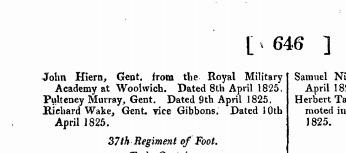
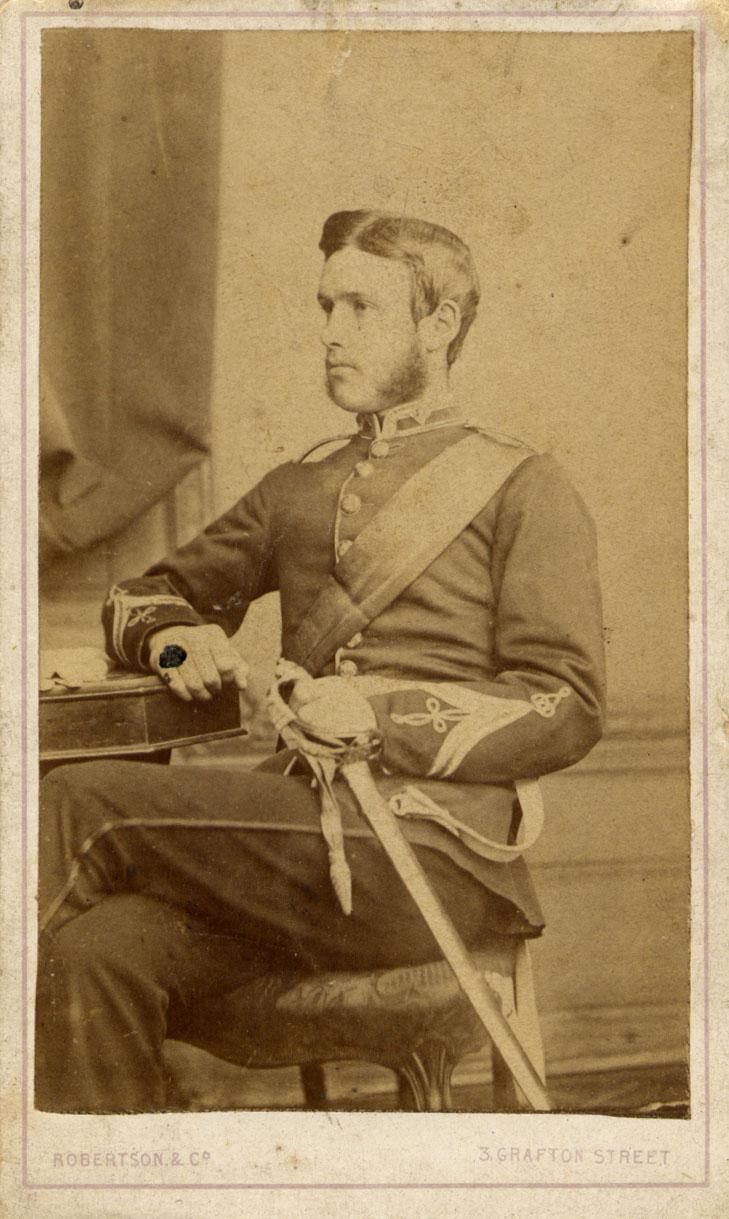
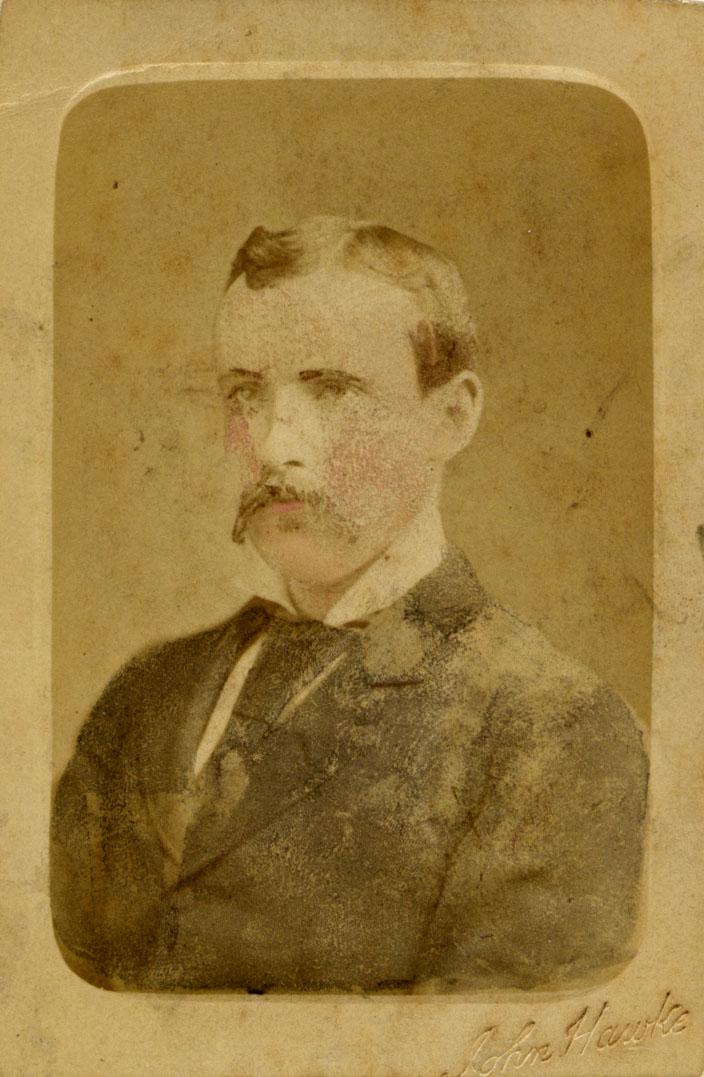
Pulteney MURRAY (1807-1875)
![]() |
![]() |
![]() |
![]() |
||||
![]() |
![]() |
![]() |
||||
| Name: | Pulteney MURRAY |
| Sex: | Male |
| Father: | James Patrick 2 MURRAY (1782-1834) |
| Mother: | Elizabeth RUSHWORTH (1783-1865) |
Individual Events and Attributes
| Birth (1) | 9 Jul 1807 | Galway, Ireland |
| Birth (2) | 1807 | Perth |
| Baptism | 20 Dec 1809 | Freshwater Church |
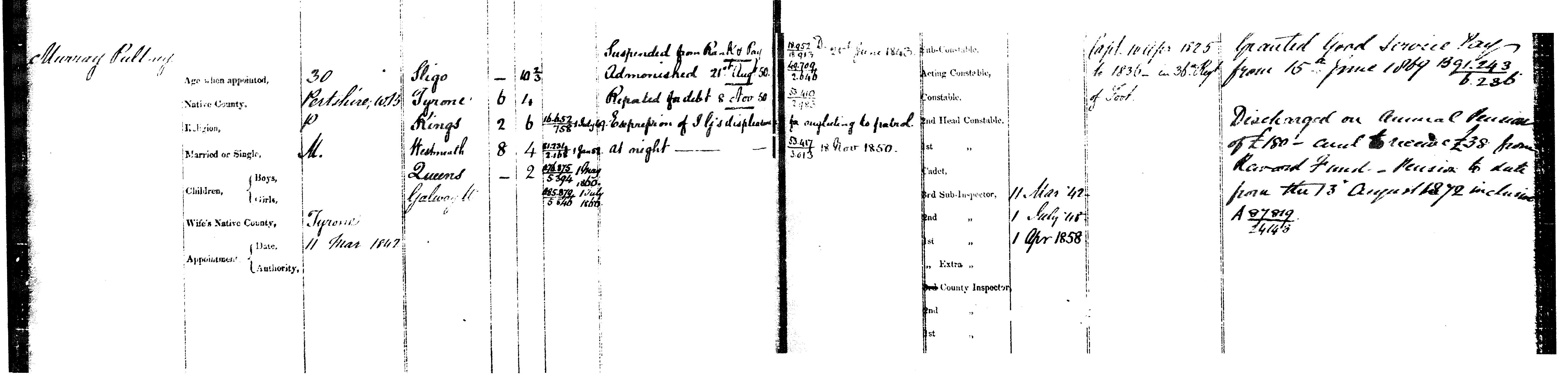
| Occupation | Major in the Army + Sub Inspector of the Royal Irish Constabulary | |
| Child Count | 1 | |
| Death | 20 Sep 1875 | Galway, Ireland |
Marriage (1)
![]() |
|
| Spouse | Jane MACKENNY ( -1851) | |
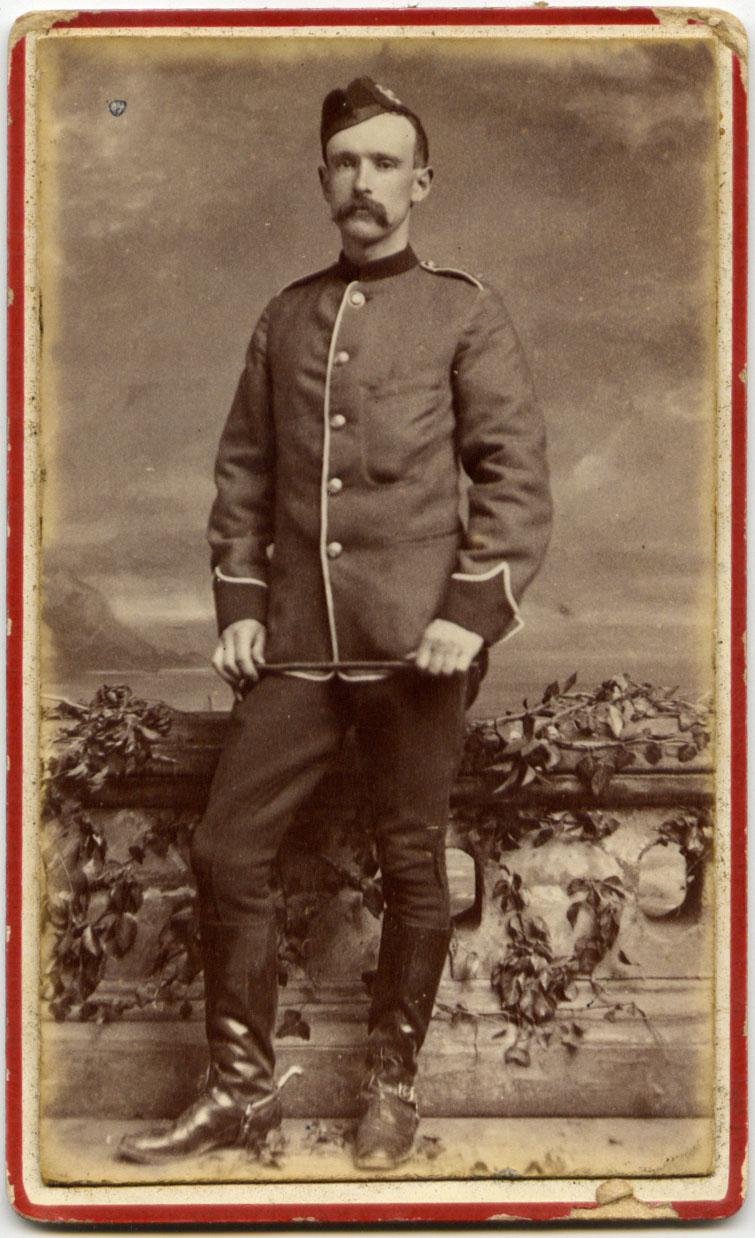
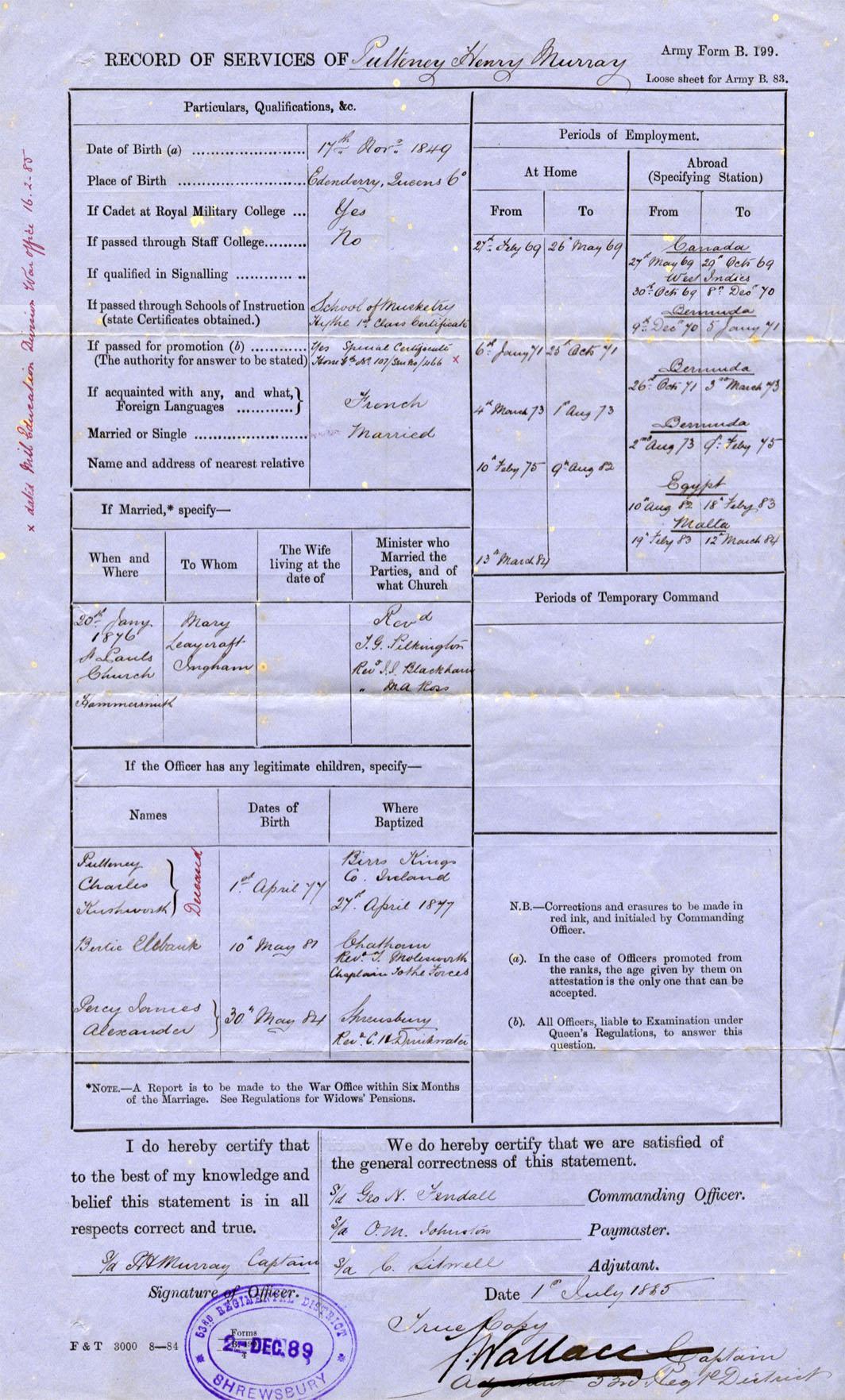
| Children | Pulteney Henry MURRAY (1849-1912) | |
| Marriage | 23 May 1848 | |
Marriage (2)
| Spouse | Elizabeth UNK ( -1898) | |
| Children | Georgina Emily MURRAY ( - ) | |
| James Alexander MURRAY ( - ) | ||
| Elizabeth Jane MURRAY ( - ) | ||
Individual Note 1
Nothing is known of what Pulteney did after he retired from the army in his late twenties, and after his wife Jane died so young. His son Pulteney Henry was brought up by his Aunt Donny (Catherine Anne) - there seems to be a family silence as to his last 30 or so years.
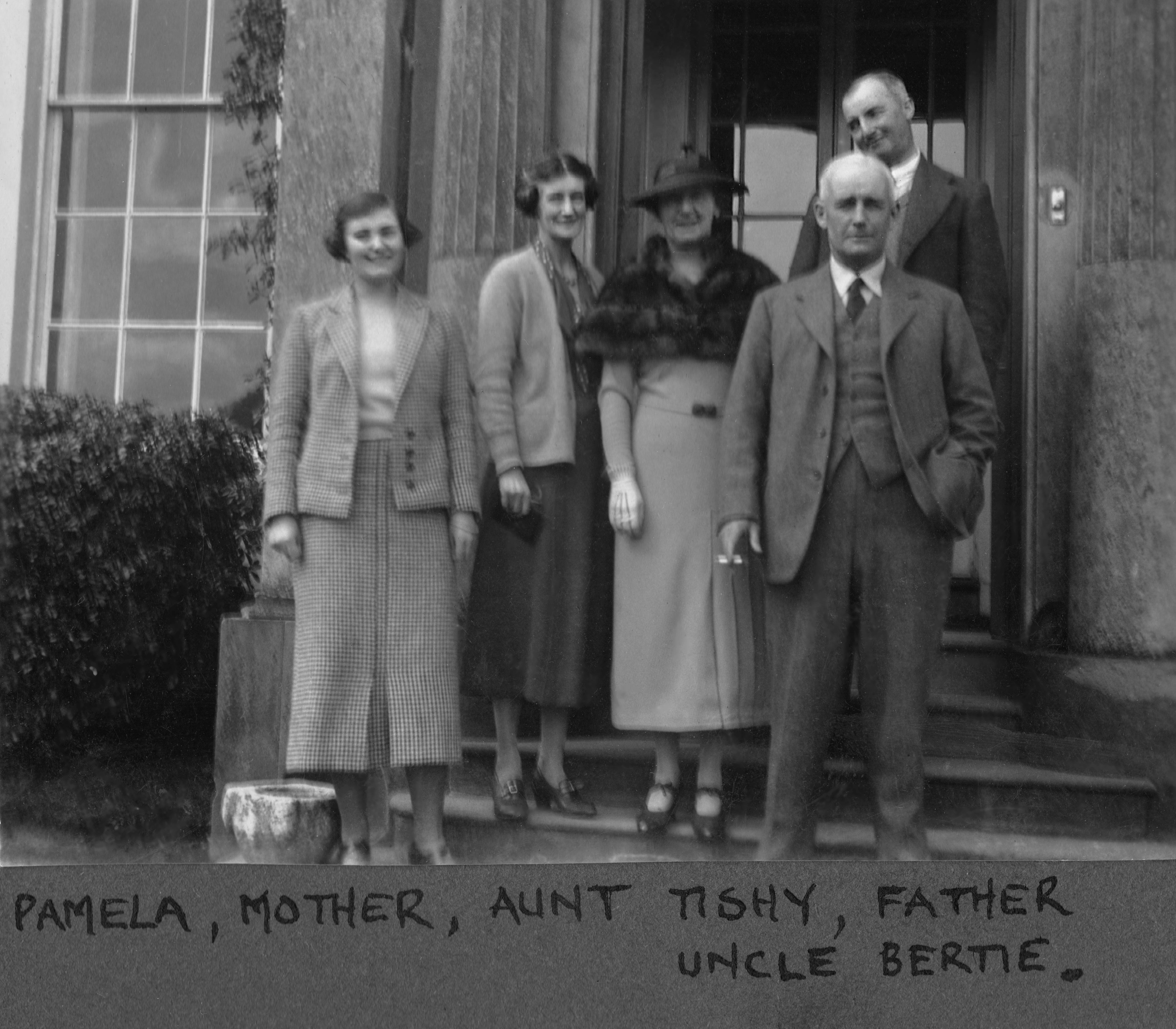
According to Pulteney's great great niece Pamela Churcher he was known to the family as the man who should have been, but never was, "the third General". This referred to the military success of his father and grandfather, the military traditions of the Murray family, and the disappointment with Pulteney's lack of success in this field. What Pulteney did after he left the army is unknown - it was not thought worth recording by the family, who could only think that he had failed by not remaining a military man.
Pulteney was probably named after Lt. General Sir J. Pulteney, to whom Pulteney's father served when Lt. Gen. Pulteney was Aide de Camp in the 9th Regiment around 1800.
Individual Note 2
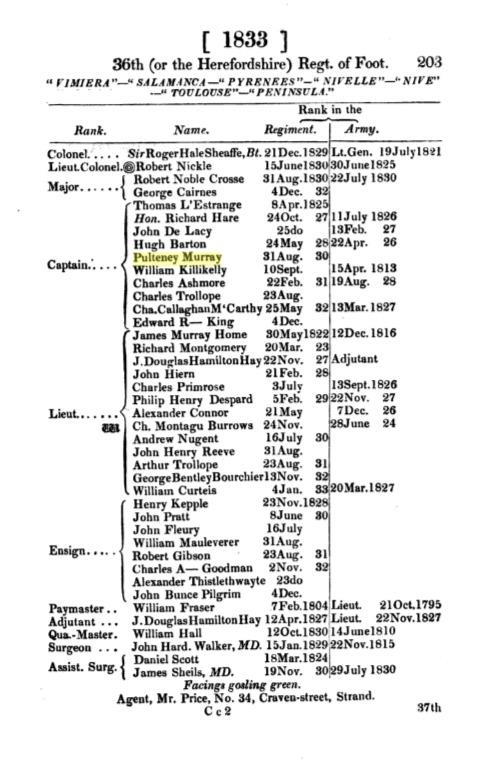
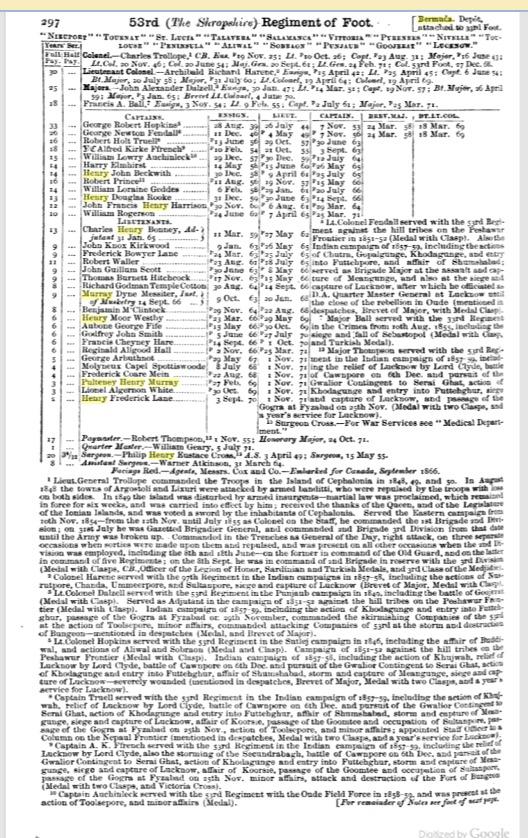
36th (Herefordshire) Regt. of Foot
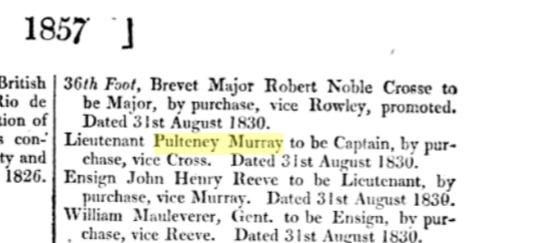
Regimental Notes: Born at Perth on 9 July 1807. 5 April 1825 Ens 36th Ft without purchase. Taken on Depot strength at IOW in Apr 1825, on leave. Shown in May 1825 to Half-Pay List Infantry unattached; however in the 1st Battalion return (Feb 1826) after its return to England he is shown as on leave (private affairs) from 8 April 1825 to 24th May 1826 by permission of C in C so the HP unattached list probably wrong. An entry elsewhere shows him in Gibraltar from 5 June 1825 to 3 May 1826. He joined Bn in May 1826 in England. - 29th August 1826 Lieutenant 36th Ft with purchase. - Moved to Ireland (Mullingar) with Bn in Apr 1827, Dublin (Sep) Philipston (May 1828), Limerick (Oct). Birr (Aug 1829), Banagher (Feb 1830), Birr (Apr), Fermoy (Jun). Stayed with his Coy at Fermoy, as part of Depot, when Bn (6 service Coys) sailed for Barbados in Oct 1830. 31 Aug 1830 Capt. 36th Foot, with purchase. - Still with Depot in Dec. 1830 at Spike Island - Took draft to Bn in Barbados on 29 Dec 1831 arrived Feb 1832, St Kitts (Feb 1833), St Christopher (Mar), Antigua (Jul), St. Lucia (Nov), until he retired on 6 May 1836 by sale of his commission.
He was a Major on retirement.
Individual Note 3
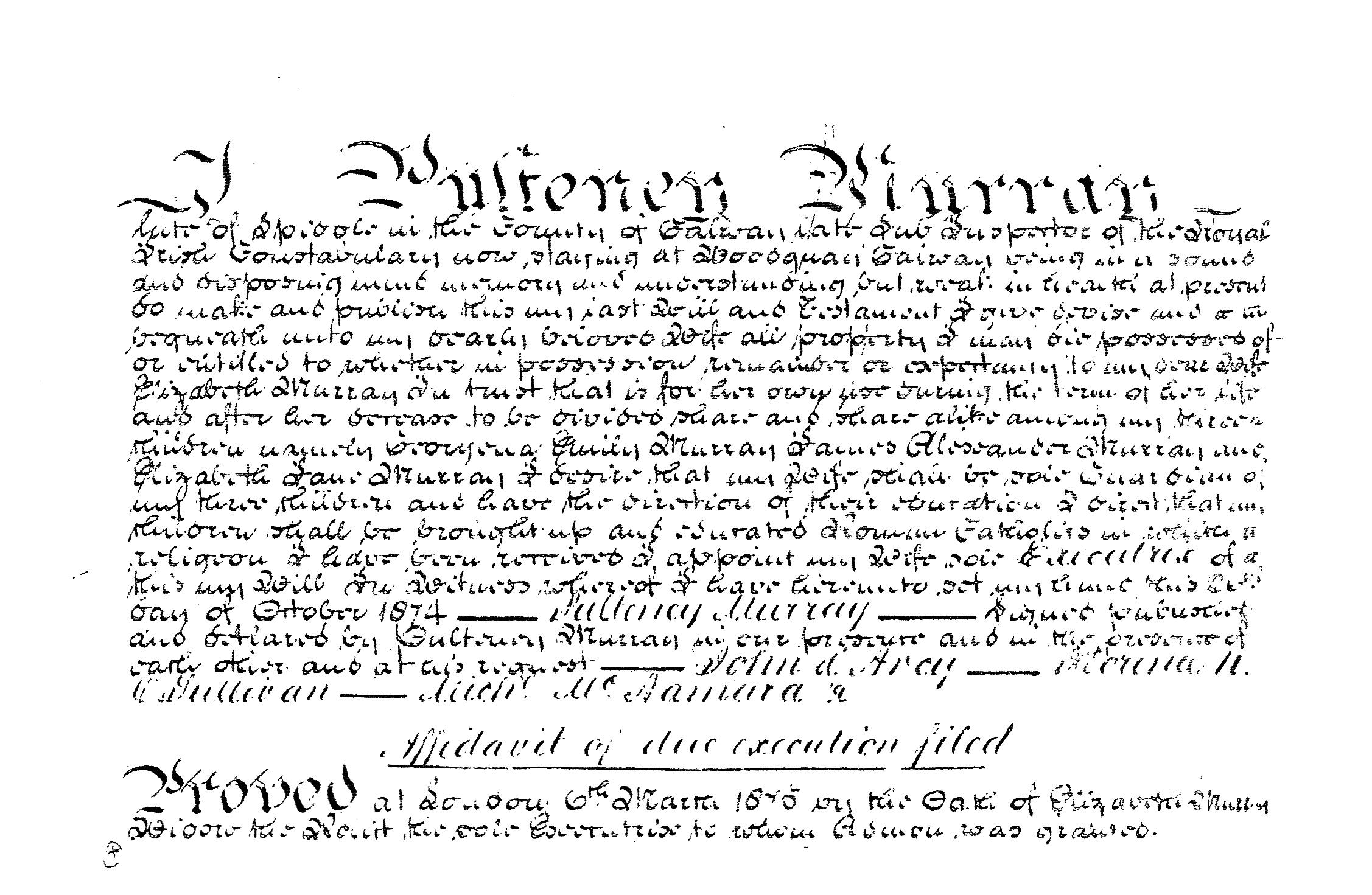
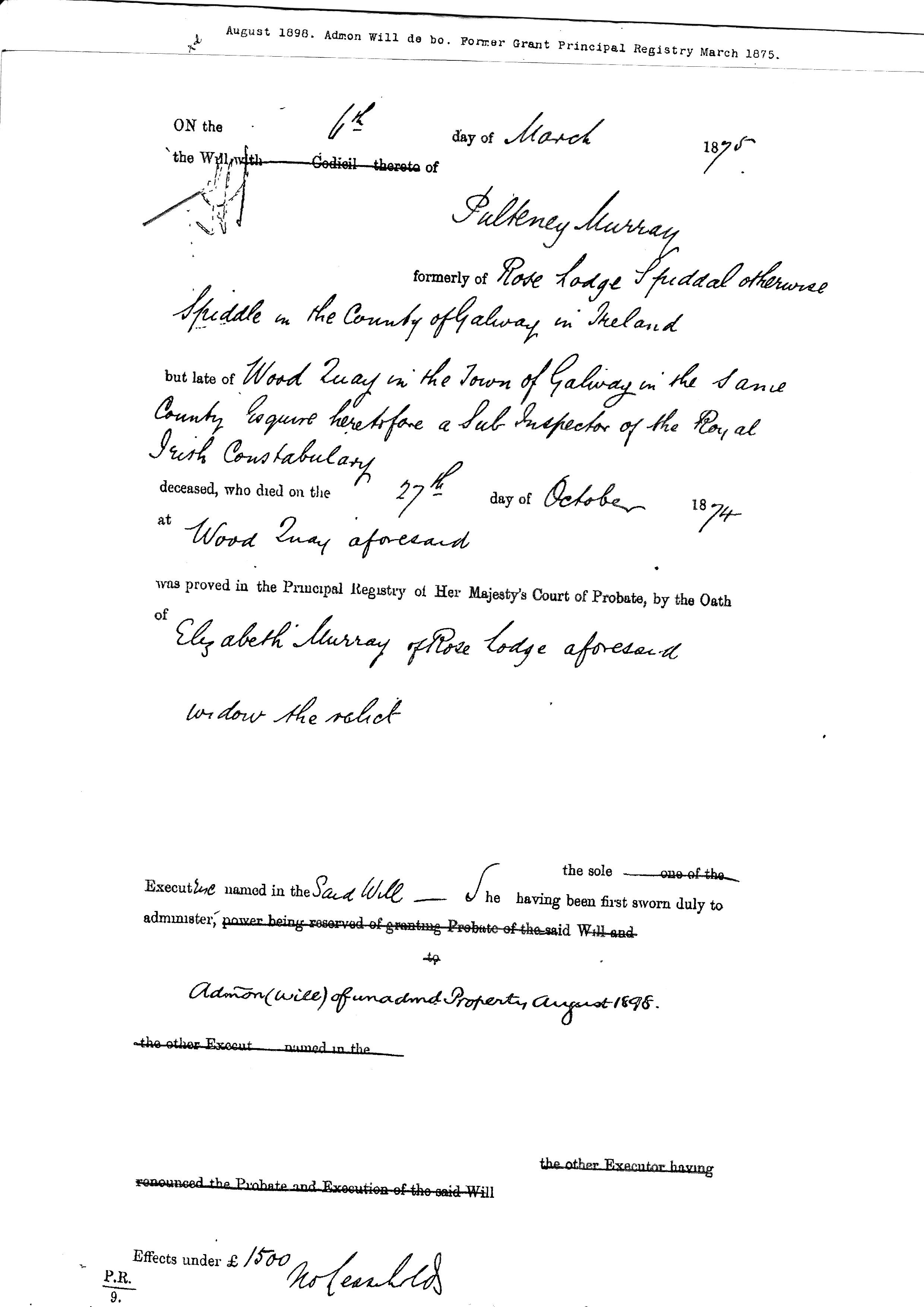
From Pulteney's will it is now known that he lived first at Rose Lodge, Spiddal/Spiddle and subsequently moved to Wood Quay, Galway, and that he worked as a sub inspector in the Royal Irish Constabulary. It is also now known that he remarried and had two daughters and one son; both duaghters subsequently moved to the United States. It is interesting to note that the family of his first wife made no record of Pulteney's remarriage and the children therefrom, despite thorough records otherwise being kept.
Furthermore, although no record has yet been found of the birth dates of the three children, the order given here is the order given in Pulteney's will. Given that the son is listed in the middle, it is more than possible that the order is that of age. In addition, when the will was properly administered in August 1898 (obviously some unfinished business in 1875), on the occasion of the death of Pulteney's wife Elizabeth, James Alexander Murray (Pulteney's son) was not mentioned, perhaps impyling that he had died. It is also worth noting that Pulteney's will makes no provision whatsoever for his son by his first marriage, Pulteney Henry Murray.
Lastly, in 1895, at her death, Elizabeth Murray is stated as being "of Rose Lodge", and yet her late husband Pulteney, at his death in 1875, was said to be "of Wood Quay, formerly of Rose Lodge", seeming to imply that the couple had separated before his death.
The question remains why the will was not administered in 1875, but had to wait a full twenty years, when the two daughters in America laid claim to the relatively small sum of £1350 left by Pulteney (that part of the will which was left unadminstered until 1898).
Individual Note 4
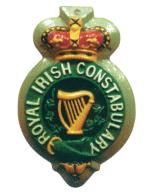
The first organised police force in Ireland came about through the Peace Preservation Act of 1814 but the Irish Constabulary Act of 1822 marked the true beginning of the Irish Constabulary. Among its first duties was the forcible seizure of tithes during the "Tithe War" on behalf of the Anglican clergy from the mainly Catholic population as well as the Presbyterian minority. The act established a force in each barony with chief constables and inspectors general under the control of the civil administration at Dublin Castle. By 1841 this force numbered over 8,600 men. The force had been rationalised and reorganised in an 1836 act and the first constabulary code of regulations was published in 1837. The discipline was tough and the pay poor. The police also faced unrest among the Irish rural poor, manifested in organisations like the Ribbonmen, which attacked landlords and their property.
The new constabulary demonstrated their efficiency against Irish separatism with the putting down of the Young Ireland uprising led by William Smith O'Brien in 1848. There then followed a spell of relative calm. However, the Irish Republican Brotherhood, founded in 1858, planned an armed uprising against British rule. This rose into direct action in with the Fenian Rising of 1867, marked by attacks on the more isolated police stations. This rebellion was also put down fairly easily, as the police had infiltrated the Fenians with spies and informers. The loyalty of the constabulary during the rising was rewarded by Queen Victoria granting the force the prefix 'royal' and the right to use the insignia of the Most Illustrious Order of St Patrick. The Royal Irish Constabulary (RIC) presided over a marked decline in crime in the country with the rural unrest of the early nineteenth century (characterised by secret organizations and crimes such as unlawful armed assembly) being replaced by relative misdemeanors such as public drunkenness and minor property crimes.
By 1836 this force had grown to around 5,000 men and by 1841 this had risen to a total of over 8,600. and from its inception the Irish constabulary was a barracked force. It was spread thinly throughout the country, with four or five policemen living in each barrack the norm.
Ireland in the first half of the nineteenth century was the pioneer for policing, acting almost as a laboratory for its development. With Irish society volatile, disordered and disorderly, the establishment of a uniformed, professional police force for the maintenance of law and order was an absolute necessity. It was the nature of collective violence and the weakness of previously existing forces for social control that led successive governments, from the early 1800's on, to press ahead with the establishment of a centrally controlled armed constabulary. The constabulary in Ireland served as a model for the establishment of a policing system in the rest of the British Isles, and ultimately even further afield in the developing colonies of the Empire. Throughout the 19th century the constabulary continued to develop as a police force. The evolution of the force was characterised by improvements in rank structure, training, and the rules and regulations governing the duties, conduct and discipline expected of the men. One of the most significant developments in the history of the constabulary during the 19th century was its redesignation as the Royal Irish Constabulary, making it the first 'Royal' police force in the British Empire.
Life in the constabulary during the 19th century could certainly, on occasions, be difficult. There was periodic agrarian unrest and constant simmering discontent in relation to the land question, particularly in the south and west. Indeed the dominant image of the R.I.C. for many people often stems from its responsibility to give protection to bailiffs executing distress warrants and evicting tenants, an unpleasant duty that was greatly disliked by members of the force (most of whom were themselves from a rural background). Nevertheless, the duties of the averagepoliceman were otherwise usually varied and uncontroversial.
These extensive civil and local government duties as well as routine patrolling in their districts ensured that the police constable was a very familiar part of daily life, someone with whom people would expect to have regular contact. It was the constable's job to acquire a thorough knowledge of his district and good relations with the local community made this easier. Indeed, good community relations, then as now, were essential for effective policing.
By the end of the 19th century there was a total of around 1,600 barracks dotted around the Irish countryside and some 11,000 constables. The territorial division of county and district on which the command structure had been based since the 1836 reorganization continued throughout the life of the R.I.C. Each county was supervised by a county inspector, with the counties sub-divided into a number of districts, each headed by a district inspector. They in turn were assisted by a head constable based at the district headquarters, on whom rested the main responsibility for operational policing and the conduct of the men in the barracks. There were a number of barracks in each district, usually with a sergeant and four constables.
The R.I.C. was characterised by a strict code of discipline. There was no official system of duty, rest days or annual leave, and in the interests of political impartiality members were even banned from voting at parliamentary elections. There were strict instructions laid down in police regulations concerning standards of conduct and appearance (for example, at one time police were absolutely prohibited from entering a public house socially). Other regulations were principally designed to maintain the standing of the police within the community. Members were forbidden to marry until they had at least seven years service and any potential bride had to be vetted by the constabulary authorities to ensure her social suitability. It was forbidden for policemen and their wives to sell produce, take lodgers or engage in certain forms of trade (for example, wives could be dressmakers but could not employ apprentices).
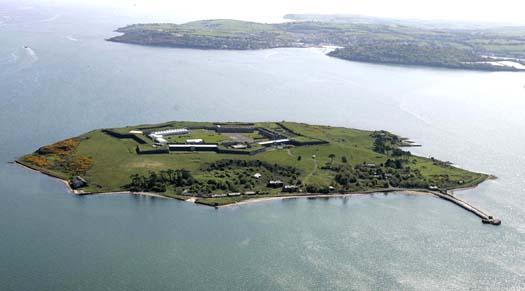
Spike Island (Fort Westmoreland): was purchased by the Government from Nicholas Fitton c1779 and fortified with a small 21 gun battery but it was the war against revolutionary France that saw the beginning of the major construction which, in 1790, was named Fort Westmoreland, after the then Lord Lieutenant, the Earl of Westmoreland. Construction continued throughout the period of the Napoleonic war at Westmoreland, Camden and Carlisle Forts.
Opposition to the practice of 'transporting' convicts, most notably from the convict colonies themselves, saw a decline in transportation and the establishment of 'home convict depots'. In 1847 Spike Island and Philipstown (Kings County) were selected as male convict depots (females were accommodated at Fort Elizabeth in the city of Cork). By 1853 there were 3,764 male and 514 female convicts in Ireland of which c2,500 were on Spike Island. By 1860 this had dropped to 1,076 male (c500 on Spike Island), and 416 female. Intermediate prisons were also established at Carlisle and Camden forts but were closed by 1865. Prisoners were employed quarrying stone, building the Haulbowline Island docks, and construction work at Fort Westmoreland. The two Islands were connected by a causeway and wooden bridge for the duration of this work. The last prisoners were removed from Spike Island in 1885.
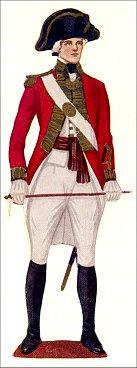
The following is a description of living conditions in British army barracks and is applicable to the period 1815-80. During this period the army stagnated, change, if any, came slowly. The only major war of the period was the Crimean war and the only good to come from that fiasco was the sanitation committee which was established in part because of agitation by Florence Nightingale. Throughout this period the army suffered from a major recruitment problem, in 1860 a royal commission was set up to investigate but they could find no reason a young man might not find the army an attractive career. This reminds me of that story about most football referees "he would make a great referee if only the white stick did not get in the way".
In 1830 the Irish made up 42% of the regular army, this had reduced to 25% by 1871.
The source for this material is:
Peter Burroughs, "Barrack Life", The Oxford Illustrated History of the British Army, ed. David Chandler, (Oxford University Press, 1994).
The sections enclosed in quotation marks are extracted directly from the article, the rest is my summary.
Construction and maintenance of barrack buildings was the responsibility of the Ordnance until that department was disbanded in 1855. The size and construction of barracks varied greatly but they were generally arranged around a barrack square. What they all had in common was overcrowding. "……Often soldiers had to make do with 200-300 cubic feet of air per man, when 600 was considered the minimum in British prisons."
Conditions inside were squalid and unsanitary. "….frequently soldiers washed indoors, the overnight urine tub being used for this purpose, until the sanitary commission in 1857 advocated ablution rooms and baths." Sometimes the buildings were located close to open sewers which served to exacerbate the problem.
The diet had little variation, breakfast was 1lb of bread with coffee, a midday dinner consisted of ¾lb of boiled meat served with potatoes (in Britain) and any vegetables the men purchased with their own money. Facilities for roasting or frying were not introduced until the 1860s.
Basic pay was 1s. per day (slightly more for the cavalry), from this was deducted 6d. per day for rations, further stoppages were made for other living expenses so that after the deductions a soldier would be lucky if he got anything.
Marriage for the rank an file was discouraged, the reason given was lack of suitable facilities although the real reason was simply that senior officers did not want women around the regiment. A soldier could marry with the permission of his commanding officer in which case his wife and family were either ‘on the strength’ or not. Those ‘on’ were permitted to live in the communal barracks and received half rations, there was little privacy other than a blanket hung as a curtain. Married quarters were introduced from the 1850s but progress on construction was slow and most continued to live in barracks.
The official roll for wives was restricted to six per 100 infantrymen, those ‘off the strength’ received no acknowledgement or help from the army.
In the British army the construction and maintenance of barrack buildings was the responsibility of the Board of Ordnance which had a reputation of being slow to act especially if that action might improve conditions for the common soldier. Accommodation for the rank and file was overcrowded, unsanitary, and squalid (up to six wives per 100 infantrymen were also permitted to live in the barracks). Conditions were slightly improved by the sanitation committee which was established following the Crimean war but no significant changes took place until the barrack building programme of the 1890s.
In the 1830s county Cork was part of the Southern Military District. There were 16 military stations providing, in total, accommodation for 352 officers and 6799 men. Given the overcrowding problems it is likely these figures were significantly exceeded. The barracks were for the most part populated by regular army regiments (the majority were English) which were changed often. During the Victorian period 20,000-30,000 regular soldiers were deployed in Ireland at any one time for the "maintenance of civil order".
Individual Note 5
SOCIAL HISTORY - THE IRISH
During the nineteenth century theories of race were advanced both by the scientific community and in the popular daily and periodical press. Even before Charles Darwin published On the Origin of Species in 1859, the old concept of the great chain of being, marking the gradations of mankind, was being subjected to a new scientific racism. The "science "of phrenology purported to demonstrate that the structure of the skull, especially the jaw formation and facial angles, revealed the position of various races on the evolutionary scale, and a debate raged on whether there had been one creation for all mankind (monogenism) or several (polygenism). "To a large extent, the story of racial science in Britain between 1800 and 1850," Nancy Stepan writes "is the story of desperate efforts to rebut polygenism and the eventual acceptance of popular quasi-polygenist prejudices in the language of science" (30). Polygenists stressed the unequal nature of the various creations and this theory mingled with general evolutionary theories and concepts of arrested development to create an atmosphere congenial to racial stereotyping.
In much of the pseudo-scientific literature of the day the Irish were held to be inferior, an example of a lower evolutionary form, closer to the apes than their "superiors", the Anglo-Saxons . Cartoons in Punch portrayed the Irish as having bestial, ape-like or demonic features and the Irishman, (especially the political radical) was invariably given a long or prognathous jaw, the stigmata to the phrenologists of a lower evolutionary order, degeneracy, or criminality. Thus John Beddoe, who later became the President of the Anthropological Institute (1889-1891), wrote in his Races of Britain (1862) that all men of genius were orthognathous (less prominent jaw bones) while the Irish and the Welsh were prognathous and that the Celt was closely related to Cromagnon man, who, in turn, was linked, according to Beddoe, to the "Africanoid". The position of the Celt in Beddoe's "Index of Nigrescence" was very different from that of the Anglo-Saxon. These ideas were not confined to a lunatic fringe of the scientific community, for although they never won over the mainstream of British scientists they were disseminated broadly and it was even hinted that the Irish might be the elusive missing link! Certainly the "ape-like" Celt became something of an malevolent cliche of Victorian racism. Thus Charles Kingsley could write
I am haunted by the human chimpanzees I saw [in Ireland] . . . I don't believe they are our fault. . . . But to see white chimpanzees is dreadful; if they were black, one would not feel it so much. . . ." (Charles Kingsley in a letter to his wife, quoted in L.P. Curtis, Anglo-Saxons and Celts, p.84).
Even seemingly complimentary generalizations about the Irish national character could, in the Victorian context, be damaging to the Celt. Thus, following the work of Ernest Renan's La Poésie des Races Celtiques (1854), it was broadly argued that the Celt was poetic, light-hearted and imaginative, highly emotional, playful, passionate, and sentimental. But these were characteristics the Victorians also associated with children. Thus the Irish were "immature" and in need of guidance by others, more highly developed than themselves. Irish "emotion" was contrasted, unfavorably, with English "reason", Irish "femininity" with English "masculine" virtues, Irish "poetic" attributes with English "pragmatism". These were all arguments which conveniently supported British rule in Ireland.
Individual Note 6
MILITARY HISTORY - PURCHASE
The South African
Military History Society
Die Suid-Afrikaanse Krygshistoriese Vereniging
Military History Journal - Vol 4 No 6
The Problem of Purchase Abolition in the British Army 1856-1862
by Carl G. Slater
By 1856, the great disillusionment generated by the severe casualties and the numerous frustrations incurred by the British army in the Crimea had brought the issue of military reform into national prominence. Although the nation’s confidence in the British soldier’s ability to overcome any foreign enemy was confirmed by The Alma, Balaclava, and Inkerman, it had become dubious whether the stalwart redcoat could continue to endure against the excessive incompetence and inefficiency of his own army’s administration. For the unprecedented newspaper coverage of the Crimean War had revealed to the British public the distressing facts of army disorganization that the soldiers themselves had long known.(1)
Used sporadically in Europe and the Near East as a tool of diplomacy, and often in remote parts of the world to fulfil the policing responsibilities of empire, the bulk of the British army had remained relatively inactive since 1815 when, under Wellington, it had attained its greatest glory. During the ensuing four decades, however, it had remained the army of Wellington — an eighteenth-century fighting force virtually oblivious to technological and administrative improvements. The Crimean experience was a rude and abrupt awakening from this stupor and demonstrated the necessity for a total overhaul of the military establishment. The functions and purpose of the army required redefinition; its administration demanded simplification and its echelons needed professionalization from the lowest ranks to the highest commands. Such ends could be attained only by extensive reform throughout both the civil and military branches of the service. Yet the issue that dominated the entire army reform controversy was the continuance of the long-standing tradition of promotion by purchase.
It is the purpose of this essay to provide a brief background of the operation of the purchase system, and then to examine more fully the government’s official attitude toward the reform of that system prior to 1868. More specifically, the focus of this study will be upon the official investigation of the purchase system undertaken in 1856 and 1857. It will be seen that although no reform was actual]y intended by the Palmerston ministry, the investigation conducted was quite thorough, and its conclusions influential on the eventual abolition of the purchase system in 1871.
II
Unlike the continental military forces of the nineteenth century, officers’ commissions in the British army were, in a broad sense, marketable commodities. In most cases, though not in all, applicants for commissions in the cavalry and infantry of the line and in the guards were required to lay out a specific sum of money for their initial rank of ensign or cornet. This practice generally applied to each additional step of promotion (excluding advancements due to deaths in the upper ranks) until attainment of the rank of lieutenant-colonel, which signified regimental command.
Although the origins of the purchase of commissions may be traced back to the middle ages, (2) its general adoption by the army is usually dated at March 7, 1683-84 when Charles II, by Royal Warrant, conferred his sanction upon the embryonic purchase system.(3) Still, during the ensuing reigns of William III and Anne, the progress of purchase within the service remained uncertain and informal until George I finally introduced elements of official systematization. His Royal Warrant of February, 1719 established a definite tariff of prices for each regiment and reimposed certain restrictions upon the sale of commissions first enacted in 1711. Prior to this time, a considerable number of promotions within the infantry, cavalry, and guards regiments had been based upon private financial arrangements between the officers themselves. By the new regulations of 1720, the Crown formally acknowledged purchase as a viable means of promotion within the army, but simultaneously laid an undisputed claim to the collection and disbursement of purchase money.(4) In 1766 a Board of General Officers issued a uniform price list for commissions in all purchase regiments, and the prices established at this time(5) remained essentially the same until they were substantially raised in 1821.(6)
By the nineteenth century, the purchase system had established itself as the most common means of promotion within the army, applying to about seventy-five per cent of all men appointed to fill commissions.(7) Despite the implications of its title, purchase was not simply a matter of buying and selling commissions in an open market. A definite scheme of qualification and advancement did exist, even if only theoretically. It was intended to exert some form of regulation upon the distribution of commissions to ensure at least a minimum of professional competence among purchase officers. Applicants for the initial appointments of cornet and ensign as well as for the subsequent advancement to captain (following suitable service in the intermediate rank of lieutenant) were required to pass written examinations.(8) Promotions to captaincies and majorities were also contingent upon a prescribed number of years’ service within the respective subordinate ranks of lieutenant and captain.(9) Purchase, finally, followed the orderly progression of rank and applied initially to only the senior officers within each rank. If such an officer proved unable to meet the expense of promotion, the option for advancement by purchase passed to the next in line according to seniority within the respective rank. If none of the officers within this rank could meet the purchase price, the promotion went to a suitable applicant from another regiment who could afford the advancement. Upon an officer’s retirement (even a non-purchase officer if he had served for at least twenty years), he sold his commission, theoretically receiving in return a sum of money equivalent to the amount he had invested in the purchase of his promotions based upon the prices established by official regulations.
The purchase system was restricted to regiments of the infantry and cavalry of the line and to the guards. Ideally open to all aspirants — though naturally not all could meet its heavy financial requirements — the purchase system provided a modified form of advancement through seniority as well as ability to pay. It was non-existent in the ordnance corps and in the Indian army, where promotion was based upon strict seniority. Nor was it the sole means of advancement in the regular army, since a vacancy created by a death in an upper regimental rank brought the normal rule of seniority into play and enabled everyone in the subordinate ranks within that regiment to advance a step. Purchase applied only to regimental advancement and stopped at the rank of lieutenant-colonel. Promotion beyond this position to the ranks of colonel and general officer was based exclusively upon seniority.
The actual operation of the purchase system was characterized by numerous evasions and violations of its rules and regulations. Prior to 1849, when Wellington introduced the practice of written examinations,(10) an officer’s competence for promotion by purchase had only to be certified by his commanding officer and approved by the Commander-in-Chief. Such a procedure was a simple formality, and there are probably few if any instances on record of an officer otherwise eligible for purchase being refused his promotion on the grounds of ineptitude.(11) During the eighteenth century, it was also common practice to purchase commissions for children. This was conceived originally as a means of providing for the male orphans of deserving officers, but it quickly degenerated into a major abuse that was not abolished until the Duke of York’s administration as Commander-in-Chief at the end of the century.
But of all the irregularities and abuses stigmatizing the operation of the purchase system, the most flagrant and widespread was the problem of over-regulation payments. The British army officer was probably the worst paid in the world.(13) Although the cost of living had increased four fold between 1750 and 1850, the pay of officers had remained virtually static, creating severe hardships for those men striving to subsist solely on the basis of their meagre remuneration. Such officers were sometimes driven deeply into debt, the result of the sizable loans which they were compelled to contract in order to meet the exorbitant expenses of their chosen profession. Under these circumstances, a system of over-regulation payments arose and flourished as a method of providing a form of supplemental income.
Consequently, it became customary for officers, when meeting the regulation price of a commission during peacetime, to make an additional payment to the officer selling out. This was a completely private transaction of which the authorities could claim no official knowledge. It was also quite illegal. But this fact in no way prevented the development of a distinctive over-regulation price list prevalent throughout the army.(14) The tariffs laid down by Warrant, therefore, were merely the minimum values of purchase commissions, while the actual values were considerably higher. In fact, at times true prices soared to astronomical heights, depending upon the prestige of a particular regiment.(15) The Government was not blind to the problem of over-regulation payments, and official efforts to abolish the practice began as early as 1766. But all executive and legislative attempts to stop or even control the practice proved to be futile, indicating that over-regulation payments would continue to exist as long as the purchase system itself remained in effect.
For all of its flaws and abuses — and there were many — the purchase system nevertheless endured for approximately two centuries. This can only be explained by the fact that it gave the country what it wanted — a cheaply financed officer corps that in no way threatened the established order, mainly because the social background of the officers themselves generally comprised a principal prop to that order. Because most commissions were purchasable and salaries were so outrageously low, it was fairly obvious that only men of independent means could actually afford a career in the army. Provision was made to some extent for indigent but talented individuals, but, for the most part, the English did not desire to see command of the military devolve upon a body of mercenaries.(16) It was far more preferable, both economically and politically, to draw the officers from that part of society most concerned with the preservation of its order and stability, the wealthy and landed classes.
It was thus the intention of the purchase system to avoid the employment of mere, untrustworthy soldiers of fortune through the enlistment as officers of men possessing the finest qualities of English gentlemen. ‘It is the promotion by purchase which brings into the service men of fortune and education — men who have some connection with the interests and fortunes of the country, besides the commission which they hold from his Majesty. It is this circumstance which exempts the British army from the character of being a ‘mercenary army and has rendered its employment for nearly a century and a half, not only not inconsistent with the constitutional privileges of the country, but wise and beneficial.’(17)
Hence, the Duke of Wellington’s faith in purchase. The system’s failure to provide for officers of a high professional aptitude was one of its more obvious shortcomings. If promotion was largely dependent upon the size of a man’s fortune, any wealthy fool might find himself leading a substantial number of troops into battle. The case of the Earl of Cardigan is probably the best example of the purchase system at its worst.(18) The great majority of purchase officers naturally fell between the two extremes represented by Wellington and Cardigan. For the most part, while deficient in adequate professional training, the officers still generally fulfilled the tasks assigned them by the civil and military authorities. As a result, the British officer enjoyed one of the highest reputations for courageous and valorous conduct in Europe, and in eighteenth-century warfare, the possession of such traits often proved sufficient to win battles.
The obvious defects of purchase — promotion on the basis of wealth rather than ability and the general absence of professionalism within the service — were eclipsed by the relative success of British arms during the eighteenth century. The purchase system adequately furnished officers capable of inflicting defeat upon the nation’s enemies, a fact most demonstratively borne out by 1815. But the glory of the Peninsular War and of Waterloo concealed the overall inefficieneies of army administration of which the purchase system’s defects comprised only one example. It was only after a substantial period of international peace permitted the deep entrenchment of these abuses within a relatively inactive service, that the purchase system and the general question of army reform became a pressing issue of national concern.
With all of the problems that purchase created, the system still seemed to provide the relatively inexpensive and socially acceptable army desired by the country. Although all officers were not drawn from the wealthier classes, the financial demands of the service — both in the purchase of commissions and in the often extravagant expenses incurred in the maintenance of the officers’ mess — rendered extremely unlikely the rapid advancement of officers who lacked substantial independent means. Purchase thus symbolized the heavily aristocratic and monetarily-dominant nature of the officer corps which, over the years, had come to assume aspects of a rich men’s club, flagrantly violating the regulations and laws created to control it. By the middle of the nineteenth century, and despite all of the other defects in army administration revealed in the conduct of the war against Russia, it was the purchase system that had become a key focal point in the movement for army reform.
III
Even before the Crimean War, the purchase system had become the subject of inquiry — both private and public, official and unofficial. The army had indeed vindicated itself quite admirably in the monumental struggle against Napoleon, and the notion of army reform in the wake of such triumph and glory appeared superfluous, foolhardy, and — most important — unnecessarily expensive. But the subsequent years of international peace within Europe brought the army into a relative state of inactivity that permitted the problems associated with purchase to reappear in an even greater intensity. The existence of these problems, reflecting the archaic and anarchic administration of the army, culminated in the publication of private pamphlets and government-issued reports that probed the merits and demerits of the purchase system. The result was the development of opposing schools of thought advocating the total abolition or preservation of purchase, or the application of some via media that would correct its most obvious faults while still retaining its essence.
Critics of the purchase system stressed the fundamental inconsistencies in a promotion system based mainly upon seniority, favour, and money to the detriment of merit, aptitude, and professional knowledge. Advancement by such questionable means within so vital a service as the army would virtually ensure the presence of incompetence, inefficiency, and senility in the higher ranks.(19) Purchase, in addition, left the peacetime army officered almost exclusively by amateurs of high social standing and independent means, men who regarded their army careers as a temporary youthful pastime. The maintenance of discipline by commanding officers over such unruly subordinates was, to say the least, difficult, while the purely financial foundation of promotion furnished little, if any, inducement for mental exertion or professional distinction among purchase officers.(20)
Hence, the only feasible solution to the dilemmas posed by the purchase system was its total abandonment and replacement by a new promotion system based upon the criterion of merit.
‘On the whole then it appears that this system of promotion, which has been maintained in deference to a short sighted and huckstering policy, has not even the advantage of being economical; while on the other hand it manifestly ignores talent and thus impairs the efficiency of the army to the great detriment of the public service. If the aristocracy knew their true interest, they would furthermore abolish a practice which is discreditable and pernicious to their order, and fearlessly encounter the generous and ennobling rivalry of merit.‘(21)
The advocates of purchase quickly responded to these vehement assaults. One rejoinder even went so far as to defend the system by virtue of the divine right of the aristocracy to staff the officers’ ranks of the army. More realistic, however, was the contention of several defenders of purchase that the system’s most obvious abuses originated not from purchase itself, but in the deviations from the rules and regulations intended to govern its operation. For, when operating properly, the system was not based merely upon a simple exchange of cash in return for a higher position, but was geared to provide for a just and impartial selection of an educationally qualified individual.
‘The money paid is neither more nor less than the premium or fee of entrance into the army, on the same principle as that paid by the alumnus, pupil or apprentice . . . to an attorney, conveyancer, surgeon, architect, or tradesman (not to allude to the case of true sale and purchase in the church), with the difference in favour of the army of the previous examinations and reputed fitness’.(23)
Viewed in this light, the army would still retain its rightful aristocratic composition, while the few officers who advanced by means of non-purchase commissions would comprise something of an elite within the officer corps. But the reformers’ insistence that purchase be entirely abandoned in order to open the officers’ ranks to the middle class was totally impractical. So drastic a reform would entail a significant increase in the officers’ pay necessary to sustain men of middle-class backgrounds in the heavy expenses imposed by the obligations of their rank. The result would be the end of England’s cheaply financed army.
‘England must rest assured that by no class will her army be so well or so cheaply officered as by the English gentleman, but fair opportunities must be afforded him of learning his profession in practice, and he must likewise be taught to regard his pay as, in itself, an adequate means of subsistence.’(24)
It was generally the advocates of the purchase system who prevailed in these debates, especially prior to the Crimean War. One of the principal reasons for their success was the influence of the Duke of Wellington, whose opinions on any military subject were not to be taken lightly. In a memorandum appended to the Report of the Select Committee on Army and Navy Appointments in 1833, the great Duke extolled the virtues of the purchase system. He particularly stressed its provision of a fairly steady and self-regulatory rate of promotion and retirement without the infliction of a heavy financial burden upon the state in the form of pensions, bonuses, and/or other remunerations for retiring officers.(25) Seven years later, Wellington presided over the Commission for Inquiring Into Naval and Military Promotion and Retirement, and with his fellow commissioners arrived at a similar conclusion:
'... The advantages of speedy promotion to the superior regimental ranks may to a considerable extent be secured by the system of purchase, even under circumstances which, in some respects, may be considered unfavourable to its development.’(26)
The only officially proposed modification to the promotion system prior to 1857 was the Report of the Commissioners on Promotion in the Army issued in 1854. Purchase was not a subject under consideration, although the report was significant in its recommendation concerning the principle of selection by merit for promotions above the rank of lieutenant-colonel. Such promotions (to colonel and general officer) had hitherto been based upon strict seniority, with the result that by the time most men had attained the rank of general, they were well past their physical and mental prime. To prevent the most responsible positions in the army from falling to men of declining capabilities, the Commission recommended that subsequent appointments to the rank of general officer be given to the fittest officers available for the particular duties involved, without reference to seniority. Promotions to colonel, furthermore, would be based solely upon years of actual service rather than seniority, with a minimum of three years in actual command of a regiment being the necessary prerequisite for elevation to this rank.(27)
A definite principle of selection in the promotion of senior officers had thus been recommended to the sovereign by an authorized investigative body. While not totally abandoning the rule of seniority, the commissioners had notably amended it with the concept of selection. They had, in consequence, conferred a degree of official recognition upon what would prove to be one of the principal points of contention in the later debates over the abolition of the purchase system. Yet that system, for the time being, remained inviolate, a principal bastion defending aristocratic control of the army.
It was under these conditions that the army was dispatched to the Crimea where, despite three victories on the battlefield, its high command proved incapable of capturing the key city of Sebastopol. The staggering number of casualties inflicted upon the British troops at this time resulted from a combination of the extremely bitter Crimean winter and, more significantly, from the total breakdown of the army administration, which failed to ensure the provision of even the barest necessities for the soldiers’ survival in the harsh climate.(28) The Aberdeen government could not withstand the combined public and political pressure nurtured by the extensive newspaper coverage of the war and ultimately yielded to the new Palmerston ministry.
With the shadow of the Crimea cast upon the service, the question of army reform attained a greater sense of urgency and necessity. The War Department consequently underwent an administrative consolidation that somewhat reduced the excessive number of offices and agencies through which it had formerly operated. The purchase system, in particular, was subjected to a new evaluation. This was manifested initially in private publications that revived the debate upon its propriety and effectiveness in securing the advancement of the most qualified individuals, and in maintaining overall morale within the service. Then, in 1856, the purchase issue was brought before Parliament.
IV
Sir George de Lacy Evans, one of the foremost soldiers of the age, possessed the unique distinction of having risen through all ranks of the service on the basis of merit. In one year alone, 1815, he attained the ranks of captain, major, and lieutenant-colonel, all achieved within a period of six months for services rendered previously in the Peninsula and more recently in America and at Waterloo.(29) Coming forward as an advanced radical reformer, he was elected to Parliament in 1833 where he was to serve intermittently until 1865. As a general during the Crimean War, he was present at the Alma and at Inkerman where, once more, he acquired numerous decorations and honours. On March 4, 1856 Evans spoke in the House of Commons upon the evils of the purchase system, emphasizing its unfairness to meritorious officers in particular and its impracticality to the country in general. He then proposed the following motion:
‘That a Select Committee be appointed to consider, examine evidence, and report to the House on the expedience of abolishing the System of Sale and Purchase in the Army, and on the means that may be adopted for the accomplishment of that object.’(30)
Once the motion had been seconded, a brief debate ensued on the relative advantages and disadvantages of purchase. The system’s advocates — among them Sir John Fitzgerald and Frederick Peel (the Under-Secretary for War) — stressed the longevity of the system, a factor that would render its abolition exceptionally difficult. Peel, in particular, denied that purchase operated detrimentally to the national and military interests, cited its benefits of rapid promotion to non-purchasers, and rejected the notion that increased educational standards were dependent upon the termination of the system. He maintained that purchase, seniority, and selection already existed in co-ordination, and that the elimination and/or the exclusive adoption of one of these facets would precipitate administrative chaos and considerably augment military expenditure.(31) Colonel James Lindsay claimed that abolition would ruin the army’s esprit de corps by its consequent destruction of the regimental system. He did acknowledge the flaws within the system and urged that it be improved by the introduction of higher educational qualifications and by more stringent examinations upon entrance into the army.(32)
On the other side of the question, Lord Stanley stressed the injustice and consequent demoralizing effect of the supersession of qualified officers who lacked sufficient funds to purchase promotion, and he urged the establishment of a committee to determine upon a suitable alternative to purchase.(33) Henry Rich claimed that only the non-purchase officers acquired suitable experience which qualified them for advancement, since purchasers often avoided service abroad and also lacked a sense of devotion to the service.
As the debate progressed, numerous references were made to the advisability of establishing a royal commission rather than a parliamentary committee to deal with this issue. Sidney Herbert especially elaborated upon this alternative. This former Secretary-at-War (and future Secretary of State for the War Department) had presided over the 1854 Commission on promotion in the army. He now urged the necessity of dealing delicately with the problem of army efficiency. While denying some of the more serious charges laid upon purchase by its detractors, he recognized the need for a thorough investigation of the system that would consider alternative methods of promotion and retirement in order to ensure the advancement of suitably qualified individuals. A committee, however, would fail to do justice to this important topic, since it would lack a sufficient number of members fully cognizant in the details of this subject; nor would its findings carry sufficient weight with the army. He therefore advocated the establishment of a commission comprised of knowledgeable officers and civilians.(35)
Palmerston finally brought the debate to a conclusion. The Prime Minister conceded his opposition to purchase in theory, but emphasized its long existence as an integral component of army administration, a factor requiring great consideration before abolition could be decided upon. He personally favoured a system of purchase combined with examination to insure the gentlemanly character of the officer corps. His own convictions notwithstanding, he believed the subject merited investigation by a commission which could also study the armies of other European nations. For these reasons, he requested that Evans withdraw his motion, promising to establish the necessary commission.(36) Evans quickly complied.
V
The Royal Commission Appointed to Inquire into the System of Purchase and Sale of Commissions in the Army was accordingly established in 1856. It initially appeared, therefore, that the government was on the verge of undertaking a significant reform in army organization, since the thorough investigation proposed would have to reveal the gross inequities in the then system of promotion and retirement. Such expectations were to be frustrated, however, as Lord Panmure — the Secretary for War — reported to the Queen:
‘The Commission was proposed rather in deference to the opinions of the House of Commons than from any expectation that any change could or ought to be made, and in constituting it, the object is to select men in whom the House of Commons has confidence and in whose hands as a body the system of purchase is safe.’(37)
Thus, according to Panmure, the Commission was created only as a sop to the army reformers, as there was never any real intention of abolishing the purchase system. The government’s failure to act upon the Commission’s recommendations at this time confirms the validity of Panmure’s statement.
The Duke of Somerset presided over the Commission, among whose other nine members were Lord Stanley, Sidney Herbert, and Sir de Lacy Evans.(38) The investigation itself consisted of the testimony of twenty-six individuals interviewed by the commissioners. Included within the persons interrogated were several high-ranking officers of the various branches of the army as well as certain key military and governmental administrators, and a representative of the army agency through which the details of the purchase and sale of commissions were actually conducted.(39)
Issued in 1857, the Commission’s Report comprised an in-depth study of the system’s operation. It considered the arguments for and against purchase and its alternatives, provided a comparison with the French system of promotion and retirement, gave an exposition upon a new system for the British army, and, finally stated the Commission’s recommendations based upon all of this data. The Commission found that purchase was detrimental to army efficiency in its emphasis upon wealth for advancement rather than dutiful exertion and merit. There was, consequently, small incentive for officers to acquire a truly professional interest in their careers. In addition, the fact that their commissions represented considerable financial investments could impede their performance in actual combat, since the officers would be risking not only their own lives but very possibly their families’ means of subsistence. For the families of officers killed in action received little or no compensation from the government except, at times, a return of the original money invested in commissions (regulation prices only). The system also produced extensive trafficking and bargaining among the officers, practices that did not reflect a proper sense of honour nor fostered a professional attachment to the service.
All of these customs and practices were especially harmful to the poorer officers who, unlike some of their more affluent associates, were more sincere in their devotion to the army as a profession. Purchase, furthermore, enabled officers to obtain regimental commands solely on the basis of their financial resources despite their lack of professional aptitude, while at the same time professionally qualified officers could be deprived of such promotions simply because they were unable to meet the payments. This situation, in turn, could seriously affect the higher commands of the army if they were filled with wealthy but inept officers.
‘Such a basis for the establishment of an army is not impolitic in a country whose military force is necessarily small when compared with continental states, and whose power therefore depends upon rendering its army efficient in the highest degree by the selection of officers distinguished for their personal qualities and for their professional acquirements.’(40)
Despite these serious drawbacks to the system, the commissioners also determined that most officers still preferred the maintenance of purchase. No other system, it appeared, would so facilitate retirement or accelerate peacetime promotion which would otherwise stagnate under a seniority system, or guarantee against the favouritism that would prevail under selection.(41) The French system, which entailed such promotion as well as compulsory retirement for each rank at specified ages, was thus regarded unfavourably, and an alternative scheme for promotion and retirement — containing elements drawn from the French model — was simply referred to the Secretary-at-War for further examination.(42)
It is not surprising that the commissioners decided against the general introduction of a selection principle for promotion. The army had been administered under purchase for too long to abandon it suddenly in a total overhaul for a system of only questionable benefit and one which might very well upset the entire regimental organization of the service. In any case, the present officer body was accustomed to purchase and would greatly resent its replacement by a selection method that would seriously jeopardize the officers’ pecuniary stakes in their commissions.
Selection, therefore, could not be introduced unless the government was prepared to buy out those officers unwilling to serve under the new system, an expense that might even exceed £8 million.(43) Instead, the commissioners moderated their proposals, recommending that the rank of lieutenant-colonel no longer be purchasable, but subject to appointment by selection of the Commander-in-Chief who was to be held accountable for his decisions. They proposed that the period for holding such commands be limited to eight to ten years. Officers relinquishing their commands after this time would not be liable to suffer any monetary loss, while the government must be prepared to purchase lieutenant-colonelcies from officers then holding such ranks whenever they wished to dispose of them.
The commissioners went on to recommend stricter examinations before the granting of the first commission, and an additional examination before promotion to lieutenant. These requirements could be implemented as supplemental qualifications to purchase. The ruling principle throughout all of these proposals, however, was moderation.
‘All of these changes, inasmuch as they introduce the principle of advancement by selection, tend toward the abolition of the purchase system. When experience shall have proved that officers appointed to the command of regiments, and to situations on the staff, have been chosen with due regard to their professional requirements, to their past service, and to their present fitness, the distrust of the principle of selection will be lessened, and one great obstacle to the change of system will be removed.... Until the effect of the change above recommended shall have been tried and its practical results approved, it wotild be in our opinion injudicious to interfere further with the usual course of regimental promotion.‘(22)
The adoption of these proposals, furthermore, would provide some opportunities for testing promotion by selection. The satisfactory operation of this system would thus conciliate army opinion and disprove the charges of its conduciveness to jobbery and patronage.
The publication of the Report sparked additional controversy, first manifested in a dissenting opinion issued by three of the commissioners themselves — Edward Ellice, Lieutenant-General Edward Buckley Wynyard, and Major-General Sir Henry John Bentinck. The basis for their dissent was the proposed abolition of purchase for the rank of lieutenant-colonel. They viewed this modification as merely a half-way measure that aggravated an already intolerable situation and created new problems pertaining to pay and retirement without resolving existing ones.(45) For if the purpose of the proposed abolition was simply to secure the appointment of professionally qualified officers to regimental commands, such extensive reform was unnecessary, provided the Commander-in-Chief adopted a more critical attitude and vetoed the promotion of all officers he considered unfit for higher commands.(46) But if purchase were indeed an evil, it should be totally abandoned immediately rather than undergo a dubious modification that could produce only questionable benefits.
The most outspoken critic of the purchase system proved to be Assistant Secretary to the Treasury Sir Charles Trevelyan, who, with Sir Stafford Northcote, had previously conducted a famous investigation of the civil service. During the course of the Commission’s investigation, Trevelyan had testified at length upon the inequities of the purchase system and upon the advantages of a system of regulatory selection modelled somewhat upon that of France. Trevelyan’s cause celebre was the more extensive opening of government service to the industrious and professionally deserving members of the middle class, an enterprise he believed to be advantageous not only to a particular social group, but to the nation itself. Purchase, he maintained inhibited the extension of advanced military training to this important section of the populace. For, despite its proven abilities in mercantile and manufacturing endeavours, the middle class could not afford the excessive expenses of both promotion and maintenance within the officers’ mess as could the landed interests. In addition, purchase inflicted heavy and superfluous expenses upon the nation as a whole, amounting to £540 102 per year in the maintenance of an unnecessarily large non-effective system which provided for the officers’ retirement.(47)
Purchase, Trevelyan had asserted to the Commission, was thus detrimental to army efficiency and to the national economy, while the flagrant violations embodied in over-regulation prices added a Further stigmatism to the already questionable nature of promotion and retirement. At a time when it was becoming more desirable to render army service more attractive to potential officers and enlisted men by raising its professional standards, the purchase system, with its emphasis upon wealth as the basis for promotion, operated at cross purposes with the national interest. Rather than encourage enlistments and expectations of eventual advancement, purchase had constructed ‘an artificial wall of separation between the officers and privates of the army.’(48) The solution was to abolish purchase entirely and to open the officers’ ranks to the enlisted soldiers themselves. This proposed reform would in no way exclude the aristocracy from the ranks of the officers. Rather, it would encourage the enrolment of even more young men from that class seeking both an active and intellectual career. Improved social relations between the classes would be the inevitable result, with the army itself becoming more fully embodied within English society.
Lord Panmure, the Secretary for War, responded to Trevelyan’s plan by appointing a committee to examine the proposals he had described. The Committee’s Report, issued in 1858, concerned itself mainly with the financial aspects of Trevelyan’s scheme. It concluded that while certain officers may rise faster by selection, the majority would be subjected to a corresponding retardation in promotion and a definite monetary loss upon retirement by their inability to sell their commissions.(49) Trevelyan had believed that his plan would reduce the government’s yearly expenditure upon the army. Yet the committee maintained that the demands of full-pay retirement would increase annual costs by £220 000 to which were to be added the costs of compensating officers for their loss of right to sell their commissions.(50) These amounts were impossible to estimate, but had to be borne by the public nevertheless.
An additional report by Sir Alexander Tulloch, one of the committee members, conducted a more detailed evaluation of the reforms proposed by Trevelyan. Although acknowledging the existence of flaws and abuses within the purchase system, especially the problens of over-regulation payments, Tulloch was vehemently critical of Trevelyan’s suggestions. Trevelyan, he alleged, had based much of this testimony on the erroneous contention that officers simply received back upon the sale of their commissions the money they had originally laid out. Hence, they would not hesitate in resigning when reaching a specific age if their commissions had cost them nothing.
This premise did not consider the plight of more than twenty-five per cent of the officers permitted to sell their commissions despite the fact that they had purchased only some or even none of them. Such officers would consequently be deprived of the substantial and highly profitable return they had been led to anticipate upon their retirement.(51) If adopted, Trevelyan’s scheme would have the effect of hindering retirement, since older officers were given no inducement to leave the service. Under such circumstances, only the officers of much shorter service would consider retirement, and since these would constitute — for the most part — men in the junior ranks, their removal would do little to quicken general promotion.
Tulloch concurred with the rest of the committee in its contention that Trevelyan had seriously underestimated the public expense entailed in the abolition of purchase and in the adoption of a new system of promotion and retirement in the army. Yet it was mainly the financial arrangements of this new retirement system to which Tulloch objected, for he did express his approval of Trevelyan’s notion of compulsory retirement at specific ages according to rank. He also recommended the exercise of a stricter regulatory control over the activities of the wealthier officers who often bid up the prices of commissions.(52)
The committee’s and Tulloch’s reports incited new rejoinders from Trevelyan,(53) but the urgency over the question of purchase abolition had diminished considerably in the course of the past two years. Trevelyan himself departed for India in 1859 to assume the governorship of Madras, thus momentarily depriving the abolition movement of one of its leading spokesmen. It was left mainly to Sir de Lacy Evans to continue the campaign against purchase into the next decade. And his efforts came to an end in 1862, when Palmerston concluded a debate on a motion to end purchase upon an emphatically negative note:
‘I quite admit that if the system of purchase did not exist in the British army, no one would probably think of introducing it. But I do not agree with the noble Lord [Stanley] in saying that a thing which would not be thought of originally, might not, when opinions and habits become attached to it, work well, although theoretically objectionable. That, I believe, is the case of the system of purchase.’(54)
Throughout his lengthy career of government service, Palmerston had consistently been one of the prominent advocates of aristocratic control of the army. His apparent concession to Evans in 1856, agreeing to the establishment of the investigatory commission, may be explained by the inordinate amount of criticism to which the government had been subjected because of the war. Nevertheless, by 1862, the Prime Minister probably believed, with justification, that sufficient time had elapsed to cool the reformist ardour and to produce greater public apathy towards the resolution of the purchase question. Thus, it was possible for him to reassert in more definitive terms his faith in the purchase system, which he had never really abandoned. Despite all of their previous efforts, then, the army reformers were compelled to acknowledge that purchase would continue to exist and function at least as long as Palmerston remained in office. The movement for abolition had momentarily come to a standstill.
VI
With Palmerston’s death and Trevelyan’s return from India in 1865, the campaign against purchase acquired a new impetus that finally culminated in victory six years later. A long and difficult struggle still remained before abolition would become a reality, but the movement of the 1850s had already laid considerable groundwork. This was especially evident in the publication of the Commission’s Report, which by no means could be regarded as eminently satisfactory to the advocates of purchase. For instead of conferring unanimous praise upon the system, the commissioners noted many of its flaws and disadvantages, and recommended some corrections if not the complete abolition of purchase. Perhaps it was unreasonable to expect any thing more at this time, considering the conservative attitude of the government towards reform in general and toward army reform in particular. In any case, no action was taken upon the Commission’s recommendations.
Regarded from present-day standards, the arguments for the abolition of purchase appear to be the only logical and sensible programme for army reform. Yet the present-day viewpoint also includes the advantage of hindsight which greatly facilitates the resolution of any formidable dilemma. No such beneficent influence existed for this problem in the 1850s. Those writers, publicists, investigators, and statesmen who defended purchase did so because to them it seemed, with all of its faults, to be the most effective and economical means of staffing the army. It had served the country well in the past and, with some adjustments, would continue to do so in the future. Its critics, despite the logic of their arguments, were nonetheless indulging in speculation. They could not know for certain that the reforms they proposed would truly fulfil their idealistic prophecies for a more efficient army. The benefits of middle-class employment in the officers’ ranks so persistently advocated by Sir Charles Trevelyan and subsequently by his son, George Otto, were so far only hypothetical. ‘Leap in the dark’ was a favourite phrase of the politicians during the 1860s, and to the defenders of the purchase system its abolition represented a perfect example of such a questionable action.
Despite its immediate failure, the significance of the anti-purchase campaign of the later 1850s lies in the fact that the once nearly universal acceptance of purchase was no longer in existence. In 1833 the Duke of Wellington had fully upheld the virtues of the purchase system which was still generally regarded by the nation as the most efficient and economical method of securing promotion and retirement in the army. In 1867 Sir Charles Trevelyan vehemently condemned purchase, calling for its immediate and total abolition. He urged the adoption of a system based upon selection,(55) and by this time he had a receptive and sizeable audience. In the thirty-five years following Wellington’s exemplary justification of purchase, the system had come under fire and, as time passed, its survival was becoming more questionable.
Nevertheless, the defenders of purchase were still able to hold their own. The lack of any action upon the recommendations of the Purchase Commission, and the subsequent parliamentary debates on the subject of purchase during the 1860s, more than amply demonstrated the strength of the system’s advocates in the House of Commons; their position in the House of Lords was even more formidable. It required the accession of a new government in 1868 and the example of another war (in which, ironically, Britain had no part) to provide the impetus necessary to secure the abolition of purchase in 1871. And even then an unorthodox political manoeuvre, embodied in the government’s issuance of a Royal Warrant, was required to extort the House of Lords’ reluctant acceptance of the termination of the purchase system.
TABLE I
Regulation Prices - January 1,1766
First and Second Troops of Horse Guards
Commissions Prices Difference in Value
£ £
First Lieutenant-Colonel 5 500 400
Second Lieutenant-Colonel 5 100 800
Cornet and Major 4 300 200
Guidon and Major 4 100 1 400
Exempt and Captain 2 700 1 200
Brigadier and Lieutenant or Adjutant and Lieutenant 1 500 300
Sub-Brigadier and Cornet 1 200 1 200
Total 5 500
First and Second Troops of Horse Grenadier Guards
Commissions Prices Difference in Value
£ £
Lieutenant-Colonel 5 400 1 200
Major 4 200 1 100
Lieutenant and Captain 3 100 100
Guidon and Captain 3 000 1 300
Sub-Lieutenant 1 700 300
Adjutant 1 400 1 400
Total 5 400
Horse
Commissions Prices Difference in Value
£ £
Lieutenant-Colonel 5 200 950
Major 4 250 1 150
Captain 3 100 1 100
Captain-Lieutenant 2 000 250
Lieutenant 1 750 150
Cornet 1 600 1 600
Total 5 200
Dragoon Guards and Dragoons
Commissions Prices Difference in Value
£ £
Lieutenant-Colonel 4 700 1 100
Major 3 600 1 100
Captain 2 500 1 100
Captain-Lieutenant 1 400 250
Lieutenant 1 150 150
Cornet 1 600 1 600
Total 4 700
Foot Guards
Commissions Prices Difference in Value
£ £
Lieutenant-Colonel 6 700 400
Third Major
Second Major with rank of Colonel 3 600 1 100
First Major
Captain 3 500 900
Captain-Lieutenant with rank of Lieutenant-Colonel 2 600 1 100
Lieutenant with rank of Captain 1 500 600
Ensign 900 900
Total 6 700
Marching Regiments of Foot
Commissions Prices Difference in Value
£ £
Lieutenant-Colonel 3 500 900
Major 2 600 1100
Captain 1 500 700
Captain-Lieutenant 800 250
Lieutenant 550 150
Ensign 400 400
Total 3 500
General Sir Robert Biddulph, Lord Cardwell at the War Office 1868-1874 (London: John Murray, 1904), 84-85,
TABLE Il
Regulation Prices — 1858
Life Guards
Commissions Prices Difference in Value
£ £
Lieutenant-Colonel 7 250 1 900
Major 5 350 1 850
Captain 3 500 1 715
Lieutenant 1 785 525
Cornet 1 260 1 260
Total 7 250
Royal Regiment of Horse Guards
Commissions Prices Difference in Value
£ £
Lieutenant-Colonel 7 250 1 900
Major 5 350 1 850
Captain 3 500 1 900
Lieutenant 1 600 400
Cornet 1 200 1 200
Total 7 250
Dragoon Guards and Dragoons
Commissions Prices Difference in Value
£ £
Lieutenant-Colonel 6 175 1 600
Major 4 575 1 350
Captain 3 225 2 035
Lieutenant 1 190 350
Cornet 840 840
Total 6 175
Foot Guards
Commissions Prices Difference in Value
£ £
Lieutenant-Colonel 9 000 700
Major with rank of Colonel 8 300 3 500
Captain with rank of Lieut.-Colonel 4 800 2 750
Lieutenant with rank of Captain 2 050 850
Ensign with rank of Lieutenant 1 200 1 200
Total 9 000
Regiments of the Line
Commissions Prices Difference in Value
£ £
Lieutenant-Colonel 4 500 1 300
Major 3 200 1 400
Captain 1 800 1 150
Lieutenant 700 250
Ensign 450 450
Total 4 500
Edward Barrington de Fonblanque, Treatise on the Administration and Organization of the British Army, with Special Reference to Finance and Supply (London: Longman, Brown, Green, Longmans, and Roberts, 1858), 133.
TABLE Ill
Over-Regulation Prices 1870
Cavalry
Rank Regulation Over-Regulation Total
£ £ £
Lieutenant-Colonel 1 300 1 794 3 049
Major 1 400 1 600 3 000
Captain 1100 2 006 3 106
Lieutenant 250 575 825
Ensign 450 450
4 500 5 975 10 475
Infantry
Rank Regulation Over-Regulation Total
£ £ £
Lieutenant-Colonel 1 300 1 000 2 300
Major 1 400 800 2 200
Captain 1 100 600 1 700
Lieutenant 250 100 350
Ensign 450 450
4 500 2 500 7 000
Great Britain, Parliamentary Papers, House of Commons, XII (Reports from Commissioners, l), Cmd. 210, 1870, ‘Report of the Commissioners Appointed to Inquire into Over-Regulation Payments in the Army,’ xii.
NOTES
1. J.W. Fortescue, A History of the British Army (London: Macmillan and Co., Ltd., 1930), XIII, 158-159.
2. John Harvey Bassett, ‘The Purchase System in the British Army, 1660-1871,” (unpublished Ph.D. dissertation, Department of History, Boston University, 1969), 28.
3. Report of Commissioners for Inquiring into Naval and Military Promotion; Forming a Supplement to the United Service Journal for April 1840 (London: Harrison & Co., 1840), xxxiv. Hereafter cited as Report of Commissioners ... 1840.
4. General Sir Robert Biddulph, Lord Cardwell at the War Office, 1868-1874 (London: John Murray, 1904), 82.
3. See Table I.
6. Biddulph, 82-83. See Table II.
7. Army and Navy Appointments Select Committee, "Appendix to the Report of the Committee,” United Service Journal (October 1833), 10. Hereafter cited as Report of the Committee ... 1833.
8. Observations on the Purchase System in the Army and on Jacob Omnium‘s Letter to "The Times” (London: George Earle, 1837), 28. 9. Edward Barrington de Fonblanque, Treatise on the Administration and Organization of the British Army with Special Reference to Finance and Supply (London: Longman, Brown, Green, Longmans, and Roberts, 1838), 131-132. 10. Great Britain, House of Commons, Parliamentary Papers, XVIII (Reports from Commissioners, III), 183 session 2, "Report of the Commissioners Appointed to lnquire into the System of Purchase and Sale of Commissions in the Army,’’ 92. Hereafter cited as Report of the Commissioners ... 1857.
11. De Fonblanque, 134n. 12. Charles M. Clode, The Military Forces of the Crown; Their Administration and Government (London: John Murray, 1869), II, 91.
13. Major Arthur Griffiths, The British Army: its Past History, Present Condition, and Future Prospects (London: Cassell, Petter & Galpen. 1878). 236.
14. See Table III.
15. Over-regulation prices could be double the regulation prices or even higher.
16. Clode, ll, 64.
17. Report of the Committee ... 1833, 12.
18. See Cecil Woodham-Smith, The Charge of the Light Brigade, (original title: The Reason Why) (New York: Signet Books 1953), passim.
19. The One Thing Needful (London: James Ridgway, 1855), 10-11
20. The Purchase System and the Staff (London: James Ridgway, 1833), 21.
21. Ibid., 28.
22. Veles, Col. Mitchell's Argument for the Abolishment of Promotion by Purchase in the Army: Considered in a Letter Respectfully Addressed to the Editors of ‘‘The British Critic","The British Magazine,’’ and ‘‘The Christian Remembrancer" (London: James Burns, 1842), 6-8.
23. Observations on the Purchase System ..., 8-9.
24. John William Crowe, Our Army; or Penny Wise and Pound Foolish (London: T Hatchard, 1856), 11.
25. Report of the Committee ... 1833, 11.
26. Report of Commissioners ... 1840, xxix.
27. Great Britain, House of Commons, Parliamentary Papers, XIX (Reports from Commissioners, i), Crnd. 845-846, 1854, ‘‘Report of the Commissioners on Promotion in the Army,” 11-12.
28. See A.J. Barker, The War Against Russia 1854-1856 (New York: Holt, Rinehart and Winston, 1970), 194-211.
29. "Evans, Sir George de Lacy,” The Dictionary of National Biography, VI, 927.
30. Great Britain, 3Hansard’s Parliamentary Debates, CXL: 1807. Hereafter cited as 3Hansard.
31. Ibid., CXL: 1813-1819.
32. Ibid., CXL: 1833.
33. Ibid., CXL: 1821.
34. Ibid., CXL: 1826-1827.
35. Ibid., CXL: 1845.
36. Ibid., CXL: 1849.
37. The Panmure Papers, ed. Sir George Douglas, Bart and Sir George Dalhousie Ramsay (London: Hodder and Stoughton, 1908)11, 198-199.
38. The others were Edward Ellice, Edward Buckley Wynyard, Sir Harry David Jones, Sir Henry John William Bentinck, George Carr Glyn, and Edward Robert Witherall.
39. Among the persons interviewed were the Duke of Cambridge (the Field Marshal Commander-in-Chief), Major-General Sir Charles Yorke (Military Secretary to the Commander-in-Chief), Lord Panmure (the Secretary of War), Philip Melville (Secretary to the Military Department of the East India Company), Charles Hammersley (representing the house of Messrs Cox and Co., army agents), Lieutenant-Colonel Claremont (the former Assistant Military Commissioner with the French army in the Crimea), and Sir Charles Trevelyan (the Assistant Secretary to the Treasury).
40. Report of the Commissioners ... 1857, xxiv.
41. Ibid., xxiv-xxv.
42. Ibid., xxix. 43. Great Britain, House of Commons, Parliamentary Papers, XXXII (Accounts and Papers, III), Cmd. 289, 1854-33, ‘Return of the Amount of the Value of All Regimental Commissions in the Cavalry and Infantry Specifying the Number of Regimental Commissions of Each Rank, and the Gross Value of the Same,’’ I.
44. Report of the Commissioners ... 1857, xxxv —xxxvi.
45. Great Britain, House of Commons, Parliamentary Papers, XIX (Reports from Commissioners, II), Cmd. 236, 1837-38, ‘Report of the Right Honourable Edward Ellice M.P., Lieut-General Edward Buckley Wynyard, C.B., and Major-General Sir Henry John Bentinck, K.C.B. “ 4
46. Ibid, Cmd. 237. 5.
47. Report of the Commissioners ... 1857, 270.
48. Ibid., 228.
49. Great Britain, House of Commons, Parliamentary Papers, XXXVII (Accounts and Papers, V), Cmd. 413, 1857-38, A copy of the Report upon the evidence given by Sir Charles Trevelyan Before the Commission Appointed to Inquire into the Purchase and sale of Commissions in the Army,” 7.
50. Ibid., Cmd. 416-417, 8-9.
51. Ibid., Cmd. 432, 24.
52. Ibid., Cmd. 440, 32.
53. Great Britain, House of Commons, Parliamentary Papers, XV (Accounts and Papers, 11), Cmd. 17, 1839 session 1, ‘Copy of the Statement by Sir Charles Trevelyan to General Peel of Reasons for Differing from the Report of the Committee Appointed by Lord Panmure to Examine the Proposals Submitted by Him to the Royal Commission on the Purchase and Sale of Commissions in the Army,’’ 5.
54. 3Hansard, CCXVII: 219.
55. Sir Charles E. Trevelyan, The Purchase System in the British Army, second edition (London: Longmans, Green, and Co., 1867), passim.
Return to Journal Index OR Society's Home page
South African Military History Society / scribe@samilitaryhistory.org
Individual Note 7
Between 1660 and 1814, St. Lucia changed hands between the French and the English 14 times, and was part of the Anglo-French dispute during the Napoleonic wars. Finally, the English began their reign with the Treaty of Paris in 1814, and St. Lucia became a Crown Colony.
Prosperous sugar plantations became the base of the economy, with slaves from Africa working the land, until Britain abolished slavery in 1833.
The first attempts at creating an orderly state system depended indirectly on the Windward Islands, which in 1833 comprised Barbados, Grenada, St. Vincent and Tobago. St. Lucia would join in 1838. In 1885, the Statute of the Windward Islands was rearranged so that it did not include Grenada, St. Lucia and St. Vincent. Dominica left the Leeward Islands group to rejoin the Windward Islands until 1940. In 1956, the Windward Islands were dissolved and each island formed a separate administration.
The St Lucia volcano, also called the St Lucia sulphur springs is said to be the only drive-in volcano in the world. The last minor eruption occurred in the late1700’s. It was only a steam eruption but not one with magma and ash. In the 1830’s approximately 760 tons of sulphur was mined and exported. Although there are signs of activity going on, for example the boiling mud, water and steam that emerge from the crater, the St Lucia volcano is dormant.
There never was a braver soldier, nor a worthier man,
than Major-General Stewart of Garth ; and the work he published,
entitled, " Sketches of the Character, Manners, and
Present State of the Highlanders of Scotland," proves that
he was possessed of literary, as well as military talents.
As he had commenced very considerable improvements on
his estates in the Highlands of Scotland, his friends felt an
anxious wish, that he should continue to benefit his native
country by his abilities and example. It was with great regret
therefore, that they heard of his being appointed Governor
of St Lucia ; but they hoped, that from the natural, *
strength of his constitution *, he would be able to surmount
the dangers of a West India climate. They were sure, at
any rate, wherever h'e went, that he would make every exertion
to do all the good that his situation admitted of. On
the llth of February 1830, I received a large packet from
him, with very satisfactory information of his proceedings as
Governor of St Lucia ; and, on the whole, rather a favourable
account of his health.
The British abolished the African slave trade in 1807, three years after former slaves in Haiti had gained their independence as the first black republic in the Caribbean, but it was not until 1834 that slavery was actually abolished on Saint Lucia. Even after slavery was officially abolished, all former slaves had to serve a four-year "apprenticeship" which forced them to work for free for their former slavemasters for at least three-quarters of the work week, with final freedom in 1838.
The abolition of slavery in 1838 by the English Parliament spelt the beginning of the end for the sugar industry in St. Lucia. Indentured labour from India arrived in the 1880's to alleviate the chronic agricultural labour shortages. Over the next 30 years indentured labourers continued to arrive and many of them settled permanently in the island. However, it could not stop the overall decline of the industry and by the early 1960's the sugar industry had totally disappeared.
Synopsis
The dominant star shaped fortress on Spike Island testifies to it's strategic importance in the once heavily fortified bastion of British military might that was Cork Harbour. Beneath and around this edifice however lies the story of an island steeped in extensive Irish heritage that stretches further back into the mists of Irelands past beyond the arrival of the Normans and on through to the darkest period of Irish history. From an island of ecclesiastical retreat and contemplation to a dark and godforsaken destination of victims of Ireland's Great Famine, Spike Island has been a part of two contrasting periods in Irish history. The era of saints and scholars during which Spike was described as a Holy Island is set against a later backdrop of famine, disease and death and the dark judicial practice that saw men and boys transported from it to the penal colonies of distant Australia.This book explores the island through these two very different environments from the founding of the monastery there by Saint Carthage to the use of the island as a place of detention, punishment and undignified death.
From saints to starvation, "Spike Island" embodies a part of the brightest a darkest legacy of Ireland's history.
Individual Note 8
Two rocks, called Sugarloaves, rise perpendicularly
out of the sea, and shoot to a great height in parallel
cones, which taper away towards the summit. These
mountains, which are covered with evergreen foliage,
stand on either side of the entrance into a small but
deep and beautiful bay. Behind this, the mountains,
which run N. and S. throughout the island, rise in
the most fantastic shapes.
When sailing along the shore the variety of scenery
is exquisitely beautiful ; the back ground continues
mountainous, but every three or four miles appear
the most lovely little coves and bays, fringed with the
luxuriant cane-fields, and enlivened by the neatly
laid-out mansions of the planters ; while the flotillas of fishing and passage, or drogher boats, with their long light masts and latteen sails, add life and animation to the scene. On the west coast there is an excellent harbour, called Little Careenage with three careening places, one for large ships, and the others for frigates. It is accessible only to one vessel at a time, (the entrance defended by several batteries) but capable of holding thirty ships of the line. The plains throughout the island are well watered, and the mountains clothed with fine timber. Castries, the only town in the isle, is situate at the bottom of a long and winding bay of the same name. The fort is situate on the summit of Marne- fortune, which is about two miles of exceeding steep road, or path, from Castries. Pigeon Island is six miles distant from the harbour of St. Lucia, and, in a military point of view, is of great importance to the colonies, being within a short distance of Martinique, and commanding a view of every ship that may enter or depart from that island ; —it is moreover valuable for a very fine and extensive anchorage between it and the N. part of St. Lucia. The isle is about half a mile in length N. and S. and a quarter broad, the side towards the sea (W.) is a perpendicular cliff, from the ridge or crest of which there is a gradual descent to the opposite shore, and level ground enough to erect a barrack for 500 men. A barrack and hospital has been constructed on this healthy spot, and it is one of the most salubrious that can be expected in a tropical clime. St. Lucia is divided into Basseterre, the low or leeward territory, and Capisterre, the high or windward territory. The former is well cultivated and most populous ; but the climate is unwholesome from the abundance of stagnant waters and morasses. The latter division is also unwholesome, but it becomes of course less so as the woods are cleared away. Indeed the health of all tropical countries will be found to be in proportion to their cultivation. IV. In 1777 the island contained whites, 2,397; free coloured, 1,050; slaves, 10,752; total, 14,199.
The Slave Population, according to a Parliamentary Return, was in numbers,
from 1816 to 1831, as follows:—
Loading...
Loading...
70 ST. LUCIA.—POPULATION—RELIGION—EDUCATION.
The Board of Trade returns for 1831 state the inhabitants
at—whites and free coloured males, 1,690;
females, 1,838; tlaves, males, 5,242; females, 6,129 —
total, males, 6,932; females, 7,967. The births for the year, 451; deaths, 430 ; and marriages, 19. 4,190 persons engaged in agriculture; in manufactures, 670 ; in commerce, 86.
Population of St. Lucia in 1836. [?. ?.]
The foregoing taken from returns received from justices of peace, in the several quarters, being the
only source of Information. The quarters in the district have been changed since the last return, for
the better accommodation of the special magistrates.
A statement of the number of Slaves for whom
compensation has been claimed, and of the number
of claims preferred for such compensation, and of
the amount of compensation awarded in each of the
classes of predial-attached, praedial-unattached, and
non-prsedial. [Parliamentary return to the House of
Lords, March, 1838.]
Number of claims having reference to each division.
Prœdial Attached, 332 ; Prœdial Unattached, 64 ¡ Non.
prKdial, 494. V. Churches, Livings, 4'c. in 1836 [?. ?.].—In Castries the population is about 150 souls. The value of the living is about 300Í. sterling. The church will contain about 200, of whom from 20 to 60 generally attend. This church is Protestant. In Castries also a population of 3382 Roman Catholics. The value of the living is not fixed. There is a Parsonage House allowed. The church, when finished, will contain about 800 persons. There is also a small house serving as a chapel, which will contain about 250 persons. Soufrière—Population about 3517 Roman Catl lies. Value of living, 5,000 livres per annum, church is generally full. con- atho- ?* Vieux Fort—Population 1094 Roman Catholics. Value of living 6,000 livres sterling. There is a Parsonage House allowed, to which is attached 18 acres of uncultivated land. This church will contain about 200 persons. The foregoing is taken from returns received from the curates of the different parishes. M;«. VI. Schools of St. Lucia in 1836 [B.B.].—Castries. —A National School, containing 41 male scholars. The mode of instruction is the plan generally pursued in National Schools. The Master receives a salary of 50Í., paid by the Bishop of the Diocese, and the rent of the school room is paid by voluntary subscription» until a house can be erected. Soufrière.—A National School, containing 24 male and 8 female scholars. (Mode of instruction as above). The Master receives 401. sterling, paid by the Bishop of the Diocese, and the rent of the school room is ] by voluntary subscriptions. Gros-Islet.—A National School, containing sev male scholars. The Master receives 40/. per annuti from the Bishop of the Diocese. (Mode of instruc as above). The officiating Minister of St. Lucia present bears the expenses of this school, which 1 been established but a short time. [There are other returns in the ?. ?.]
Loading...
Loading...
72 ST. LUCIA.—COMMERCE.—SHIPPING.
X. In 1810, the official notice of the exports was 43.830Í, and of imports 193,743/.
IMPORTS AND EXPORTS AND SHIPPING OF ST. LUCIA. [B.B.]
From Elsewhere, 1822, 7512/. ; 1813,4/08/.; 1831,369'. i 1834,802.
EXPORTS OF ST. LUCIA.
The principal articles of export, from 1822 to
1831, were.
XI. Accounts are kept in pounds, shillings and pence;
but the value of the circulating medium is thus
stated :—12 deniers = 1 sol ; 2 sols and six deniers=
I dog; 6 dogs or 15 sols = 1 bit ; 8 dogs, or 20 sols 1
livre; ? livres = 1 current dollar: 10 livres = l
round dollar; 20 livres = one pound currency. There
is no paper money in circulation.
The Mensures are (land or square measure) ; the
cane, containing 3 acres, 78 perches, 28 feet square (
Paris measure) or 10,000 square pacts ; the acre =
100 square perches, or 2,644 paces, 11 feet; the
perch = 26 paces, 5 feet, 72 inches square, or U square
toises ; the square toise = 36 square feet, or 2 paces, The ¡¡'fights in use are the French pound and quintal ; the pound = 2 marc (Paris) ; the marc = 8 oz.; the oz. = 8 gros = the gros = 72 grains; the quintal = 100 French Ibs.; the French Ibs. = 17 oz. 9 dr. English ; quintal of 100 French Ibs. = 109 English.
I1 feet, 72 inches square ; the square pace = 12 square
feet, and 30 square inches ; the square foot — 144 square inches; the square inch = 144 square lines, Long measure : the toise = 6 feet French ; the foot = 12 inches; the inch = 12 lines; the French foot = 12and2-3rd inches British. Cloth measure : the aune or ell = 3 feet 8 inches; and it is subdivided into one-half, one-third, one-fourth, and one-eighth; the ell = 1 yard lOj inches. Wine measure: gallon = 2 pots; 1 pot = 2 pints (Paris measure), 1 pint = lichopines; 1 chopine = 2 roquils; 1 roquil = 2 muces. Dry measure : the barrel = 4-1 quarts, or 55 pots; the half barrel = 27 pots; the quarter ditto = I3J | ots; the half quarter ditto ? 7-8thpota. XII. The number of stock in the island is, horse« 578 horned cattle, 2,231»; sheep, 1,741 ; and goats,594. The quantity of agricultural produce in 1R31 was, sugar, 5,561,815 hogsheads; coffee, 140,571 hogs- heads; cocoa, 33,515 hogsheads; rum, 90,687 galls. molasses, 224,700 gallons. The number of acres land under each crop was—in sugar canes, 4,752 coffee, 69G ; cocoa, 316; provisions, 4,049; pasture, 4,685—total, 11,321; leaving uncultivated—acres, 26,134. ~ a 2; Prices of Produce ??? Merchandise in 1836.— Horned cattle, 13/. each; horses, 25/.; sheep, 15j. goats, 10.».; swine, 1/. 10». ; salt butter, 4/. 10*. per firkin; cheese, 10». ; beef, 6/. per barrel; mutton, Is. per Ib. ; pork, 7/. per barrel ; rice, 1/. 5*. per 100 Ibs. ; coffee, 4/. per ditto ; tea, 6». per Ib. ; sugar, f,
Loading...
Loading...
70 ST. LUCIA.—POPULATION—RELIGION—EDUCATION.
The Board of Trade returns for 1831 state the inhabitants
at—whites and free coloured males, 1,690;
females, 1,838; tlaves, males, 5,242; females, 6,129 —
total, males, 6,932; females, 7,967. The births for the year, 451; deaths, 430 ; and marriages, 19. 4,190 persons engaged in agriculture; in manufactures, 670 ; in commerce, 86.
Population of St. Lucia in 1836. [?. ?.]
The foregoing taken from returns received from justices of peace, in the several quarters, being the
only source of Information. The quarters in the district have been changed since the last return, for
the better accommodation of the special magistrates.
A statement of the number of Slaves for whom
compensation has been claimed, and of the number
of claims preferred for such compensation, and of
the amount of compensation awarded in each of the
classes of predial-attached, praedial-unattached, and
non-prsedial. [Parliamentary return to the House of
Lords, March, 1838.]
Number of claims having reference to each division.
Prœdial Attached, 332 ; Prœdial Unattached, 64 ¡ Non.
prKdial, 494. V. Churches, Livings, 4'c. in 1836 [?. ?.].—In Castries the population is about 150 souls. The value of the living is about 300Í. sterling. The church will contain about 200, of whom from 20 to 60 generally attend. This church is Protestant. In Castries also a population of 3382 Roman Catholics. The value of the living is not fixed. There is a Parsonage House allowed. The church, when finished, will contain about 800 persons. There is also a small house serving as a chapel, which will contain about 250 persons. Soufrière—Population about 3517 Roman Catl lies. Value of living, 5,000 livres per annum, church is generally full. con- atho- ?* Vieux Fort—Population 1094 Roman Catholics. Value of living 6,000 livres sterling. There is a Parsonage House allowed, to which is attached 18 acres of uncultivated land. This church will contain about 200 persons. The foregoing is taken from returns received from the curates of the different parishes. M;«. VI. Schools of St. Lucia in 1836 [B.B.].—Castries. —A National School, containing 41 male scholars. The mode of instruction is the plan generally pursued in National Schools. The Master receives a salary of 50Í., paid by the Bishop of the Diocese, and the rent of the school room is paid by voluntary subscription» until a house can be erected. Soufrière.—A National School, containing 24 male and 8 female scholars. (Mode of instruction as above). The Master receives 401. sterling, paid by the Bishop of the Diocese, and the rent of the school room is ] by voluntary subscriptions. Gros-Islet.—A National School, containing sev male scholars. The Master receives 40/. per annuti from the Bishop of the Diocese. (Mode of instruc as above). The officiating Minister of St. Lucia present bears the expenses of this school, which 1 been established but a short time. [There are other returns in the ?. ?.]
Loading...
Loading...
ST. LUCIA.—CRIME AND GAOLS—FINANCE.
VII. Number of Prisoners in the Goal of St. Lucia throughout each year. [?. ?.]
VIII. The inhabitants have their affairs administered
by a Governor and Council, with French laws, where
they are not adverse to the British.
Si. Lucia Militia in 1836.—Northern Battalion:
Regimental Officers—1 Lieutenant-Colonel ; 1 Major ;
9 Captains ; 10 1st. Lieutenants ; 9 2nd. Lieutenants.
Staff Officers—1 Pay-Master; l Sergeant-Major; 2
Assistant Surgeons ; 1 Adjutant ; 1 Quarter Master.
Staff Sergeants—1 Sergeant Major ; 1 Assistant Serjeant
Major; 1 Quarter Master Sergeant; 22 Sergeants;
14 Buglers and Drummers; 494 Rank and
File. Southern Batt.—Regimental Officers—1 Lieutenant-
Colonel ; 2 Majors ; 8 Captains ; 8 1st. Lieutenants;
8 2nd. Lieutenants. Staff Officers—1 Pay-
Master ; 1 Surgeon ; 1 Adjutant ; 1 Quarter Master ;
l Sergeant-Major; 22 Sergeants; 16 Buglers and
Drummers ; 447 Rank and File.
The Expenditure of the Militia consists in the payment
of contingencies ; viz :—Companies ; Drummers ;
Buglers and Fifers ; Camp Colour; Adjutant Allow71 ances for Stationary, &c. These expenses are paid from a fund established in each Battalion ; which is created by the payment of Fines on absentees from Parade ; and the fees of Officers' Commissions. The Army, and accoutrements of Soldiers are furnished by Government. The Soldiers pay for their own clothing, and those that are unable to pay, the Colony provides for them. The forces of the Alien Corps, which is composed of Martinique Refugees, consist of 1 Captain Commanding; 5 Lieutenants ; 15 Sergeants; and 369 Rank and File. This Corps is unarmed, it not being considered advisable to place arms in their hands ; they clothe themselves, and are no expense to the Colony. (From ?. ?. for 1836, page 45.) IX. The income is derived from custom duties, a capitation tax, licences, fines, stamp duties, &c. The poll tax is 20 livres on all adults between the ages of 16 and 60.
Comparative Yearly Statement of the Revenue of St. Lucia.
In 1817, the revenue was 8,305/. ; in 1820, 10,300/. ; in 1826,12,000/.
Commissariat Department.—Provisions and Forage
received from England, 2,882/. ; purchased in the
Command, 3,788/. ; total, 6,670/. Fuel and Light
received from England, 165/.; purchased in the Command,
217/.; total, 382Í.
Miscellaneous Purchases.—Transport, 284/. ; Pay of
extra Staff (included under the head of Ordinaries
from 1st April, 1836, pay of Commissariat and Ordnance excepted), 153/.; Military Allowance, 694/.; Special Services, 62Í. ; Contingencies, 101/.; Ordnance, 3,680/. ; Ordinaries, 6,705/. ; Pay of Commissariat Officers, 450/. ; Total, 19,184/. Deduct Re-payments. — Commissariat, 256Í. 10s. ; Ordnance, 522/. 16».; Total, 779Í. Net charge, 18,405/. Ordnance not included. (?. ?. for 1836.)
Loading...
Loading...
72 ST. LUCIA.—COMMERCE.—SHIPPING.
X. In 1810, the official notice of the exports was 43.830Í, and of imports 193,743/.
IMPORTS AND EXPORTS AND SHIPPING OF ST. LUCIA. [B.B.]
From Elsewhere, 1822, 7512/. ; 1813,4/08/.; 1831,369'. i 1834,802.
EXPORTS OF ST. LUCIA.
The principal articles of export, from 1822 to
1831, were.
XI. Accounts are kept in pounds, shillings and pence;
but the value of the circulating medium is thus
stated :—12 deniers = 1 sol ; 2 sols and six deniers=
I dog; 6 dogs or 15 sols = 1 bit ; 8 dogs, or 20 sols 1
livre; ? livres = 1 current dollar: 10 livres = l
round dollar; 20 livres = one pound currency. There
is no paper money in circulation.
The Mensures are (land or square measure) ; the
cane, containing 3 acres, 78 perches, 28 feet square (
Paris measure) or 10,000 square pacts ; the acre =
100 square perches, or 2,644 paces, 11 feet; the
perch = 26 paces, 5 feet, 72 inches square, or U square
toises ; the square toise = 36 square feet, or 2 paces, The ¡¡'fights in use are the French pound and quintal ; the pound = 2 marc (Paris) ; the marc = 8 oz.; the oz. = 8 gros = the gros = 72 grains; the quintal = 100 French Ibs.; the French Ibs. = 17 oz. 9 dr. English ; quintal of 100 French Ibs. = 109 English.
I1 feet, 72 inches square ; the square pace = 12 square
feet, and 30 square inches ; the square foot — 144 square inches; the square inch = 144 square lines, Long measure : the toise = 6 feet French ; the foot = 12 inches; the inch = 12 lines; the French foot = 12and2-3rd inches British. Cloth measure : the aune or ell = 3 feet 8 inches; and it is subdivided into one-half, one-third, one-fourth, and one-eighth; the ell = 1 yard lOj inches. Wine measure: gallon = 2 pots; 1 pot = 2 pints (Paris measure), 1 pint = lichopines; 1 chopine = 2 roquils; 1 roquil = 2 muces. Dry measure : the barrel = 4-1 quarts, or 55 pots; the half barrel = 27 pots; the quarter ditto = I3J | ots; the half quarter ditto ? 7-8thpota. XII. The number of stock in the island is, horse« 578 horned cattle, 2,231»; sheep, 1,741 ; and goats,594. The quantity of agricultural produce in 1R31 was, sugar, 5,561,815 hogsheads; coffee, 140,571 hogs- heads; cocoa, 33,515 hogsheads; rum, 90,687 galls. molasses, 224,700 gallons. The number of acres land under each crop was—in sugar canes, 4,752 coffee, 69G ; cocoa, 316; provisions, 4,049; pasture, 4,685—total, 11,321; leaving uncultivated—acres, 26,134. ~ a 2; Prices of Produce ??? Merchandise in 1836.— Horned cattle, 13/. each; horses, 25/.; sheep, 15j. goats, 10.».; swine, 1/. 10». ; salt butter, 4/. 10*. per firkin; cheese, 10». ; beef, 6/. per barrel; mutton, Is. per Ib. ; pork, 7/. per barrel ; rice, 1/. 5*. per 100 Ibs. ; coffee, 4/. per ditto ; tea, 6». per Ib. ; sugar, f,
Loading...
Loading...
70 ST. LUCIA.—POPULATION—RELIGION—EDUCATION.
The Board of Trade returns for 1831 state the inhabitants
at—whites and free coloured males, 1,690;
females, 1,838; tlaves, males, 5,242; females, 6,129 —
total, males, 6,932; females, 7,967. The births for the year, 451; deaths, 430 ; and marriages, 19. 4,190 persons engaged in agriculture; in manufactures, 670 ; in commerce, 86.
Population of St. Lucia in 1836. [?. ?.]
The foregoing taken from returns received from justices of peace, in the several quarters, being the
only source of Information. The quarters in the district have been changed since the last return, for
the better accommodation of the special magistrates.
A statement of the number of Slaves for whom
compensation has been claimed, and of the number
of claims preferred for such compensation, and of
the amount of compensation awarded in each of the
classes of predial-attached, praedial-unattached, and
non-prsedial. [Parliamentary return to the House of
Lords, March, 1838.]
Number of claims having reference to each division.
Prœdial Attached, 332 ; Prœdial Unattached, 64 ¡ Non.
prKdial, 494. V. Churches, Livings, 4'c. in 1836 [?. ?.].—In Castries the population is about 150 souls. The value of the living is about 300Í. sterling. The church will contain about 200, of whom from 20 to 60 generally attend. This church is Protestant. In Castries also a population of 3382 Roman Catholics. The value of the living is not fixed. There is a Parsonage House allowed. The church, when finished, will contain about 800 persons. There is also a small house serving as a chapel, which will contain about 250 persons. Soufrière—Population about 3517 Roman Catl lies. Value of living, 5,000 livres per annum, church is generally full. con- atho- ?* Vieux Fort—Population 1094 Roman Catholics. Value of living 6,000 livres sterling. There is a Parsonage House allowed, to which is attached 18 acres of uncultivated land. This church will contain about 200 persons. The foregoing is taken from returns received from the curates of the different parishes. M;«. VI. Schools of St. Lucia in 1836 [B.B.].—Castries. —A National School, containing 41 male scholars. The mode of instruction is the plan generally pursued in National Schools. The Master receives a salary of 50Í., paid by the Bishop of the Diocese, and the rent of the school room is paid by voluntary subscription» until a house can be erected. Soufrière.—A National School, containing 24 male and 8 female scholars. (Mode of instruction as above). The Master receives 401. sterling, paid by the Bishop of the Diocese, and the rent of the school room is ] by voluntary subscriptions. Gros-Islet.—A National School, containing sev male scholars. The Master receives 40/. per annuti from the Bishop of the Diocese. (Mode of instruc as above). The officiating Minister of St. Lucia present bears the expenses of this school, which 1 been established but a short time. [There are other returns in the ?. ?.]
Loading...
Loading...
ST. LUCIA.—CRIME AND GAOLS—FINANCE.
VII. Number of Prisoners in the Goal of St. Lucia throughout each year. [?. ?.]
VIII. The inhabitants have their affairs administered
by a Governor and Council, with French laws, where
they are not adverse to the British.
Si. Lucia Militia in 1836.—Northern Battalion:
Regimental Officers—1 Lieutenant-Colonel ; 1 Major ;
9 Captains ; 10 1st. Lieutenants ; 9 2nd. Lieutenants.
Staff Officers—1 Pay-Master; l Sergeant-Major; 2
Assistant Surgeons ; 1 Adjutant ; 1 Quarter Master.
Staff Sergeants—1 Sergeant Major ; 1 Assistant Serjeant
Major; 1 Quarter Master Sergeant; 22 Sergeants;
14 Buglers and Drummers; 494 Rank and
File. Southern Batt.—Regimental Officers—1 Lieutenant-
Colonel ; 2 Majors ; 8 Captains ; 8 1st. Lieutenants;
8 2nd. Lieutenants. Staff Officers—1 Pay-
Master ; 1 Surgeon ; 1 Adjutant ; 1 Quarter Master ;
l Sergeant-Major; 22 Sergeants; 16 Buglers and
Drummers ; 447 Rank and File.
The Expenditure of the Militia consists in the payment
of contingencies ; viz :—Companies ; Drummers ;
Buglers and Fifers ; Camp Colour; Adjutant Allow71 ances for Stationary, &c. These expenses are paid from a fund established in each Battalion ; which is created by the payment of Fines on absentees from Parade ; and the fees of Officers' Commissions. The Army, and accoutrements of Soldiers are furnished by Government. The Soldiers pay for their own clothing, and those that are unable to pay, the Colony provides for them. The forces of the Alien Corps, which is composed of Martinique Refugees, consist of 1 Captain Commanding; 5 Lieutenants ; 15 Sergeants; and 369 Rank and File. This Corps is unarmed, it not being considered advisable to place arms in their hands ; they clothe themselves, and are no expense to the Colony. (From ?. ?. for 1836, page 45.) IX. The income is derived from custom duties, a capitation tax, licences, fines, stamp duties, &c. The poll tax is 20 livres on all adults between the ages of 16 and 60.
Comparative Yearly Statement of the Revenue of St. Lucia.
In 1817, the revenue was 8,305/. ; in 1820, 10,300/. ; in 1826,12,000/.
Commissariat Department.—Provisions and Forage
received from England, 2,882/. ; purchased in the
Command, 3,788/. ; total, 6,670/. Fuel and Light
received from England, 165/.; purchased in the Command,
217/.; total, 382Í.
Miscellaneous Purchases.—Transport, 284/. ; Pay of
extra Staff (included under the head of Ordinaries
from 1st April, 1836, pay of Commissariat and Ordnance excepted), 153/.; Military Allowance, 694/.; Special Services, 62Í. ; Contingencies, 101/.; Ordnance, 3,680/. ; Ordinaries, 6,705/. ; Pay of Commissariat Officers, 450/. ; Total, 19,184/. Deduct Re-payments. — Commissariat, 256Í. 10s. ; Ordnance, 522/. 16».; Total, 779Í. Net charge, 18,405/. Ordnance not included. (?. ?. for 1836.)
Individual Note 9
Spike Island (Fort Westmoreland): was purchased by the Government from Nicholas Fitton c1779 and fortified with a small 21 gun battery but it was the war against revolutionary France that saw the beginning of the major construction which, in 1790, was named Fort Westmoreland, after the then Lord Lieutenant, the Earl of Westmoreland. Construction continued throughout the period of the Napoleonic war at Westmoreland, Camden and Carlisle Forts.
Opposition to the practice of 'transporting' convicts, most notably from the convict colonies themselves, saw a decline in transportation and the establishment of 'home convict depots'. In 1847 Spike Island and Philipstown (Kings County) were selected as male convict depots (females were accommodated at Fort Elizabeth in the city of Cork). By 1853 there were 3,764 male and 514 female convicts in Ireland of which c2,500 were on Spike Island. By 1860 this had dropped to 1,076 male (c500 on Spike Island), and 416 female. Intermediate prisons were also established at Carlisle and Camden forts but were closed by 1865. Prisoners were employed quarrying stone, building the Haulbowline Island docks, and construction work at Fort Westmoreland. The two Islands were connected by a causeway and wooden bridge for the duration of this work. The last prisoners were removed from Spike Island in 1885.
Throughout the latter half of the nineteenth century all the forts were manned by elements of the Royal Garrison Artillery (often artillery militia) and were periodically updated with new guns. They survived the Great War without incident but by 1921 a bizarre situation had developed. By a clause in the Anglo-Irish treaty the harbour defences at Cork, Berehaven and Lough Swilly were to remain under the control of British Government and were known as the 'Treaty Ports'. They could neither be extended nor used during hostilities without the consent of the Irish Government, and the Government of De Valera was not cooperative. When the dockyard was handed to the Irish Government in 1923 the harbour was reclassified as 'a commercial port and naval anchorage of minor importance'. The harbour defences were eventually taken over by the Irish Government in 1938 at which time Fort Westmoreland was renamed Fort Mitchel, it is now owned by the Department of Justice.
British Prisons in Ireland: Some historical notes
By Mike Tomlinson and Patricia Heatley
This article orginally appeared in "The Abolitionist" The magazine of Radical Alternatives to Prison No 15 in 1983
(An extended version of this article appeared in Hillyard, P. and Squires, P. (ed) Securing the State: the politics of internal security in Europe, Working Papers in European criminology No.3, Bristol 1982.)
The escape in September of 38 Republican prisoners from one of Northern Ireland's notorious H Blocks provides a timely reminder that what goes on in the North's prisons is never very far removed from the broader battle between the Republican objective of national liberation and the British government's determination to contain, if not crush, the Republican movement. Far from being a recent post-1969 phenomenon, this article argues that prison resistance linked to major political struggles outside the prison walls has a long historical pedigree in Ireland.
The first. half of this article summarises the main developments in the prison 'system in Ireland from the end of the eighteenth century onwards and the second half considers a number of selected issues concerning prison regimes. In particular we look at the controversies surrounding the protests of political prisoners and how there were involved.
THE DEVELOPMENT OF THE PENITENTIARY IN IRELAND
The latter half of the eighteenth century was an unsettling period for British rule in Ireland. On the one hand, prolonged agrarian unrest, perpetrated by secret societies of the impoverished Irish peasantry deprived of political and social rights by the Penal Laws, was providing a major challenge to English and Protestant settler landlordism and specifically to the quadrupling of rents between 1760 and 1815. Effectively, two forms of law existed by this time: the popular justice of the secret societies carried out against landlords and their agents, and the official law which was often difficult to administer without military backing.
On the other hand, the increasing frustration of the Protestant colonists with British restrictions on Irish trade was beginning to generate a movement for political and legislative independence from England. Britain's strategic interests in Ireland were threatened on two fronts: the withdrawal of troops required for the American War of Independence and the subsequent threat of a French and Spanish invasion of Britain through the 'back door' of Ireland. The Irish Protestant volunteer militia, while filling the breach in Britain's defences, demanded greater legislative autonomy for the Irish parliament which was granted in 1782. This was, however, a short-lived resolution of the movement of Protestant nationalism. With the inspiration of the French revolution, the movement acquired a more radical impetus involving demands for a parliament based on representation rather than patronage and for Catholic emancipation. Thus the Society of United Irishmen, initiated mainly by Belfast Presbyterians, became the first advocates of Irish Republican separatism. Having no success with the government and only limited success with other Protestants, many of whom were rallying behind the newly formed Orange Order dedicated to Protestant supremacy, the United Irishmen planned for rebellion, seeking assistance from the French and from the network of agrarian secret societies of the Catholic peasantry with all their experience in rural guerrilla warfare.
The immediate outcome of the United Irishmen's rebellion of 17')8 was the creation of the United Kingdom of Great Britain and Ireland under the 1801 Act of Union. The Irish parliament was abolished and Ireland placed under the direct rule of the British government who used a relatively centralised administrative apparatus with its headquarters at Dublin Castle to carry out its policies. The 'Castle system' as it was known - sinecures, patronage and government appointees survived until the Easter Rising of 1916 and the partition of Ireland under the Government of Ireland Act., 1920
The period surrounding the 1798 rebellion demonstrates the extent to which the prevailing methods of punishment in Ireland were dependent on Britain's changing imperial fortunes and colonial experience. As in England, transportation or execution were the favoured means of dealing with serious crimes, but with the outbreak of the American War of Independence there was a sudden suspension of transportation. The War had two consequences. With the closing off of the American colonies as a depository for British and Irish prisoners, sentences of imprisonment rose dramatically.
Secondly, the crisis in the prisons was further exacerbated by the increase in crime associated with the depression in trade which went. hand in hand with the loss of a major colonial market.2 Although new avenues of transportation were opened up in the 1780s, for instance Gibraltar, the Bermuda Islands and the Antipodes, the serious political disturbances in Ireland referred to above ensured that the county jails and bridewells were overcrowded with prisoners awaiting transportation. To meet this crisis, the lord lieutenant of Ireland had, from 1792, powers to convert transportation to a term of imprisonment and to establish penitentiaries to house such prisoners, but it was not until 26 years later that the first penitentiary was opened at Richmond, Dublin.3 Thus the penitentiary as a system of discipline generalised throughout prisons in Ireland was delayed until the colonial administration of the nineteenth century made a political judgement as to its necessity. Direct military repression coupled with grotesque public displays of torture designed to extract information from suspected rebels, were the chosen methods of suppressing the United Irishmen. In circumstances of continued agitation and revolt, punishment was characteristically arbitrary. The Act of Union heralded a greater centralisation of the coercive arm of the state. Although considerable use was made of 'emergency' legislation, the British were determined, under the direction of Sir Robert Peel, to construct a more permanent and legitimate apparatus of control - essentially less reliant on the military. By 1836, Ireland had a unitary police force under the direct command of Dublin Castle and by 1821, a central inspectorate of prisons was established to give effect to the recommendations of the 1809 prison inquiry for universal regulations to he applied to prisons throughout Ireland - pre-dating the inspectorate for Britain by 13 years. Under the consolidating Prisons Act of 1826, the Inspectors General were provided with wide-ranging powers to use moral and legal pressures to ensure that the local authorities carried out British government policies. As with policing, reforms of the prisons would begin, it was hoped, to break the old running battle between the martial law of the Protestant ascendancy and the popular justice of the secret societies.
Notwithstanding the occasionally defiant local authority, the Inspectors were able to transform the prisons over the l820s and l830s. The continuing agrarian disturbances of the period were an ever-present incentive to local magistrates and Grand Juries to take the ideas of the mind-bending, well-regulated penitentiary seriously, even though the typical fate of political offenders remained transportation or execution. By the mid-1840s more than one hundred local prisons and bridewells had been closed and 26 new prisons built, most of which were constructed along panoptic radial and semi-circular lines. Only a handful of prisons had failed to install tread wheels, a third operated the silent system and educational and religious instruction were universal. From the late l820s separate prisons were being established for women following Elizabeth Fry's dictum, quoted enthusiastically by the Irish Inspectors, that 'the first thing which is absolutely essential if a woman is to be reformed is that she shall be kept from the other sex, not only from prisoners but from the male officers.?
While considerable central control was being exerted by the Inspectors General, individual prisons remained the responsibility of local boards of superintendence appointed by Grand Juries. The Inspectors had succeeded in demilitarising the prison (military guards were withdrawn in 1830), even though they continued to express dissatisfaction with the quality of prison governors and other staff. It took the crisis of the famine years (1845-9) coinciding with the cessation of transportation before the central administration assumed direct control of the incarceration of serious offenders.
The Consolidation of the Modern Prison
Transportation ceased for a number of economic and social reasons. 'Convict labour' wrote Rusche and Kirchheimer, 'could not compete with free labour the moment the latter began to assume appreciable proportions '. Initially, convict labour was tolerated by the colonisers out of necessity. Once the pioneering work was done, the presence of convicts threatened the search for stability and social maturity. The governor of Western Australia, referring specifically to Irish convicts reported that 'coercion appears to be the only force they are capable of appreciating' Another observer noted that 'even in Australia, where, in consequence of the want of labour, healthy muscular power was held in higher estimation than resolutions of amendment, the Irish convict was feared, and on account of his entire uselessness was considered fit for no occupation'. Such sentiments were echoed by Nassau Senior's comment that transportation was 'sowing our colonies with poisoned seed '. However, Rude suggests that Irish political transportees were generally highly regarded by the colonial administrators, much to the resentment of those trying to keep the lid on Irish revolt back home. From the account of John Mitchel, transported under the Treason Felony Act 1848 for publishing a journal, the United Irishman, we learn that Irish political convicts were indeed respected by the Australian colonial authorities. But at the same time, fearing their escape and re-involvement in politics, the authorities kept these prisoners under much closer surveillance than the 'real convicts', as Mitchel called them. Political leaders such as Mitchel himself were singled out for particular scrutiny
Despite the growing restrictions on transportation, there was an explosion in the numbers sentenced-to transportation as the famine progressed - a fourfold increase in 1847 alone. The prisons, particularly in the hardest hit south and west, rapidly filled to overflowing, quickly disrupting the regime encouraged by the Inspectors over the past twenty years and increasing disease and death to epidemic proportions. 81 prisoners died in 1845 compared to 1,315 two years later. Petty larceny soared as people tried to fight against starvation - as the Inspectors put it, 'men will steal food rather than die'. The authorities responded by cutting the milk ration in the bread, oats and milk diet by half. Many committed more serious offences to secure the comparative respite of transportation. Over 40,000 rural outrages were recorded for 1849 alone. In 1853, there were complaints that women were deliberately seeking conviction as a cheap way of emigrating taking their children with them, as they were permitted to do. The following year, 42% of new inmates were women (compared to 25% in England). As a temporary disincentive, children over 2 years old were forbidden to accompany their mothers if transported, but the ultimate solution was seen to be a 'separate and distinct model prison' for women.
It must be said, however, that notwithstanding individualised political responses to the famine and the abortive 1848 insurrection, the most dramatic consequence of the famine was mass starvation and migration. Estimates suggest that just under a million peasants died and a further 1.5 million emigrated, mainly to America.
But the problem of disposing of a grossly inflated prison population was real enough. New convict depots for those awaiting transportation were hastily constructed, notably on Spike Island, a military fortress in the mouth of Cork Bay. Spike Island quickly became a massive hard labour camp housing 2,000 convicts. Many others were put on the Hulks moored at Dublin. With the ending of transportation, a number of Acts were passed to enable the government to set up a new system for dealing with convicts within Ireland itself. Transportation was converted to a term of penal servitude and a central administration under the control of Directors of the Convict Prisons was appointed. The Directors were responsible for managing the Hulks, Spike Island and the four large Dublin prisons at Richmond, Smithfield, Kilmainham, and Mountjoy
.. which was opened in 1850 as one of the Jebb-designed 'national model? prisons alongside Perth and Pentonville. It was from this basis that the Directors constructed the full rigours of the Irish convict system.
Initially, the Directors concentrated on problems of accommodation, but they also took steps to tighten prison discipline not only as regards prisoners but also prison staff. For the latter, detailed rules were issued describing their duties, qualifications for entry to the prison service and the keeping of records and returns to be forwarded to the Directors. A new temporary prison of iron huts was opened at Philipstown. By 1854, the Directors controlled eight prisons including the large women's prison at Grangegorman, Dublin. Most of their accommodation was situated in the Dublin and Cork areas. Much of it was recently built and therefore suitable for separate cellular confinement. However, two-thirds of all convicts were still housed on Spike Island where, due to the numbers and the essentially temporary nature of the accommodation, discipline remained a constant headache for the authorities. There was little prospect of closing Spike Island in the short term, even though the drop in the crime rate after the famine years reduced the convict population from 3,933 in 1854 to 1,768 ten years later. After 1864 the numbers of convicts began to rise, largely as a result of a change in sentencing policy. Under the Penal Servitude Act of that year, five years (instead of three) became the minimum sentence.
As regards the local prisons, the Inspectors continued to apply pressure on the boards of superintendence to modernise buildings, conditions and regimes, using British developments and penal servitude as their models. They were particularly enthusiastic about the English Prisons Act of 1865 which legislated separate cellular confinement, graduated penal labour and standardised diets. While four attempts were made to copy this law for Ireland, none was successful. It seems that Irish members of the English parliament, conscious of the treatment of Irish political prisoners under the convict system, resented these attempts to perfect the penal servitude regime throughout the Irish prison system. It was certainly on this basis that they opposed the centralisation of the entire prison system under the Act of 1877 .
It is difficult to make conclusive comparisons between the convict system and local prisons during the period from the famine to the 1877 Act which brought all prisons in Ireland under the direct control of Dublin Castle and the General Prisons Board for Ireland. Certainly there was a marked difference in the emphasis on separation; by 1866, 17 of the 39 local prisons under the watchful eye of the Inspectors General were recorded as having no separation of the different 'criminal classes' (but separation of males and females was universal). 'Punitive labour' was the dominant form of work, although as might be expected in the newest prisons such as Belfast's Crumlin Road jail, opened in 1840 and very similar in design and construction to Mountjoy. ?industrial labour' was 'carried on with great activity' and was combined with strict separation.
It would appear then that by the time the General Prisons Board took over, the largest and newest local prisons provided a very similar disciplinary experience to that of the permanent prisons used for the initial stages of the convict system. It was around these similar institutions that the Prisons Board consolidated the prison system. By the middle of the nineteenth century the wave of prison construction was over and the Board's modernising function was one of closure and demolition, with the scrapping of 90 bridewells and 24 local prisons over the next forty years. Only the core of the convict prisons, those at Mountjoy and Portlaoise (formerly known as Maryborough), survived this consolidation; indeed these prisons remain the backbone of the penal establishment in the Republic of Ireland today, just as Belfast's Crumlin Road jail still stands as the central monument to nineteenth century discipline and punishment in the North.
PRISON REGIMES
The pre-famine period had reflected various themes in penitentiary theory; an emphasis on hygiene, deterrent labour, religion, education, surveillance, silence and separation. There was even mention of 'useful' labour and trades, but this was confined to stone-breaking and from the prisoners' viewpoint was scarcely distinguishable from turning the crank or treading the wheel. None of these elements was of course contradictory although they were yet to be assembled and refined as a coherent science of punishment. The impetus for that came with the need to set up the convict system.
Though its architects were ex-military Englishmen, notably Knight and Crofton, the Irish convict system differed in a number of respects from the English system. In theory, convicts were first sent to Mountjoy for a period of total solitude, but unlike in England, they were given no work to do. The purpose of this stage was described by four visiting Justices from Wakefield prison:
'idleness and dislike of steady work are probably the most universal characteristics of the criminal class We in England have sought to correct that evil by making labour as penal as possible ... The Directors of the Irish convict prisons have adopted the opposite plan: they have made idleness penal and work a privilege ... The want of work becomes the severest punishment..?
Once this had been endured, the 'privilege' of solitary work was granted - typically the tedious oakum picking for men and needle work for women. The boring labour presumably kept the mind constantly open to the process of repentence and the occasional dose of direct moral persuasion. Such instruction was, according to one observer, explicitly concerned with teaching the 'fundamental principles of political economy'. It was a schooling that must have been particularly alien to a rural peasantry struggling for subsistence.
Eventually, the male convicts would he transferred from Mountjoy for a period of 'hard labour in association' at Spike Island. This was to be conducted in silence and convicts were to be excluded from 'association with free labour of the working classes outside'. The latter requirement was largely unenforceable because much of the work, for example the building of roads and fortifications for the British army, took place outside the depots.
The next stage was unique to the Irish system and involved a term in what was called an 'intermediate prison' There were two of these, one at Smithfield and the other at Lusk. Not all convicts were processed through this type of prison since entry was selective. For instance all agrarian offenders were barred from intermediate prisons. The aim here was to establish an environment in which the prisoner was 'assailed by temptations' and his conduct as a reformed character put on trial. Prisoners were usually employed outside of the prison and were sent to visit shops as a test of self-discipline. They were required to accumulate all but a small proportion of their earnings so that they would have a sizeable lump-sum when discharged. More than two-thirds used this to finance emigration, which was the intention behind the scheme. The authorities therefore saw the intermediate prison as a sort of 'finishing school'.
The equivalent of intermediate prisons for women were known as 'refuges' of which there was one each for Protestants and Catholics. Again, entry was selective. Women were groomed for domestic service, marriage or for returning to the family. In fact this emphasis on femininity and domestic labour was a strong current running through every stage of the convict system as it applied to women. Many of the women in the refuges were prostitutes and for this reason, and others, were encouraged to emigrate. An extra £5 gratuity was paid to those women who left the refuge with the intention of emigrating. As a matter of government policy therefore, emigration was seen as one way of reducing both male and female crime.
The final stage of the convict system was release on licence, and this too differed in practice from the English system. The length of licence rested on the amount of remission earned through good conduct, but whereas in England remission was seen as a right by prisoners, only to be withdrawn for serious misconduct, in Ireland it had to be positively earned. Moreover, the conditions of licences were rigidly enforced. Failure to report to the police meant being sent back to prison; in England police reporting was usually ignored. Given the political nature of many of the offences of Irish prisoners, it was clearly important to extend the surveillance of the convict system well beyond the prison walls. But this had drawbacks. Reporting on a regular basis to the Royal Irish Constabulary, the front-line of the Castle system, was very unpopular amongst prisoners. More important to the authorities however were the views of potential employers of ex-convicts. If criminal reform was to be successful, convicts had to be accepted as free labourers outside the prison walls. Some employers obviously felt that the need for police supervision meant that prisoners were untrustworthy. The problem for the managers of the convict system was to legitimate the system to this class; release on licence could be misunderstood as an admission of failure of the other stages of the system.
In fact this problem with the final stage of the reforming process explains the appearance of the intermediate prisons. In Crofton's words, 'the object of the intermediate establishments was this: the Irish public were more hostile, if possible, to the ticket of leave than the public in England and one had to consider how this could be met. Employers would not take any man from an ordinary prison and we felt that if we showed some confidence in their training in the intermediate prisons, the public would be more likely to aid us'. In the 1860s there was a fierce argument between Jebb and Crofton over the intermediate prisons, sparked off by Crofton's suggestion that England had much to learn from the Irish system. Jebb responded by accusing Crofton of pandering to the Irish and failing to show confidence in the beneficial effects of separation and hard labour. The dispute went further than this and reflected not only different philosophies regarding the purpose of imprisonment but also different approaches to Ireland itself.
Progress through the Irish convict system was constantly monitored and measured by means of a marks system, the 'scientific' tool by which privileges or punishments were applied. If the carrot was graduation to the next stage, the stick was the ever present threat of regression reinforced by all the usual dietary deprivations and cellular punishments in the 'dark cells', and by the occasional flogging. Maconochie, who had developed the marks system on Norfolk Island, felt that Ireland, with its 'superior and centralised police' and general social conditions, more closely resembled the far-flung colonies than England. It therefore required novel institutions such as the intermediate prisons. Maconochie saw Jebb's approach as producing 'obedient and submissive prisoners' rather than 'active, efficient, industrious and well-disposed free men'; Jebb represented control as opposed to the remoralisation of the individual. This was an exaggerated dispute in many respects since the vast majority of convicts never came near the intermediate prisons, but Jebb's view prevailed with the closure of Smithfield in 1869 (supposedly for want of customers) and Lusk in 1886.
Prison Struggles and the Republican Movement
'In criminal jurisprudence, as well as in many another thing, the nineteenth century is sadly retrogressive; and your Beccarias, and Howards, and Romillys are genuine apostles of barbarism - ultimately of cannibalism'.
This seemingly radical dismissal of the tyrannies of the new prison discipline comes from an entry in John Mitchel's prison diary for 3rd February 1848. Mitchel, the son of an Ulster presbyterian minister, was in Bermuda at the time, awaiting shipment to South Africa and finally Australia. He was reflecting not only on his own fate but on the 'convict industry' as a whole. In rejecting the prison reformers, Mitchel was a hard-headed traditionalist and a fervent supporter of less-eligibility. He made a clear distinction between himself as an unjustly transported political activist and the mass of 'robbers, burglars and forgers' around him for whom he declared 'hang them, hang them'.
Mitchel represents the tail end of a Republican tradition tied to the presbyterian radicalism of 1798. In the intervening years it had become increasingly infused with conservatism and romanticism. The Young Irelanders of 1848, while holding to the belief in the need to oppose British rule through force, had few solid links with the Catholic peasantry. Over the next 30 years, the Republican movement was transformed. The formation of the Irish Republican Brotherhood (the fore-runners of the Irish Republican Army) and its Irish American support group, the Fenian Brotherhood, laid the basis of a mass secret organisation which eventually became firmly wedded to the social issues and struggles of the peasantry. The Fenians, as the whole movement became known in the 1860s provided a threatening accompaniment to the more constitutionalist campaigns for land reform and Home Rule. At one stage they claimed to have several thousand members serving in the British Army.
These developments were to make the nature of imprisonment a major political political issue. There had always been a degree of muted resistance to the new prison order, such as the symbolic defiance of tearing down notices of the prison rules. Beneath the formal regulation of daily life, the rule of silence was flouted or circumvented, and systems of smuggling developed. But this was all low level stuff. It seems that during the early years of the convict system, very few prisoners were prepared to risk insanity by protesting to any great extent. Insanity, suicide and death through illness were, after all, regular products of the prison regime. Anew challenge, however, emerged in the shape of Republican activists. When the producers of the Fenian journal, the Irish People, were imprisoned in 1865, the British government was aware that it had on its hands a group of highly committed "and politically determined militants enjoying popular support. The army and the Castle administration apparently felt it was too risky to confine such men in Ireland and so they were removed to Pentonville where the authorities could be relied on to administer an especially vindictive regime. It proved to be a wise precaution on the part of the government because two months later the founder of the Irish Republican Brotherhood, James Stephens, was able to escape from Richmond jail with the assistance of two warders.
It is evident from the accounts of Thomas Clarke and O'Donovan Rossa that the mental and physical destruction of the Fenian prisoners in English jails was a conscious policy. Clarke, confined in Chatham in the 1880s, records that the Irish prisoners were known as 'the Special Men' and treated accordingly. The exceptionally defiant Rossa, whose mind survived to tell the tale and who was elected as MP for Tipperary without his knowledge while in prison, was subjected to treatment which even the conservative Spectator described as 'barbaric', calling for a separate and more relaxed regime for political prisoners. Many of the Fenian prisoners died or were transferred to lunatic asylums. Their presence in the prisons had consequences for other prisoners. Regimes were stiffened and a special cage was introduced for visits. As Marx reported, 'the convicts say it was a bad day for them when the Fenians were sent to the prisons'.
Public outcry over the treatment of the Fenians led the government to set up the Devon Commission.This inquiry allowed the state to explore ways of dealing with Irish political protest which legitimated oppression as 'a lawful custom' in the full glare of English politics. Irrespective of their political motives, it was argued, the Fenians were still criminal lawbreakers and their incarceration was therefore beyond question. This logic prevented the opening up of wider issues concerning the nature of the judiciary and the rule of law in Ireland. Marx dryly noted, 'in England, the judges can be independent, in Ireland they cannot. Their promotion depends on how they serve the government. Sullivan (Rossa's prosecutor) has been made master of the rolls.'
Although the Devon Commission had aired the question of what sort of regime was appropriate for the 'political prisoner class', little had been resolved. The issue was next advanced by a series of protests mounted in Irish prisons by supporters of the Land League, imprisoned under the Prevention of Crimes Act in the 1880s. The prisoners began to refuse to have haircuts, to have their beards shaved off and to wear prison uniform. The impetus for this form of protest appears to have stemmed from inconsistencies within the prison system itself.
Again, the protest was a low-key affair and most of the prisoners would reluctantly accept uniform when threatened with punishments, restraints such as handcuffs, or force. But the issue was a sensitive one given the serious agitation on the land question and the British parliament's moves towards Home Rule, so yet again a government inquiry was established.
Prison protest became much more collective and intense after the turn of the century, With the more decisive rising of 1916, there was so much more at stake for political prisoners with the immediate prospect of liberating Ireland from British rule and the ruthless suppression of Republicans under martial law. The form of protest, whether against imprisonment, internment or military detention, changed dramatically. The war outside the prisons was matched by a life and death struggle inside the prisons. The hunger strike became the dominant form of protest.
The contrast between the treatment of the Fenians and the 1916 rebels shipped over to English jails and the Welsh internment camp could not have been starker. At Stafford jail (which was being run by the army as a military prison) the prisoners managed to negotiate. amongst other things, free access to newspapers, food parcels. free association by day and night (the cell doors were permanently unlocked) and were able to create and administer their own rules to govern their daily activities. The War Office had insisted that letters be addressed to 'prisoners of war' and the rebels had used this to demand the same rights as agreed between Germany and England for prisoners taken in the First World War. The rights were conceded on the condition that the prisoners elected a commandant who was to be responsible to the governor for discipline. Similar rights were' granted to the' prisoners held at Reading jail.
Conditions were not so easy in the internment camps or in the Irish prisons, either before or after the partition of Ireland. Hunger striking may have been the most prevalent form of protest but to achieve specific minor short-term changes other tactics were used such as riots, refusal to work and flooding the formal complaints procedure.
The hunger strike was first used in Ireland by Connolly on his arrest in 1913. Both he and the pacifist Sheffington were released, Although the British government had some experience of prison hunger strikes from the struggles of the suffragettes, no coherent policy seems to have emerged on how to deal with them, The political crisis was such that one moment a person could be sentenced to death and the next released. This, for instance, was the case with Thomas Ashe who took part in the 1916 rising. Likewise, there were uncertainties over the practice of force-feeding hunger strikers. Ashe himself, on hunger strike in 1917, died as a result of force-feeding, yet two years later the practice was not carried out on MacSwiney, the Mayor of Cork. MacSwiney who was serving a two year sentence, died after a hunger strike lasting 73 days.
During the civil war, hunger striking was used as a mass tactic either to demand unconditional release or political status, Both types of demand were usually granted after the ritual death of one hunger striker. Perhaps the most remarkable campaign was the hunger strike launched by 425 men and women in Mountjoy in August 1923 in which around 8,000 prisoners participated at one stage. The aim was 'unconditional release in the defence of the Irish citizens' right to set up their own government and their own courts without voluntary allegiance to any power or authority hostile or inimical to the Republic of Ireland.'
SECURING THE STATE
In one of the lectures first delivered to his only cell mate Joe (a pet blackbird), Michael Davitt. one of the leaders of the Land League, listed no less than 49 'coercion Acts' passed between 1830 and 1882 which were used by the British to maintain control of Ireland, Davitt summed up the Castle system by saying, 'its judges are mistrusted, its juries generally believed to be packed, its police hated, its authority defied and the name and power of the British government......held in undisguised detestation by four-fifths of our population........While the imprisoned popular leaders are loved and their names cheered by the people, their Castle jailers are hated, and the mention of their names groaned at every public gathering'.
The' Irish prisons of the nineteenth century were the bastilles of the Castle system. The disciplines and the surveillance they brought to bear on a hostile people were seen first and foremost as products of an alien power. Ultimately such prisons were not simply the tools of a colonial power, but expressions of the search for a new type of authority and control which was in progress throughout Europe and America. In Ignatieff's words, the penitentiary was 'a response, not merely to crime, but to the whole social crisis of a period ... part of a larger strategy of political, social and legal reform designed to re-establish order on a new foundation.' Initially, this new order seemed inimical to the dominant mode of production and the form of class relations in Ireland. In many areas, the Protestant ascendancy preferred the suspension of civil rights and the open authority of the militia to the closed discipline of the penitentiary. But it was no accident that the industrial north-east was the first to sponsor a large purpose-built monument to the separate system.
Clearly, history provides many parallels as well as contrasts with the prison situation today, but the debate between those trying to rehabilitate the prisoner to the status of free wage labour and those more concerned with punishment, deterrence and control - the tender and tough faces of British rule in Ireland - has been largely resolved. Nowadays, every issue of prison policy and administration seems to revolve around the question of 'security'. We hope to explore this theme in a subsequent article.
No More Prison
Site last updated 21 October 2007
Opposition to the practice of 'transporting' convicts, most notably from the convict colonies themselves, saw a decline in transportation and the establishment of 'home convict depots'. In 1847 Spike Island and Philipstown (Kings County) were selected as male convict depots (females were accommodated at Fort Elizabeth in the city of Cork). By 1853 there were 3,764 male and 514 female convicts in Ireland of which c2,500 were on Spike Island. By 1860 this had dropped to 1,076 male (c500 on Spike Island), and 416 female. Intermediate prisons were also established at Carlisle and Camden forts but were closed by 1865. Prisoners were employed quarrying stone, building the Haulbowline Island docks, and construction work at Fort Westmoreland. The two Islands were connected by a causeway and wooden bridge for the duration of this work. The last prisoners were removed from Spike Island in 1885.
Individual Note 10
Fermoy: By the 1830s this was the principal military depot for the county. In 1791 Mr. John Anderson purchased two thirds of the manor and when, in 1797, the army was looking to establish a new and permanent base Anderson gifted them the land as an inducement to locate in Fermoy. Anderson and the whole town received considerable economic benefit from that gift. In 1806 the first permanent barracks, the East Barracks, were built. They were located on 16½ acres of land and provided accommodation for 112 officers and 1478 men of infantry, and 24 officers, 120 men, and 112 horses of cavalry. A general military hospital of 130 beds was also built. In 1809 the smaller West Barracks were built which also included a 42 bed hospital. When both barracks were complete there was accommodation for 14 field officers, 169 officers, 2816 men, and 152 horses. The town of Fermoy expanded around these facilities and retained its British military facilities until 1922.
Individual Note 11
Smuggling was widely practiced in the 18th century and the dark ruggedness of the Spike Island shoreline was a favourite hiding place for smugglers. However, this stopped in 1779 when the island was purchased by the British government from a local landowner. The construction of Fort Westmoreland began in 1790. Called after the then Lord Lieutenant, the Earl of Westmoreland, the first regular garrison moved in in 1806. In 1810, the Arsenal was moved from Kinsale to Spike.
In 1847, Spike first became a convict depot. By 1850, over 2,000 were detained there. It was here in 1848 that John Mitchell, Irish nationalist activist and political journalist, was held on his way to Van Diemen’s Land. Mitchell’s classic Jail Journal, one of Irish nationalism’s most famous texts, was written, some say, while he was imprisoned at Spike.
Fort WestmorelandPrisoners on the island were employed in quarrying stone, building the Haulbowline Island docks and constructing Forts Westmoreland, Camden and Carlisle. Spike and Haulbowline Islands were connected by a wooden bridge for the duration of this work. Co-operative prisoners were permitted to go to Forts Camden and Carlisle. Prisoners were paid for their work, but first had to go through a probationary period of 8 months during which time no payment was made.