See also
- James MURRAY's parents: James Patrick 1 MURRAY (1721-1794) and Ann WHITHAM (1761?-1824)
- James MURRAY's siblings: Cordelia MURRAY (1781-1849), Elizabeth Mary MURRAY (1783-1785), Wilhelmina MURRAY (1787-1866), Anne Harriet MURRAY (1788-1850) and George MURRAY (1794-1794)
Major General James MURRAY (1782-1834)
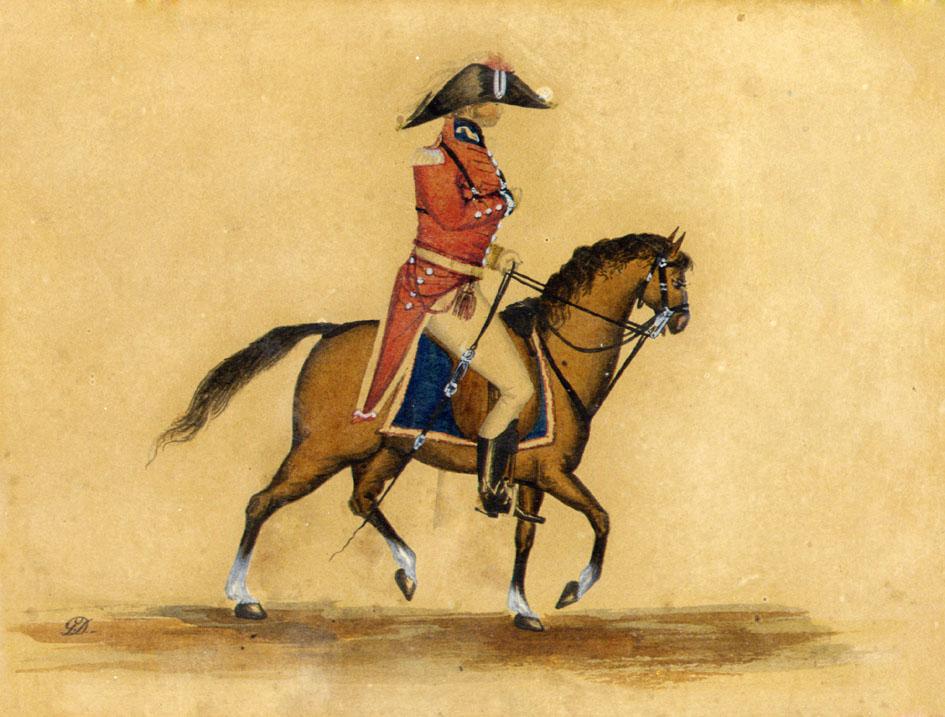
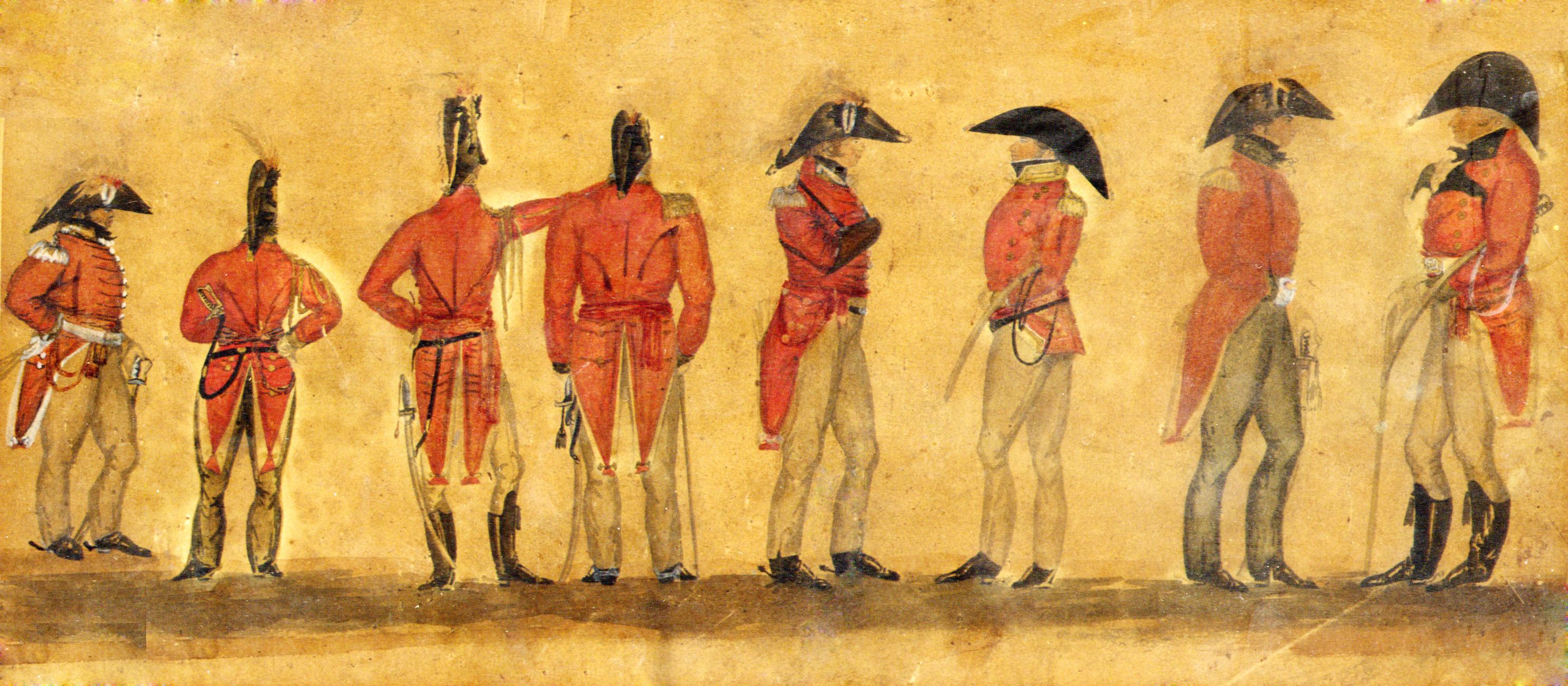
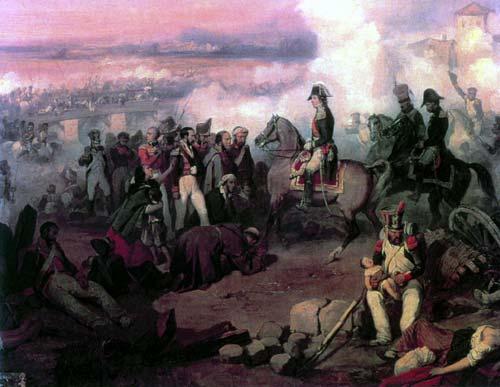
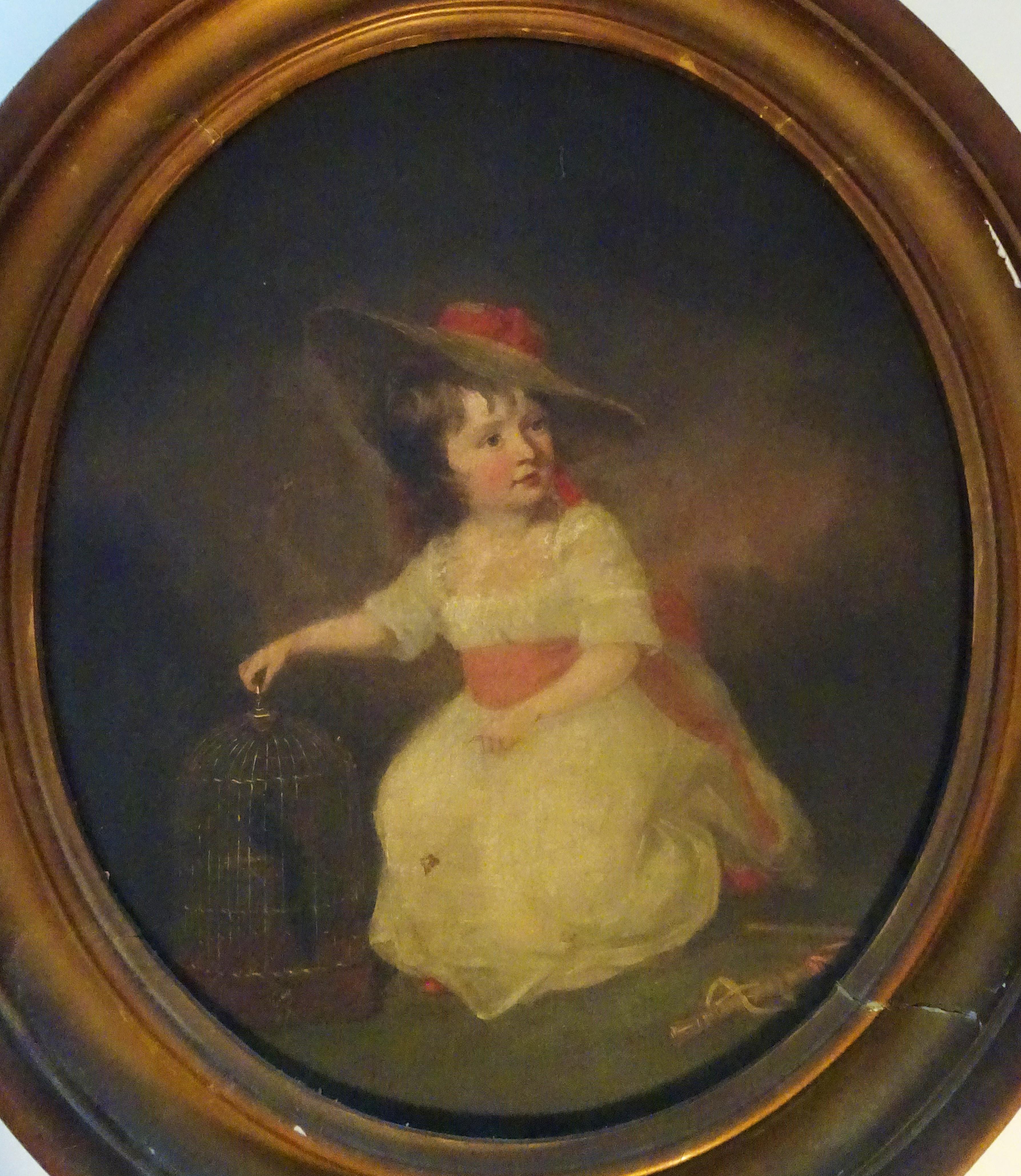
1. Major General James Patrick 2 MURRAY, son of General Sir James Patrick 1 MURRAY Governor of Canada, Warden of the Cinque Ports, Governor of Hull (1721-1794) and Ann WHITHAM (1761?-1824), was born on 21 January 1782 in Leghorn. He was a Major-General in the Army. He married Elizabeth RUSHWORTH on 31 January 1803 in Freshwater, Isle of Wight. He died on 5 December 1834 in Killenure House, near Athlone.
James Patrick Murray was the eldest son of the Hon. General James Murray. He was born in Leghorn Italy while his father was Lt. Governor of Minorca. The British Garrison on Minorca was under siege from French and Spanish forces and his mother, the former Ann Witham, was evacuated from the island to safety as she was expecting his imminent birth. Italy was the nearest friendly country.
Cordelia, General James' first wife, had died on 16th June 1779. Quite soon afterwards,1st June 1780, he married Ann Witham, a girl of only 19, who had just lost her father, (Abraham Witham, H.M.Consul to the Island of Majorca). General James Murray was 51 years old at the time. Their first child Cordelia, (JPM's elder sister) was born in Majorca on 16th March 1781.
French and Spanish forces began the siege of Majorca on 17 August 1781 and 2 days afterwards it was decided that Mrs Murray, her baby daughter and two other officers' wives would be evacuated. The account of her escape, as told by her granddaughter in 1877, is as follows: -
"My grandmother and the wives of the officers of his staff made their escape in an open boat in the midst of the night. Through the presence of mind of my grandmother, the boat was enabled to pass through the French and Spanish fleets, she repeating the parole in the Spanish language with calmness and being, like the other ladies, wrapped in a large military cloaks".
Although we know that General Murray did manage to maintain some sort of communication with Leghorn, Ann must have been a pretty cool young lady if, with the baby girl in her arms and another child on the way, she managed all this and a 500 miles sea journey from Minorca to Leghorn in an open sailing boat.
According to Lady O'Donnel's account "soon after they landed at Leghorn, she was taken ill and when the little boy was born he was apparently dead, but his mother entreated that he should immediately be put into a warm bath. She had dreamt that he was born dead and that thus, through the mercy of God, he was restored to life".
It seems that after they arrived in Leghorn they moved in fairly high class circles. JPM's godfather was the Grand Duke of Tuscany who was the son of the Emperor Francis I and Maria Theresa, and the brother of Marie Antoinette. The Grand Duke himself became Holy Roman Emperor as Leopold II in 1790.
JPM was probably brought up at Beauport, his father's estate in Sussex, but there is no record of his schooling. His father died when he was only 12 years old in 1794. On Gen. James's death, part of the Beauport Estate reverted to the Collier family and part sold to provide for his widow and daughters. Like his father JPM was destined for an army career and at the age of 14, in 1796, he was commissioned Ensign in the 44th Regiment .
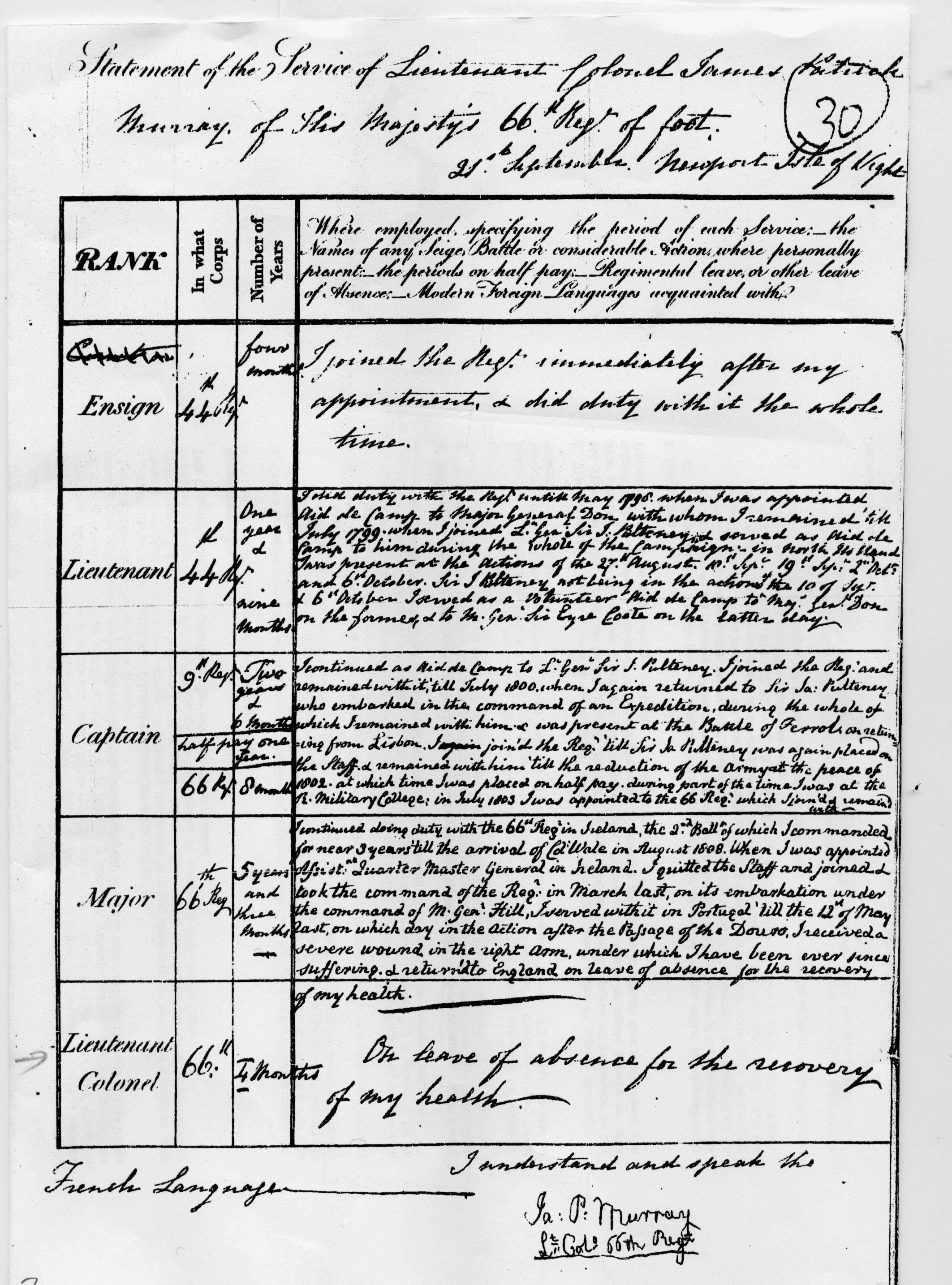
In 1797 he was promoted lieutenant and was employed on regimental duty until 17th May 1780. He was then appointed ADC (Aide de Camp) to General George Don (Maria Murray's husband) with whom he served until June 1799. He then joined his relation Lieutenant General Sir James Pulteney Murray and served as his ADC during the campaign in North Holland.
The French had invaded and overrun Holland, renaming it the Republic of Batavia. It was in this war that the Dutch fleet, lying frozen in the Zuider See, was captured by French cavalry. In 1799, Pitt decided that unless Britain made some gesture and opened up a second front, the Austrians would make a separate peace with France. He therefore made a pact with Russia that a joint expedition should be launched against the low countries, Britain to supply 30,000 troops and Russia 16,000. To ensure success the Grand Old Duke of York was made commander in chief and his three divisional commanders were Abercrombie, Pulteney and Dundas. In spite of an unfavourable report by Abercrombie, it was decided that the expedition should land in the Helder area and drive south to Amsterdam. Landing in the Helder was not very difficult, but the Russian contingent soon proved unreliable and the British got bogged down amongst the dykes and canals. So an armistice was arranged whereby both sides agreed to exchange prisoners and Britain evacuated her army.
Although, as a lieutenant, JPM cannot have played in important part in this campaign he certainly took part in several actions and according to reports, General Pulteney enhanced his reputation by the resource and skill which he displayed. JPM saw active service on the 27th August, the 10th & 19th of September, and the 2nd & 6th October 1799. Clearly he did quite well as he was appointed Commanding Officer of a company in the 9th Regiment on the 26th December 1799.
The following year Pitt decided to send an expedition to Ferrol in northern Spain. Raids such as these had earlier been described as ' breaking windows with guineas. General Pulteney was put in command and landed on the 25th August 1800. On the next day General Pulteney, having surveyed the fortress, held a staff conference and advised that it was far too strong to be assaulted with any chance of success, so he re-embarked his men. For his conduct he was the subject of a motion of censure in the House of Commons, in which Pitt spoke against him, but to which he replied vigorously and was finally exonerated. Murray had again accompanied him on this abortive expedition as his ADC.
At the Peace of Amiens in 1802 JPM was placed on half pay .
It was about this time that he went to the Isle of Wight . Why he gave up his military career at this point is a little bit of a mystery. When the Peace of Amiens was signed in 1802 he was aged 20, had already had some six years military service and must have decided to abandon a military career and take up politics. He may have become disenchanted with the idea of a military career , having seen unsuccessful commanders arraigned before Parliament or courts martial for lack of success. Austria had made peace with France, Napoleon had won the battles of Marengo and Hohenlinden, the war had reached a stalemate and people had begun to get war weary . Perhaps there was a vacant parliamentary seat going cheap at Yarmouth. Perhaps Edward Rushworth fixed him up, encouraged marriage to his daughter Elizabeth and even gave her some land at Farringford Hill for the couple to build themselves a home. In any case he married Elizabeth Rushworth, the daughter of Edward Rushworth and granddaughter of Lord Holmes, and entered Parliament as MP for Yarmouth on the 8th July 1882 at a general election. His parliamentary career was extremely brief, however, for on the 25th February 1803 someone else was returned in his place. He had resigned his seat accepting the motion to assume the office of Steward of the manor of East Hendred. Between his election and his resignation the House only sat in the period 16th November to 29th December 1802 and from the 3rd February 1803. He was thus effectively a member for little more than seven weeks.
However war broke out almost immediately and JPM went off to the newly founded Royal Military College at High Wycombe (later moved to Sandhurst) and on 18th May 1803 was gazetted to a company in the 66th Foot (the Royal Berkshire Regiment). During the next six years the regiment were on garrison duty in Ireland and their various moves may be followed in the history of the Berkshire Regiment. In spite of the fact that the Act of Union had just been passed and that St Patrick's cross had been added to the Union Jack, that country was still unsettled. A few years earlier there had been two French landings and the National rising had been defeated at the battles of the New Ross and Vinegar Hill. Pitt tried to include Catholic emancipation as part of the terms of the Union, but George III had refused to sanction such a clause (which might later have saved much unrest and bloodshed) because he considered it contrary to his coronation oath.
While stationed in Ireland the Murrays had three children who survived, a daughter and two sons. They were privately baptised in Ireland and each later publicly christened at Freshwater Church in the Isle of Wight - so they moved fairly often between Ireland and England.
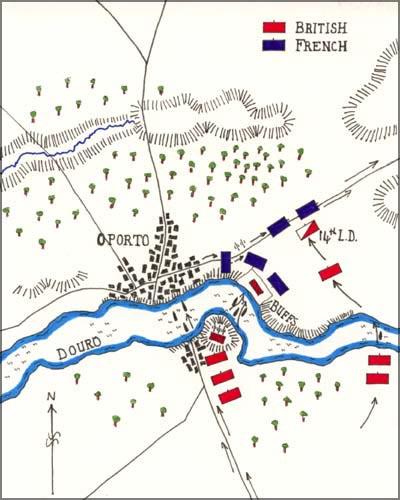
Whilst in Ireland the regiment had been alerted that they might be sent abroad and there was speculation as to whether it would be to the East Indies, to South America or Ceuta (see the letters sent by JPM to his wife during this period - they are rather sad in that Elizabeth was unable to see her husband despite being in (a different part of) Ireland herself at the time, very heavily pregnant and with no idea where JPM would be sent next or when she would next be able to see him; the situation was even more poignant in hindsight as he would shortly sustain the injury which altered the course of his whole career). Actually they landed in Portugal in April, about the same time as Arthur Wellesley and on the 12th May 1809 they played an important part in the passage of the river Douro (see separate account of this).
Marshall Sault had entrenched himself on the north bank of a broad river in the town of Oporto and had kept a strong reinforcements on his right wing for fear Wellesley might attempt a landing by sea in his rear. Wellesley found some unguarded wine barges and a scuttled ferry boat upstream and, round a bend of the river, out of sight of the French, pushed over 30 men of the Buffs, who immediately occupied a convent. The Berkshire Regiment under Murray were then sent over to reinforce them. During this diversion the townsfolk in Oporto started to riot at and the Worcesters and the Guards crossed the river. The French retreated in confusion leaving behind their artillery and stores.
It was during the fierce fighting to retake the convent that JPM received the severe wound which ever after impaired his health and deprived him of the use of his right arm. According to his daughter, "his right elbow was shattered in the battle, the arm was on the point of being amputated, when Sir Arthur Wellesley came into the hospital and stopped the operation. However the arm was always useless". According to the official records of the Berkshire Regiment in the glorious fight at the seminary the 66th lost Major Murray and Captain Benning, both seriously wounded. The brigade was thanked on the spot by the Commander in Chief himself. In 1814 the Regiment received the battle honour 'Douro' for this action.
On the 25th May 1809 JPM was promoted Lieutenant-Colonel and subsequently employed in the Quarter Master General's Department in Ireland. On the 2nd November 1809 he was appointed Lieutenant-Colonel of the 5th garrison Battalion. From 1811 to 1819 he was assistant Adjutant General in Ireland and stationed at Athlone and on the 12th August 1819 he received the brevity of Colonel .On the 22 July 1830, he was promoted to Major-General, and was created a Companion of the Bath on the first creation of that class of order.
He died in Ireland at his home Killenure House, near Athlone after a few days' illness, in his 53rd year "greatly lamented by his family, and sincerely regretted by his relatives and friends " . An Irish newspaper describes the accident leading to his death as follows: "....the circumstances attendant upon the death of General Murray are rather of a tragic nature and afford a convincing proof of the finest feelings of human nature and the most humane and sympathetic dispositions are merely allied to or associated with courage and native bravery. He caught cold from his exertions in endeavouring to recover the bodies of two fellow officers who met with a watery grave on their way back to their barracks from his house".
JPM and Elizabeth had six sons and six daughters.
Elizabeth Murray, nee Rushworth, survived until 15th November 1865, when she died at Rossanna House, and was buried in Benowen churchyard. She was descended from two important families in the Isle of Wight. Records of the members of Parliament for Yarmouth, which was a pocket borough, show that you had either to be a Holmes, a Rushworth or a Jervoise! Elizabeth's mother Catherine, born in 1725, was the daughter of the 2nd Lord Holmes, whose family name was Troughear. The story starts with a gentleman who began life under the name of the Reverend Leonard Troughear. By 1763 this fellow was thoroughly involved in local politics and borough-mongering as Sir Leonard Troughear Worsley Holmes (having taken his mother's maiden name). In 1797 he became Lord Kilmalloch in the county of Limerick and he died in 1804. When his daughter Catherine (1765 - 1829) married Edward Rushworth at the tender age of 15 he gave her some land in the neighbourhood of Freshwater. Thereafter Edward Rushworth seems to have been described as ''of Freshwater House'' (this was possibly on the site of what is now described as Manor Farm). In 1790 Edward Rushworth added to his property by purchasing various fields from a Mr William Bowman of Brook, a neighbouring hamlet not far from Farringford .
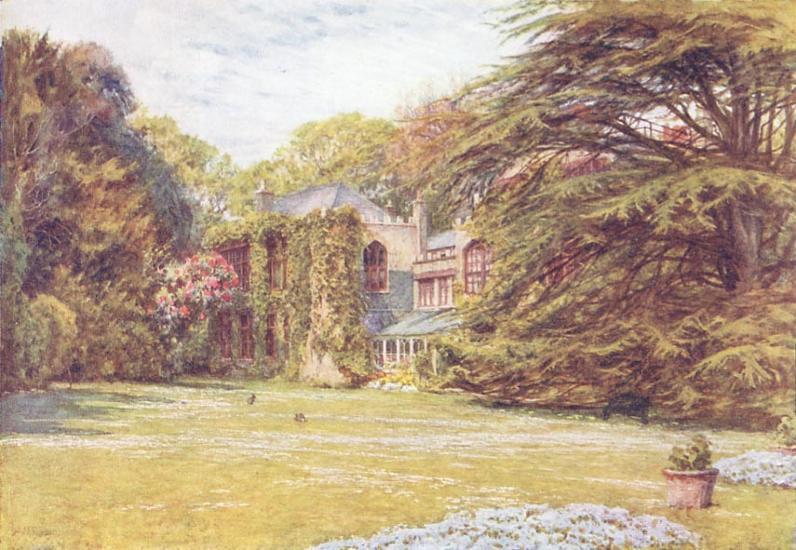
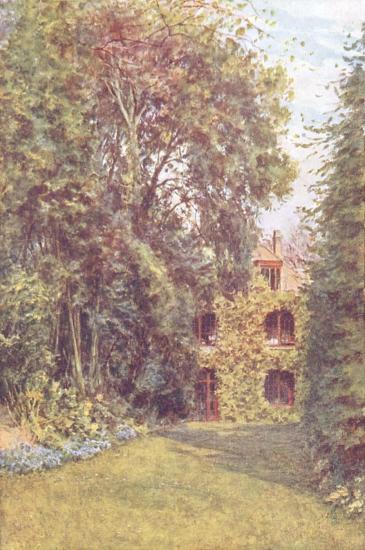
It seems that when Elizabeth Rushworth married JPM they were given land on which to build a house by her father Edward Rushworth. This house was called Farringford Hill. When JPM went to Ireland with his regiment they clearly left some bills behind, possibly for completing the house. Edward Rushworth wrote to Thomas Sewell of Newport, Isle of Wight, as follows: "I am greatly hurt by receipt of your letter respecting the taxation of costs. I have repeatedly written to Murray on the subject and his answers were not at all satisfactory. I shall again write to Col. Murray and press the subject very warmly, adding that if he does not think proper to pay the costs, I shall make the satisfaction from my own purse, which has already undergone privations". The story is confirmed by Lizzie Harvey ( JPM's granddaughter) who stated in a letter that her grandfather began building Farringford "which was considered very foolish of him owing to his financial circumstances". She maintained that Elizabeth's father took the building off his hands and finished it. She also believed they had a lawsuit. Farringford Hill was sold on Edward Rushworth's death to a family called Middleton, who probably later sold it to Alfred, Lord Tennyson. Lord Tennyson later extended the house and renamed it Farringford House .
It is unlikely that James Patrick Murray took part in the festivities following the armiy's success at Douro. His arm had been completely shattered. In fact, it was on the point of being amputated when the Duke of Wellington interceded and demanded the arm be saved. However, it was thenceforth completely useless, and Murray always had to carry it in a sling, as the portraits of him by Sir George Don show.
Some of Murray's letters to his wife Elizabeth, who was from a well-known family in the Isle of Wight, survive. They date from just before and just after the passage of the Douro, and acquire a particular poignancy given the injuries that were inflicted on Murray in that battle: immediately before the regiment was sent to Portugal, Murray had no idea where or when they would next be sent. Elizabeth ("Betsy") was then staying fifty or so miles away in Limerick, and is most anxious to see her husband. He replies with great affection, but rejects the possibility as impractical, since she might arrive, after a substantial journey, only to find that the regiment has just left or is about to leave; then, they would be in a worse situation than now, he says. The letters give a lot of detail about the speculation which was rife in the regiment about where they will next be posted, and give an insight into how insecure the world of a military officer was, especially in those days of colonial expansion, where the army was deployed all over the world - for example: "...your surmise respecting the battalion on a draft going to the West Indies is not correct, as you will see in the letter which I wrote to you yesterday, that we do not pack our heavy baggage, we are to go in the lightest possible order and camp equipage is to be delivered to us today; I am convinced we are going either to Cadiz or Cueta - General Sherbrooke's expedition is driven into Cork entirely and an officer of the 88th, Mr McCarthy, who belongs to it, came on shore this morning to see his brother, who is in this regiment. He says that the orders were yesterday that we are to join that expedition...", and so it goes on. Then, a few days later: "I have nothing new since last night, we are all in the same uncertainty, the report is now that we are not to join Shellbrooke's expedition, but that they are to sail immediately and that we are to go as was first mentioned under Beresford, one report is to Cueta, and the other is to South America, the former destination I believe to be the true one, as if we were destined for South America we should receive more than two months pay in advance...."
Clearly, though, the couple are very much in love and missing each other. It is particularly touching that they are so close, relatively, and yet unable to be together, considering that he is to get a posting abroad in the near future. Murray's letters finish with real outpourings of feeling: "I must now, my ever dearest Betsy, conclude. God Almighty bless, preserve and protect you, my dear Catherine, James and little Pulteney, and kiss them all a thousand thousand times for me and believe me to be ever your most sincerely and truly affectionate husband". Sometimes he refers to his second son as "pretty Pulteney": it is interesting to note that, unlike his father and grandfather, and unlike his son and grandson, "pretty Pulteney" did not have a successful career in the army: maybe he was a little too pampered.
On the subject of James Patrick's 12 children, it is extraordinary that he got the time and opportunity to be so fecund, given the amount of time he spent away from home!
James Patrick's last surviving letter is after Douro, when he was still suffering badly from his shattered arm. The letter in full goes: "Thank God I am safely arrived in the Island - I landed at Ryde this morning and have suffered so much both in the boat and the hack chaise, that I find it impossible to come on to Farringford this afternoon- so much as I wish it. I beg therefore you will request Mr Rushworth to let you have the carriage to come over and we will return with you tomorrow. Do pray come - Sir H. and Lady Holmes are both extremely kind and request you will come - I cannot write more; God bless you all, remember me most affectionately to Mr and Mrs Rushworth and all, and believe me...".
Obituary in the Gentleman's Magazine June 1835
MAJOR-GEN.. J. P. MURRAY, C.B.
Dec. 5. At Killeneure, near Athlone,
In his 53d year, Major-General James
Patrick Murray, C.B.
This gallant officer was the only son of General time Hon. James Murray, (fifth Son of Alexander fourth Lord Elibank,) distinguished by his persevering defence of Minorca in the years 1781.82. It was at that period that the subject of this notice was born, on the 21st Jan. 1782, at Leghorn, to which city his mother had retired from the siege. She was Anne daughter of Abraham Whitham, esq. the British Consul-general at Majorca. He was educated at Westminster School; and, having determined to follow his father's profession, obtained an Ensigncy in the 44th regiment in 1796, and in the following year was promoted to a Lieutenancy in the same corps. In May 1798 he was appointed Aid-de-camp to General Don, with whom he continued in the Isle of Wight until June 1799; when he joined his relation and guardian Lt.Gen. Sir James Pulteney, and served as Aid-de-camp to that officer during the campaign in North Holland. He was present in the actions of 27 August, 10 and 18th Sept. 2nd and 6th Oct. and was in one of them slightly wounded. On Dec. 26, 1799, he was gazetted to a company, by purchase, In the 9th foot. He next accompanied Sir James Pulteney to the Ferrol, and was intrusted, by both the General and the Admiral in that expedition, with some important and confidential transactions. At the general election of 1802 he was returned to Parliament as one of the Members for Yarmouth in the Isle of Wight; but vacated his seat in the following March. At the peace of Amiens he was placed on half pay; and after studying for some time at the Royal Military Academy, was re-appointed to half pay in the 66th foot. In 1803 he espoused the amiable object of a long attachment, Elizabeth, eldest daughter of Edward Rushworth, esq. of Freshwater House, Isle of Wight, and granddaughter of the late Lord Holmes, by whom he has left twelve children. In Feb. 1804, he obtained by purchase, a Majority in the 66th, with which he was stationed in several parts of Ireland; and subsequently was appointed to the staff of that country as Assistant Quartermaster-genera1 at Limerick, which situation he relinquished in order to accompany his regiment on foreign service. With the same regiment he also served in Portugal; where, at the passage of the Douro, he received a severe musket wound, which not only completely shattered and deprived him of the use of his right arm, but ever after impaired his general health. His gallant conduct, on this occasion, is honourably recorded in the public despatch of Sir Arthur Wellesley, who, shortly after he had received the shot, came up to him on the field, and, taking him by the hand, said, -" Murray, you and your men have behaved like lions; I shall never forget you". On the 25th May 1809, Major Murray was promoted to the rank of Lieut. - Colonel; and on his return home, he was employed in the Quartermaster-general's department in Ireland. From 1811 to 1819 he was Assistant Adjutant-general, stationed at Athlone. In 1819 he received the brevet of Colonel, and in 1830 that of Major General.
His death was occasioned by a cold caught in his humane exertions to save the lives of two young officers, who were drowned in the lake in front of his residence (see p. 220). He possessed an accomplished and a benevolent heart; and was characterized by the highest honour, integrity, and worth.
P220 - Drowned by the upsetting of a boat on the Upper Shannon, near Athione, Ensigns James R. Byers and Win. J. Kerr, (see p. 110), both of 1st regt.
Elizabeth RUSHWORTH, daughter of Edward RUSHWORTH (1755-1817) and Hon. Catharine HOLMES (1765-1829), was born on 15 October 1783. She died on 15 November 1865 in Benowen, Ireland. She and James Patrick 2 MURRAY had the following children:
| +2 | |
| +3 | |
| +4 | |
| +5 | |
| +6 | |
| +7 | |
| +8 | |
| +9 | |
| +10 | |
| +11 | |
| +12 | |
| +13 |
Second Generation
2. Catherine Anne MURRAY, daughter of Major General James Patrick 2 MURRAY and Elizabeth RUSHWORTH, was born on 21 September 1804 in Banagher, Ireland. She was baptised in Freshwater Church. She married Charles Routledge O'DONNELL on 4 September 1846. She died on 26 February 1895 in Kingstown, Ireland.
JEFM's elder sister was Catherine Anne born 21 September 1804 at Clooney, Kings Co. Ireland. She was baptised at Freshwater Church. She married on 4th September 1846 Lt.Col. Sir Charles Routledge O'Donnell. She was generally known in the family as 'Aunt Donny' and brought up her nephew Pulteney Henry when the latter's mother died. She died without issue on 26th February 1892 in Kingstown, Ireland. Amongst some of the papers that have survived are her recollections of her grandfather's (Gen. James) life.
O’Donnell Papers
P35
O’Donnell Papers
Introduction
A. John O’Donnell (1738 – 1803)
I. Correspondence (1755 –1787)
II. Legal Matters (1742 –1770)
(a) Papers concerning Trugh Estate including Lease agreements, Bill of Release, Bill of Complaint, and Power of Attorney concerning lands of County Clare and Limerick (1738 –1803)
(b) Other Legal and Financial Papers including Rent Receipts, papers concerning the Marriage of John O’Donnell and Deborah Anderson including Marriage Defeasance, and Copy of Will of Henry Anderson, brother to Deborah (1742 – 1773)
B. Henry O’Donnell (1814 – 1839)
I. Correspondence (1803 – 1839)
(a) Incoming private correspondence (1814 – 1839)
(b) Outgoing private correspondence (1836)
(c) Incoming Military correspondence (1793 – 1820)
(d) Outgoing Military correspondence (1803 – 1815)
II. Personal accounts of Military Service in India (1805 - 1814)
III. Lease proposals for lands at Trugh, also known as Rough, County
Clare (1807 – 1829)
C. Sir Charles Rutledge O’Donnell (1828 - 1868)
I. Personal and legal correspondence concerning marriage to and
legal separation from Catherine Anne Murray (1828 – 1868)
(a) From Mrs Murray, mother to Catherine Anne (1828)
(b) To Mrs Murray (1828)
(c) To Lady Catherine Anne Murray (1865 – 1866)
(d) From E.S. Bailey Solicitor (1852 – 1868)
(e) To E.S. Bailey Solicitor (1857 - 1868)
(f) From Ranken and Ford Solicitors (1857 – 1866)
(g) To Ranken and Ford Solicitors (1857 –1866)
(h) Other correspondence concerning marriage to and legal separation from Catherine Anne Murray (1829 – 1866)
II. Letters from Bailey Shaw Smith and Bailey relating to the management
of the Estate of Sir Charles Rutledge O’Donnell (1845 - 1865)
III. Personal Correspondence (1823 - 1866)
(a) Relating to travel (1851 – 1853)
(b) Other personal correspondence (1823 – 1866)
IV. Financial Papers and Accounts (1815 – 1879)
(a) Account books and statements (1815 – 1869)
(b) Other financial papers and accounts including rent rolls for Trugh Estate, Records of Costs and Payments Received (1824 – 1879)
V. Legal Matters (c. 1830 - 1866)
(a) Concerning the management of the Estate of Sir Charles
Rutledge O’Donnell including Lease and Sale Agreements
(1842 – 1866)
(b) Concerning the marriage to and legal separation from Catherine
Anne Murray (c. 1830 – 1866)
VI. Personal papers and research notes (1823 - 1860)
(a) Genealogical research (1838 - 1860)
(b) Military papers and research notes (1823 – 1853)
(c) Concerning travel (1839 – 1859)
(d) Concerning Wallachia (1828 – c. 1830)
(e) Concerning ‘Order of St John of Jerusalem’ (1832 – 1852)
(f) Other personal papers and research notes including historic research and Plan of Trugh Estate (1832 – 1851)
D. John Vize O’Donnell (1828 - 1902)
I. Business and legal correspondence (1870 – 1902)
(a) From E.H.P. Hosford, Land Agent (1879 – 1894)
(b) To E.H.P. Hosford, Land Agent (1885 – 1886)
(c) From George Aldham, Solicitor (1880 – 1891)
(d) From Aug. P. Scoles (1888 – 1895)
(e) To Aug. P. Scoles (1888)
(f) Other incoming business and legal correspondence (1870 –
1895)
(g) Other outgoing business and legal correspondence (1888)
II. Personal Correspondence (1884 – 1901)
III. Financial Papers and Accounts (1868 – 1894)
(a) Bills and requests for payment (1873 – 1891)
(b) Loans (1868 – 1884)
(c) Account books and statements (1868 – 1900)
(d) Other financial records including receipts and auction advertisements (1856 – 1894)
IV. Legal Matters (1859 – 1902)
(a) Documents and correspondence concerning ‘the Matter of the Estate of John Vize O’Donnell – Owner and the Scottish Union and National Insurance Company – Petitioner’ (1879 – 1890)
(b) Documents and Correspondence concerning the matter of ‘Trollope-v-O’Donnell’ and the Estate of Catherine Anne Murray (1884 – 1902)
(c) Requests for payment (1885 – 1893)
(d) Other legal papers including Bill of Complaint filed against father-in-law Timothy O’Brien, and Answer to Bill of Complaint, Life and Home insurance policies, Court Affidavits, Deed of Lease and Power of Attorney (1854 – 1897)
V. Personal Papers including copy of Last Will and Testament and
Military and Mason Certificates (1829 – 1903)
E. Charlie O’Donnell (1889 - 1901)
I. Correspondence (1889 - 1901)
(a) From Charlie O’Donnell to John Vize O’Donnell (1889 – 1901)
(b) From William Earl Solicitor to Charlie O’Donnell (1889)
F. Other Papers concerning the O’Donnell Family (1712 - 1898)
I. Other correspondence relating to the O’Donnell family (1755 – 1898)
II. Other legal papers including Will of John O’Daniell and Account of
Estate of Henry Murray (1712 – 1872)
Introduction
The O’Donnell Papers are comprised of the records of five generations of the O’Donnells, a once affluent upper middle class Protestant family resident at Blackwater, Trough, Co. Clare. The collection is organised by family member. The earliest records relate to John O’Donnell and to his son Lieutenant-Colonel Henry Anderson O’Donnell. These include leases which connect the O’Donnell family with Trough from as early as 1743, although throughout the collection numerous associated addresses within the City of Limerick are also mentioned.
The O’Donnells were a successful and respected Military family, serving in and becoming decorated Officers of the British Army. Henry Anderson O’Donnell, served for an extended period in the Regiment of Lucknow in the Bengal Army in India and received much recognition for his accomplishments there.
He arrived as a Cadet in Madras in January 1781, and by 1809 was promoted to Lieutenant Colonel. He eventually retired with the rank of Colonel. His correspondence presents a fascinating picture of Military life and the perilous circumstances facing the British Officers stationed in India.
P35/643 gives an account of an attack made on his Battalion at a time when he suffered with Dysentery ‘I was reduced to a skeleton by a violent dysentery which attacked me a few days after my arrival at Kampoorah, the cure for which the doctor administered Mercury which threw me into a high salivation and swelled my head to the size of a bull and in this situation was I when we began a retreat without a [ ] to carry me’.
Henry Anderson was granted the status of ‘Freeman of Limerick’ on 10 February 1817.
Sir Charles Routledge (1796-1870) was the son of Lieutenant-Colonel Henry Anderson O’Donnell, by his wife, the Princess Domina Jan, niece of the Shah of Persia, and is the primary record keeper in the collection. Sir Charles also rose through the military ranks and was conferred a Colonel of 18th Hussars, a Cavalry regiment of the British Army on 10 September 1864. He was also secretary to the Commander-in-Chief of the Forces in Canada.1
In 1826 Sir Charles married Lady Kate [Catherine Anne] Murray (d. 26 February 1895), daughter of Major General James Patrick Murray (21 January 1782 – 5 December 1834) and Elizabeth Rushworth (d.15 November 1865). They had one son John Vize O’Donnell (b. 1828) who attained the rank of Lieutenant Colonel of Infantry in November 1870.
Sir Charles did not have a good relationship with his wife’s family. His letters to Lady Kate and her mother paint a picture of a controlling husband, who dictated on what terms she could visit her family and how her allowance should be used. Following their separation an eventual breakdown in communication led to disputes over her inheritance. There is a large amount of legal correspondence concerning the financial and legal implications of their separation.
Sir Charles Rutledge was a meticulous record keeper, retaining much of his personal and business correspondences both sent and received over his lifetime. He had a keen interest in Genealogy, and conducted much research into his own family history. The collection contains many research notes and some correspondence relating to the genealogy of the O’Donnell family in Ireland including family trees, Pedigrees, gravestone inscriptions and Coats of Arms - P35/292-331.
Of significant interest in the collection are the records of Sir Charles Rutledge’s extended
travel throughout Eastern Europe in the mid-eighteenth century, from which he kept in-depth guides to destinations including Persia, Turkey and Bulgaria. These guides hold information on routes of passage being utilised, accounts of expenses incurred, and recommendations on the best methods of travel - such as what time of year to journey, where to stay and what items to carry. P35/380 provides descriptions of towns and villages encountered on a journey through Persia with commentary on the appearance, history, geographical location, climate and population of the areas explored.
His travels also encompassed ‘Wallachia’, modern day Romania. Chapters written by Sir Charles describe a city ‘overcome by the wings of pestilence’ P35/405 (Chapter 8, page 2). The partial texts include information on the historical and geographical landscape of Wallachia.
The material also includes travelling ‘firmans’ (royal mandates or decrees issued by a sovereign in certain historical Islamic States) received by Sir Charles Rutledge, including one from the Sultan of Bulgaria (P35/397) ordering that he be granted ‘all possible facilities and protection, and be guarded against all danger’ on a journey through Bulgaria in August 1853, and another (P35/398) from the ‘Embassy Capou Aglan’ dated 8 September 1853, granting permission for 8 post horses to assist him in his travels in Turkey.
The O’Donnell’s finances are well documented throughout the collection. Sir Charles maintained a substantial London Estate with properties in St Johns Wood, Drummond Street, Southampton Street and Mornington Crescent for which the collection contains account books and statements spanning six decades through to the 1860s. On his retirement from the Army he returned to Co. Clare.
Rent Rolls, receipts and other accounting documentation illustrate the typical income and expenditure of a sizeable Irish Estate, surveyed at 878 Acres 1 Rood and 10 Perches and valued at £358.0.0 in 1876 2. Rent Rolls provide names of tenants of the Trugh Estate, divisions of land, and amounts payable of the tenants in rental rates between 1856 and 1864.
There is evidence of the distress typically felt by the middle class landlords who struggled with the financial management of their Estates in a time of political upheaval and social unrest. P35/143 shows O’Donnell’s apparent ambivalence to the plight of his leaseholders in a response to parish priest, Father Kennedy’s request for lenience on behalf of one of O’Donnell’s tenants made in December 1856 -
‘What may I ask would the Landlords of this country say were they to learn that, by the interference and dictation… of the Clergyman of the Parish, I had quietly submitted to reduce my rents to a certain valuation’ (p.1). ‘The sooner he ceases to be my tenant, the better’ (p.2).
Sir Charles dislike of clerical intrusion on his affairs is made further apparent in P35/147, a letter dated 30 May 1862 in which Sir Charles rebukes Reverend Vaughan of Trough chapel. ‘You called one of my female servants into the Sacristy and peremptorily desired her to quit my service within three days… commenting on my character and on my domestic arrangements’. ‘I am at a loss to account for this strange and unaccountable movement on your part’…‘you exceeded your clerical authority’ (p.1). Sir Charles declared himself offended as a Protestant threatening ‘I may quit the country altogether and remove my permanent headquarters to England, leaving my half built residence as a monument to priestly interference’ (p.3)
Sir Charles records show an undoubtedly difficult character but one much respected by his peers. His portrait was commissioned by William IV in 1832, and is now held in the Royal Collection.
Following Sir Charles Rutledge’s death in 1870 the Estate fell to John Vize, who exhausted much of his inheritance on the renovation of Trough Castle. John Vize’s struggle with the management of the Estate is evident in the increasing volume of requests for payment and threats of legal action from the mid-1870s onwards.
A perceived threat of uprising and mutiny from the tenants at Trough is evident in P35/479, a letter from John Vize to unknown recipients seeking assistance for Landlords suffering with heavily mortgaged Estates and reduced rents, referring to a ‘Plan of Campaign and Boycotting’ by the Irish tenants. ‘It leaves the Estates unable to meet the charges, and leaves the Landlords scarcely enough to exist on!!’ He remarks that ‘a more monstrous outrage never existed before in Ireland… The object of this League is to starve the Landlords, get the land for nothing and leave the Landlords pay all taxes etc.’
P35/619 contains judgments from the Limerick Land Sub-Commission in cases from the Limerick Union heard at the County Courthouse in July 1889 listing names of Limerick landlords and their tenants, and the revised amounts of rent to be paid following the judgments, including ten tenants of the Trough Estate, all with significantly reduced rents.
As John Vize’s financial situation worsened his relationship with Land Agent E.H.P. Hosford deteriorated. Following a request from O’Donnell for further financial aid, Hosford declared in a letter dated 24 April 1885
‘I have lost enough by you and I cannot lose any more.’ P35/449
John Vize later dismissed Hosford and returned to Ireland to manage his property.
Failure to pay Lady Catherine Anne O’Donnell’s Annuity of £150 per annum and also repayments on a loan of £1000 borrowed from the Scottish Union and National Insurance Company, secured by a mortgage on his Life Estate on the lands in County of Clare, led to court battles. A Receiver, Arthur White, was appointed over the O’Donnell Estate in 1885. Left bankrupt John Vize declared in a court affidavit of 28 March 1885 that as a result of the legal action taken against him he had been deprived of the means of living and was at that point reliant on ‘the voluntary assistance of friends and relatives’ (p.1) P35/578 contains a Notice dated 20 July 1886 making known John Vize O’Donnell’s intention to request from the Court that Arthur White pay to him £1 per week subsistence money.
Section E relates to John Vize’s son, Charles ‘Charlie’ O’Donnell on whom there is little information other than he pursued a military career to some degree. Correspondences to his father also indicate that he was in some form of difficulty which prevented him from returning to Ireland. He died in Scarborough on 17 May 1919.
The O’Donnell Papers are a valuable resource for researchers concerned with middle class Landlordism and Land Agitation in Ireland in the mid 19th century. The papers document the O’Donnell family’s economic struggle for survival and the eventual complete ruination of the Estate.
The papers also give an insight into the life of the Irish Officers of the British Military from the late 18th to the early 20th century with some fascinating first hand descriptions by Colonel Henry Anderson of experiences of the Officers stationed in India in the late 1800s. Sir Charles’ own military research (P35/332 – 384) includes many notes and diagrams on the British Army’s protocols in the event of invasions by the enemy in Ireland and other notes relating to battles and skirmishes which took place in Ireland and Britain. 0.
Sources
1. ‘Confessions of a Ghost Hunter’ by Elliott O’Donnell, page 79, footnote 1 –
2. ‘Landowners in Clare 1876’
A. John O’Donnell (1738 – 1803)
I. Correspondence (1755 –1787)
1 14 March 1755 Letter from Pierce
O’Donnell, Barbados, to his
father John O’Donnell, Merchant, Limerick detailing the costs of goods in Barbados and reminding his father to send the goods he asked for in previous letters. Includes discussion of the possibility of his coming home but states ‘I am doing very well here lately’ (p.2), the post script promises to send as much as £30.
4 pp
2 3 February 1787 Letter from [Eph Monsell],
Ballysimon to John
O’Donnell expressing his hurt on receipt of Mrs O’Donnell’s last letter and explaining himself ‘I certainly did hear that she derived comfort and competence from your filial duty and love, but not knowing the amount of your remittances, I was unwilling to diminish them by an application of this kind’ (p.1)
3 pp
II. Legal Matters (1742 –1770)
(b) Papers concerning Trugh Estate including Lease agreements, Bill of Release, Bill of Complaint, and Power of Attorney concerning lands of County Clare and Limerick (1738 –1803)
3 10 August 1743 Receipt for twenty pounds
eleven shillings and four
pence given by Elizabeth
[Harte] to John O’Donnell for rent of lands at Trugh.
2 pp
4 c. 1750 Draft Bill of Complaint by
Richard Powell of
Newgarden, County Limerick against John O’Donnell of Mount ’Donnell County Clare, concerning a Deed of Lease made by Charles MacDonnell on 4 August 1738 for £80 sterling per annum and a loan taken by O’Donnell from Powell for £50 sterling with his Estate and interest in the lands as security by Deeds of Lease and Release signed 27 and 28 November 1749.
4 pp
5
Deed: Lease
Date: 15 February 1754
Parties: William Kean of Clontarf, County Dublin in the 1st part
James Daniel of Limerick City in the 2nd part
Property: Piece of land formerly called Snipes Field in the North Libertys,
Limerick City and part of the North Priors Land, bounding on the West
with Alderman Rawley Colpoys, Robert Smith and Daniel Lie’s
holding, and on the North with Thomas Hubbards holding, on the East
with Philip Hefferan’s holding and on the South with the high Road
leading from Limerick to the Mayors Stone.
Terms and William Kean, as Executor of the last Will and Testament of his late
Conditions: brother John Kean, demised set and to farm the lands to James
Daniel for a term of eleven and a half years as of 29 September 1753 at
the yearly rental sum of twenty six pounds ten shillings sterling by even
and equal portions every 25 March and 29 September.
Size: 2 pp
Other: Signed and sealed by William Keane and James Daniel in the presence
of Robert Jones, [Richard] Maunsell and Eaton Maunsell.
6 1757 Bill of Complaint by
regarding a Lease made between John O’Donnell of Limerick City and Richard French for land of Eat [Ing] containing about 134 acres in the Barony of Bunratty, on 12 August 1747 in violation of the Popery Act, which from 24 March 1703 prevented any ‘Papist’ from purchasing or leasing land in his own name.
2 pp
7
Deed: Indenture
Date: August 1767
Parties: Lawrence Saule of the city of Dublin, Merchant of the 1st part
John O’Donnell of the City of Limerick, Gentleman of the 2nd
part
Property: Lands of East [Ing] in the County of Clare
Terms & Conditions: Laurence Saule entered up two Judgements against John
O’Donnell for £400 plus costs and assigned the Judgements and
all interests and costs due to him from the Judgements to
Richard French of the City of Dublin, to whom O’Donnell by an
Indenture dated 19 October 1753 assigned to Richard French his
Interests in the lands of East [Ing], County Clare. Richard Saule
filed a suit against O’Donnell to foreclose the Mortgage and sell
the premises of East [Ing], County Clare
Size: 4 pp
Other:
8
Deed: Lease
Date: 20 June 1769
Parties: John O’Donnell of Mayors Stone in the North Libertys of
Limerick City in the 1st part
Patrick McNamara of Trugh, County Clare
Property: Part of the lands and the house quarters at Trough commonly
known as Church Park in the Parish of Killaloe, Barony of
Tulla, County of Clare
Terms & Conditions: John O’Donnell demised, granted, set and to farm let the above
lands and property to Patrick McNamara on a 31 year Lease for
a per annum rental amount of £10 sterling to be paid by
two equal half yearly payments on every 29 September and 25
March
Size: 2 pp
Other: Signed and sealed in the presence of Derby O’Brien and Tim
Ryan
9 9 November 1803 Letter of Attorney from John
O’Donnell of Baltimore
County Maryland USA, son of John O’Donnell late of Liberty Lodge, Limerick, Ireland giving Power of Attorney over his Estate in County Clare to Michael Rochford, Merchant of Limerick City. Document is signed and sealed by Jas. Calhoun, Mayor of Baltimore City.
6 pp
10 14 June 1738 Bill of Release by Richard
Bennis of Durroe, County
Clare of his freehold and Interest on the late William Stritch’s premises in Limerick to John O’Donnell. Document is signed sealed and delivered by Richard Bennis in the presence of Edmond Brown and Daniel Halluran.
2 pp
11 1738-1739 File of two short notes
written by [Mr Crothy]
concerning rent rates for James O’Donnell, [Pierce] O’Donnell, [Dromuroe] castle Limerick, Earl of Inchiquin. One of the items is torn making the start of the note illegible.
2 items
(b) Other Legal and Financial Papers including Rent Receipts, papers concerning the Marriage of John O’Donnell and Deborah Anderson including Marriage Defeasance, and Copy of Will of Henry Anderson, brother to Deborah (1742 – 1773)
12 1742 Memorial of Marriage
Articles between John
O’Donnell of Mount Donnell, County Clare and Deborah Anderson, daughter to William Anderson of Garronacanty, County Tipperary.
2 pp
13 15 January 1742 Marriage Defeasance
between John O’Donnell of
Mount Donnell, County Clare and Deborah Anderson, daughter to William Anderson of Garronacanty, County Tipperary, who promises [to pay John O’Donnell £1000 when the marriage takes place].
2 pp
14 15 January 1742 John O’Donnell of Mount
Donnell, County Clare signs
and seals a bond to pay William Anderson Of Garronacanty, County Tipperary the sum of £1000 sterling, unless O’Donnell pays to Anderson £500 sterling on or before 1 May 1742, in which case the original obligation for the £1000 will be made invalid.
4 pp
15 30 April 1757 Receipt from John O’Donnell
for a five year lease at the
yearly rental rate of [..] signed by Henry Holland.
2 pp
16 1 September 1759 [Receipt] signed by [Tho.
Franks] for an amount paid
by James O’Donnell and John O’Donnell
2 pp
17 1764 Rent receipt for [Mr Richard
Turkill]. Document is water
damaged and difficult to read
2 pp
18 31 August 1770 Copy of Will of Henry
Anderson of Coleman,
County Tipperary leaving to his wife Anastacea Anderson his farms and lands of Sollohead and Killpatrick County Tipperary, and Knockinnerry County Limerick. Following the death of Anastacea, those farms and lands pass to his nephews Alexander and Henry Anderson, sons of his brother John Anderson. Also £100 sterling to his sister Deborah Daniel (on the condition that her husband John Daniel not have any power or Dominion on the sum), £100 sterling to his brother-in-law Earbery Hendley of Dublin City, £20 sterling to John Shanahan of Sollohead, and £5 sterling to his servant maid Mary Bryans. Also to his wife, his house and furniture in [Feathard] County Tipperary. Signed sealed published and declared in the presence of John Bacon, Edward Bacon and Thomas [Greynan].
Damaged. Closed for conservation.
3 pp
19 12 December 1772 Partial receipt ‘From Patrick
Carrol 5:5 sterling and will
be allowed him in the rent of Trough’.
2 pp
20 17 May 1764- 14 January 1795 File of retail and rent
receipts, including proof of
payment for clothes from Michael Martin to John O’Donnell.
8 items
21 31 October 1773 Short note recording items
‘received from [Mich. Spiley]
for the use of Mr John O’Donnell ten turkeys £0.10.10’, includes an acknowledgement of the transactions being entered into the book and is signed by John Anderson.
2 pp
B. Henry O’Donnell (1814 – 1839)
I. Correspondence (1803 – 1839)
(a) Incoming private correspondence (1814 – 1839)
22 20 [June] 1814 Letter from [M.M Brid] to
Lieutenant Colonel Henry
O’Donnell Midnapore wishing him well in his new residence and giving news of their friends -‘The [Salimors] are in Calcutta with my eldest sister.’ (p.1)
2 pp
23 20 July 1823 Letter from Sir Francis
[Berhed], Ramsby Manor, to
Capt O’Donnell ‘Many thanks for his obliging behaviour’ (p.1)
2 pp
24 5 February 1826 Letter from Gore Anseley, to
‘My Dear O’Donnell’
expressing his delight at hearing from him. He writes of his grief for the loss of his ‘beloved angel’ (p.2) and of his being ‘confined to the house from June to September with bilious fever and rheumatic gout’ (p.2), his joy over the birth of his son, Frederick Arthur Gore ‘now nearly 6 months cut 4 teeth before he was five months’ (p.3), also mentions the Dukes of York and Wellington who are the child’s godfathers. Discusses O’Donnell’s money problems in India. ‘Affairs in India I fear are not much improved the rate of exchange is certainly improving in consequence of the Indian Government being in want of money and I propose drawing for the whole of what I have in India £40,000 or 50,000’ (p.3)
4 pp
25 26 March 1830 Letter from Thomas [Rose],
Limerick to Colonel
O’Donnell confirming receipt of the £10 forwarded by O’Donnell for Mr Handcock which he will on-forward by post the same day.
2 pp
26 8 May 1833 Letter from [Shaik Munnoo
C…], Central India, Sauqor
to Colonel H O’Donnell, George Street, Limerick, his former employer, seeking information on his welfare, not having made contact in over 19 years and now communicating his need for financial assistance. ‘Ever since your departure up to the present instant I regularly received the pension you kindly bestowed on me but I am told by your agents that I am to receive it annually instead of monthly. I am reduced now a great deal and quite poor’ (p.1) Contains a note of the date 15 February 1834 on which the Colonel responded to the letter.
See also P35/28, P35/30
3 pp
27 10 November 1835 Letter from Gore Anseley,
Hall Barn Park, Beaconfield
to Colonel O’Donnell, Limerick thanking him for the ‘picture of a man I have affectionately loved through life’ (p.1) which O’Donnell’s son Charles delivered to him. He sympathises with O’Donnell who is suffering from Gout, includes a home remedy for gout ‘To 6 grains of [Tukey] Rhubarbpowder add 40 grains of calcined magnesin and two drops of essential oil of Cinnamon and just before you are going to take it add 20 grains of carbonate of Soda and 40 drops of Vinum Colehyci to be repeated in 8 hours and a third or fourth time at similar intervals’ (p.2)
2 pp
28 3 January 1837 Letter from Shaik Munnoo,
Cawnpore, India to Colonel
Henry O’Donnell in response to his letter of 21 July 1836, thanking him for the charity of [50v] a month which the Colonel had been providing, but regrets that the payments have been stopped since 1 September 1832 and he has not received payment for 4 years and 4 months up to 31 December 1836. ‘I am now at present in distress, and hope your goodness will make settlement with some house in Calcutta or here where I may receive the arrears and monthly pension or the Charity allowed me from the Family’(p.1)
See also P35/26, P35/30
2 pp
29 23 January 1839 Letter from [the Honourable]
George Massey, Limerick to
Colonel Henry O’Donnell returning the £50 loaned to him by the Colonel and thanking him for his kindness. Expresses his hope that he may meet him in person to thank him but is prevented from doing so at the moment due to the weakness in his feet which confines him to his home.
3 pp
(b) Outgoing private correspondence (1836)
30 21 July 1836 Letter from Colonel Henry
O’Donnell, Limerick to
[Munnoo Cawn], Central India, Calcutta, Bengal expressing his sorrow on hearing of the financial distress of his former servant, but regrets his inability to help having no access to money. Hopes that financial aid will be granted by an old friend in India to whom he shall write on the subject. O’Donnell’s describes his suffering with Gout for years previous and ‘Charley bouba’, now a ‘fine handsome fellow about six foot tall’ and a Colonel in the Army with the title Sir Charles O’Donnell, married but without children.
See also P35/26, P35/28
1 p
(c) Incoming Military correspondence (1793 – 1820)
31 8 May 1793 Letter from Mr [Dowdeswell]
to Lieutenant Henry
O’Donnell, [Jaunpore] praising O’Donnell for his attention paid to ‘the peace and good order’ of India. Discusses issues relating to the Rajab [Daneoder] Bunge and the management of his Estate and the [Tyotts] people. ‘I much wish that the [R…] could be brought to depend more upon the Off’rs of Gov’t and less upon the Rajab than they appear to do, yet as I am confident from the [in..] of old habits and prejudices, that it may be difficult to bring them to this immediately’ (p.2)
2 pp
32 26 December 1804 Letter from [M.J.]
Prendergast, Calcutta to
Henry O’Donnell congratulating him on the favour which he has won with the Governor General ‘To have gained such applause in the midst of such calamities and misfortunes, as befell poor Mouson’s Detachment, is probably a better test of good Soldiership than the most brilliant achievement effected under other circumstances’ (p.1) but advising him that the ‘official narrative’ given by Mouson regarding O’Donnell’s behaviour and actions fell short of his Mouson’s private ‘panegyries’ (p.2) of him. Advises on the best method of obtaining aid for a ‘widow and orphans’ (p.4) from Armstrong.
4 pp
33 1808 Letter from [M.J.]
Prendergast to Major Henry
O’Donnell in response to O’Donnell’s previous of the 23rd which he thought so well articulated that he had it shown at the Government House where it was well applauded. Expresses his angst regarding the war and the importance of influencing ‘political characters’ (p.4) on the issue. Includes a loose note in response from ‘his Excellency the Governor General’ commenting on O’Donnell’s letter ‘I return O’Donnell’s letter with many thanks. He is a very fine fellow. The list is a sad one but not so bad as I expected from the reports in circulation’ (p.5)
6 pp
34 5 November 1808 Letter from [Captain] Baillie,
Lucnow to Major Henry
O’Donnell, Commanding the Detachment in Kewall expressing his satisfaction on the recent success of the Troops under his command against the Bheetur Surall and the defeat of the Garrison of that Fortress.
2 pp
35 8 November 1808 Letter from [Captain William
Casement] Cawnpore to
Major Henry O’Donnell, Commanding at Purtaub Gurh conveying the congratulations of Major General St Leger on the success of the Detachment under O’Donnell’s command in the attack of the Gurhee of Pater Seraie and also the Major General’s advise on the subject of communication ‘when no particular delay can be the consequence, all reports to the Commander in Chief should be from the Major General to His Excellency, and to him from officers under his Command, except in cases of Emergency, of the March of Troops, or of any extraordinary occurrence which may occasionally render a direct report to Head Quarters indispensable’ (p.1)
2 pp
36 12 November 1808 Letter from [Captain William
Casement] Cawnpore to
Major Henry O’Donnell, Commanding at Purtaub Gurh conveying the congratulations of Major General St Leger on the success of the Detachment under O’Donnell’s command. Informs O’Donnell that his return to quarters has been approved and that his sketch of Patah Seraie has been forwarded to Head Quarters as per his request.
2 pp
37 12 November 1808 Letter from Lieutenant
Baillie, Lucnow to Major
Henry O’Donnell, Commander of the Troops at [Purtaubgurh], praising the success of O’Donnell’s Operations in the District of Keware and giving approval for the return of the Troops to Cantonments, but noting that his Excellency the Vizir wishes to communicate that the Detachment under Captain Ryan may not be withdrawn from Keware until he gives sanction to do so. Reminds O’Donnell of the correct procedures of communicating with his Office – being that all Military Operations in the Vizier’s Dominions first be addressed to the Resident at Lucnow – a mode which had not been observed by O’Donnell on the last occasion.
2 pp
38 27 November 1808 Letter from Captain William
Casement, Cawnpour to
Major Henry O’Donnell, Commanding at Purtaubgurh communicating the wishes of Major General St Leger that the acting Adjuth. General E.H. Fagan’s attached letter of 16 November 1808 be read and explained to the native soldiers. Includes copy of a letter from Adjuth. General E.H. Fagan, Head Quarters Camp Hoorole to Major General St Leger, Commanding in the Field congratulating Major O’Donnell and the men under his service on his Detachment’s successful operations against the refractory Zeminders of the Hawab Vizier in the district of Pertaub Gurh.
3 pp
39 20 October 1810 Letter from Captain Baillie,
Lucnow to Lieutenant
Colonel Henry O’Donnell, Commander of the Troops at Lucnow, in relation to the conduct of a subordinate officer, Lieutenant Shiekle, who has had a civil complaint filed against him by his servants, and subsequently attempted to have the servants charged and tried with a military crime, before the civil complaint against him could be dealt with. Baillie has refused this course of action advising O’Donnell that the instructions given in regard to the matter in his previous correspondence be adhered with.
See also P35/564
4 pp
40 22 October 1810 Letter from Captain Baillie,
Lucnow to Lieutenant
Colonel Henry O’Donnell, Commander of the Troops at Lucnow, in relation to Lieutenant Shiekle’s demands to have his servants charged with a Military crime and O’Donnell’s handling of the case he was instructed to investigate. ‘… in your letter of the 20th Instant, you evinced a departure from your own original intention, and from the spirit and letter of my instructions, by suggesting the trial of the Complainants at the instance of Lieutt Shiekle, and in the terms of his repeated demand in direct opposition to my sentiment, … you acted without due consideration for the subject, and in a manner which as calculated, tho’ unintentionally, to support the request of Lt Shiekle in opposition to my decision…’ (p.3) Urges O’Donnell to re-peruse his previous correspondence.
See also P35/536
4 pp
41 15 March 1812 Letter from John J Wood,
[Chunar], to Lieutenant
Colonel [Henry] O’Donnell praising O’Donnell for all he has done and advising that Mr Brooke will be passing on the ‘Instructions’ (p.1), which Wood had already given to Colonel Plumer and requests that O’Donnell pass them to Captain Leith after he has studied them.
2 pp
42 October 1820 Letter from Captain Baillie to
Lieutenant Colonel Henry
O’Donnell on the matter of the civil bill complaint filed by the servants of and against Lieutenant Shiekle. ‘He had certainly no business to see my letter to you unless attended by your order for his immediate compliance with my instructions, and with or without that order it was highly disrespectful as well as improper on other grounds to attempt to turn the tables against the complainants by demanding their trial at this instance before he satisfied their demands.’ (p.1) Baillie advises O’Donnell that he does not wish to see Lieutenant Shiekle; also mentions a complaint filed against O’Donnell for allegedly establishing ‘[Gumuy] houses’ in his [Bugan] advising him to limit the abominable practice to his own camp.
See also P35/536, P35/564, P35/590
4 pp
43 22 October 1820 Letter from Captain Baillie to
Lieutenant Colonel Henry
O’Donnell reprimanding him for his misconstruing of Baillie’s instructions in regards to the matter of Lieutenant Shiekle, who has had a civil complaint filed against him by his servants, and subsequently attempting to have the servants charged and tried with a military crime, before the civil complaint against Shiekle could be dealt with.
See also P35/536, P35/564, P35/591
4 pp
(d) Outgoing Military correspondence (1803 – 1815)
44 February 1803 Extract of a letter from Major
Henry O’Donnell to an
unnamed friend giving an account of a retreat of a Detachment of the Bengal Army under the command of Colonel Mouson consisting of five Battalions of Sepoys which had been in pursuit of Insurgent [Row Noolker]. ‘I was reduced to a skeleton by a violent dysentery which attacked me a few days after my arrival at Kampoorah, the cure for which the doctor administered Mercury which threw me into a high salivation and swelled my head to the size of a bull and in this situation was I when we began a retreat without a [ ] to carry me’ (P.2) Describes an attack by the enemy while the Troops attempted to cross ‘another plaguey river’(p.2) when heavy artillery ‘cut to pieces’ (p.3) one of the Battalions under the command of Major Sinclair who was killed on this occasion. ‘In the course of this retreat … three fourths of our men fell into the hands of the enemy (very few having reached Agra with us) who, cruel rascals, cut off the right hands of many of them and then allowed them to join us in that mutilated state, cutting off the heads of all the European Officers and artillery men that fell into their clutches’ (p.3) O’Donnell gained his Majority shortly after this commanding the 2nd Battalion 12 N.I.
6 pp
45 February 1803 Letter from Henry O’Donnell
addressed ‘My Dear
Routledge’ describing his experiences over the past months in the Army. ‘I have, my Dear John, undergone more hardship, fatigue, trouble, loss, vexation and sickness than ever I did in the course of my life in the month of January last hurried away from the Guard Army with a Detachment being under the command of the honourable Col. Mouson consisting of five Battalions of Sepoys in persuit of Insurgent [Row Noolker], then in the neighbourhood of, and threatening with destruction, our allie, the Rajah of [Jaypour]’ (p.1) Describes retreat of the Detachment and the subsequent operations of that part of the Bengal Army.
5 pp
46 1806 Letter of complaint from
Major Henry O’Donnell,
Commander of [DeLach…], Seetapore to Colonel Collins, Resident at the Vizien Court Lucknow regarding the behaviour of the Nabob [Vizien] outlining his grievances in 11 numbered paragraphs. Points include attempts made to injure his character as a British officer by false accusations. Other matters include the withholding of various provisions from the British Detachment and the assignment of new duties to all articles of consumption for the British troops in Seetapore.
4 pp
47 13 October 1808 Letter from Major Henry
O’Donnell, Commanding at
Purtaubgurh to Captain William Casement, Acting [ ] Adj. General, Cawnpour regretting that Captain [Hanwith] has failed to reconcile matters between the [Aumeel Sumust Khawn] and Zeminders of [Handeap] and advising of that ‘strong coercive measures must be adopted to reduce the refactory Zeminders to obedience’ (p.1)
2 pp
48 2 November 1808 Letter from Major Henry
O’Donnell, Camp before
Peterseraie to Major Fagan, Acting Adj General giving a Return of the killed and wounded in the assault of Peterseraie and detailing the operations of the Detachment under his command.
4 pp
49 2 November 1808 Letter from Major Henry
O’Donnell, Commanding
Officer to the officers and men involved in the capture of Peterserai on the previous day expressing his congratulations and thanks.
2 pp
50 21 October 1810 Letter from Lieutenant
Colonel Henry O’Donnell,
Commander of the Troops at Lucnow to Captain Baillie expressing his regret that his behaviour in relation to the matter with Lieutenant Shiekle, in particular the transmission of Baillie’s correspondence to Shiekle, is viewed by Baillie as ‘inconsiderate and contrary to established observances’ (p.1) and explaining his reasons for doing so. Confirms that he will advise Shiekle to pay his servants the amount he admits is due to them, and in the case of their refusal to accept the amount or their demanding more, he will refer the case to the Court of Inquiry and advise its result to Baillie.
2 pp
51 1815 Notes by Henry O’Donnell
briefly outlining his military
career from arrival in Madras as a Cadet in January 1781, to promotion to Lieutenant Colonel on 8 September 1809.
2 pp
52 1815 Copy of letter from
Lieutenant Colonel Henry
O’Donnell to the Earl of Buckinghamshire nominating himself as a candidate to be conferred with the honour of 3rd class of the Order of the [Batt.] following his lengthy service in India.
1 p
53 14 July 1815 Notes by Henry O’Donnell, London briefly outlining his military accomplishments from his arrival as a Cadet for Bengal at Madrass in January 1781 to approbation for success against ‘refractory Zemindars’ (p.2) on 14 July 1815.
2 pp
54 14 July 1815 Copy of letter from
Lieutenant Colonel Henry
O’Donnell to the Earl of Buckinghamshire, nominating himself as a candidate to be conferred by the Prince of [Regent] with the honour of 2nd or 3rd class of the Order of the [Batt.] following his return from India and extended years of service to his King and Country.
2 pp
55 15 October 1785 Account of the murder of Lt
Edmund O’Donnell while he
was proceeding through the [Sunderburns] to Chittagong with Mr John Chambers having quit and accompanied by the gunmen of Captain Gray. On the third day of their journey, they met two boats which put about and pursued them, a battle ensued and O’Donnell after receiving many wounds was knocked overboard. The document is unsigned.
2 pp
II. Personal accounts of Military Service in India (1805 - 1814)
56 1805 Notes by Henry O’Donnell
titled ‘Charges against the
[NabobVizier] of Pude by Major Henry O’Donnell’ outlining his complaints under eleven points.
Closed for Conservation.
4 pp
57 15 March 1807 Sketch by Henry O’Donnell
titled ‘1807 - Plan of a
Mud Fort of [Dourerah]’, illustrates a large building enclosed by a trench with descriptions of the surrounding land including ‘light jungle, dry bushes’ and notes the location of two tanks and two wells and directions to nearby village.
2 pp
58 29 September 1807 Account by Major H.
O’Donnell of an attack by the
natives of a village named [Kuasragepoere], [India] who attempted to board his [Budgerow] or boat, allegedly angered by a sepoy or soldier who ‘had gone into the village, wanted wood and abused some of the most respectable people in it, and that they all came to request upon his being given up to them, or severely punished in their presence.’ (p.4) O’Donnell believing this story to be false and fabricated by the natives in order to start a quarrel and force their way onboard to ‘plunder everything they could lay their hands on’ (p.6) O’Donnell advises of the danger of this passage through the Nabobs country ‘I would not undertake it again , without a strong guard and spare ammunition.’ (p.7)
8 pp
59 1 November 1814 Military notes by Henry
O’Donnell titled ‘Camp
near Fort [Kallungah]’ describing a storm which took place on the Battery at which he was stationed on 30 [October 1814]. Includes a diagram illustrating the fort and its surroundings.
6 pp
60 Undated Notes by [Major Henry
O’Donnell] advising on how
to surprise the enemy’s camp of cavalry with infantry, and how to conduct ‘foraging parties’ (p.2)
2 pp
III. Lease proposals for lands at Trugh, also known as Rough, County
Clare (1807 – 1829)
61 19 February 1807 Lease proposal by Roger
Dwyer, Dennis Noonan,
Thomas Shaughnessy, Michael Meany, Michael Casey and James Donnellon to Michael Rochford for the amount one pound two shillings and nine pence for the lands of Truagh commonly known as Rough in County Clare in their possession.
2 pp
62 1816 Lease proposal by David
Spaight, James [Maley] and
John Dundon to Michael Rochford for the amount thirty shillings per acre for the lands at upper Rue in their possession
2 pp
63 January 1816 Lease proposal by Roger
Dwyer, Thomas
Shaughnessy, Michael Meany, Dennis Noonan, Michael Casey and James Donnellon to Michael Rochford for the amount thirteen shillings per acre for the lands at lower [Coue] in their possession.
2 pp
64 20 February 1816 Lease proposal by David
Brown to Roger Dwyer for
the amount ten pounds sterling per year for the lands of Rue containing about eight acres in his possession. Proposal is signed as accepted by Roger O’Dwyer.
1 p
65 3 May 1817 Lease proposal from James
Dwyer, James Donnellon,
Batt Donnellon and Thomas Donnellon to Colonel Henry O’Donnell for the amount sixteen shillings sterling per acre yearly for part of the lands at Trough in their possession.
2 pp
66 3 May 1817 Lease proposal from Thomas
Shaughnessy, James Noonan,
John Shaughnessy and John Noonan to Colonel Henry O’Donnell for the amount sixteen shillings sterling per acre per year for the lands at Trough in their possession.
2 pp
67 26 May 1817 Lease proposal from Patrick
Noonan to Colonel Henry
O’Donnell for the amount 17 shillings sterling per acre for the lands at Rue in their possession for a term of three years.
1 p
68 26 May 1817 Lease proposal by James
Noonan, John Noonan,
Thomas Scanlon, Matthew Carmody, William Noonan, Patrick Noonan and John McNamara for the amount fourteen shillings sterling per acre per year for the lands of Rue in their possession.
2 pp
69 26 May 1817 Lease proposal from Mick
Casey and Mick Keany to
Colonel Henry O’Donnell for the amount fifteen shillings sterling per acre per year for the lands of Rue in their possession.
1 p
70 2 June 1817 Lease proposal from David
Brown and James Tuthill to
Colonel Henry O’Donnell for the amount 18 shillings sterling yearly for seventeen acres at the lands of Rue in their possession for a term of three years.
1 p
71 4 June 1817 Lease proposal from James
Hickey and Mick Casey to
Colonel Henry O’Donnell for the amount sixteen shillings per acre per year for the lands of [Pine] in their possession.
1 p
72 1829 Lease proposal from […]
Grady and John […] to
[Colonel Henry O’Donnell] for lands situated in the Parish of Trough, Tulla, County Clare.
2 pp
C. Sir Charles Rutledge O’Donnell (1828 - 1868)
I. Correspondence (1803 – 1839)
(i) Letters from Mrs Murray, mother to Lady Catherine Anne Murray (1828)
73 17 April 1828 Letter from E Murray,
mother of [Catherine]
Murray, to Lieutenant Colonel O’Donnell expressing her happiness on receiving his last correspondence, and her hopes that ‘nothing will ever again occasion any unkind feeling in either of our minds towards each other’ (p.1) Discusses the state of her daughter’s health and the possibility of his coming to visit. ‘In respect to your return, much as she would rejoice to see that happy day, she would sincerely lament your giving up your continental journey, …and …her considering herself the cause of hurting you would much more injure her health than the present painful separation.’ (p.1) Mentions the family’s affliction felt on the Colonel’s referring to himself as an exile in his previous letter. O’Donnell later added the note - ‘1828. No 3. Letter from Mrs Murray’ (p.4)
4 pp
(b) To Mrs Murray
74 6 April 1828-14 April 1828 Copies of two letters sent by
C.R. O’Donnell to Mrs
[Murray] the mother of his wife Kate [Catherine Anne]. In the first letter O’Donnell ‘I must acknowledge that the message formally conveyed to me by Kate from you (being that if I went to Limerick without my wife, your house could no longer be considered a home to me) not only surprised me at the time but for some period afterward was the occasion of the most mortifying […] feelings’ (p.1) Mentions his limited means at the time of marriage and how neither his own father nor Col Murray was in a position to help and goes on that in the lead up to his marriage it was implied that he would consider the Murray home as his home. He also alludes to the ‘circumstances with his own father’. He then goes on to explain his reasons for not bringing his wife to Limerick with him. He ends by saying he cannot forget how Mrs Murray insulted him and that he shall never visit her house again unless his wife’s health requires it. In the second letter O’Donnell apologises for any misunderstandings and offers to forgo a trip to Russia in order to be with his wife who is ill at her parents’ house. He asks that she let him know before the ‘arrival of the Duke of Cumberland, that I may withhold my application for letters to the leader of the Russian Army’ (p.2)
2 pp
(c) To Lady Catherine Anne Murray (1865 – 1866)
75 17 December 1865 Copy of letter from Sir
Charles O'Donnell to Lady
O'Donnell expressing his surprise at the Lady's accusation in her previous correspondence of having ‘left her’. 'It was by your own wish and choice you went to your family', (p.1) and offering Lady O'Donnell now, 'if only for the sake of form', (p.1) to receive her under his roof and his protection. References her finances stating that he was always ready to supply her with money when she desired it. He sends with the letter a cheque for £25 and advises that he is prepared in future to allow an additional £100 per annum for the Lady's 'own special use' (p.1), underlined, noting that he cannot have his means expended on her sister, nephew or any other member of her family.
4 pp
(d) From E.S. Bailey Solicitor (1852 – 1868)
76 30 June 1852- 9 July 1852 File of letters between Mr
Lane and Mr Bailey,
Berners Street and Col C. O’Donnell, United Service Club, Pallmall. Topics discussed include the observations of Mr Bailey on the Draft Deed from Mr Vincent and others to Sir C.R. O’Donnell with Mr Lane’s replies to the observations, the draft deed of Rough Trough, a letter dated Dublin 1 July 1807 from Mr Edward [Cassall] to Mr M. Rodford in which the last renewal to [Cassall] is alluded to, a letter from 1739 is also discussed.
4 items
77 4 July 1857 Letter from E.S. Bailey to
Major General Sir Charles
O’Donnell Limerick titled ‘Correspondence respecting attaching my signature to a Release respecting Ms Murray’s marriage settlements’. ‘There are therefore two points for you to consider. 1st Whether you will consent to give up the share of Lady O’Donnell in the deficiency and which according to my calculations amounts to about £94,10,0.’ ‘2ndly If you consent to give up the deficiency then whether the deed is in the form in which you should execute it’. (p.1)
4 pp
78 7 March 1866 Letter from E.S. Bailey,
Hanover Square to Sir
Charles O’Donnell advising him of a cheque received from W. Ford for the balance of £63.18.11 due to him from the Estate of Mr. S. Don Murray.
2 pp
79 5 July 1866 Letter from E.S. Bailey,
Hanover Square to Gen Sir
Charles O’Donnell concerning his separation from Lady O’Donnell. ‘My Dear O’Donnell, I was sorry I did not see you on duty as I wished to have gone through the Draft Deeds with you. I now send it for your perusal…’ (p.1)
2 pp
(e) To E.S. Bailey Solicitor (1857 - 1868)
80 29 March 1866 Copy of letter from Sir
Charles R O’Donnell,
London to Edward Bailey titled ‘Letter to Ed Bailey after reading the mems. respecting Gen. Murray’s will’ discussing the appropriation of the late General Murray’s Estate.
2 pp
81 1868 Copy of correspondence from
Sir Charles O’Donnell to
Bailey Shaw Smith and Bailey titled ‘Bailey and Smiths’ bill for costs in case of Separation and my letter returning same for re-perusal and reconsideration’. Lists 28 costs from O’Donnell’s solicitors for dates between the months of December 1865 and April 1866 totalling £47.2.2. Explanations of costs include ‘Very many visits on you and on Mr. Ford, solicitor for Lady O’Donnell and discussing the business in hand, conferences and advising’ (p.1)
4 pp
82 20 March 1857 Copy of letter from Sir
Charles O'Donnell Limerick
to Edward Bailey in relation to a Deed sent to O’Donnell by Ms Murray's solicitors for his signature; discusses his suspicions about the case and his disinclination to sign the Deed. Includes copy of letter from Sir Charles O'Donnell to Mr Ford, Grays Inn, London, regarding the same Deed. 'I have endeavoured to peruse it, but must confess my attempt has been unsatisfactory partly from my want of knowledge of that peculiar style and idiom used by you gentlemen... and partly from my ignorance of the circumstances of the subject matter therein contained' (p.2)
2 pp
(f) From Ranken and Ford Solicitors (1857 – 1866)
83 24 July 1857 Letter from W. Ford, 4 South
Square, London to Sir
Charles O’Donnell, Hibernian Hotel, Dublin respecting a Deed of Release relating to the Estate of the late Mr S. Don Murray. Mr Ford advises O’Donnell that his ‘share’ will be £72,10,10 and not £95 as previously advised by Mr Bailey and that all other parties involved have signed the Deed, and now his signature alone is required to ‘avert litigation’ (p.4)
4 pp
84 9 March 1866 – 14 March 1866 Copies of two letters from
Ranken and Ford, 4 South Sq
Grays Inn, London to E.S.Bailey,19 Hanover Sq. Topics discussed include, the draft deed of separation, that he has lent Lady O’Donnell £200, ‘Lady O’Donnell’s capital [producing] income will not much exceed £1,000 that Sir Charles allowance should be £270 instead of £260’ (p1) the second letter stresses Lady O’Donnell’s ill health and asks to speed up the process of drafting the deed. Letters are written at either side of the same page.
2 pp
85 15 [June] 1866 Copy of a letter from Mr
Ford 4 South Square, Grays
Inn London to Mr Bailey 19 Hannover Square informing him that he is not aware of Lady O’Donnell, daughter of General and Mrs Manning being titled to £200 or any other sum after the death of her parents, he also refers to a post nuptial settlement of 1825 and the appointment of Mrs Manning as [executer of Gen Manning’s estate] in 1862.
2 pp
(g) To Ranken and Ford Solicitors (1857 –1866)
86 24 May 1857 Copy of letter from Sir
Charles O'Donnell to Mr
Ford, Grays Inn, London regarding Deed of Release. O'Donnell remarking on his hopes that within his last communication he had conveyed his 'disinclination to act in reference to the Release without the recommendation and advise of his Legal [friend]. (p.1) He writes that there is 'no ill feeling on any part nor the slightest [wish] to cause unnecessary trouble, expense or indeed litigation' (p.1) Numerous changes and corrections have been made by O'Donnell to the wording of the letter.
2 pp
87 19 July 1857 Copy of letter from Sir
Charles O'Donnell, Dublin to
Mr Ford, Grays Inn, London. O'Donnell advises Ford that he has just received a communication from Messrs Bailey and Co Solicitors in reference to the Release which was forwarded from Limerick, where he had left several days ago en route to England. He regrets that he cannot sign the document in question.
2 pp
88 1 August 1857 Copy of letter sent by Sir
Charles O’Donnell to Messrs.
Charles Ranken, Edward Everand Rushworth, and [..] Ford Esqs, ‘Gentlemen, I hereby engage not to require you or any other persons, except the Executors of the late [… Senall] to make good to Lady O’D or to me in her right, any part of a sum of £72.10.10 mentioned in a Release dated the 2nd March 1857’ (p.1) Includes a letter from E.S. Bailey, Berners Street, London to C.R. O’Donnell, ‘My dear O’Donnell, I enclose you a letter which Mr Ford has sent to me for my perusal and approval. You may sign and send it’ (p.2)
2 pp
89 3 January 1866 Copy of letter from Sir
Charles R O’Donnell,
London to W. Ford, Solicitor making reference to a deed which O’Donnell was asked but declined to sign. O’Donnell seeks clarification of his Dower entitlement from Lady O’Donnell’s account which he understood from the Lady’s father, General Murray to be £2000, but which Ford has advised may be closer to £1000. The final paragraph has been crossed out by O’Donnell – ‘Being an old friend of Mr Rankin’s I trust I shall be favored by your kind sense of justice without […] favor or affection’ (p.2)
3 pp
(h) Other correspondence concerning marriage to and legal separation from Catherine Anne Murray (1829 – 1866)
90 6 August 1829 Copy of letter from Sir
Charles R O’Donnell to W Rushworth thanking him for passing on Mrs Murray’s letter, but returning it unread, in the fear that his feelings may cause him to misinterpret the letter resulting in a prolongation of the dispute. ‘…the end for which you assure me it is intended may hereafter be better attained by my refusal to peruse it’ (p.1)
2 pp
91 5 January 1866 Copy of letter from Sir
Charles O’Donnell to J.
Parker Deane asking for advise on whether ‘… in a deed of separation between husband and wife which is about to be proposed, any provision can be inserted in it by which neither would have the power of taking proceedings in the Divorce Court against the other for a Divorce, whether on the grounds of adultery, cruelty or any other cause’ (p.1) Includes a letter from E.S. Bailey, Hanover Square to Gen. Sir Charles O’Donnell requesting that O’Donnell call to see him to discuss matters relating to the Separation Deed.
3 pp
92 22 March 1866 Copy of letter from Sir
Charles R O’Donnell to Cox
and Co. Bank, [Craigs Court],
London authorising payment of £270 annually to Lady O’Donnell through Messrs Trollope and Ford, solicitors to Lady O’Donnell.
2 pp
II. Letters from Bailey Shaw Smith and Bailey relating to the management of the Estate of Sir Charles Rutledge O’Donnell (1845 - 1865)
93 12 April 1845 Letter from Michael Smith, 5
Berners St, London to Sir
Charles R O’Donnell discussing lease holds purchased in London on behalf of O’Donnell, in particular the desire of Mr Robins, the tenant of Lot 12, to purchase same from O’Donnell following his unavoidable absence on the day of auction.
4 pp
94 12 April 1845 Letter from Michael Smith, 5
Berners St, London to Sir
Charles R O’Donnell discussing lease holds purchased in London on behalf of O’Donnell, in particular the desire of Mr Robins, the tenant of Lot 12, to purchase same from O’Donnell following his unavoidable absence on the day of auction.
4 pp
95 22 November 1845 Letter from Bailey Shaw
Smith & Bailey, 5 Berners
Street, London to Sir Charles R O’Donnell on necessity of filing a charge in the Court of Chancery to register his claim regarding the Earl of Blessington’s Estate.
2 pp
96 26 November 1845 Letter from Montgomery and
Stanley Solicitors, 26 Rutland
Square to Sir Charles R O’Donnell regarding a charge to be filed by O’Donnell before a Commissioner for the Court of Chancery in support of his claim on the Blessington Estates.
2 pp
97 25 March 1846 Letter from Michael Smith, 5
Berners Street, London to Col.
Sir Charles R O’Donnell confirming receipt of his last correspondence and of having ‘sent the notice to Mr. Baker … for the purpose of facilitating the passing of an Act of Parliament to free the Incumberances on the Blessington Estates’ (p.1)
2 pp
98 11 January 1849 Letter from Michael Smith, 5
Berners Street, London to
Col. Sir Charles R O’Donnell sent in response to O’Donnell’s request for explanations regarding transactions on his account and the balance dating from November 1847. Includes notes on one of O’Donnell’s properties remarking that it is not expected to remain unoccupied for long.
4 pp
99 4 October 1849 Letter from Edward Bailey to
Sir Charles R O’Donnell
advising of a payment of £20 made to O’Donnell’s account with Cox & Co for interest due from Bailey’s father, noting that another £20 will be lodged to clear the amount due.
4 pp
100 11 March 1850 Letter from Bailey Shaw
Smith & Bailey, 5 Berners
Street, London giving account of rents collected up to the month of [January] and confirming letting of the house in Drummond to a tenant named Manning following repairs carried out under the superintendence of a surveyor named [Lockyer] at a ‘large’ cost, (p.2) Discusses the situation with the Mornington Crescent property which remains vacant of a tenant. Includes copy of O’Donnell’s reply thanking Bailey Shaw Smith & Bailey for the arrangements they have made and requesting that they be mindful of his interests in relation to Mr Robins and the Mornington Crescent property.
4 pp
101 21 August 1850 Letter from Michael Smith, 5
Berners Street, London to Sir
Charles R O’Donnell discussing a Lease between O’Donnell and a Mr. Briant for 35 Marchmont Street, in response to O’Donnell’s concerns regarding it having been drawn correctly.
Smith advises it is sometimes preferential to not make the rent payable to any party in particular and that the Law gives a ‘Right of Distress’ (p.2) to landlords. Includes notes by O’Donnell regarding the Lease having been signed and returned by post.
4 pp
102 21 August 1850 Letter from Michael Smith, 5
Berners Street, London to Sir
Charles R O’Donnell discussing a Lease between O’Donnell and a Mr. Briant for 35 Marchmont Street, in response to O’Donnell’s concerns regarding it having been drawn correctly.
Smith advises it is sometimes preferential to not make the rent payable to any party in particular and that the Law gives a ‘Right of Distress’ (p.2) to landlords. Includes notes by O’Donnell regarding the Lease having been signed and returned by post.
4 pp
103 24 January 1851 Letter from Edward Bailey, 5 Berners Street, London to Sir Charles R O’Donnell advising that a sum of £80, the balance of the interest for £700 due at [October] 1850, has been paid to O’Donnell’s account with Cox & Co.
2 pp
104 20 February 1851 Letter from E.S. Bailey to Sir
Charles R O’Donnell
advising of a payment of £400 to be made to O’Donnell’s account on or before 8 July 1851.
2 pp
105 6 May 1851 Letter from Michael Smith, 5
Berners Street, London to Sir
Charles R O'Donnell on the sale by auction of O'Donnell's properties No. 78 Drummond Street and No. 3 Southampton Street for £545 and £250 respectively with O'Donnell's property in Mornington Crescent not having sold. Includes notes on the overall losses involved in the properties totalling £215.
2 pp
106 27 May 1851 Letter from Bailey Shaw
Smith & Bailey, 5 Berners
Street, London to Sir Charles O’Donnell questioning whether or not he will accept the offer advised by Foster & Son on O’Donnell’s property 21 Mornington Crescent for £550.
1 p
107 5 June 1851 Letter from Foster & Son, 54
Pall Mall, London to Sir
Charles O’Donnell communicating an offer of £550 for his property in Mornington Crescent and requesting a decision from O’Donnell on this offer in the next few days.
2 pp
108 27 June 1851 Letter from Edward Bailey, 5
Berners St, London to Sir
Charles O’Donnell advising of a payment of £200 made to O’Donnell’s account with Cox and Greenwood on behalf of Bailey’s father. He adds that he is not sure whether his father will be ‘ready to pay the other £200 exactly by the 8th proximo but as little delay shall occur in his doing so as possible’ (p.2)
2 pp
109 21 July 1851 Letter from Edward Bailey, 5
Berners St, London to Sir C
R O’Donnell advising of his inability until that day to pay an amount of £200 into O’Donnell’s account with Cox and Greenwoods Bank. He relates his attempt to make the payment on the previous Saturday afternoon, but was unable due to the bank closing at the ‘unusual hour of 3’. (p.1)
2 pp
110 15 December 1851 Letter from Edward Bailey, 5
Berners Street, London to
General Sir Charles R O’Donnell discussing details of O’Donnell’s account with Bailey’s father and congratulating him on his ‘new grade’ (p.3) Includes copy of O’Donnell’s response confirming that the account of monies paid, as advised by Bailey, are correct.
4 pp
111 15 January 1852 Letter from Edward Bailey, 5
Berners Street to General Sir
Charles R O’Donnell advising of a payment of £33 made to O’Donnell’s account with Cox & Co, covering the balance of interest due to October 1852.
2 pp
112 30 June 1852- 9 July 1852 File of letters between Col C.
O’Donnell, United Service
Club, Pallmall, Mr Lane and Mr Bailey [Berners] Street. Topics discussed include the observations of Mr Bailey on the Draft Deed from Mr Vincent and others to Sir C.R. O’Donnell with Mr Lane’s replies to the observations, the draft deed of Rough Trough, a letter dated Dublin 1 July 1807 from Mr Edward [Cassall] to Mr M. Rodford in which the last renewal to [Cassall] is alluded to, a letter from 1739 is also discussed.
4 items
113 17 November 1854 Note from WJ Nash, 92 Park
Street, Camden Town to [Sir
Charles R O’Donnell] listing house repairs undertaken and price of £2.15.0 settled for same.
2 pp
114 5 February 1855 Letter from Bailey Shaw
Smith and Bailey, 5 Berners
Street, London to Major General Sir Charles R O'Donnell confirming errors were made in his account of 1854 both in relation to the amount of property tax allowed to the tenant Mr Hutton and to the ground rent being incorrectly calculated to midsummer 1852.
4 pp
115 23 February 1855 Note by Sir Charles R
O’Donnell relating to the
property 21 Mornington Crescent. ‘Messrs Foster & Son on the 5 June 1851 offer £550 for house on consulting with Mr Robins. He states that according to the 8 per cent tables it is worth full £650 without fixtures.’ Includes notes regarding purchase in 1845 for a total of £857.0.0 and that ‘net rent’ of property amounted to £53.7.6. Note signed ‘London 23 February 1855 CRoD’.
1 p
116 5 February 1862 Letter from Michael Smith, 5
Berners Street, London to
Lieutenant General Sir Charles R O'Donnell enclosing a Deed for his signature and that of a witness allowing transfer of the property No. 35 Marchmont Street, Brunswick Square [to Alfred Vaughan Esq.].
4 pp
117 29 June 1864 Letter from Michael Smith, 5
Berners Street to Major
General Sir Charles O’Donnell advising of a lodgement of £206.14.11 to O’Donnell’s account with Cox & Co.
2 pp
118 6 July 1864 Letter from Michael Smith, 5
Berners Street, London to Sir
Charles R O’Donnell discussing house repairs requested by Mr Harper, the tenant of 21 Mornington Crescent and price for same. Includes O’Donnell’s response to Smith suggesting Harper’s requirements to be unreasonable and his thoughts on getting rid of the property altogether.
4 pp
119 18 July 1864 Letter from Michael Smith to
Major General Sir Charles R
O’Donnell discussing O’Donnell’s property 21 Mornington Crescent and his belief of Mr Lerew to be ‘very fair and straight forward and unlikely to lend himself to anything that was otherwise’ (p.1) Includes a summary of monies received from rent of the property from 1858 to 1863 and amounts deducted for repairs, insurance, ground rent, property tax and commission between these dates.
2 pp
120 22 July 1864 Letter from Michael Smith, 5
Berners Street, London to
Major General Sir Charles R O’Donnell advising of the unwillingness of Mr. Harper, the tenant at 21 Mornington Crescent, to sign a lease agreement for five years. Smith looks for permission to let the property for three years without undertaking any repairs.
2 pp
121 9 August 1864 Letter from Michael Smith, 5
Berners Street, London to
Major General Sir Charles R O’Donnell enquiring as to whether his tenant Mr Harper may continue his tenancy for three more years under the terms stated.
2 pp
122 24 May 1865 Letter from Michael Smith, 5
Berners Street, London to
Major General Sir Charles R O’Donnell advising that the Metropolitan Railway is disturbing the property in St John’s Woods known as the ‘Elizabethan Villa’ on which O’Donnell pays ground rent of £40 per annum and for which Smith has given them a claim on O’Donnell’s behalf of £1,177.
2 pp
[123]
III. Personal Correspondence (1823 - 1866)
(c) Travel correspondence (1851 – 1853)
124 6 September 1851 Letter from Henry Blanchard
to Sir Charles R O’Donnell
titled by O’Donnell ‘Letter from Mr Blanchard with hints respecting travelling in the East’. Author expresses regret at not seeing the recipient before his departure from London and offers advice on journeying from Constantinople onwards.
2 pp
125 c. 1853 File of correspondence, some
with original sealed
envelopes, possibly in Turkish, from various individuals connected with the [Turkish] Military to Major General Sir Charles R O’Donnell, with some envelopes containing descriptive notes later added in pencil and pen by O’Donnell – ‘Letter of Introduction from Mr [Sarmlason] Consul at Boensa to [P… B…] in Lena’, ‘Letter of Introduction from Malcolm Khan (Major)’, ‘Letter of Introduction from Malcolm Khan to his [Bo…]’, ‘Letter of Introduction from [Hausededllen] Pasha Minister of Police Constantinople 1853’, ‘Letter of Introduction from Omer Pasha Shamla 1853’, ‘Letter of Introduction from Omer Pasha Shamla 1853 Biruth Militar Comandant’.
20 pp
126 14 May 1853 [Letter] from [Dr. T.
Stephenson], 37 Upper
Grosvenor Street, to Charles O’Donnell] containing ‘A few medical hints’ (p.1) for travelling in Persia, advice given includes ‘provide a small chest for a few of the effective medicines’ (p.1) these include pills of [calomel], Quinine, some boxes of [seidlity] powder, a 2oz bottle Batleys Sedative to be labelled Batley’s Liquid Opiate from 5 to 20 drops for a dose, castor oil, a belt worn tightly around the waist, a handkerchief, in case of spasms the writer also suggests a dose of the opiate with brandy and advises that fatigue should be avoided (p.1)
4 pp
127 18 August 1853 File including a letter and a
report form Sir Charles
O’Donnell to the Aide de Camp in waiting for the King of Hanover discussing ‘the Russo Turkish question (which) occupies so much the attention of Europe’ (18 August 1853, p.1) describing the situation from Turkey and that ‘while the last accounts from Constantinople were of a pacific nature, the Turks however do not desist from their activity in making preparations’ (18 August 1853, p.1) Discusses his intentions of travelling to Persia and the adverse effects of the outbreak of cholera and plague on these plans. The report, titled ‘Military Report from Shumla and accompanying letter to the King of Hanover’ details the structure and movements of the Turkish army giving the locations of army units as well as a thorough account of the unit at Shumla and the reaction of the townspeople. Also conveys the dedication of the Turkish soldiers. Notes that the Turks have modelled their infantry and cavalry on the French system. Particularly praises a commander named Omar Pasha. Also discusses the religious character.
3 items
(b) Other personal correspondence (1823 – 1866)
128 21 January 1823- 5 [January] 1832 File of letters from various
correspondents including
Col. Fox, Brighton, [Mr Jelf], and Mr [Thiniager] St James’ Palace, London also a copy of a letter from Col [Charles R] O’Donnell to Col Fox in relation to a Lithographic drawing ‘Regenerating a panoramic view of the battle of Kilkenny in Ireland’ by Col O’Donnell. Topics discussed include expressed wishes to dine with him from the Duchess of Cumberland, a collection of drawings from Prince William of Prussia and Prince Albert’s delight with O’Donnell’s work.
5 items
129 19 June 1838 Letter from Lt. Col.
Campbell Salford Barracks,
to Lieutt. Colonel Sir Charles O’Donnell Brigade Major Nottingham, thanking him for his last letter of the 16th, [wishing him well in..] mentions that he wrote to Richard Jackson. Includes information on the ‘Distribution of the Light Company in [Billet] on the Line of March at [Nilmslow] 5 June 1838’.
4 items
130 10 January 1839-31 May 1839 File of correspondence from
the Duke of Newcastle to Sir
Charles O’Donnell. Topics discussed include the Duke offering Sir Charles [assistance] and inviting him to stay on the 24 January 1839.
4 items
131 8 May 1839 Letter from Lord Fitzroy
Sommerset to Sir Charles
O’Donnell to inform him that it has been decided more suitable for O’Donnell to remain in Nottingham and that he will inform Sir Charles Napier of this arrangement.
2 pp
132 10 [December] 1839 Letter from Sir Charles
Napier Nottingham to Sir
Charles O’Donnell, Canada asking him to ‘Tell me about a cousin of mine Lt Col Jonathon of the 66th! I understand that he and General [Clinthrone] do not agree and that [Tom] does not agree with his own officers- is this true?’ (p.1) Includes news of O’Donnell’s wife, that she is safe at her mothers and asks him to write and tell him about Canada.
4 pp
133 25 August 1840 Personal letter from
Columbus O’Donnell
Baltimore, to Sir Charles O’Donnell informing him of his safe return home and expressing the delight of his family at their treatment by the latter’s friends in Canada and inviting him and his family to stay in September.
2 pp
134 5 January 1841 Letter from [Thomas
Williamson] Limerick to Sir
Charles O’Donnell to express sorrow on the death of his father Henry O’Donnell ‘Condoling with you (on the loss) in your case that of an affectionate father and mine in that of a dear and great friend’ (p.3). The letter discusses his death and mentions the care and attention he received before he died.
3 pp
135 16 October 1842 Letter from Jeremiah
O’Donnell, Anglesborough to
Sir Charles R O’Donnell offering information on the subject of ‘the race of Alexander O’Donnell the Great’ having heard of Sir Charles’ research into the subject when visiting with Lord Kingsborough.
2 pp
136 8 February 1844 Letter from Columbus
O’Donnell, Baltimore to his
‘devoted friend’ (p.3) Sir Charles O’Donnell hoping for a regular correspondence and giving news of his family - Eldest son John H O’Donnell left in May as an Attacher to The Honourable W. Cusken Minister to China. Second son Charles Oliver O’Donnell will leave on 1 March for Valpariso and other places in South America. Two single daughters are soon to be married. Two youngest sons Lewis and Columbus promise to be fine talented young men. Mother continues to live with him in good health. Enquires about his aged aunt who he has heard is to be married ‘She is certainly mad and should be confined’ (p.1)
4 pp
137 18 August 1847 Letter from Mrs [Traners] to
General Commanding
Garrison, Sir Charles R O’Donnell, Clonmel communicating the hope of a poor ‘memorialist’ named Margaret O’Donnell, the cousin of the late Edmond O’Donnell, who died abroad worth ‘an immensity of money’ (p.1), that Sir Charles will forward her claim on her late cousins property to the proper Department.
1 p
138 6 April 1849 Letter from Sir Charles R
O’Donnell sent to Col. […]
and the Bishop of Limerick, in response to a letter by Rev. D Foley which appeared in the ‘Dublin Tribune’, accusing O’Donnell, at the time when an Uprising in the country was feared in the Spring of the previous year, of trying to accumulate the names of Catholics and Protestants who would be trusted with ammunition sent from Government for those who might act in support of the Civil and Military Authorities.
6 pp
139 9 September 1850 Copy of a letter sent by C.R.
O’Donnell to the
O’Donnell’s of Lakefield and Grayfield informing them that he is having an historical document produced and wishes to include the different coats of armour of the O’Donnell’s, asking for a detailed description or sketch no matter how rough.
2 pp
140 27 March 1851 Copy of letter from Charles R
O’Donnell, United States
Club, Pall Mall, London to an unknown recipient politely declining the offer to become a sponsor to their first born infant. ‘I think that the charge is a very serious one and that a person undertaking it is bound in some degree to watch and direct the religious and moral progress of the child and this from my position and other circumstances I am unable to do’ (p.1) Mentions an article published in the Irish papers written by Mr. Charles Joseph O’Donnell, a Barrister from Castlebar. ‘… a very long story full of assertions without facts respecting the Southern branch of the O’Donnells to which my family belongs, accusing me of wishing to take a precedency in the General family.,’ (p.2), the intention of the article O’Donnell believed being to damage his electioneering in Limerick politics.
4 pp
141 23 [January] 1852 Letter from [..] to Lieu Col
O’Donnell concerning a farm
at Trough Castle formerly held by a Mr Connolly and a [tenant the sender wishes to recommend] and to congratulate O’Donnell on his promotion.
2 pp
142 16 February 1855 Letter from Mr Thomas
Wilkinson, 70 Georges
Street, Limerick to Sir Charles R O’Donnell advising O’Donnell of the death of Mrs Wilkinson that morning.
4 pp
143 13 December 1856 Copy of letter from C. R.
O’Donnell, Trough to Father
Kennedy relating to [a request for lenience made by Father Kennedy on behalf of one of O’Donnell’s tenants] O’Donnell is not keen to acquiesce ‘What may I ask would the Landlords of this country say were they to learn that, by the interference and dictation… of the Clergyman of the Parish, I had quietly submitted to reduce my rents to a certain valuation’ (p.1). ‘The sooner he ceases to be my tenant, the better’ (p.2). The document is in a bad state of repair and incomplete.
2 pp
144 31 October 1857 Letter from C.R. O’Donnell
to Mr Elliot O’Donnell [Crescent] Limerick discussing [family matters].
2 pp
145 27 June 1858 Letter from C.R. O’Donnell
Trough (Castle, Limerick) to
Colonel John Vize O’Donnell [-] referring to his being prevented from staying with him in [Butleworth] as he has ‘to go immediately to Dublin and England’ (p1), expresses his sympathy on the latter being prevented from going to India because of his health. Includes a hope that the latter will not have to pay for his ‘Majority’ and that he is pleased that ‘Lizzy has written to her mother’ (p2).
2 pp
146 5 April 1860- 9 April 1860 File of letters between Gen P.
Cook Cox & Co. [..] London
and Sir Charles O’Donnell Limerick, topics discussed include payment of bills, O’Donnell required £1300 and was ‘A couple of hundred pounds short of that sum’ (8 April 1860, p.1) and asked Cook for a loan of the money and if he ‘would be so kind as to say that I should feel obliged if the house will accommodate me’ (8April 1860, p.1) Cook replied that he would supply the money and more if the former needed it.
2 items
147 30 May 1862 Copy of a letter of complaint
from C.R. O’Donnell, Trough
to Rev [Vaughan] C.C. of Trough chapel, complaining about his conduct towards one of his servants ‘You called one of my female servants into the Sacristy and peremptorily desired her to quit my service within three days… commenting on my character and on my domestic arrangements’. ‘I am at a loss to account for this strange and unaccountable movement on your part as I have always behaved towards you with consideration and kindness’ ‘you exceeded your clerical authority’ (p.1), declares he is offended as ‘a Protestant’ and threatens legal action. ‘I may quit the country altogether and remove my permanent headquarters to England, leaving my half built residence as a monument to priestly interference’ (p.3)
2 pp
148 17 July 1866 Letter from Mr Brown,
Limerick to General Sir
Charles R O’Donnell communicating that a [Mr Beatty] and his brother Henry desire to rent a plot of land from O’Donnell to farm and also the house and demesne if available to let. Includes a copy of O’Donnell’s letter of reply of 28 February1866 giving permission to let the land, however, not the house and demesne as his affairs at the time did not enable him to do so. Remarks that he does not know when he can be with Mr Brown saying that ‘the [Lawyers] here have a firm hold of me, but the moment I can snatch away from them I will’ (p.3)
4 pp
149 Undated Letter from Eugene Curry to
Colonel Sir Charles R
O’Donnell containing a rough translation of an Elegy on James O’Donnell ‘who was treacherously killed on the 20th day of April in the year 1720 by William O’Collin and Thomas O’Coinnegan’ (p.1) Includes James O’Donnell’s Epitaph and part of the O’Donnell Genealogy from the same unnamed author of the Elegy, showing ten generations from whom James O’Donnell was descended.
4 pp
IV. Financial Papers and Accounts (1815 – 1879)
(a) Account books and statements (1815 – 1869)
150 September 1815 - 24 July 1816 Details private account of
Lieutenant Sir Charles R
O’Donnell, 15th Hussars, with Messrs Greenwood and Cox showing a closing balance of £32.4.3.
2 pp
[151]
152 18 January 1817 Letter from Greenwood and
Cox, London to Lieutenant
O’Donnell, 15th Hussars containing an Abstract of O’Donnell’s account showing a balance of £49.9.0 on 24 December 1816. ‘We presume you will find no difficulty in obtaining value for your Bill upon us for the balance due… from any Banker or Tradesman, on producing our letter, as the same will be duly honored by us when presented for payment’ (p.1)
2 pp
153 25 January 1817 - 24 March 1818 Details private account of
Lieutenant Sir Charles R
O’Donnell, 15th Hussars, with Messrs Greenwood and Cox showing a closing balance of [£77].
2 pp
154 23 March 1818 - February 1819 Details private account of
Lieutenant Sir Charles R
O’Donnell, 15th Hussars, with Messrs Greenwood and Cox showing a closing balance of £89.13.6.
2 pp
155 18 February 1819 - December 1819 Details private account of
Lieutenant Sir Charles R
O’Donnell, 15th Hussars, with Messrs Greenwood and Cox showing a closing balance of £118.4.7½.
2 pp
156 25 January - 24 December 1820 Details private account of
Lieutenant Sir Charles R
O’Donnell, 15th Hussars, with Messrs Greenwood and Cox showing a closing balance of £66.4.6½.
2 pp
157 29 December 1820 - 24 September 1821 Details private account of
Lieutenant Sir Charles R
O’Donnell, 15th Hussars, with Messrs Greenwood and Cox showing a closing balance of £15.7.11½.
2 pp
158 22 October 1821 - 24 October 1822 Details private account of
Lieutenant Sir Charles R
O’Donnell, 15th Hussars, with Messrs Greenwood and Cox showing a closing balance of £ 66.7.11½.
2 pp
159 June 1822 to 8 May 1829 Details twenty-seven charges
from solicitors Saunders and
Bailey to Sir Charles O’Donnell covering a period including ‘£2.2.0 for ‘a great many attendances on you as to the affair at Ipswich and the course to be pursued’ (p.1)
4 pp
160 1822 - 15 December 1823 Details private account of
Lieutenant Sir Charles R
O’Donnell, 15th Hussars, with Messrs Greenwood and Cox showing a closing balance of £ 83.12.4.
2 pp
161 23 December 1823 - 13 July 1824 Details private account of
Lieutenant Sir Charles R
O’Donnell, 15th Hussars, with Messrs Greenwood and Cox showing a closing balance of £318.18.7.
2 pp
162 4 July 1825 - 7 February 1826 Details private account of
Lieutenant Sir Charles R
O’Donnell, 15th Hussars, with Messrs Greenwood and Cox showing a closing balance of £50.3.6.
2 pp
163 1 June 1826 - 2 November 1826 Details private account of
Lieutenant Sir Charles R
O’Donnell, 15th Hussars, with Messrs Greenwood and Cox showing a closing balance of £9.2.4.
2 pp
164 18 September 1826 - March 1828 Details private account of
Lieutenant Sir Charles R
O’Donnell, 15th Hussars, with Messrs Greenwood and Cox showing a closing balance of £34.7.10. Contains a note by O’Donnell - ‘Commencing half pay in August 1826’ (p.2)
2 pp
165 17 April 1828 - 29 April 1829 Details private account of
Lieutenant Sir Charles R
O’Donnell, Unattached, with Messrs Greenwood and Cox showing a closing balance of £0.14.6.
2 pp
166 30 April 1829 - 16 April 1830 Details private account of
Lieutenant Sir Charles R
O’Donnell, Unattached, with Messrs Greenwood and Cox showing a closing balance of £9.9.7.
3 pp
167 16 April 1830 - 24 January 1831 Details private account of
Lieutenant Sir Charles R
O’Donnell, Unattached, with Messrs Greenwood and Cox showing a debit balance of £14.18.10. Includes ‘mems.’ by O’Donnell regarding the account on the reverse, most having been crossed out in ink.
3 pp
168 10 October 1830 Record for payments on a
loan for £800 from Sir
Charles O’Donnell to Mr [Ed] Bailey with £200 paid on 27 June 1851 and £200 on 21 July 1851 documents instalments paid between 12 March 1857 and 8 March 1857.
3 pp
169 3 January 1831 - 31 December 1832 Details private account of
Lieutenant Sir Charles R
O’Donnell, Unattached, with Messrs Greenwood and Cox showing a closing balance of £72.11.2.
2 pp
170 13 March 1833 - 31 December 1833 Details private account of
Lieutenant Sir Charles R
O’Donnell, Unattached, with Messrs Greenwood and Cox showing a closing balance of £44.17.7.
3 pp
171 14 January 1834 - 31 December 1834 Details private account of
Lieutenant Sir Charles R
O’Donnell, Unattached, with Cox & Co, Craigs Court, London showing a closing balance of £72.15.9.
3 pp
172 4 January 1835 - 31 December 1835 Details private account of
Lieutenant Sir Charles R
O’Donnell with Cox & Co, Craigs Court, London showing a closing balance of £29.6.2.
3 pp
173 4 January 1836 - 1 June 1837 Details private account of
Lieutenant Sir Charles R
O’Donnell, Unattached, Nottingham, with Cox & Co, Craigs Court, London showing a closing balance of £238.3.4.
3 pp
174 1 April 1837 - 22 December 1837 Details private account of
Lieutenant Sir Charles R
O’Donnell, Unattached, Nottingham, with Cox & Co, Craigs Court, London showing a closing balance of £279.2.3.
2 pp
175 4 January 1838 - 12 January 1839 Details private account of
Lieutenant Sir Charles R
O’Donnell, Unattached, with Cox & Co, Craigs Court, London showing a closing balance of £32.1.10.
2 pp
176 19 January 1839 - 9 September 1839 Details private account of
Lieutenant Sir Charles R
O’Donnell, Unattached, with Cox & Co, Craigs Court, London showing a closing balance of £178.15.6.
2 pp
177 9 September 1839 - 11 January 1840 Details private account of
Lieutenant Sir Charles R
O’Donnell, Unattached, with Cox & Co, Craigs Court, London showing a closing balance of £655.11.5.
2 pp
178 15 January 1840 - 14 January 1841 Details private account of
Lieutenant Sir Charles R
O’Donnell, Unattached, Montreal, with Cox & Co, Craigs Court, London showing a balance of £1059.17.11
2 pp
179 19 March 1841 - 26 July 1841 Details private account of
Lieutenant Sir Charles R
O’Donnell, Unattached, with Cox and Co, Craigs Court, London showing a closing balance of £14.6.2.
2 pp
180 29 July 1841 - 31 December 1842 Details private account of
Lieutenant Sir Charles R
O’Donnell, Unattached, with Cox and Co, Craigs Court, London showing a closing balance of £82.4.7.
2 pp
181 1 January 1843 to 19 May 1845 Details charges from Bailey
Shaw Smith & Bailey to Sir
Charles R O’Donnell’s account relating to O’Donnell’s St Johns Wood, Drummond Street, No. 3 Southampton Street and No. 21 Mornington Crescent properties; ‘June: To pay the Misses Saunders purchase money for 78 Drummond Street, Euston Square £682.10’. (p.1) The first seven charges have been marked in pencil with the letters ‘A to G’. The closing balance is for £6,548.5.0.
3 pp
182 2 January 1843 - 31 December 1843 Details private account of
Lieutenant Sir Charles R
O’Donnell, Unattached, with Cox and Co, Craigs Court, London showing a closing balance of £117.8.9.
2 pp
183 16 February 1843 - May 1845 Details charges from Bailey
Shaw Smith & Bailey to Sir
Charles R O’Donnell listing 79 costs billed under six headings – ‘General Matters’, ‘As to purchase by you of Mr Freely of 11 houses at Saint Johns Woods’, ‘As to your purchases of the Misses Saunders’, ‘As to No. 78 Drummond Street’, ‘As to Southampton Street’ and ‘As to No. 21 Mornington Crescent’. A ‘Summary’ at the end of the document shows a balance of £90.16.6 for this period.
1 p
184 14 October 1843 -15 April 1844 Sir Charles R O’Donnell’s
account book from New Ross Bank of Ireland.
16ff
185 2 November 1843 - 21 July 1849 Details charges from Bailey
Shaw Smith & Bailey to Sir
Charles O’Donnell relating to O’Donnell’s properties in the Blessington Estates and 21 Mornington Crescent with charges listed under three headings – ‘Charges connected with your security on the Blessington Estates in the County of Dublin’, Saunders Sale’, and ‘General Matters’ and include ‘You having been served with a subpoena in Chancery in Ireland in the matter of the Blessington affairs. Writing to instruct our Agent on the subject’ (p.1)
8 pp
186 13 January 1844 - 21 February 1845 Details private account of
Lieutenant Sir Charles R
O’Donnell, Unattached, with Cox and Co, Craigs Court, London between 13 January 1844 and 21 February 1845 showing a closing balance of £725.17.1
2 pp
187 21 May 1844 - 2 March 1847 Sir Charles R O’Donnell’s
account book from Waterford Bank of Ireland.
34ff
188 21 February 1845 - 31 July 1845 Details private account of
Lieutenant Sir Charles R
O’Donnell, Unattached, with Cox and Co, Craigs Court, London showing a closing balance of £0.13.9
2 pp
189 17 May 1845 Duplicate note signed
by E.S.Bailey and Sir
Charles R O’Donnell titled by O’Donnell ‘Memorandum of Private account with E.S. Bailey & Co for Mortgages’ detailing payments made by Bailey to O’Donnell for a period from October 1842 to May 1845.
2 pp
190 June 1845 - December 1848 Details Sir Charles
O’Donnell’s account with
Bailey Shaw Smith & Bailey with opening balance of £733.7.9 and closing for the amount £71.7.9.
5 pp
191 1 August 1845 - 12 February 1846 Details private account of
Lieutenant Sir Charles R
O’Donnell, Unattached, with Cox and Co, Craigs Court, London showing a balance of £326.9.4.
2 pp
192 27 February 1846 - 26 February 1847 Details private account of
Lieutenant Sir Charles R
O’Donnell, Unattached, with Cox and Co, Craigs Court, London showing a closing balance of £832.10.2.
2 pp
193 13 January 1847 - 31 December 1847 Sir Charles R O’Donnell’s
account book from Clonmel Bank of Ireland.
45ff
194 5 March 1847 - 3 May 1847 Details private account of
Lieutenant Sir Charles R
O’Donnell, with Cox and Co, Craigs Court, London showing a closing debit balance of £1.4.10.
2 pp
195 28 May 1847 - 20 August 1847 Details private account of
Lieutenant Sir Charles R
O’Donnell, with Cox and Co, Craigs Court, London showing a closing balance of £265.1.6.
2 pp
196 20 August 1847 - 8 February 1848 Details private account of
Lieutenant Sir Charles R
O’Donnell, with Cox and Co, Craigs Court, London showing a closing balance of £837.8.10.
2 pp
197 October 1847 - 27 October 1851 General Sir Charles R
O’Donnell’s private account
with E.S. Bailey showing a closing balance of £953.19.7.
3 pp
198 1847 - April 1848 Supplementary Abstract of
private account of Sir C R
O’Donnell with Messrs Bailey Shaw Smith and Bailey showing a closing balance of £86.4.9
3 pp
199 3 January - 10 November 1848 Page from Sir Charles R
O’Donnell’s account book
with Bank of Ireland detailing sums deposited in the bank totalling £325.
1 p
200 6 January 1848 - 3 May 1849 Account Notebook
of Colonel Sir Charles R
O'Donnell with the Bank of Ireland Clonmel.
29 pp
201 16 February 1848 - 10 May 1848 Details private account of
Lieutenant Sir Charles R
O’Donnell, with Cox and Co, Craigs Court, London showing a closing balance of £995.4.2.
2 pp
202 5 June 1848 - 21 November 1848 Details private account of
Lieutenant Sir Charles R
O’Donnell, with Cox and Co, Craigs Court, London between 5 June 1848 and 21 November 1848 showing a closing balance of £81.14.10.
2 pp
203 7 October 1848 - 31 December 1849 Sir Charles R O’Donnell’s
account book from Waterford Bank of Ireland.
31ff
204 28 November 1848 - 7 January 1850 Details private account of
Lieutenant Sir Charles R
O’Donnell, with Cox and Co, Craigs Court, London showing a closing balance of £285.12.10.
2 pp
205 31 December 1848 - 5 March 1850 Details 34 charges from
Bailey Shaw Smith & Bailey
to Sir C R O’Donnell‘s Cash Account, many relating to his properties in Blessington Estates, Drummond Street and Mornington Crescent. All of the transactions have been marked correct in pencil, with the exception of one which has been marked with an ‘x’ from the date 30 July 1849 – ‘Private a/c to this time £24.13.4’. Three transactions at the end of the document totalling £168.19.1 from the date 5 March 1850 have been crossed out in pencil - ‘To bill for repairs Drummond Street due to [chase] as per contract £85.6.9’, ‘Ditto Lerew – house agent on letting house £4.14.6’ and ‘ditto balance due to Sir Charles O’Donnell £78.17.10’.
3 pp
206 1849 to 30 April 1850 Details costs of Messrs
Bailey Shaw Smith & Bailey
to Sir Charles O’Donnell concerning properties No.78 Drummond Street, Euston Square and No 21 Mornington Crescent including ‘negotiating with Mrs Hayward to take No. 21 Mornington Crescent on an agreement for three years at £65 per annum enquiring into her references which being satisfactory Mr Smith agreed to let her the same’ (p.1)
2 pp
207 1850 Statement of Rent due for the
amount £13.17.10 from Mr
Robins to Sir Charles O’Donnell. Expenses include 3 Qtrs Rent due at Lady Day £52.10.0, Property Tax £1.10.8 and amount of fixtures £39.1.6.
2 pp
208 10 January 1850 - 12 August 1851 Details private account of
Lieutenant Sir Charles R
O’Donnell, with Cox and Co, Craigs Court, London showing a closing balance of £2.2.10.
2 pp
209 5 March 1850 - 30 May 1850 Statement of Account from
Messrs Bailey Shaw Smith &
Bailey, London to Sir Charles O’Donnell showing an opening balance of £168.19.1 and detailing payments involving insurance, ground rent and house rent on O’Donnell’s Drummond St, Southampton St and Mornington Crescent properties. Includes a note on the reverse by Sir Charles O’Donnell ‘Acct. of Bailey Shaw Smith & Co. From 5 March to 30 May - £52.5.1 balance in my favor’.
2 pp
210 December 1850 - 21 August 1851 Charges from Bailey Shaw
Smith and Bailey to Sir
Charles R O’Donnell’s account in connection with O’Donnell’s properties in Drummond Street, Southampton Street and Mornington Crescent showing a closing balance of £22.4.0.
6 pp
211 1851 - May 1852 Charges from Bailey Shaw
Smith & Bailey to Sir
Charles O’Donnell’s account from a period 1851 to May 1852 with a closing balance of £124.3.8.
3 pp
212 23 January - 8 July 1851 Charges from Bailey Shaw
Smith & Bailey to Sir
Charles R O’Donnell’s cash account showing a closing balance of £1554.15.1.
3 pp
213 19 August 1851 - 31 December 1851 Details private account of
Lieutenant Sir Charles R
O’Donnell, with Cox and Co, Craigs Court, London showing a closing balance of £22.3.1.
2 pp
214 1 January 1852 - 31 November 1852 Details private account of
Lieutenant Sir Charles R
O’Donnell, with Cox and Co, Craigs Court, London between 1 January 1852 and 31 November 1852 showing a closing balance of £831.18.7.
3 pp
215 18 May 1852 - 31 December 1854 Charges from Bailey Shaw
Smith & Bailey to Sir
Charles R O’Donnell in connection with O’Donnell’s properties in 21 Mornington Crescent showing a closing balance of £17.19.7.
5 pp
216 June 1852 - March 1855 Charges from Bailey Shaw
Smith & Bailey to Sir
Charles R O’Donnell’s account showing a closing balance of £17.17.6.
2 pp
217 1 January 1853 - 31 December 1854 Details private account of
General Sir Charles R
O’Donnell, Limerick with Cox and Co, Craigs Court, London showing a balance of £1095.2.5.
2 pp
218 1855 – 1864 Sir C R O’Donnell’s Account
Book listing payments
received for rental of lands at Trugh. Includes an index of 21 tenants and their corresponding pages in the account book.
68ff
219 1 January - 18 April 1855 Statement from Bailey Shaw
Smith & Bailey to Sir
Charles R O’Donnell giving an account of ½ years rents of St. Johns Woods to [..] Christmas 1854 paid into Cox & Co by Bailey & Co, showing a balance of £115.4.9. Contains notes by O’Donnell on Mr. Hutton’s payments.
2 pp
220 1 January 1855 and 31 January 1856 Details private account of
Lieutenant Sir Charles R
O’Donnell, with Cox and Co, Craigs Court, London showing a closing balance of £1314.13.11.
2 pp
221 9 July to 22 August 1855 Charges from Bailey Shaw
Smith & Bailey to Sir
Charles R O’Donnell’s account showing a closing balance of £110.2.5
3 pp
222 11 January - 27 August 1856 Details of Sir Charles R
O’Donnell’s account with
Messrs Bailey Shaw Smith & Bailey showing a closing balance of £172.2.9
2 pp
223 1 February 1856 - 31 March 1857 Details private account of
General Sir Charles R
O’Donnell, Limerick with Cox and Co, Craigs Court, London showing a closing balance of £1222.14. Includes a letter from Cox and Co informing O’Donnell that they have lodged £1000 to his deposit account as per his instruction.
3 pp
[224]
225 c. 1850 Details private account of
General Sir Charles R
O’Donnell, with Cox and Co, Craigs Court, London showing a closing balance of £752.7.2
2 pp
226 1 April 1858 - 31 March 1859 Details private account of
General Sir Charles R
O’Donnell, with Cox and Co, Craigs Court, London showing a closing balance of £1634.5.9.
2 pp
227 28 July 1858 – 23 August 1859 Sir Charles R O’Donnell’s
Rent Cash Account with
Messrs Bailey Shaw Smith & Bailey showing a closing balance of £301.6.3.
3 pp
228 1 April 1859 - 31 March 1860 Details Sir Charles R
O’Donnell’s account with
Cox showing a closing balance of £957.5.4
2 pp
229 12 July 1859 Notes by Sir Charles R
O’Donnell concerning his
finances noting a credit balance on his account with Cox and Co of about £850. Includes a note on the reverse dated 30 June 1859 ‘1200 Gt. Southern and Western of Ireland up 105’
2 pp
230 18 November 1859 – 11 April 1860 Sir Charles R O’Donnell’s
Rent Cash Account with
Messrs Bailey Shaw Smith & Bailey showing a closing balance of £106.7.11.0
2 pp
231 12 May - 16 August 1861 Sir Charles R O’Donnell’s
Rent Cash Account with
Messrs Bailey Shaw Smith & Bailey showing a closing balance of 302.10.10.
3 pp
232 2 September 1861 - 5 July 1862 Sir Charles R O’Donnell’s
Rent Cash Account with
Messrs Bailey Shaw Smith & Bailey showing a closing balance of £160.3.10
2 pp
[233]
234 26 July 1862 - 6 August 1863 Sir Charles R O’Donnell’s
Rent Cash Account with
Messrs Bailey Shaw Smith & Bailey showing a closing balance of £189.9.9
2 pp
235 1 July 1863 - 1 July 1864 Sir Charles R O’Donnell’s
Rent Cash Account with
Messrs Bailey Shaw Smith & Bailey showing a closing balance of £206.14.10
2 pp
236 April 1864 k Notes by [Sir Charles R
O’Donnell] titled
‘Memorandum for the correction of the Rent Roll of April 1864, includes details of amount of rent per acre.
4 pp
237 4 July 1864 - 29 April 1865 Statement of Account from
Bailey Shaw Smith and
Bailey to General Sir Charles R O'Donnell showing a closing balance of £228.6.2
3 pp
[238]
239 1 November 1864- 17 June 1865 Account statement between
General Sir Charles
O’Donnell and Messrs Cox and Co containing crossed out passages and notes on the reverse.
2 pp
240 25 March 1864 - 25 March 1866 Details Lieutenant General
Sir Charles O’Donnell’s
account with John Brown showing a closing balance of £131.3.10½ .
3 pp
241 2 December 1869 Current account statement of
Gen Sir Charles O’Donnell
with the Provincial Bank of Ireland Limerick, lists transactions from 28 September 1868 to 28 June 1869 involving ‘J Brown & Son, Jas Hickey and R.J. Brown’.
1 p
[242]
(b) Other financial papers and accounts including rent rolls for Trugh Estate, Records of Costs and Payments Received (1824 – 1879)
243 18 September 1824 Receipt from Messrs
Greenwood Cox and Co for
£2925 to be lodged to the account of Sir Charles R O’Donnell.
1 p
244 30 August 1839 Note from Edward Bailey to
Sir Charles R O’Donnell
stating that he owes £100 on the amount of £128 due to O’Donnell on April 1839 for interest on O’Donnell’s account. 2 pp
245 6 November 1841 Note from Edward Bailey to
Sir Charles R O’Donnell
titled by O’Donnell ‘Memorandum of amount due to me from Edward Bailey for interest up to October 1841 for £300’ noting that Bailey has stated the amount will be paid shortly.
2 pp
246 1842 Note from Edward Bailey to
Sir Charles R O’Donnell
detailing sums received from Bailey on dates between April 1839 and August 1842, leaving £800 principal money and one hundred pounds interest still due.
2 pp
247 March 1842 The quality of land is
according to the Irish
standard. The rate and amount in Irish currency except the rent charge where it is in English currency. The leased were granted in 1817 for 21 years and copied in 1838 for 21 years. Contains the names of tenants, previous and current occupiers, and the number of acres each rented and for how much.
See also P35/248 and P35/266
2 pp
248 12 July 1842 Memorandum of the lands of
[Clohera] 173 acres
[Clanwilliam] and [Knockdonagh] 160 acres County Clare. Contains the names of all tenants, how many acres they are renting, annual rent, with comments ‘good tenant’, ‘very good tenant’, ‘not a good tenant’ and the reasons for these descriptions; includes rough calculations in pencil and on front in purple are the initials ‘JVO’D’ and the date 4/7/80.
See also P35/247 and P35/266
3 pp
249 13 August 1842 Receipt from Messrs Cox and
Co for £115 to be lodged to
the account of Sir Charles R O’Donnell.
1 p
250 30 December 1842 Receipt from Messrs Cox and
Co for £100 to be lodged to
the account of Sir Charles R O’Donnell.
1 p
251 11 January 1843 Receipt from Messrs Cox and
Co for £81.13.11 to be
lodged to the account of Sir Charles R O’Donnell.
2 pp
252 5 April 1843 Receipt from Bailey Shaw
Smith & Bailey for a
payment made by Sir Charles R O’Donnell of £1959 on the mortgage of Blessington Estates, Dublin.
2 pp
253 6 June 1843 Note by Sir Charles
O’Donnell titled
‘Memorandum from Mr Michael Smith showing the principal amount paid by O’Donnell on the mortgage of Blessington Estate’.
2 pp
254 [3 December] 1847 Note from E.S. Bailey, London to Sir Charles R O’Donnell advising of a payment of £140 made to O’Donnell, leaving the principal sum of £800 due with interest as from October 1847.
2 pp
255 30 January 1849 – 22 December 1881 File of check book stubs
showing the amount paid and to whom.
2 items
256 14 August 1849 Westminster Fire Office King
Street, Covet Gardens.
Insurance premium payment for Mornington Crescent
1 p
257 31 May 1850 Handwritten receipt from an
[…], London. ‘Received of
Messrs Bailey Shaw Smith & Bailey the sum of ten pounds, nineteen shillings and six pence the amount of the annexed account’.
1 p
258 6 May 1851 Copy of advertisement by
Bailey Shaw Smith & Bailey,
Solicitors, Berners Street, Oxford Street, London for an auction of properties in Drummond Street in Euston Square, Southampton Street & Mornington Crescent, Camden Town; the auction to be held by Messrs Foster & Son. Includes a description of No. 21 Mornington Crescent ‘A brick built family residence of neat elevation, and stuccoed front, being No. 21, Mornington Crescent, Hampstead Road, a healthy and pleasant situation’ (p.1) Further description details layout of property and a note ‘Let to Mrs. Hayward on an agreement for a Term of Three Years from Lady-day 1850, at per Annum 65’ (p.1) Contains a note by Sir Charles O’Donnell ‘1851 Particulars of the [St. Panners] Estate to be sold by auction’ (p.2)
2 pp
259 25 June 1851 Notes on monies involved in
the purchase of No. 78
Drummond Street and the assignment of the property by Sir Charles R O’Donnell to Mr Nash of No. 26 Tottenham Court Road.
1 p
260 25 June 1851 Notes on monies involved in
the purchase of No. 3
Southampton Street and the assignment of the property by Sir Charles R O’Donnell to Mr Woodin.
1 p
261 1852-53 William H Franis and Major
Gen Sir Charles O’Donnell to
James Lane solicitor. Costs of processing fee farm grant of the lands of Rough, Trough and Knockdonagh under the Renewable Leasehold Conversion Act the said lands held by O’Donnell and Franks under lease for lives with covenant for perpetual renewal and being titled under the provisions of the afore mentioned act to have a [..] in fee executed to them by the parties in whom the leasers estate was now vested. Provides a chronological list of costs includes several mentions to Mr Vincent refers to a ‘deed between the Bradshaws and John O’Donnell 27 December 1774 in which the lands were partitioned between them and Mr Franks’ also mentions Mrs Wilkinson Mr Welsh, the settlement of Rev George Vincent 6 October 1795, Mr Bruce and Mr Bailey’s observations total costs amount to £35,7,9.
10 pp
262 7 April 1852- 8 September 1852 Account of Miscellaneous
Costs of £25:6:11 from Major
General Sir Charles R. O’Donnell to James Lane Solicitor Costs in relation to Fee Farm Grant. Includes information on Mr Lane’s correspondence with various people on behalf of Sir Charles R. O’Donnell, these include, Mr Niall Walsh of Trough House under tenant Mr Thomas Boyse, Mr John Boyse solicitor is mentioned several times as is Mr Carroll Fee Farm Grant Dr [Wilkinson] Mr M. Egan and Mr O’Shea. Also attached to the front of the document is a receipt acknowledging O’Donnell’s payment of forty three pounds, dated 28 January 1853.
16 pp
263 19 June 1853-7 September 1853 File contains receipts from
various locations around
Europe including six receipts of General Sir Charles O’Donnell from Hotel Angleterre Grande Rue de Pera Constantinople, a bill from Hotel des Etrangers, Athens, a receipt for a hotel in Jerusalem and two receipts for ‘the European Hotel’. Also includes a boat ticket from [Begrout to Saffa] as well as memo’s for cash received.
14 items
264 1 October 1857 Letter from Messrs Cox and
Co to Major General Sir
Charles R O’Donnell informing him that they have paid the London [S West] Bank £1000 as per his instruction.
2 pp
265 6 October 1857 Receipt signed by Philip
Kennedy Doonass, Trough
acknowledging payment by Major General Sir Charles O’Donnell of £20,11 ‘that being the price of his pew P1 in the north wing of the Chapel of Trugh (p.1)
2 pp
266 March 1862 Rent Roll for Trugh Estate by
Sir Charles R O’Donnell
listing details of 21 tenants under 8 headings (across): ‘No.’, ‘Name of Tenants’, ‘Town Land and Division’, ‘Quantity of Land in Each’, ‘Rate per Acre including Rent Charge’, ‘Total Land’, ‘Total Yearly Rent including Rent Charge’, ‘Half Yearly Rent’.
See also P35/247-248
1 p
[267]
268 29 September 1864- 29 September 1865 Copy of ‘the rental of the
Estate of Lieutenant General
Sir Charles O’Donnell’ for one year. Contains rental details including tenant names, outstanding arrears, and poor rates allowed.
4 pp
269 17 July 1879 Memorandum from The
National Bank, Limerick to
Colonel J.R. O’Donnell, Trugh Castle confirming receipt of ‘two boxes, contents unknown, for safe keeping, the Bank not being responsible under any circumstances for them or their value’ (p.1)
1 p
270 Undated Notes titled ‘Yearly
Rental’ listing twenty two
tenant names and the amount of rent paid by each totalling £416.3.0. The number 41 is written on the top right-hand corner on the reverse.
1 p
V. Legal Matters (c. 1830 - 1866)
(a) Concerning the management of the Estate of Sir Charles
Rutledge O’Donnell including Lease and Sale Agreements (1842 – 1866)
271 25 February 1842 A copy of a Lease from the
year 1808, composed by Sir
Charles O'Donnell from the original, respecting the ploughland of Trough 'except Clonwilliam beyond the river, containing by common estimation the number of 240 acres, be it more or less, situate lying and being in the parish of Killaloe Barony of Tulla and County of Clare' The lease agreement is between [George Vincent and Edward Carroll] for the sum of £20 payable half yearly.
14 pp
272 9 March 1842 Copy of memorandum of
documents sent from Sir
Charles R O’Donnell to [Simon Rox Esq] concerning the State of Title of the Ploughland of Trough.
2 pp
273 1843 Memorial of Indented Deed
of Assignment dated 6 April
1843 made between William Turguand of Copthall Buildings London City Esquire, William Chittenden of Greek Street Saint Ann’s Parish Middlesex Undertaker, and John Earl Huxley of Castle Street Long Acre Middlesex Ironmonger of the 1st part, Edward Bailey Mount Street Grosvenor Square Middlesex Gentleman of the 2nd part, Richard Sanders Alsop Terrace Saint Marylebone Middlesex Esquire of the third part and Sir Charles Routledge O’Donnell of the fourth part. Contains a copy of the original Deed.
See also P35/662 and P35/667
Damaged. Closed for conservation.
4 pp
274 27 March - 24 May 1843 Subpoena filed by John
Williamson Fulton Esquire in
the High Court of Chancery in Ireland to Edward Bailey, Richard Saunders, Ralph Watson and Susanna Tatham on 24 May 1843; Includes a Notice to be served with Subpoena dated 27 March 1843 from John Williamson Fulton Esquire Plaintiff to Edward Bailey, Richard Saunders, Ralph Watson and Susanna Tatham and Henry Mills, 12 Upper Temple Street as solicitor acting for the Plaintiff. Contains a copy Prayer of Bill filed 1 May 1843 by John Williamson Fulton Esquire calling the Defendants to answer the premise and take account of the monies owed to himself on foot of the Mortgage of 1 August 1840 and copy request from John Williamson Fulton dated 13 May 1843 to the Master of the Rolls to serve a letter missive and subpoena to Alfred Count D’Orsay, The Countess D’Orsay and other Defendents to appear in Court to answer his Bill.
Prayer of Bill damaged and fragile. Closed for conservation.
4 items
275
Deed: Indenture of Release and Mortgage
Date: 6 April 1843
Parties: William Turguand of Copthall Buildings London City Esquire; William
Chittenden of Greek Street in the Parish of Saint Ann Soho in the
County of Middlesex Undertaker; John Earle Huxley of Castle Street
Long Acre in the County of Middlesex Ironmonger of the 1st part
Edward Bailey of Mount Street Grosvenor Square in the County of
Middlesex Gentleman of the 2nd part
Richard Sanders of Alsop Terrace in the Parish of Marylebone in the
County of Middlesex Esquire in the 3rd part
Sir Charles Routledge O’Donnell Knight a Colonel in Her Majesty’s
Army of the 4th part
Property: Ground on the East side of Denmark Street in the Lordship of Saint
Mary’s Abbey, Dublin City
Terms and Mortgages transferred to Sir Charles Routledge O’Donnell with an
Conditions: amount of 561.7.8 ‘consideration money’ to Richard Sanders, and
£1379.15.5 ‘consideration money’ paid to William Turguand
Size: 7 pp
Other: Property is subject to two Underleases: To William Nugent and Samuel
Orson as of 25 March 1804 for a term of 999 years at a yearly rent of
£200; and to John Claudius Beresford and Charles Cobbe Beresford as
of 12 May 1806 for a term of 999 years at an annual yearly rental
agreement of £543.3 in the first four years and £1086.6 during the
remaining term
See also P35/276
276 20 May 1843 Notice of Indenture from
Colonel Sir Charles Rutledge
O’Donnell that William Turgand, William Chittenden, John Earl Huxley, Edward Bailey and Richard Saunders did bargain sell and release to him the lands, tenements and hereditaments conveyed in an Indenture of Release and Mortgage of 1 January 1823. Document signed in the presence of Michael Smith, 5 Berners Street.
See also P35/273 and P35/275
4 pp
277 14 August 1845 Insurance premium No 402
from Westminster Fire Office
to Miss Sarah Saunders, Miss Charlotte Saunders and Lord Southampton for insuring No. 21 Mornington Crescent for £500 at a cost of £1.2.6. Signed by Mr Stephenson.
1 p
278 3 December 1845 Notes by Sir Charles R
O’Donnell titled ‘Extracts
from a document sent to me to swear and sign before a [Chancery Commissioner …] respecting Lord Blessington’s Estate.’ ‘To principal sum due to the Defendant Sir Charles R O’Donnell on foot of said Mortgage of 1 January – £1,933.18.11. To interest thereon fm. the 1st day of July 1845 to the 26th day of November 1845 £39.4.2’ (p.1)
2 pp
279 14 August 1847 Receipt for payment of
annual Insurance Premium
and Duty from Westminster Fire Office, King Street, Covent Garden to Mrs Sarah Saunders insuring a premises at Mornington Crescent for £500 at a cost of £1.2.6
. 1 p
280
Deed: Indenture of Sale of Property
Date: 25 June 1851
Parties: Sir Charles Routledge O’Donnell, Knight of the United Service Club in
the County of Middlesex, a Colonel in Her Majesty’s Army of the 1st
part
Joseph Heward Woodin of Rutland Lodge, Petersham in the County of
Surrey Esquire of the 2nd part
Property: Part of the ground names the Halfway Field situated on the North side
of Southampton Street in the Parish of Saint Pancras, London known as
No.3 Southampton Street
Terms and Property sold by Sir Charles Routledge to Joseph Heward Woodin for
Conditions: £250 Sterling subject to an Underlease dated 21 March 1826 between
Charlotte Saunders and Sarah Saunders, previous owners of the
property, to William Henry Klyne for the term of 31 years from the 25
March 1826 at an annual rental agreement of 40 pounds sterling
Size: 2 pp
Other: Sold by public auction by John Welson , 18 Charles Street, Middlesex
Hospital. Signed and Sealed by Joseph Heward Woodin
281 13 June 1852 – 3 July 1852 Observations and replies
from Mr Bailey, London and
James Lane 26 South Mall, Cork respectively on the ‘Draft Deed from Mr Vincent and others to Sir C.R. O’Donnell and Mr [Franks] with Mr Lane’s replies thereto’ (p.2) Topics discussed include the rights of the Freeholder, the effects of ‘the grant to Sir C.R. O’Donnell and Mr [Franks] on the [Partition], the [reservations] of the timber minerals and right of shooting on the land, and ‘a provision of re-entry in case on non-payment of rent’ (p3)
3 pp
282 11 May 1855 ‘A list of documents sent
with this memorandum of
Major General Sir Charles O’Donnell respecting the lands of Trough in the Co. Clare leased by Mrs Mary Wilkinson to Mr Holland Esq. and now in the [possession] of Mr Thomas Wilkinson’. List includes a certified copy of the will of Col. Henry O’Donnell.
A note later added by Sir Charles O’Donnell reads ‘the case having been compromised, returned to me on 30 May 1856’.
2 pp
283 17 April 1865 ‘Memorandum of agreement
between General Sir Charles
O’Donnell of Trough House in the county of Clare and James Bentley of Glanlon in the said county [farmer]’ stating that Bentley ‘To hold as tenant from year to year at and subject to the yearly rent of fifty one pounds…to be payable half yearly on every first day of May and first day of November’ (p.1)
2 pp
284 19 February 1866 Copy of 'An Account of the
personal Estate of the late
Lieutt. George Don Murray R.N. who died on the 12 August 1857 intestate and unmarried', prepared by Ranken Ford Longbourne and Longbourne, Grays Inn and signed by Sir Charles R O'Donnell. Details the dispersal of the remainder of Lieutt Murray's Estate with one of the 1/9th payments of £63.18.11 received by Sir Charles R O'Donnell and Catherine Anne Lady O'Donnell.
8 pp
285 6 March 1866 Articles of Agreement made
between General Sir Charles
O’Donnell and Henry James Bentley concerning the leasing of O’Donnell’s land to Bentley. The rent was set at ‘fifty eight pounds, nine shillings and three pence’ (p2) to be paid annually on the 1st of May and 1 of November, with the first instalment to be paid that coming November. Includes the stipulations of tenancy such as ‘that the said Henry James Bently is not to be at liberty to assign sub let cotter’ (p2).
2 pp
(b) Concerning the marriage to and legal separation from Catherine
Anne Murray (c. 1830 – 1866)
286 c. 1830 Notes by Sir Charles R
O’Donnell titled
‘Memorandum of Deeds [.. (Old Family Papers). Refers to an Indenture dated 1 May 1683 between the right Honourable William Earl of Inchquin and John [Tyrry] of the City of Limerick concerning the letting of a property built by the former, with mention of Nicholas Stritche, John Loftus and Dennis Hickie. The second relates to the provisions of the will of John Danniell dated 20 May 1712 listing his executers which include many family members. The third relates to the will of Henry Anderson of Coleman in the Co. Tipperary and of Solohead and Killpatrick of Co Tipperary and of Knockinnerny in Co Limerick gives the provisions of the Will and names family members. The fourth refers to the Will of William Stritche.
2 pp
287 15 June 1831 Memorandum of conditions
on which Lieutenant Col C.R.
O’Donnell Limerick consents to Mrs O’Donnell’s visiting her parents Major General and Mrs Murray. These include: ‘that no undue influence be used to prejudice her against me’ ‘that her father, mother or either of her elder brothers come to some place appointed by me for the purpose of escorting her to [Kill..] and ‘That all her expenses whatsoever lay with her parents’(p.1) The document is signed and dated by C.R. O’Donnell.
1 p
288 29 June 1855 ‘An Account of the Estate of
Henry Patrick Murray Esq.
who died intestate on the 29th day of June 1855. Letters of Administration granted by the Prerogative Court of Canterbury to Mrs Elizabeth Murray on the 30 July 1855’. Includes details of Henry Patrick Murray’s assets at the time of his death and the division of the ‘Net Residue’ of £752.05 into ten shares.
7 pp
289 1866 Titled ‘Memos on Lady
O’Donnell’s case’ contains
notes on the marriage and financial arrangement between Sir Charles and Lady O’Donnell. Written by Sir Charles who notes that he received ‘no [dower], refers to a meeting in which Gen Murray promised him [..] a sum of about £2,000. Mentions that General Murray died insolvent in December 1834 and the date of his will and several memorandums written by him. Also the date of Mrs Murray’s death and dates of memorandums written by her. Also mentions a post nuptial settlement dated in 1825 and a Mr Ford and a Mr Bailey.
2 pp
290 28 March 1866 Notes by Sir Charles R
O’Donnell titled ‘Mems
respecting Gen. Murray’s Will’, taken at Messrs Bailey Solicitors from a document sent by Lady O’Donnell through her Solicitor W. Ford. Notes relate to the Will of General Murray, father to Lady O’Donnell, made on 17 May 1831, who later died on 5 December 1834.
2 pp
291 Undated Draft Will of Sir Charles
Routledge O’Donnell ‘Knight
and Lieutenant General in the British Army’ in which he leaves his Estate to his wife Lady Catherine Anne O’Donnell and ‘After the death or second marriage of my dear wife’ all his property should be given to ‘descendants and heirs of my cousin the late Elliot O’Donnell’ ‘To Robert Edmund O’Donnell… the lands on the part of Trough called Church Park’ (p.2). ‘I bequeath my Badge and Cross of the Order of St John of Jerusalem to my old friend Sir John Philippent of Collage Home Hammersmith’ (p.2)
Closed for conservation.
2 pp
VI. Personal papers and research notes (1823 - 1860)
(g) Genealogical research (1838 - 1860)
292 1838 Family tree depicting
generations of the Rose
family, includes a drawing of the family crest as well as a paragraph signed by W. Brothers.
2 pp
293 c. 1840 Family tree by Sir Charles R
O’Donnell showing five
generations descended from ‘John Napper of Limerick Esq, ob. about 1718’ (p.1), dates shown only in the 1700s.
2 pp
294 c. 1840 Family tree by Sir Charles R
O’Donnell showing five generations descended from the Frank Creagh and O’Shaughnassey family, second generation being Frank and Biddy Creagh married to [Miss Kilkelly] and John Napper respectively. Includes a second tree detailing four generations of the Napper and Boyle [Branning] family with corrections made in pencil.
2 pp
[295]
296 c. 1840 Handwritten note by
Charles R O’Donnell
titled ‘[…] O’Donnells of Carrick’ relating to the O’Donnell family genealogy -
‘What were the names of the father and mother of Richard O’Donnell of Ballyneale who married Margaret Higgins and died in 1774?’
‘What was the surname of Sarah, the wife of Robert O’Donnell, brother of the above Richard and grandfather of the present Robert O’Donnell of (Paulakerry) and of Pierce O’Donnell of [Youghal]?’
What was the name of the sister of Valentine and Maurice O’Donnell who married Mr. Mat Maher?
1 p
297 c. 1840 Notes [by Sir Charles
R O’Donnell] titled
‘Mems respecting O’Donnells, Stritches and Creaghs from Fitzgerald’s History of Limerick’ containing notes on the three families listed by various years beginning 1535 to 1702. Includes a drawing of the Stritch family seal with a note ‘this seal in the profession of Mr. Michael Stritch of [Tonwellin] Co. Clare near Doolin was given by a Miss Stritch an old nun to Mr Edward Murphy a [lone] Merchant of Limerick’. (p.2)
2 pp
298 c. 1840 Family tree by Charles R
O’Donnell titled
‘Genealogy O’Donnells of Carrick’ showing five generations of the O’Donnell family, beginning Richard O’Donnell ‘of Ballyneale Castle and [Magginstown] Co Tip. ob. 1774 aged 76 years’ married to ‘Margaret of Maurice Higgins Esq. of Timballa, Co. Waterford’. Also, ‘Robert O’Donnell of Castle John, Co. Tip married Sarah […]’
2 pp
299 c. 1840 Notes titled ‘A nominal
return of persons of the
names of Daniell and O’Donnell in the county of Tipperary including the [lands] of Tipperary, Clonmel and others, who are titled to vote for [……] or county members’ Tenant information for 24 members of the Daniel and O’Donnell families shown under five headings ‘Name of the Individual, Place of Residence, Amount of Leasehold, Date of Registry, [ ]’.
Includes family tree showing three generations of the Daniel family and two of the O’Donnell and Hickey family. Further editions to the latter were made in pencil and are difficult to read. A third tree shows two generations of the O’Donnell and Keating family.
3 pp
300 c. 1840 Notes relating to ‘Genealogy
of Franks of Carrig’, by
Charles R O’Donnell, includes family tree of the Thomas Franks - Solicitor of Dublin died 1786, and Richard and Ely Harte with corrections in pencil.
2 pp
301 c. 1840 Notes by Sir Charles R
O’Donnell on the Earls of Tyrconnell.
3 pp
302 c. 1840 Notes by Charles R
O’Donnell relating to the
O’Donnells of Newport, Co. Mayo, contains a family tree relating to the ‘Hogh Oge, alias Hugh Duffe, Chief of Tyrconnele who died 5 July 1537’.
2 pp
303 c. 1842 Notes by Charles R
O’Donnell relating to the
‘O’Donel family of Newport in Co. Mayo from Burkes Peerage of 1830’ and ‘Burkes Peerage of 1842’, contains family tree of descendents of Hugh Oge alias Hugh Duffe died 5 July 1537.
2 pp
304 1842 Notes by Sir Charles R
O’Donnell on the
O’Donnell’s of Tipperary containing a family tree showing approximately four generations descended from Michael O’Donnell of Clonmara near Cahir with no dates mentioned; O’Donnell has noted ‘taken on 3rd July 1842 at Ballynahinch from Richard, the son of James O’Donnell, Farmer aged 84 years’ (p.2) Includes a family tree showing approximately five generations descended from Austace English and James O’Donnell ob. 1724 beside which O’Donnell has noted ‘taken down from Michael O’D at Cahir 7 July 1842’ (p.2) Also includes a family tree showing four generations descended from [Dennis] O’Donnell and Honora Lorrigan of [Shrownell ….] Co. Tipperary beside which is noted ‘From James 13 July 1842’ (p.1)
4 pp
305 July 1842 Notes by [Sir Charles R
O’Donnell] titled ‘Names
of O’Donnells in the Co. and City of Limerick taken from the Wills in the Registry Office 1842’. Begins with Thomas O’Donnell of [Fairingtown] 11 June 1742 spanning to 1840.
(See also p35/68)
2 pp
306 1842 Notes by Sir Charles R
O’Donnell on the
O’Donnell’s of Tipperary showing approximately five generations descended from John O’Donnell of Limerick County who died c.1670.
2 pp
307 7 January 1842 Notes by Sir Charles R
O’Donnell on the genealogy
of the Creagh family in Ireland with a sketch of the family Coat of Arms. Includes notes titled ‘The Creaghs Pedigree according to the Battle of Cashil’. Contains a sub-note from O’Donnell – ‘Taken from a document on parchment in Irish with the English translation alongside of it and with the Arms of the Creaghs embroidered in silk attached in the centre. The document in possession of Creagh Esq of Limerick’ (p.2)
Includes undated family trees documenting four generations of the descendents of Christopher Creagh, and approximately four generations descended of James and Ellen Creagh of Limerick.
4 pp
308 April 1842 Notes by Charles R
O’Donnell, relating to the
‘White of Limerick’ family genealogy, ‘the first of this noble name and family that came into the city of Limerick was Richard White who acquired great honour and reputation to himself and posterity in the said county and city and in the year 1418 …and therein settled and lived’, contains White family coat of arms, includes carefully drawn White & Butler and White & O’Rourke family trees, contains a transcript in Latin from a document relating to Johannes Hawkins with a note underneath signed CRoD ‘This document is not sealed or signed but another copy in the possession of Mr John White of Castleconnell is dated 6th Sept 1716 and signed Mr Hawkins and backed by the signature under date Limerick 1st September 1776 of Daniel O’Kearney’.
4 pp
309 July 1842 Family tree by Sir Charles R
O’Donnell titled
‘O’Donnell’s of County and City of Limerick’ detailing approximately seven generations of the O’Donnell family.
2 pp
310 6 July 1842 Notes by Sir Charles R
O’Donnell titled
‘Memorandum respecting the O’Donnells taken by me on 6th July 1842.’ Contains notes on the O’Donnell family genealogy including the headstone inscription ‘Here lieth the body of Robert O’Donnell and Sarah his wife late of Castle John, also Mrs Ann O’Donnell late of Maginstown who died on 27th Nov. 1800.’ Includes O’Donnell family trees outlining various branches of the O’Donnell family descended from Michael O’Donnell of Cahir, all dated July 1842 and signed by Charles R O’Donnell. Contains the watermark ‘R&JCouper 1844’.
4 pp
311 9 March 1844 Notes by Charles R
O’Donnell titled
‘Genealogy of the O’Donnells of Carrick on Suir, taken 1844’, contains family tree of the ‘Richard O’Donnell & Margaret d. of Maurice Higgins Esq of [Truhalla] Co. Wexford’ beginning in the year 1774.
2 pp
312 1846 Rough family tree by Sir
Charles R O’Donnell
showing descendents of Manus O’Donnell of the parish of [Tullaby] County Donegal spanning the dates 1720 to 1846.
2 pp
313 15 September 1846 Letter from John O’Donnell
Donegal to Lt Col Sir Charles
R. O’Donnell relating to O’Donnell family history. He expresses his delight at being contacted by Sir Charles and concludes with the promise of evidence of their being descendants of [Donegal Castle]. In the post script he asks for Sir Charles’ address.
2 pp
314 20 August 1847 Letter addressed to ‘Sir’ from
Edmund O’Donnell relating
to an ancestor of the O’Donnell family, Sir Richard O’Donnell who was forced into exile in France by the ‘tyranny of Captain Clear’ and the fact that his lands were confiscated by William III. Also mentions a previous occasion when he met with the recipient of the letter and ‘had an interview concerning the O’Donnell family. Signed by Edmund O’Donnell. There is added writing from an unknown source in black ink.
2 pp
315 1848 Copy of the inscription taken
from the O’Donill tomb in St Mary’s Church, Clonmel.
See also P35/316, P35/320
2 pp
316 c. 1848 Extract from the ‘Tipperary
Free Press’ containing
ancient inscriptions from Clonmel, which had been presented at a monthly meeting of the Archaeological Society of Kilkenny. Includes an inscription from the O’Donil tomb in St Mary’s Church, Clonmel.
1 p
317 February 1848 Notes by Charles R
O’Donnell titled
‘Genealogy O’Donnell and Daniel of Clonmel , a very doubtful one - in fact a fabrication’, includes a tree of the family of Roderick O’Donnell ‘who purchased lands in the county of Clare after the Battle of Kinsale’ and ‘one of the daughters of the McCarthy [More] of Cork’. The tree begins with the date 1615 and ends 1835 and shows approx. seven generations. A note by CRoD reads ‘Compiled from a manuscript written by John O’Donnell in 1806 and afterwards continued by John O’D. in 1848. 3 pp
318 March 1848 Family tree by Charles R
O’Donnell showing seven
generations descended from the O’Donnell and [Malahoney] family. A second tree shows two generations of the Daniel and Tobins family. A note refers to a ‘Pat O’Donnell of Pat. Well: near Clonmel’ with date ‘19th July 1847.
2 pp
319 July 1850 Handwritten list of names by
Sir Charles R O’Donnell
titled ‘Memorandum from Mr Curry Dublin July 1850. O’Donnell’s from Niall’
2 pp
320 25 August 1855 Letter from Mr Kearney, Gas
Consumers Company,
Northumberland Road, Clonmel to Sir Charles R O’Donnell enclosing a copy of the inscription from the O’Donel tomb in St Mary’s church yard, Clonmel which they had tried to decipher previously and inviting Sir Charles to become a member of the Kilkenny Archaeological Society of Limerick for an annual subscription fee of 6/.
See also P35/505, P35/506
4 pp
321 June 1858 One titled ‘Memorandum on
looking over old papers’.
Two of the other notes feature lists of family names. Another note contains Charles O’Donnell’s name written three times in Irish.
4 items
322 1859 Note by Sir Charles R
O’Donnell marked
‘Genealogies’ concerning Rose Montgomery O’Donel aged 8 months and ten days second daughter of Rev. Tho. O’Donel incumbent of St. Peter’s Allenheads Parsonage Northumberland.
2 pp
323 29 May 1859 Handwritten note by Sir
Charles R O’Donnell titled
Origins of Stritche Family in Limerick and mentions Nicholas Stritche who was Mayor of Limerick during the second Desmond Rebellion of 1579-1583. Also mentions William Stritche who was mayor of Limerick during the Nine Years War.
2 pp
324 February 1860 Newspaper cutting from the
Telegraph containing an
article titled ‘Origin of Names including O’Nyland, M’Keon, Gallagher, Henery, Deady and York.’ A short poem has been marked in pen under the O’Nyland piece –
‘The sons of Eire rushed on the foe
With shouts of Neal aboo
And England’s standard sunk beneath
The strong Red Hand of Hugh’
1 p
325 Undated Pages extracted from a book
under the chapter title ‘The
O’Donnell’s in Exile’. Includes information on branches of the O’Donnell family from all over Ireland, ‘The Duke of Tyrconnell’s commission to O’Donnell 16th July 1690’ in which he appoints O’Donnell ‘Commander in Chief of five thousand men’ (p.1). Describes the O’Donnell clan as ‘This great family who have figured so conspicuously in the wars of Europe for the last century’ (p.2). Also includes a family tree of ‘the different branches of the O’Donnells in Ireland, Spain and Auistria’ (p.9).
John Of Lurg is listed as an ancestor to ‘Gen Charles O’Donnell of Trough’
5 items
326 Undated Handwritten notes by Sir
Charles R O’Donnell titled
‘Extracts for programme of Genealogy’ concerning the ancient history of the O’Donnell family with the date range discussed extending from 379AD to 1439. Takes inspiration and lists page numbers from ‘The Annals of the Four Masters’. ‘In the 10th Century some of the [..] of the Chiefs of the [Commallians] took the name of Clanna Dalaigh from Dalach one of their chief whose death is recalled in the Annals at AD868 [..] afterward took the name O’Domhimaill or O’Donnell’ (p.4)
(See also p35/80)
4 pp
327 Undated Article written by an
unknown source for Colonel
Sir Charles R. O’Donnell. Writer describes himself as an old man, writing to remind future generations that ‘the name O’Donnell was always and invariably shrouded by deeds of heroic chivalry and [..] honour’. (p.1) In 1333 ‘An O’Donnell peasant insulted one of the Bards of Munster and fled to Connaught where he was handed over by the resident lord to face his punishment, which he contested to the last, the writer believes [this story powerfully illustrates the love of justice which governed the O’Donnell’s in the discharge of their legal duties]. Story of a remarkable man of the O’Donnell name who lived in 1535 called [..] O’Donnell distinguished by his athletic prowess also refers to a distinguished ‘red mark’ (p.2) usually formed on our family. ‘We have heard from our ‘cronies’ that it was after the battle of Kinsale that our fathers settled in Munster ‘There can be no doubt, but that our family’s education is as old as the nation on whose record we find honourable mention of it daily recorded’ (p.2) Cites sources including the Feudal annals. The O’Donnell’s settled in several different places and among the best was Roderick O’Donnell our great progenitor whose sons were Roderick, Hugh and Owen. Roderick and Owen died leaving Hugh this account was gained from old cronies and manuscripts on the O’Donnell’s up to 1756. When Clarence O’Donnell the great, great grandson of Hugh O’Donnell murdered his brother Roderick out of a ‘desire to possess himself of his father’s lands’ He goes on to reiterate a long narrative, but does not give the exact source of the tale. Name became a byword of scorn and disgrace referred to in the text as a renegade and an apostate. One desperate lunge brought Roderick to the ground, with the sword of Clarence in his head. Clarence fled to France where he was joined by Eva after the death of her father, they had six children, 4 sons and 2 daughters. They returned to Ireland 15 years later in 1770, two of the children, Roderick and Hugh were killed in the Irish Brigade in France. Tale of their spirits appearing in Ireland. Employed Shawn Bourne or Jack White. Before his marriage he had seven children by different women all of whom he kept at his own expense. Richard settled in Carric an Suir. William settled in Clonmel in Tipperary and became a Protestant and wrote his name as Danielle and his son Richard and daughter Anastasia became Quakers. Our Father Maurice was remarkable for his English habits and his adoption of the English practices. He married Mary Butler cousin to the Marquis of Ormond by whom he had one son John and three daughters. He died very young having first provided for his children, the three females of which became protestant and been reared up in that religion by their uncle Col Butler.
9 pp
328 10 February 1827 – 31 January 1849 File of research Notes [by Sir
Charles R O’Donnell]
includes note on Hugh Dubh possible ancestor to Hugh O’Donnell of [Ramelson] ‘one of the leading Catholic Confederates; a note titled ‘Saturday Evening’ on sources consulted for genealogical purposes including books containing information for the early part of the O’Donnell history, history of the castle and monastery built by the O’Donnell’s, for the genealogy of the family, for the Spanish part of the history; includes a note titled ‘From [Boyne Water] and dated 10 February 1827 on ‘The ancestor of the Earls of Antrim was [yellow] Charles, a Scottish Chieftain’ , a note on Hugh O’Donnell in brackets at the end is Gordon’s History of Ireland . Includes a note in Latin concerning the O’Donnell’s, a note titled ‘[Baldreag] O’Donnell’ concerning a story about ‘an O’Donnell’ in Ireland who had a red mark and should free his country from England, a two page note on the death of [..] O’Donel of Grayfield House County Leitrum [copied from the Limerick Chronicle 27 January 1849], a note titled [..] on Irish History concerning the Earl of Tyrconnell, a note with a description and rough sketch of a coat of arms , a note with a copy of the Smile of the Signature and Seal of Manus O’Donnell 1540, includes extracts from his original letter of his declaration of support for King Henry VIII held in His Majesty’s State Paper Office; includes a newspaper cutting on the death of Mr Roger O’Donnell of Balllinamore aged 79 years, son to the late Hughragh O’Donnell, ESQ, of Glashaghmore, in the county of Donegal, who was nephew to the late Earl O’Donnell, who died 27th of November 1754, whose ancestor was Roderick, created Earl of Tyrconnell by James the First, on the 23rd of February, 1803. (1841 handwritten in black ink)
Includes notes on ancient Irish history referring to Hector [Boece] and ‘Doctor [Hammers] Chronicle of Ireland’
15 items
[329]
330 Undated Notes [by Sir Charles R
O’Donnell] taken from an article which appeared in the 19 November 1865 issue of ‘Journal Illustre’, on the family history of Marshall Leopold O’Donnell, Duke of Tetuan and Prime Minister of Spain. Mentions a family who entered the Irish Brigade of France, represented by Jean Louis Bartholemy O’Donnell, Counseiller d’Etat of Paris, whose father Columbus Hyacinthe O’Donnell was an officer in the Regiment of Clare, and a subsequent member of the same family, Columbus O’Donnell, who later to settled in America, a cousin of Sir Charles O’Donnell of the British Service.
2 pp
331 Undated Extracts of prose pieces in
English and Irish addressed
from Thomas [Gaghain] to Sir Charles O’Donnell ‘Chieftain of Britain’s martial hosts’ (p1). Includes an 18 line tribute composed for O’Donnell with each line beginning with each letter of his name ‘New heartfelt blessings from the Power Divine Each, day, in smiles, encircle thee and thine’ (p3) as well as an English translation of an Irish text eulogizing Ireland ‘Yes Erin, my own Erin ! Are not thy sons the scions of manly dignity? Are not thy daughters the gems of resplendent [lovelinys]’ (p2). 4 pp
b. Military papers and research notes (1823 – 1853)
332 1823 ‘Field Return of a Division of
Cavalry, and Brigade of
Horse Artillery, assembled on Houndslow Heath for Review, under the Command of Major-General Lord Edward Somerset. July 15, 1823’. Lists the numbers comprising the Cuirassiers,
Light Dragoons and Royal Horse Artillery Brigades, commanded by Colonel Sir Robert Hill, Colonel Lord C. Manners and Lieutenant Colonel Sir A. Frazer.
1 p
333 1823 Diagram [by J. Wyld]
titled ‘Movements of a
Division of Cavalry and Horse Artillery under the Command of M. Genl. Lord Edwd. Somerset, on Houndslow Heath, 1823’ shown in four parts with red ink used to illustrate the movements. Contains the signature ‘CRO’D, 15th Hussars’.
1 p
334 1823 ‘Order of Review and
Exercise of a Division of
Cavalry and Horse Artillery, under the command of Major-General Lord Edward Somerset. July 15, 1823’. Description of events given under the headings ‘Parade’ and ‘Movements and Attacks’.
1 p
335 1823 Diagram [by J. Wyld] printed
at the Lithographic Estab. Q.
Gens. Office Horse Guards titled ‘Movements of a Division of Cavalry and Horse Artillery under the Command of M. Genl. Lord Edwd. Somerset, on Houndslow Heath, 1823’ showing movements in four illustrated sections.
1 p
336 c. 1824 Typescript notes from
unknown source titled
‘Order of Review of a Division of Cavalry and Horse Artillery, under the command of Major-General Lord Edward Somerset, July 7, 1824’ with description of the event given under the headings ‘Parade’ and ‘Movements and Attacks’.
1 p
337 1824 Diagram drawn and printed
by J. Wyld, Geographer to
the King, and to H.R.H. The Duke of York, 5 Charing Cross, titled ‘Movements and Attacks of a Division of Cavalry and Horse Artillery, under the Command of M. Genr. Lord Somerset. 7 July 1824’. Contains diagrams numbered 1 – 11 illustrating the military movements which occurred on Hounds Heath 1824 in black, red and blue ink
2 pp
338 1824 Notes drawn and printed by J.
Wyld, Geographer to the
King, and to H.R.H. The Duke of York, 5 Charing Cross titled ‘Movements of a Division of Cavalry & Horse Artillery under the Command of Major General Lord Edward Somerset on Houndslow Heath 1824.’ containing descriptions numbered 1 – 11 corresponding to a diagram of the same title.
See P35/337
1 p
339 1824 Diagram and notes [by J.
Wyld] titled ‘Movements
of a Division of Cavalry & Horse Artillery under the Command of Major General Lord Edward Somerset on Houndslow Heath’ containing descriptions numbered 1 – 11 corresponding to the movements illustrated.
1 p
340 c. 1824 Diagram [by J. Wyld]
illustrating military
movements in black, red and blue ink. Contains the note ‘C.R. O’Donnell. Capt. 15th Hussars [R.]B.M.’
1 p
341 c. 1830 Hand drawn, undated,
untitled map [by Sir Charles
R O’Donnell] showing the counties and outlying areas of Dublin, Mullingar, Kilkenny, Waterford, Wexford and Wicklow and Meath. Lines have been added in blue ink [representing the principal lines of Military communication from Dublin].
1 item
342 1825 Printed notes titled
‘Movements of a Division of
Cavalry and Horse Artillery under the Command of Lieut. Gen. Lord Edward Somerset H.C.B. on Houndslow Heath. June 28th 1825.’ Summarises the Cavalries movements in six points and includes a diagram illustrating the movements.
1 p
343 1825 Printed diagram illustrating
‘Movements of a Division of
Cavalry and Horse Artillery under the Command of Lieut. Gen. Lord Edward Somerset H.C.B. on Houndslow Heath. June 28th 1825’. Document is signed in pencil ‘CRO’D 15th Hussars’.
1 p
344 c. 1825 Notes [by Sir Charles R
O’Donnell] titled ‘General
Salute’ describing military movements in numbered points.
2 pp
345 1826 Hand-drawn diagram by
Colonel Sir Charles R
O’Donnell titled ‘Changes of Position and Attacks of a Force of Horse Artillery and Cavalry, Athlone 2nd May 1826’. Includes eight explanatory points on the illustrated movements of the Division.
2 pp
346 26 April 1828- 14 September 1829 Chronological account of
major incidences during the
‘Russian war 1828-1829 For the Companion to [..]’ written by Charles R. O’Donnell, includes information on the movements of Russian troops and the royal family ‘12-20 May 1828 Arrival of Emperor Nicholas in the Russian Camp at the village of [Gladoehi Capitan] near Bahilow’ (p1)
5 pp
347 April 1829 Notes by Sir Charles R
O’Donnell describing a
‘Grand Field day’ event, which took place on 23 April 1829 at Newcastle race grounds under Major General Sir Edward Blakeney, K.C.B. Descriptions of ‘Movements and Attacks’ are given under eleven points. Includes a note ‘Inserted in the Limerick Chronicle 25th April 1829’ (p.2)
2 pp
348 23 April 1829 Notes by Sir Charles R
O’Donnell titled ‘Military
Mems: Movements. Field Day at Limerick under Sir Ed Blakeney’ describing movements and attacks under twelve headings with illustrative diagrams for each for the event held at Newcastle Racecourse on 23 April 1829.
4 pp
349 c. 1830 Map surveyed and drawn by
W. Sibern titled ‘Plan of
the Field of Waterloo’, sub-titled ‘Showing the extent of Ground comprised in Lieutenant Siborn’s Model of the Battle of 18 June 1815’. Locations marked on map include Planchenoit, Papalotte, Mont St. Jean, Merbe Braine, Hougoumont and Rossomme. Contains a scale with dotted lines covering the ground indicating the altitude in multiples of 25 feet above the lowest point of the ground.
Size: 59.5 x 54cm
1 item
350 c. 1830 Hand drawn plan by Sir
Charles R O’Donnell titled
‘Plan of Huts erected at [Brephile] by the Germans’ showing circa 140 huts erected and their location in relation to the village, road, and old barracks. Areas marked A-W illustrates areas including the mess rooms, field officers quarters, officers’ huts, private huts, kitchens, wells, [magazines], bat. horse stables, forage shed, canteen, coal yard, straw shed, parade, barrack store, outbuildings belonging to the hospitals, hospitals, outbuildings belonging to the private huts. Includes a ground plan of a sod hut for 32 men with areas marked A-D illustrating births, intervals between the walls and births, sod wall and windows.
Drawn at scale of 1.9cm equalled to 100 feet.
2 pp
351 c. 1830 Handwritten notes [by Sir
Charles R O’Donnell]
containing information on Bucharest such as geographical details and information on the inhabitants.
3 pp
352 c. 1830 Extract taken by Sir Charles
R O’Donnell from ‘The
United Service Journal for 1834. Vol 14.’ titled ‘Observations on the Movements of large bodies of Cavalry by M. General Sir [Lamford] Whittingham’.
2 pp
353 1830 Passage written by Sir
Charles Routledge O’Donnell
on the mechanics of the new army order in Prussia ‘the grand feature in the new regulations is the establishment of the [Landivelir] or Militia of the Kingdom.’ (p.1) Explains the superiority of the Prussian army system and maintains that the ‘Officers of the Prussian Army are as a body a very superior, enlightened and respectable class of individual.’ Also frequently mentions Fredrick of Prussia.
23 pp
354 30 October 1831 File of notes by Sir Charles R
O’Donnell Limerick titled
‘Military Mems. Movements of the Horse’; document includes extracts from a French text ‘Bibliotheque [ ] Officier’ author unknown, ‘Mems relative to the rates of marching and firing from [Rufals Tactical Regulator]’, author unknown, and ‘From the Companion to the [Alm...]’, author unknown.
3 pp
355 1832 Portions of a map of Ireland
‘Shewing the Post Towns,
Mail Roads & others with their distances in British miles by William Duncan Principle Draftsman Qr Mt General’s office Dublin Castle’.
Document is in a bad state of repair.
1 item
356 c. 1835 Notes by Sir Charles R
O’Donnell titled ‘Military
Mems. Character of Troops of different nations – British, Austrian, French, Russian and Spanish’
‘When the Russians attack they must either conquer or die’ (p.1)
‘The German troops are slow in their attack, indifferent in battle, and slow in their retreats… without spirit of union they are inclined to surrender when alarmed at several points at once’(p.2)
‘The French soldiers are quick and attack with immediate rapidity, they retract with the same rapidity, return to the charge with no less impetuosity and as quickly retreat again’ (p.3)
‘The Spanish Army bears strong marks of the weakness and defects of its Government. The Spanish regiment when drawn up in line with the troops of any other service, looks like an assembly of beggars’ (p.5)
‘The English are unquestionably the most intrepid people in Europe, the one that braves death and sees its approach with the greatest coolness and indifference’ (p.6)
8 pp
357 1836 Notes by Sir Charles R
O’Donnell titled ‘Arrival
and Departure [ ] of the Post. Pontefract 1836’ with information listed under the headings ‘Places’, ‘By what Conveyance or Routes’, ‘Time of Closing the Seller Box’, ‘Time of Departure of the Mail’, ‘Time of Arrival of the Mail’, with other sections ‘Mails through Pontefract’, ‘Adjacent Mails’ and ‘Coached through Pontefract’.
2 pp
358 1837 Hand drawn form by Sir
Charles R O’Donnell titled
‘Form of Return for a March’ with information to be filled under the headings ‘Days’, ‘Stages from Nottingham’, ‘Distance’, ‘Time of Departure, ‘Time of Arrival’, ‘Average Rate per Hour of Marching at a walk, at a trot’, ‘Capability of holding in billets on a march or in quarters Cavalry Horses Infantry’, ‘If any regular Police in the Town, what number or how watched’, and ‘Remarks’. Requests other observations on points including ‘the general fractures of the country and the peculiar nature of the district with regard to agriculture, manufacture and population the character of the inhabitants;- the state of the roads, and whether turnpike, parochial or cross;- the names of the rivers, by what means they are passed and their width; the mountains, roads or any particular objects on or near the line of march;- the names also of the intermediate towns and their capabilities for the accommodation of troops; whether they have jails that afford means for inflicting punishment with hard labor and back up places for prisoners’ p.1
2 pp
359 April 1837 Contains a copy of a letter
from Sir Charles R
O’Donnell, Nottingham to Lt. Colonel Jackson dated 21 April 1837 requesting information regarding a military march he will undertake including his observations on ‘The general fractures of the Country;- the peculiar nature of the Districts with regards to agriculture, manufacture and population;- the character of the inhabitants;- the state of the roads, and whether turnpike, parochial or cross;- the names of the rivers, by what means they are passed and their width; the mountains, roads or any particular objects on or near the line of march;- the names also of the intermediate towns and their capabilities for the accommodation of troops; whether they have back up places for prisoners;- jails that afford means for inflicting punishment with hard labor …’ p4.
Includes a hand drawn form titled ‘March of a Division of the 6th [ ] Guards [Carcluvius] with information to be filled under the headings ‘Days’, ‘Stages from Nottingham’, ‘Distance’, ‘Time of Departure, ‘Time of Arrival’, ‘Average Rate per Hour of Marching at a walk, at a trot’, ‘Capability of holding [in billets] on a march or in quarters Cavalry Horses Infantry’, ‘If any regular Police in the Town, what number or how watched’, and ‘Remarks’.
4 pp
360 c. 1838 Notes by Sir Charles R
O’Donnell titled
‘Memorandums respecting the Post’ listing the postal connections in Carlisle, Newcastleupon Tyne, Sunderland, Manchester, Leeds, York, Hull, Sheffield, Derby, Stockport, Chester, Bolton, Wigan, Haydock Lodge, Liverpool, [Burmley], Blackburn, Rochdale, Birmingham, Coventry, Northampton, [Weedon] and Isle of Man.
4 pp
361 September 1838 Draft form by Sir Charles R
O’Donnell titled ‘Form for
Mems. respecting neighbourhood of Towns and the Arrival and Departure of the Post’ with information to be listed under the headings ‘Geometry’, ‘Magistracy’, ‘Civil Force’, ‘Poor Laws’ and ‘Trade’.
4 pp
362 11 may 1839 Newspaper cut-out from the
‘Naval and Military Gazette’
containing a letter by Lieutenant Colonel Sir Charles R O’Donnell to the Officers commanding the South Nottinghamshire Regiment of Yeomanry Cavalry regarding the duties of Yeomanry.
2 pp
363 1843 Notes by Sir Charles R
O’Donnell titled
‘Instructions for Troops having occasion to act against an insurgent mob in streets or elsewhere and also for officers commanding in detached quarters’ listing instructions in twenty-one numbered points. Document is signed ‘By Command Signed T. T. Wade [D’et. G.] and dated ‘Ireland Oct. 1843’ (p.5)
6 pp
364 22 October 1846 Notes [by Sir Charles R
O’Donnell] titled
‘Memorandum issued at Dungarvan for covering the Town with Pickets.’ Describes in points five pickets to be
made in Dungarvan on 23 October 1846. ‘The troops will cover Dungarvan to the westward tomorrow, with all the disposable Infantry of the Garrison, and occupy, with a chain of posts, by 12 o’clock, the several approaches from the Slieve [Grine] County between the Rivers Colligan and Bricka’ (p.1)
2 pp
365 1847 Notes by Colonel Sir Charles
R O’Donnell, Clonmel
titled ‘List of the different defensive posts in Clonmel Barracks, with the number of loopholes in each’. Details the loopholes of the North, South, East and West Walls giving a summary of the total number of effective loopholes in each.
4 pp
366 24 May 1847 Notes by Sir Charles R
O’Donnell, Clonmel titled
‘Field day – Defence of Barracks’ describing a forthcoming event where the Infantry will act out the course of events to be taken should an armed attack target the Clonmel Barracks.
2 pp
367 24 May 1847 Notes by Colonel Sir Charles
R O’Donnell, Clonmel on the
actions to be taken in the event of an attack on the Clonmel Barracks with instructions given under the headings ‘Taking up the Outposts’, ‘Manning the Works of the Barracks’, ‘Defence of the Citadel’, ‘The Sally and Repulse’ and ‘The Pursuit’.
2 pp
368 26 May 1847 Notes by Colonel Sir Charles
R O’Donnell, Clonmel
describing a drill planned for the next day in which the Garrison will assemble and play out the actions to be taken in the event of an attack on the Clonmel Barracks.
1 p
369 1848 Hand drawn map by Sir
Charles R O’Donnell titled
‘A sketch of the principal lines of communication from Dublin to the south-eastern and southern counties of Ireland’. Lines crossing the counties of Kildare, Tipperary, Waterford, Wexford, Wicklow, Carlow and Kilkenny are illustrated.
1 item
370 May 1848 Notes by Colonel Sir Charles
R O’Donnell, Clonmel on the
actions to be taken in the event of an attack on the Clonmel Barracks with instructions given under the headings ‘Manning the Works’, ‘Defence of the Citadel’ and ‘The Sally and Repulse’.
4 pp
371 10 August 1848 Notes from unknown source
listing the numbers from the
Marine Artillery, 4th [ ] Dragoons, 7th Fusiliers, Royal Marines and Police fit for duty and also the numbers sick in the Garrison of Waterford on this date.
2 pp
372 19 October 1849 Notes [by Sir Charles R
O’Donnell] titled
‘Memorandum Field day at Kilkenny’ describing a forthcoming event where the Infantry will act out the course of events to be taken should an armed attack target the Kilkenny Barracks. Actions are described under the headings ‘Taking up a Position’, ‘The Combat’, ‘The Attack’, ‘The Retreat’, and ‘The Repulse of the Enemy’.
4 pp
373 19 October 1849 Diagram [by Sir Charles R
O’Donnell illustrating the
land surrounding the Barracks of Kilkenny] for a Field Day where the Infantry will act out the course of events to be taken should an armed attack target the Kilkenny Barracks.
1 p
374 c. 1850 Hand-drawn document from
unknown source titled
‘Cavalry Skirmish’ containing a map and text describing a battle which took place between the troops of Colonel LeBlanc, represented by black ink and the troops of Colonel Maittands, represented by red ink on the map. The locations ‘Kilmorey Gate’ and ‘Entrance Gate’ have been marked on the map.
1 p
375 Undated Notes [by Sir Charles R
O’Donnell] appearing to be
an index to his own records relating to military combat.
2 pp
376 c. 1850 Account by Sir Charles R
O’Donnell [of gathering in
the hut of the Etal Major where he observed interrogation of a Turkish Chief who had been captured in battle the previous day. Numerous paragraphs have been crossed out.]
4 pp
377 c. 1850 File of notes [by Sir Charles
R O’Donnell] relating
experiences of the Russian and Turkish armies, mentions in particular a commander of the Turkish forces, ‘Pacha’. Relays events of various instances during the war
4 items
378 c. 1850 File of notes [by Sir Charles
R O’Donnell] relating
experiences of the Russian and Turkish armies. Mentions in particular a commander of the Turkish forces, ‘Pacha’.
2 items
379 1853 Notes by Sir Charles R
O’Donnell on the Turkish
Army titled ‘Military Mems. of the Turkish Army’ and ‘Mems. of Shumla’ listing ration entitlements for soldiers and horses. Includes notes in French relating to the Military.
2 pp
380 c. 1853 Notes in French language by
Sir Charles R O’Donnell relating to the Military.
1 p
381 c. 1853 Notes by Sir Charles R
O’Donnell on the
composition of a Regiment in the Turkish Army.
2 pp
382 1853 Hand written extract taken by
Sir Charles R O’Donnell
from ‘Voyage Militaire dans l’Empoire [Othman]’ by Baron Felix de Beaujour discussing points for consideration in relation to an attack on Constantinople.
7 pp
383 29 August 1853 Notes by Sir Charles R
O’Donnell describing a bag
used by the Turkish Infantry to hold ammunition and supplies when employed on sudden emergencies or forced marches. ‘Ternavoda to Kustengee’ is noted on the reverse.
2 pp
384 Undated Illustration from unknown
source titled ‘Disposition
of the Troops in the Northern District and Midland Counties of South Britain’. Contains a map of the area with each County marked with a ‘+’
1 p
(h) Concerning travel (1839 – 1859)
385 1839 Notes by Sir Charles R
O’Donnell titled ‘Hints in
Travelling in the East Memorandums from The Travellers in the East’ by Godfry [Levinge] [...]. Contains advice on what time of year to visit various locations ‘the months of March April and May devoted to the Ionian Islands, Albania and Greece. The Remainder of July and the month of August remain quietly in Constantinople…’ (p.1) A tour of Syria and the Holy Land may be accomplished in the months of September, October and November. After visiting Alexandria there is usually an opportunity to go to Malta’ as well as ‘ways of going from Egypt to Palestine’ (p.1)
2 pp
386 c 1850 Travel notes Sir Charles
O’Donnell titled
‘Memorandum of Routes through Turkey and Persia’; contains advice for travel between Constantinople and Tehran including where to stay, how to travel. ‘Without travelling in the dark or being deprived of your rest you can easily travel two stages a day, which will bring you to Tehran, the Persian capital, in about 18 days’(p.4); what to carry - ‘Requisites for the journey: a very small compact canteen, tea, sugar, coffee, a wide brim’d white hat, a waterproof coat or cape for Turkey, a pair of long waterproof boots, light coats and trousers for the summer in Persia’ (p.8); what kind of weather to expect – ‘You will in all probability have a good deal of rain between Trebejorde and Erzeroom or perhaps the Persian frontier, but after that dry fine weather in May and June’ (p.8); Expenses for the entire journey are listed according to the six ‘stages’. Advice is given on acquiring a servant at Constantinople ‘who speaks Turkish as well as English or French. Hire him only to Tabreez, for unless this servant can speak Persian, he will be useless in the South of Persia’ (p.2)
15 pp
387 c. 1850 Guide by Sir Charles R
O’Donnell on travel in Persia
giving descriptive notes on locations within the country, including history, geographical location, climate and population. Includes notes on various routes throughout the country including routes from Bushire to Shiraz, from Shiraz to Ispahan, from Ispahan to Terhaun, and from Persopolis to Ispahan with descriptions of locations on routes given under the headings ‘names of places’, ‘distances’ and ‘remarks’.
30ff
388 c 1850 Handwritten notes by Sir
Charles R O’Donnell titled
‘From Frasers […] Journey to Persia’. Contains travel advice on various routes within the country. ‘3 February 1834: The country between Erzeroom and Khoe is at all times a disturbed and dangerous track inhabited by wild Koordish tribes who are thieves by habit and profession’ (p.1) Loose page inside contains notes titled ‘Extract from Fraser’s Journey from Constantinople to Tehran’. Lists 48 locations on this route and includes notes extracted from a text titled ‘From Ainsworth’s Tract of the 10,000 Greeks’. Holds a United Services Club stamp.
6 pp
389 c. 1850 Notes taken by Sir Charles R
O’Donnell from a text
titled ‘Travels by the [Rev] Horatio Southgate’ describing travel between Trebizonde and [Diarbekin] in Persia in 1837 listing travel times and distances between locations.
10 pp
390 c. 1850 Notes Sir Charles R
O’Donnell taken from a text
titled ‘Hamiltons Asia [..]’, Volume 1. p158, containing descriptions of a journey made by the author in
1836 from Trebizonde to Erzeroom & [Khorasan]. Contains descriptions of locations enroute noting the geography and distances involved.
12 pp
391 c 1853 Extract by Sir Charles R
O’Donnell taken from an
unknown text by an author named Valentine discussing various routes to Constantinople with the second half of the text in French.
2 pp
392 c. 1853 Notes by Sir Charles R
O’Donnell listing passes
through the Balkan in 10 points.
1 p
393 1853 Account of expenses possibly
in Persian language for Sir
Charles O’Donnell and his servant’s travel on a German boat from Constantinople to Shumla and back.
2 pp
394 c. 1853 Map showing ‘The Passes of
the Balkan’ depicts the
mountain ranges and rivers of Bulgaria as well as the seas bordering it. Mentions towns in the area including Shumla.
1 item
395 1853 Firman in [Persian] for Major
General Sir Charles R
O’Donnell for travel in Bulgaria.
2 pp
396 23 June 1853- 8 July 1853 File of extracts from letters
from [Tobroy and Egerman]
Constantinople to Sir Charles O’Donnell ‘representing the state of the country … which preventing my proceeding to Persia’. Topics discussed include the threat of another cholera epidemic, their preparations to move to a valley 20 miles from where they are staying, the rough treatment of Persia and Russian military rule.
2 items
397 August 1853 Firman from the Sultan of
Bulgaria for Major General
Charles O’Donnell to travel in Bulgaria giving orders that he be allowed all possible facilities and protection and be guarded against all danger on his journey through Tirnova, Shumla, Varna, Nish and other locations within Bulgaria.
4 pp
398 8 September 1853 Letter from Henry Simmons,
Pera to Major General Sir
Charles R O’Donnell forwarding a Travelling Firman and an Order for 8 [post] horses from the Embassy Capou Aglan, as per O’Donnell’s application for travel in Turkey. Quotes a fee for the horses of 2½ piastres per horse per hour and a fee of 63 piastres for the Firman and the Order, the amount to be paid to the Capou Aglan. Includes the Firman in [Turkish].
4 pp
399 13 August 1859 Receipt for exchange of
currency from Mr Ferrere
Laffitte rue Laffitte No.1 Paris to Sir Charles R O’Donnell for £10 at a rate of 25/07½ [Francs] equalling 250.75 Francs. The reverse contains hand written notes of currency exchanges made by O’Donnell in Cologne on 22 August 1859 for £10 and also at Cologne on 7 September 1859 at the Office of the South Eastern Railway Company also for £10.
2 pp
400 Undated File includes brass name
plate inscribed ‘Col Sir
Charles R. O’Donnell Brigade Major’ and three [military] coat button inscribed [ In Hog Signo Vinces] and
[Danes J. Croker Dublin].
The catalogue also contains several newspaper cuttings. Including one concerning ‘Spain’s representative at the Peace Conference….Charles O’Donnell. His family hails from County Donegal of which he claims that his ancestors were the Kings in Milesian times. His father Leopold O’Donnell, rose to fame and fortune in Spain under the reign of Queen Isobella….He was Governor General of Cuba for a time, and before his death attained the rank of Prime Minister and Captain General receiving his title of Duke of Tetuan as a reward for his successful campaign against the Moors in Morocco.’
One article on the ‘15th (Kings’s) Hussars marked with four x’s by an unknown source and another on a ‘review of the troops by his Majesty’.
One article relating to the opposition to Home Rule in Ireland ‘The enforcement of such an act would not bring peace to Ireland, but disgrace, ruin and a sword of entreaty so that they might not make us victims of such an unparallel piece of treachery’. The article goes on to criticise the Roman Catholic Church and its hold over the majority of the Irish population. There is also an article titled ‘Regulations for Lent 1859, to be observed in the dioceses of Dublin by Paul Cullen Archbishop & Primate of Ireland, includes ‘Person’s not twenty one years old, those who are broken [..] by old age, those who engage in hard labour, or are suffering from sickness are exempt from fasting. If others think themselves in need of a special dispensation, they can explain their case to any of the parish priests or any of the heads of religious houses of men, to whom power is given to dispense, where there is a just reason for doing so. As secret societies are the causes of the greatest evils to religion, tending to promote impiety and incredulity, and most hostile to the public good, the Catholic Church has solumely excommunicated all her children who engage in them. Hence no Catholic can be absolved who is a Freemason, a Ribbonman or enrolled in any other secret society.
Also includes a short, damaged article on ‘the Best Sewing Machine’ and another clipping from the letters page of the paper.
The newspaper(s) from which the extracts are taken are unknown.
4 pp
401 Undated Extract from a published list
of members of the 18th
Regiment of Hussars. Includes information on Colonel Sir Charles Routledge O’Donnell such as chronology of his promotion within the service and notable battles he was involved in.
2 pp
402 1822 Diagram by J. Wyld titled
‘Movements of a Corps of
Cuirassiers and Light Cavalry commanded by General Earl Cathcart K.T.’ shown in five sections with red and blue ink used to illustrate the movements.
2 pp
[403]
(i) Concerning Wallachia (1828 – c. 1830)
404 1828 Text titled ‘Notes on
Wallachia 1828 by Lieu
Colonel C.R. O’Donnell late of 15th Hussars, Thus generations in their course decay’. Contains information on the historical and geographical landscape of Wallachia. ‘There are perhaps, few people who have suffered more in consequence of the persecutions of their Governors, or the visitations of the Almighty than those of these provinces. It would indeed seem that this unfortunate land is doomed to suffer successively from various scourges to human kind – for, not only are its fields occasionally laid waste by locusts, its cities damaged by earthquakes and hurricanes, and its population thinned by pestilence; - but harassed by the presence of troops who are subsisted upon its very vitals, it is constantly the seat of war between the Turks and their Christian neighbours…’ (p.2) Includes information on the physical landscape of the area and sites works from Strabo and Ptolemy and declares that ‘It is chiefly to the Latin and Greek writers epically to those Greek authors who flourished during the fourth century and [usurped] the title of Byzantine Historians’ (p.5). Gives a brief account of how the area then known as Dacia became a Roman Province before being ‘wrested from them by the […] and the Goths’ (p.10).
3 items
405 c. 1830 File of three book chapters
by Sir Charles R O’Donnell
titled chapter 7, chapter 8 and chapter 9 in which he describes Wallachia - a city overcome ‘by the wings of pestilence’ (Chapter 8, p.2) ‘Symptoms are many and varied:- a slight headache, giddiness or nausea, pains in the bones and limbs like those which proceed a cold, a diarrhoea or pain in the stomach, shivering, heartburn, swellings/ boils appear under the arm and in the groin’ (Chapter 8, p.2) ‘The plague made its appearance this season as is always the case amongst the lower orders and the Jews’ (Chapter 8, p.3)
3 items
406 c. 1830 Pages of notes [by Sir
Charles R O’Donnell] on
Wallachia including an in depth analysis of the Wallachian peasantry.
17 pp
(e) Concerning ‘Order of St John of Jerusalem’ (1832 – 1852)
407 12 March 1832 Notification from Sir John
[Philippiant] Albany House,
[Hammerscourt] on behalf of the Order of St John of Jerusalem, informing Lieu Col O’Donnell that the Order, ‘Taking into consideration your service [with the Christian armies against the infidels] as well as your high merit as an officer of the British Army, have conferred on you the [..] of a Knight of this illustrious Order’ (p1).
2 pp
408 31 March 1832 Copy of Declaration by D.
Currie, Agent General of the
Sovereign Order of St. John of Jerusalem in the Kingdom of England, Scotland and Ireland dismissing Alexander Mortara from the Order as a result of the 'system of hypocrisy, deception and misrepresentation adopted' (p.1) by him.
2 pp
409 13 April 1832 Partial notes by Sir Charles R
O’Donnell on the Knights
Hospitallers and Knights Templars and how their religious factions worked. Subjects include the Commandery, the Preceptory, the Almoner, the Pitancer, the Chamberlain, the [Cellarer], the Infirmarins, the Sacrists, the Precentor or Chantor, and the hospitals, Friaries, and Chantries.
2 pp
410 25 June 1832 Hand-drawn image from an
unknown source of a knight
in full armour titled ' A knight of St John of Jerusalem From the Monasticon Hibernieum'.
1 p
411 26 September 1832 Signed statement by Donald
Currie, elected Agent General
of the Sovereign Order of Saint John of Jerusalem, London responding to an article which appeared in the Times Journal of 25 September 1832, to make known to the public the illegitimacy of the group calling themselves the 'Brothers of Saint John's Hospital' who assemble at St John's Gate, Clerkenwell.
2 pp
412 30 September 1832 Notes [by Sir Charles R
O’Donnell] on the Order
calling themselves 'The Knights of St. John of Jerusalem', known to gather at St Johns Gate, Clerkenwell.
1 p
413 October 1832 Notes [by Sir Charles R
O’Donnell] on the Order
known as 'Saint John of Jerusalem' including an extract from an article which appeared in the 'Standard' newspaper regarding a group gathering in Clerkenwell, London calling themselves 'The Knights of St. John of Jerusalem' and aligning themselves as members of the Order '...the farce carried out at Clerkenwell under the cloak of charity, where an Italian as Superior or President regularly dules knights, administers oaths and causes himself to be styled ''my Lord'', is the work of a set chiefly of foreigners and apothecaries for the purpose of bringing themselves into notice and practice' (p.1)
1 p
414 31 August 1833 Article from The London
Policeman describing a
gathering of a group known as 'The Knights of St. John of Jerusalem' in St John's Gate, Clerkenwell, London. ' A flourish of trumpets announced the assent of the Knights assembled, and soon they entered a procession of Knights and Pilgrims with swords, spears, and banners, to the lively notes of a grand piano, the melodious roll of the weighty kettle-drum, and the spirit stirring blast of the brazen trumpets'.
2 pp
415 September 1833 Advertisement for
productions showing at
Saddler’s Wells theatre including ‘Knights of Saint John!’, described as a ‘new grand military and chivalric spectacle, founded on celebrated historical events, in the middle ages, interspersed with novel and characteristic effects peculiar to that era, embracing songs, duets, choruses, combats, Asiatic dances, and military movements’.
1 p
416 1834 File cover to enclose
documents by Sir Charles R
O’Donnell titled ‘Relative to the Order of St John of Jerusalem’.
1 p
417 28 January 1835 Notes by Sir Charles R
O’Donnell on the Order of St
John of Jerusalem taken from an article in the [Morning] Herald newspaper. 'While the rest of Europe considers the order of the Knights of St John of Jerusalem as extinct, Rome beholds it in some sort rising from its ashes' (p.1)
1 p
418 7 March 1852 Document confirming ‘Sir
Charles Routledge O’Donnell
selected and admitted to the rank and dignity of a knight of the Order of St John of Jerusalem. A pendulum seal is attached.
1 item
419 c. 1830 Notes [by Sir Charles R
O’Donnell] on the practices
of a group gathering in London calling themselves 'The Knights of St. John of Jerusalem' believed to be headed in London by an Italian names Mortara. Includes comments on the monetary collections made at gatherings in Clerkenwell.
2 pp
420 c. 1830 Notes from an unknown
source [extracted from an
article in a Morning Post Newspaper] on the Order known as ‘'The Knights of St. John of Jerusalem'. 'This order has for a long time been little else than a [species] of Freemasonry’ (p.1)
1 p
421 c. 1830 Notes by Sir Charles R
O’Donnell extracted from
‘Pennant’s London’, p.191, on St John of Jerusalem and the history of the Knights Hospitallers from before the 16th Century, later known as the Knights of Rhodes following their occupation of the Island of Rhodes and post-1522, Knights of Malta on their retreat to the Island of Malta. Includes notes on history of the area now known as St John’s Square in London.
4 pp
422 c. 1830 Article on the history of the
Sovereign Order of St John
of Jerusalem from its founding in 1048, inviting candidates for 'Admission to the Sixth Language', 2 pp, to make their applications to the Secretary C.S. Bromley who will submit them to the council.
2 pp
423 c. 1830 Notes by Sir Charles R
O’Donnell on the history of
the Knights of the Order of St John of Jerusalem and their residences in Ireland in the 12th Century. Includes notes on the Knights Hospitallers.
2 pp
424 c. 1830 Newspaper cutting of an
article titled ‘The
Sovereign Order of Saint John of Jerusalem’, on the history of the Order in Europe from 1798 onwards.
3 pp
425 c. 1830 Notes titled ‘Signatures of
documents from the French
language [of K.S.S]’ [relating to the Order of Saint John of Jerusalem]; names mentioned include Victor de [Totempede] Feuillafse, Philippe de Chastelain, Donald Currie.
1 p
426 c. 1830 Notes from an unknown
source on nine individuals
and their professions [associated with the 'The Knights of St. John of Jerusalem'].
1 p
427 c. 1830 Notes extracted [by Sir
Charles R O’Donnell] from
the ‘Monasticon Hibernicum’ on the history of the Knights Hospitallers and their Priory at Randown, County [Athlone].
2 pp
428 c. 1830 Partial notes extracted [by Sir
Charles R O’Donnell] from
the ‘Monasticon Hibernicum’ on the history of the Order of the Knights Hospitallers or Knights of St. John of Jerusalem.
2 pp
429 c. 1830 Notes by Sir Charles R
O’Donnell titled ‘Mems.
and History relative to the Knights of Malta’, in part extracted from ‘Histoire du Congres de Vienne – Paris 1829 – Vol. 2nd – Book 11th’. Discusses the ‘Order of Saint John of Jerusalem’ and their history in Europe. Includes newspaper cutting of an article from ‘The Court Journal’ titled ‘Knighthood, Ancient and Modern,-No. IV. – Knights of the Order of St. John of Jerusalem’.
15 pp
430 c. 1830 Notes by Sir Charles R
O’Donnell extracted from
‘Pennant’s London’, p149, 1st Edit 1790, on the history of [St John’s Gate] in London, and how it came to be in the possession of the Knights Hospitallers of St. John of Jerusalem ‘a few years after they had so valiantly driven the Turks out of the Isle of Rhodes’ (p.1), includes a drawing of an inscription ‘Old Jerusalem Tavern John [Banyer]’ found at St John’s Gate and eight drawings of Coats of Arms taken from ‘Pennant’s London’.
2 pp
(f) Other personal papers and research notes including historic research and Plan of Trugh Estate (1832 – 1851)
431 Undated Extract taken by Sir Charles
R O’Donnell titled
‘Extracts from the first or early part of the Annals of the Four Masters’ beginning at [557AD] and ends on 1609.
19 pp
432 c. 1832 File of notes by Sir Charles R
O’Donnell titled ‘Extracts
respecting Ireland chiefly from Keating’. Includes extract from ‘The History of the Civil Wars of Ireland’ by W.C.Taylor taken by Sir Charles in Edinburgh 1831, also includes descriptive notes on the Irish and Baronial Cavalry who were involved in the wars of Edward 3rd and Henry 5th. Also contains a commentary on Irish history and English Rule at the time of ruling of Henry 8th and Queen Mary up to the Reign of James 1, also a note containing an Irish translation for ‘The Queen. God Bless Her’ by Eugene O’Curry and a note by Sir Charles O’Donnell containing a translation given to him by Eugene O’Curry of the Elegy of James O’Donnell who was killed on 20 April 1725.
Includes a hand written extract from ‘Keating’s History of Ireland’ translated by Dermad O’Connor [in Dublin in the year 1723]
c. 30pp
433 12 June 1833 Notes [by Sir Charles R
O’Donnell] London
containing a glossary of Irish words.
2 pp
434 2 September- 13 September 1835 Notes [by Sir Charles R
O’Donnell] the first page
noting the addresses of famous people in London. Includes a note at the end of this page by a different source on the naming of Soho Square, a note ‘For D.D. Richard’s Library 14 Great Portland Street’ on the reverse and two more documents titled 'Localities of London from Morning Post’ and the above dates.
4 items
435 26 December 1835 Note by Sir Charles R
O’Donnell titled ‘The San
[Graal]’ discussing King Arthur and his Knights and their quest for the San Graal. ‘It appears that the roumers relating to King Arthur and his Knights may be divided into two [classes] the first those which relate the various chivalrous exploits of his knights and himself and the second those which describe the journeyings and perils of the Knights who devoted themselves to the quest of the San Graal’ (p.1)
2 pp
436 1841- July 1843 File of lists from ‘Catalogues
of book for sale’ includes the
lot numbers and names of the books.
2 items
437 1842 Notes by Sir Charles R
O’Donnell containing an
extract from the poet Edmund Spenser’s ‘Views of the State of Ireland’ copied from the Dublin Penny Journal of 22 December 1832.
2 pp
438 10 February 1843 Notes by Sir Charles R
O’Donnell taken from Bishop
Heher’s ‘Morte d’Arthur’ on the history of Prince Arthur and the Holy Grail.
2 pp
439 23 July 1851- 26 July 1851 Series of extracts from the
Limerick Chronicle on
Limerick Borough elections. Includes comments on the position of Irish Catholics, nationalist overtones ‘The children of Ireland have died [contending] for it’ (p.1) and criticisms of the choice of Earl of […] in the election, calls to ‘make Ireland a prosperous and independent country’ (p.1)
2 pp
440 Undated Notes by Sir Charles R
O’Donnell titled ‘Extracts
from Capt. [Ouseley’s] Journal’ containing extracts from diary entries from 13 November 1794 to 7 January 1796, some relating to the O’Donnell family of Trough. ‘January (Wednesday) 7th 1795 Mrs Deborah O’Donnell died at 2 O’Clock – aged 76 years.’, ‘Friday 9th I went to Mrs O’Donnell’s funeral at Trough – buried at 2 o’clock’ (p.2)
3 pp
441 Undated Map from an unknown
source titled ‘Plan of the
Estate of Trugh in County Clare, 3 miles from Limerick, belonging to Colonel O’Donnell, in the Barony of Tulla, Parish of Trugh and County of Clare, scale 10 [pe…sts] to an inch, plantation measure’. Includes the names of seven tenants and the proportion of land they occupy totalling 301 Acres, 3 Roods and 31 Perches. The Estate is divided into sections numbered 1 to 6 with the new Blackwater Mills and Broadford Roads, as well as several ‘bye roads’ running through it. The surrounding lands of Knockdonagh, Coolderry, Ganaveen, Derrymore, Lackile, Glounlen have been included as well as the location of the Blackwater River and ‘Carey’s House’.
1 item
442 Undated Typescript extract from ‘The
Annals of the Four Masters
of Ireland’ from page 617-640 under the heading ‘Reign of Elizabeth’. The document is damaged with pages missing from the start.
24 pp
B. John Vize O’Donnell (1828 – 1902)
I. Business and legal correspondence (1870 – 1902)
(a) From E.H.P. Hosford, Land Agent (1879 – 1894)
443 11 December 1879-15 October 1884 File of correspondence
between E.H. Poe Hosford
59 George St Limerick and Col John V. O’Donnell Trough Castle Limerick.
Documents are badly damaged and closed for conservation.
4 items
444 17 February 1880- 26 July 1889 File of correspondence
between Lieu Col John V.
O’Donnell of (variously), 99 George Street Limerick, 2 [Hauner Road Page Green], [Manouth], Trough Castle Limerick and London) and E.H. Poe Hosford [Land Agent] 76 George Street Limerick concerning O’Donnell’s finances. Topics discussed include, Management of Trough Estate, O’Donnell’s progress in raising £200 ‘though this will not satisfy the creditor’s bills’ nor the bank, the Grand Jury case of [Mr Bently], O’Donnell’s claim of £24,6,5 as well as a claim by Lady O’Donnell, a letter Hosford received from Lyle & Brown, acting for Lady O’Donnell concerning payments of her annuity, O’Donnell requests his [estate notice], a letter to [Mr Allen]. The file also contains a note titled ‘News’ dated 4 March 1886 from Hosford. For further information see p35/3, p35/ 16
7 items
445 11 March 1880-12 October 1883 File of short letters from E.H.
Poe Hosford 59 George St,
Limerick to Col John V. O’Donnell, in relation to the management of his Estate. Topics discussed include requests for stamps to be signed by O’Donnell and returned to Hosford, also requests a cheque for £232 to pay a bill. Five of the letters are written on paper headed ‘Limerick Chronicle Office’.
11 items
446 12 February 1883 Letter from E. H. Poe
Hosford 59 George Street
Limerick to Col John V. O’Donnell replying to his last letter. He comments on Mr Aldham’s [relation to Trough] and believes O’Donnell cannot raise money through a mortgage and offers advice on other options, warns him not to engage someone to help him unless they have a thorough knowledge of his affairs for ‘Had I known so much of your affairs when you were [doing] the [Insurance matter] as I know now I never would have let you go on with it’ (p.2) He advises that it is a bad time to sell in Ireland but that it will get better, he suggests splitting the property and allowing the tenants to buy their holdings under the ‘act’ and then decide after the debts are paid how much should go to ‘Charlie’ and how much to himself. Also mentions a letter from Mrs O’Donnell.
4 pp
447 25 [March] 1885 Letter from E.H. Poe Hosford
76 George St, Limerick to
Colonel O’Donnell 99 George Street, Limerick replying to his last letter that he has already explained the situation with Mr Connelly and refers him to his previous correspondence on the subject, mentions Mr Ryan and feels that there is no cause for dispute between them much better be friends than fighting, and that his sister has not home yet and when she does he will ask her for the boxes.
2 pp
448 [30 March] 1885- 6 November 1885 File of correspondence
between Col John V. O’Donnell 99 George Street Limerick, 55 Henry Street and E.H. Poe Hosford 76 George Street Limerick. Topics discussed include a letter Hosford received from Mr Mecredy, a solicitor informing him that Mr Arthur White had been appointed ‘Receiver’ over O’Donnell’s Estate, rentals concerning the Estate, items of O’Donnell’s which were in Hosford’s care, Hosford refers him to his solicitor Mr James Ryan.
5 items
449 24 April 1885 Letter from EH Poe Hosford,
76 George Street, Limerick to
Colonel J V O’Donnell, United Services Club, Pall Mall, London expressing outrage at O’Donnell’s deceit and ingratitude for the financial assistance he received, having borrowed a considerable sum from the National Bank on which Hosford acted as security, later borrowing more from Hosford himself, and now seeking even further assistance. ‘I have lost enough by you and I cannot lose any more’ (p.2) Hosford reiterates his advise to O’Donnell to find someone to go through the Rentals and Statements relating to his Estate. ‘I will call on that person and fully explain every item to the last farthing, then you will see that you are in my debt a considerable amount’ (p.3)
3 pp
450 16 June 1885 Letter from E H Poe Hosford,
76 George Street, Limerick
enclosing a yearly Rental with details of the yearly disbursements for Colonel J.V. O’Donnell’s Estate. Discusses O’Donnell’s finances advising of his great debt and inability to pay the claims upon him ‘…the money left on my hands each year to pay off the debts due, could not possibly leave money in my possession belonging to Colonel O’Donnell, on the contrary he is largely in my debt’ (p.1) Notes that the Rental and Vouchers have been passed to a solicitor named Mr Connolly on O’Donnell’s instruction. Notes from an unknown source have been made in pencil in the margins of the letter.
2 pp
451 21 July 1885 Incomplete letter from
(E.H.P. Hosford) 76 George
Street Limerick to [John Vize O’Donnell] regarding unpaid debts, demanding reparations, and advising O’Donnell to ‘Look into the accounts or get [..] a gentleman of experience . Also refers to an ‘auction affair’ which was ‘outside of my business’ and to O’Donnell’s being ‘deeply in debt’ when he left Limerick and refers to being misled about O’Donnell’s level of income. (p.2)
3 pp
452 24 August 1889 Letter from E.H.P. Hosford
Estate Agents, Fire and Life
Insurance Agents, 76 George Street, Limerick to LC John Vize O’Donnell, Rossbrine Cottage Limerick regarding the rent on said cottage which was less because of necessary improvements being made to it.
1 p
453 28 September 18[94] Letter from E. H. Poe
Hosford District
Receivership, House and Estate Agency Office, 76 George Street, Limerick to Colonel O’Donnell informing him of there will be a vote at a ‘Meeting of the Board of [Conservators] today at 4 o’clock pm at the Town Hall Limerick concerning [Trough], asks O’Donnell to be at the vote but ‘Please do not say to any person I asked you’ (p.1)
2 pp
(b) To E.H.P. Hosford, Land Agent (1885 – 1886)
454 February [1885] Unsigned possibly
undelivered letter [from John
Vize O’Donnell] to Mr Hosford informing him that the sender is pleased that Mr Hosford agrees with the ‘report’ that he made a mistake entering into ‘Bill transactions’.
2 pp
455 28 August 1885 Letter from [J.V. O’Donnell]
99 George Street Limerick, to
E H P Hosford 76 George St Limerick dismissing him, ‘As you have not furnished me with the back Rentals and [..] accounts I had no alternatives but to come to Limerick and take up the management of my property’(p1)
1 p
456 9 June 1886 Unsigned letter [from Col
J.V. O’Donnell] to E.H. Poe
Hosford 76 George St Limerick requiring ‘By 12 June 86 a copy of the mortgage deed held on the mortgages of my property - at a future day I shall also require a full detailed [account] from you as to how you dispensed my [..] and same will require to be accompanied with vouchers as they will be [put] through the hands of professional accountants’ (p.1)
2 pp
(c) From George Aldham, Solicitor (1880 – 1891)
457 13 August 1880 Letter from [G Aldham] 16
Parliament Street London to
Colonel O’Donnell Trough Castle Limerick acknowledging he received previous letters and stating ‘quite not in my power to do more than I have done’ (p1) regarding [O’Donnell’s money troubles] and tells him ‘If I had money you should not wait a single day for it’ (p.1)
2 pp
458 18 September 1889 Letter from William Earl
Solicitor, St Andrews
Chambers 9a Princes Square, Plymouth on behalf of C. V. O’Donnell the son of Col J. V. O’Donnell to Sellors & Sons Solicitor’s George Street Limerick asking them to communicate with Col O’Donnell as he believes he is their client ‘on the subject of barring the entail to the property under which your client enjoys a life estate’ (p.1) and asks if they would engage Col O’Donnell on the subject ‘with a view to arrangements being concluded between the father and son’ (p.2)
2 pp
459 6 August 1886 Letter from George Aldham,
16 Parliament Street, London
to Lieutt. Col. J. V. O’Donnell in relation to the court proceedings taken by Ford and Co. resulting in the sale of No.16 Mornington Crescent, an application having been made for the balance of the receiver’s account of £150 to be paid out to Lady O’Donnell.
3 pp
460 11 September 1886 Letter from George Aldham,
16 Parliament Street, London
to Lieutt. Col. J. V. O’Donnell seeking advice or suggestions in relation to O’Donnell’s annual life assurance premium payment of £97 due the following week. Includes news of a court order to sell No. 16 Mornington Crescent for £500, with £300 due to Lady O’Donnell and a large sum to her solicitors Ford and Co. ‘The position of affairs is as bad as possible’ (p.1)
2 pp
461 22 October 1886 Letter from George Aldham,
16 Parliament Street,
Westminster to Lieutt. Col. J. V. O’Donnell, Limerick communicating the sale of a No. 16 Mornington Crescent by private contract for £500 with the sanction of the Court of Chancery. ‘The money goes into Court to be dealt with hereafter. Both [Mr Scoles] and I opposed the sale with all our power but the Court were against us’ (p.1) Aldham encloses for O’Donnell’s attention a copy of a letter he received from Ford Rankin Ford and Ford Solicitors, 4 South Square, Grays Inn, London concerning the case of Trollope v O’Donnell, containing advise on obtaining a copy of the private contract for the sale of the property No. 16 Mornington Crescent and the required execution of an ‘Engrossment’ on the property by Sir Charles R O’Donnell.
4 pp
462 24 August 1887 Letter from [G. Aldham] 16
Parliament Street, London to
[M. Sellers] 47 George Street Limerick asking that when he next sees Col John V. O’Donnell would he communicate to him that [Aldham] has an opportunity which may gain him some money.
2 pp
463 6 September 1887 Letter from [G. Aldham
Princes, …….Bucks] to Lieu
Col O’Donnell, Post Office, Limerick wishing him better luck in the future, refers to the ‘Chancery proceedings should amount to £100’ (p1). Advises him to sell [St John’s wood] as it is ‘worth being protected in the long [term]’. Discusses O’Donnell’s insurance policy and hopes the [office] will advance money using the policy as security, comments on the payment of Lady O’Donnell’s annuity and complains about her showing such ‘tenacity of life’ (p2).
2 pp
464 16 September 1887 Letter from George Aldham,
16 Parliament Street, London
to Lieutenant Colonel O’Donnell suggesting that they seek a loan of £340 or £350 from the Insurance Office using his policy as security, and arrange for the amount to go towards Ford and Co bill for costs of £400. Makes reference to Mrs O’Donnell’s whereabouts - ‘I cannot think where Mrs O’Donnell is. Nobody has heard anything of her for months’ (p.2)
3 pp
465 5 January 1866 Copy of letter from W. Ford,
4 South Square, Gray’s Inn,
London to E. S. Bailey, 19 Hanover Square, [solicitor for Sir Charles R O’Donnell] in relation to Lady O’Donnell’s annuity, mentions that no settlement was reached on the marriage of Sir Charles O’Donnell and Lady O’Donnell and that he is not aware of any agreement whereby Lady O’Donnell is titled to £2000 on the death of General or Mrs Murray, and that even if such an arrangement had been made it would be of no relevance as General Murray had died insolvent.
2 pp
466 16 March 1888 Letter from George Aldham,
16 Parliament Street, London
to Lieutt. Col. J. V. O’Donnell, Limerick discussing the court proceedings taken by Ford and Co which he claims have nearly ruined him ‘I have been daily expecting to hear of their Bill of Costs – then they give me notice of having left the Bill at the Court. I shall go their and look for it for neither you nor I [consented] to pay £4 or £5 for a copy.’ (p.2) Includes notes in blue ink by [O’Donnell] discussing his living arrangement in Limerick; difficult to read.
3 pp
467 21 November 1891 Letter from Mr Aldham 3
Prince’s Street Storey’s Gate
Westminster to Colonel O’Donnell Limerick relating to a letter O’Donnell wrote to Cox & Co and informing him that [Mr ..] has charge of all stocks, shares and securities and that he has £6,000 in Railway shares which will produce £6,300 at 105 the current price, also informs O’Donnell that he has £4,000 in his account there will therefore be a balance in his favour after [..] discharge the legacies and compromise money, includes calculations also tells him that Needhams £800 was paid by Cox & Co. Includes a note and calculations written in pencil.
2 pp
(d) From Aug. P. Scoles (1888 – 1895)
468 18 July 1888 Letter from [Aug P. Scoles]
[Rugby Chas Chapet St] to
Lieutenant Colonel O’Donnell in relation to Mr Brothers and promising to write again when he has news.
Contains handwritten note on page 2 by an unknown source.
2 pp
469 8 February 1890 Short letter from [Aug. P.
Scoles] Bedford Row House,
Bedford Row Limerick to Colonel O’Donnell Limerick stating that he has enclosed [7/6] ‘to cover expenses’ (p.1)
1 p
470 21 May 1891 Letter from Mr Aug P. Scoles
38 [Gt, James St] Bedford
Row to Colonel O’Donnell Limerick informing him that the arrears of Lady O’Donnell’s annuity have increased to £55 and claiming he has ‘lost £900 through the Chancery suit’ (p.1) On page 1 an unknown source has written ‘NB’. The document also contains an unfinished, undated, unsigned reply to the Mr Scoles referring [to the effects of the Land Bill on landlords and rents. Includes comments on the Will of ‘Uncle Henry O’Donnell’ (p.1) and also his son Charles].
2 pp
471 21 March 1895 Letter from Aug. P. Scoles,
38 Gt. James St, Bedford
Row, N.E. to Colonel O’Donnell offering condolences on the death of Lady O’Donnell on 26 February 1895 and questioning whether the suit shall now be wound up as its purpose was to secure a £150 annuity for Lady O’Donnell, estimating the costs involved to date at around £1000, the amount he asserts should be paid through the Trough Estate. Concludes that his purchase from the mortgagees of O’Donnell’s life interest in the Saint John’s Wood property is an entirely separate matter.
3 pp
(e) To Aug. P. Scoles (1888)
472 2 July 1888 Letter from [Colonel John
Vize O’Donnell] to Mr
Scoles Limerick Ireland expressing dissatisfaction having received no answer to previous correspondence. Refers particularly to Lady O’Donnell in relation to money and lists several dates and sums of money connected with her. Also refers to Charles O’Donnell and [Mrs Buckley].
2 pp
473 [24 October 1888] Copy of a letter from J.V.
O’Donnell to Aug P. Scoles
[Royal] Chambers Chapel Street Bedford Row Limerick concerning the request he made in his last letter and to inform him that he received a letter from [Messers Scott and Horlow] which was not conducted in the friendliest terms. Also discusses Lady O’Donnell. The post script includes an enquiry of Mr Brothers. The letter appears to have been written on a page torn from a diary. On the reverse page there are notes on various topics including the ‘Art of War written in the years 1670-1671’.
2 pp
(f) Other incoming business and legal correspondence (1870 – 1895)
474 27 November 1870 Letter from Richard Reeves,
22 Merrion Square, South
Dublin to Major [Sir Charles R] O’Donnell, 27 Regt., Cruises Hotel, Limerick ‘I am very sorry to hear of the litigation that has broken out’ (p.1), includes his intention [to visit Friday or Saturday], also mentions Mr Sellers. See also P35/ 476
2 pp
[475]
476 [11] 1871- 9 April 1872 File of letters from Richard
Reeves 17 Merrion Square
East Dublin, to Lieutenant Colonel [John Vize] O’Donnell Whitehall Limerick. Each begins ‘My Dear O’Donnell’. Refers to [disputes] between [‘O’Donnell and Mr Fogarty’ and ‘O’Donnell and Taylor’] includes his opinions on said disputes and conveys the advise of Mr Fitzgibbons to reach a settlement and mentions O’Donnell having been ill treated, encourages O’Donnell ‘You have a good defence’. File includes from Gerald Fitzgibbon 10 Merrion Square Copy of opinion of Council on further [Instructions] in the matters of O’Donnell v Taylor and O’Donnell v Fogarty.
5 items
477 12 March 1878 Letter from Richard Reeves,
17 Merrion Square East,
Dublin to Lieutenant Colonel O’Donnell, Trugh Castle, Limerick seeking payment for the balance of costs due of £874.18.3.
1 p
478 24 November 1879 Letter from John M.
McClandish, Scottish Union
and National Insurance Office, 35 St. Andrew Square, Edinburgh to [E.H.P. Hosford, Limerick] regarding the circumstances involved in the granting of a loan on the security of [Lieutenant Colonel John Vize O’Donnell’s] life estate.
4 pp
479 c. 1880 Unaddressed letter from M.
Sellers Eagal Insurance
Company, 47 George Street Limerick to [Col O’Donnell] allowing ‘a temporary abatement of 15% on payment of rent made by you within one week as per [..] statement’ (p.1) Also asks him/ her to send their last receipt as well as any Poor Rates which could be claimed for credit. The back of the letter contains handwritten notes which mention Col O’Donnell and various sums of money.
2 pp
480 22 January 1883 Letter from J.B. Johnstone,
Military Tailor, 34 Sackville
Street, London and 59 Dawson Street, Dublin to Colonel J.V. O’Donnell, Clarence Villa, Rodwell, Weymouth enquiring about the draft for £145.6.0 sent to Mr Hosford for O’Donnell’s signature, which was to be returned with a remittance of £5.
1 p
481 25 August 1883 Letter from Edward White
and Son, Land Agents, 99
George Street, Limerick to Colonel O’Donnell, c/o Messrs TT Mecredy and Son, 28 Westmoreland Street, Dublin thanking O’Donnell for his approval for them to act as Agent on O’Donnell’s County Clare property and asking O’Donnell to come to Limerick to visit the lands with him and ‘see what was best to be done’ (p.1)
2 pp
482 29 August 1883 Letter from Messrs Ranken
and Ford, 4 South Square,
Gray’s Inn London to Mr Hosford [on behalf of Colonel O’Donnell] 76 George Street Limerick concerning payments made for Lady O’Donnell’s Annuity. It refers to demands made for the payment of ‘the ¼’s annuity (£37, 10) … on the 18th’ (p1) and to the cheque received on the 24th for £24,10,6. The letter demands the balance of the payment of £15,13 by the following week and threatens to ‘instruct Lyle and Brown to recover that sum together with the amount due under the judgement of the 6th of July 1883’(p1). Includes a note from Mr Hosford on page 3.
3 pp
483 4 January 1884 Letter from Thos. Down
Pettiver and Wm.Hy. Pettiver
Solicitors, 26 College Street, College Hill, London to Col O’Donnell informing him they have received a summons from Mrs O’Donnell’s solicitors ‘asking to amend her petition by paying for a Dissolution of Marriage instead of a Judicial Separation’ (p.1), goes on to advise O’Donnell that it is ‘in your interests to let the suit proceed and not for you to appear at the hearing and let her obtain a decree by which means you will get rid of her, of course any applications for alimony hereafter can be resisted’(p.1)
2 pp
484 9 January 1884 Letter from The National
Bank Limited, Limerick to
Col J.V. O’Donnell informing him that they have two [boxes] of his in their safe and suggesting that he check all of his accounts with Mr Hosford.
1 p
485 11 [January 1884] Letter from James Goff
solicitor, Chambers, Lower
Ormond Quay Dublin to Col. [J.] O’Donnell United Service Club Pall Mall London in relation to [payment to some O’Donnell’s creditors].
1 p
486 12 March 1884 Letter from Patrick S.
Connelly Notary Public and
Solicitor, 86 George Street Limerick to Col J. V. O’Donnell United Service Club Pall Mall, SW London informing him that he has written to Mr Hosford asking him to forward the [accounts] as well as a [rental recovery] of what the tenants owe and he maintains that he will not pay the money due to Hosford until he has furnished him with the account details.
2 pp
487 12 May 1885 Letter from John M.
McCandlish General
Manager, Scottish Union and National Insurance Office 35, St Andrew Square Edinburgh, to Col O’Donnell Services U.S. Club, Pall Mall, London concerning Mr Hosford’s management of O’Donnell’s Estate. ‘Failing any satisfactory proposal [..] One step that will be taken will be the appointment of a Receiver [..] of the Court to [..] and manage the property. This would of course take the management out of Mr Hosford’s hands and I suppose would compel him to send you an account of past receipts of payments’ (p.2)
2 pp
488 15 August 1885 Letter from Thomas Tighe
Mecredy and Son Solicitors,
28 Westmoreland Street. Dublin to Colonel J.V. O’Donnell, Senior United Service Club, Pall Mall, London in relation to an order made to appoint a receiver over O’Donnell’s Estate, objecting to the nomination of a man named Hosford, proposing to nominate instead a man named Mr Arthur White from Limerick or another local man. ‘In the meantime the meadows should be looked after and we presume we have your concurrence in asking Mr White to look after them and have them saved and if possible sold’ (p.2)
2 pp
489 7 May 1886 Letter from [T.T. Mecredy &
Son] of the Local
Government Board for Ireland, 28 Westmorland Street Dublin, to [M. Sellers] 47 George Street Limerick, regarding [J.V O’Donnell] and acknowledging the letter they received from [Sellers] the day before.
1 p
490 20 July 1886 [Letter] from Michael Sellers
32 Lower Ormond Quay
Dublin to Col John Vize O’Donnell, concerning a [Chancery case] involving O’Donnell. Also mentions Arthur White and Lady Catherine O’Donnell.
2 pp
491 18 June 1888-14 December 1888 Letter from Ford Ranken
Ford solicitors South Square,
Grays Inn, London to Lieu Col John V. O’Donnell Mount St Vincent Cottages, Limerick. Topics discussed include ‘In consequence of the death of Mr Aldham it is necessary that you should appoint some other solicitor in London to represent you in the English Court for the administration of the estate of the late Sir Charles Routledge O’Donnell of which you are the executor’, a letter O’Donnell wrote to the Chief Clerk, Frederick William Bell and John [..]Gable H Casey, the trusties of the settlement, ‘the Mortgages of your life Estate in the [..] Leaseholders have assigned their mortgage debt amounting to £1700 to Mr Scoles’. ‘Mr Scoles has also paid to the plaintiffs £344,14.4 on account of the Plaintiffs costs up to December 1887 (therefore) he is to have a first charge on the [Testators] Estate subject to the Plaintiffs further claims’. (p.2)
2 items
492 18 July 1888 Letter from Messers Ranken
and Ford, 4 South Square
Gray’s Inn London to John Vize O’Donnell, Mount Vincent Cottages Limerick referring to a letter received from O’Donnell and acknowledgement that Mr Brothers is no longer O’Donnell’s solicitor and giving advice on how to proceed without him and addressing financial issues. Also mentions an affidavit given by O’Donnell which was included with the letter.
1 p
493 14 August 1888 Letter from F.W. Brothers
Solicitors, 8 Victoria
Chambers, Westminster, London to Colonel J.V. O’Donnell, Limerick regretting that they are unable to give O’Donnell any information regarding the Chancery Suit of Trollope and Vis v O’Donnell but confirming Messrs Scott and Horton, Bromsgrave, W. Worcester as solicitors for Rev. Harcourt Aldham, the only surviving Aldham Trustee.
2 pp
494 27 August 1888 Letter from Scott and Horton
Solicitors, Bromsgrove to
Lieutenant Colonel O’Donnell in reply to his request for information regarding ‘chancery proceedings’ (p.1), and the application by Mr Ford for an Order for the sale of No.16 Mornington Crescent. Discusses the inability of the remaining mortgagee Rev. Aldham to pay O’Donnell’s [Life Policy] premium which is overdue and arrangements for it to be paid with an advance from the Insurance Society.
3 pp
495 1 September 1888 Letter from Scott & Horton
Solicitors Bromsgrove to
Lieu Col O’Donnell [..] Limerick in relation to the renewal of his [life assurance policy] with their client[s] ‘All that we can say is that we are bound to protect our client’s interests’ (p.1).
2 pp
496 14 September 1888 - 21 September 1888 Letters from Scot & Horton
Solicitors Bromsgrove to
Lieu Col O’Donnell General Post Office Limerick. Topics discussed include asking him for a reply to their letter of the 27th and a letter they received from the [..] society concerning a [bonus].
2 items
497 20 September 1888 Letter from Scott and Horton
Solicitors, Bromsgrove to
Lieutenant Colonel O’Donnell, Limerick in relation to ‘chancery proceedings’ (p.1), and payment of an urgent overdue Life Premium Policy for which the remaining mortgagee, Mr Aldham, whom they represent, is not in a position to pay.
3 pp
498 17 July 1889 Letter from [] Thomas
Gerrard Solicitor, 25
Westmoreland Street Dublin to W.C. Robinson Esq. 36 South Frederick street regarding John Vize O’Donnell and a Will made 22 February 1820. Includes the provisions of the will, names the trustees including Robert Reeves, David Rourke and Rev John O’Donohoue and names Sarah Vize his wife as sole executer refers to his son Joseph Edward Vize, Sarah O’Donnell, Mary O’Kelly and Colonel John Vize O’Donnell. Printed in blue ink and modified by an unnamed source that changed ‘re: Colonel John Vize O’Donnell to ‘Doctor John Vize O’Donnell (p1).
1 p
499 18 September 1889 Letter from William Earl, 9A
Princess Square, Plymouth to
J.V. O’Donnell, Mt Vincent Cottage, Rosbrien, Limerick informing him of his instruction sent to Messrs Sellors and Son to contact O’Donnell on the subject of barring [ ] of O’Donnell’s property.
1 p
500 24 October 1889 Letter from William Earl,
Solicitor, 9A Princess
Square, Plymouth to Lieutenant Colonel J.V. O’Donnell, Trugh Castle, Limerick advising that he does not know why O’Donnell’s son was compelled to leave Plymouth, where he can now be found, or whether he has resigned his commission in the [Vol.] Corp, but believes that his son’s wife may still reside at 3 Furzeleigh Villa, Alexandra Row, [Murley], Plymouth.
1 p
501 [20] December 1889 Letter from David F. Moore,
46 Kildare Street Dublin to
Colonel O’Donnell regarding his intention to apply to a judge to [expend] £10 for [repairs] on a premise. Hand written note on page 2 from an unknown source.
2 pp
502 14 December 1893 Letter from William H.
Nolan, 42 Cecil Street,
Limerick to Colonel O’Donnell, Henry Street, Limerick informing O’Donnell that a Civil Bill shall be issued against him on behalf of William O’Connell Victualler, Thomas Street, unless payment of £2.0.3, the balance of his account, is received by the following Saturday.
1 p
503 1895 Letter from the Legacy and
Succession Duty Office,
Custom House, Dublin to Lieutenant Colonel John V. O’Donnell, Trugh House, Blackwater, Limerick reminding him of a previous letter requesting payment of the duty associated with the late Lady Catherine Anne O’Donnell, now to be paid within the following ten days.
2 pp
504 14 November 1895
Letter from Secretary of the
Scottish Union and National
Insurance Office, 35 St. Andrew Square, Edinburgh to J.V. O’Donnell Esq, Mill View Terrace, Park Bridge, Limerick regretting that they will be unable to assist O’Donnell in his request as the arrears of interest and premiums now amount to over £500.
1 p
505 29 October 1895 Letter from F.M. Flint 57
George Street Limerick to
Col John V. O’Donnell Millview Terrace, Sandmall Limerick, in relation to unpaid rent owed by O’Donnell to Flint’s client P. Connelly Violet Villas Limerick.
1 p
506 1 May 1885 Letter from [John M.
McClandish, Scottish Union
and National Insurance Office, 35 St. Andrew Square, Edinburgh] to [Colonel John Vize O’Donnell] Senior United Service Club Pall Mall London concerning [unpaid rents], includes information that he has heard from Mr Hosford who told him that ‘I am trying just now to enforce the payment of the rent’(p.1), the sender is now owed £718,19.10 and he has written to one of the tenants. Also mentions Lady O’Donnell’s annuity.
4 pp
(g) Other outgoing business and legal correspondence (1888)
507 14 July 1888 Copy of letter from J.V.
O’Donnell, Limerick to
unnamed solicitor acting for the recently deceased Aldham, seeking information on the ‘Chancery Suit Re Lady O’Donnell’ 1 p, and asking for advice on Aldham’s suggestion of seeking a loan from his Insurance Co to pay Ford and Co’s costs. See also P35/508
4 pp
508 16 August 1888 Unsigned copy of letter from
J.V. O’Donnell to unnamed
Solicitors acting for the late Rev H [Harl…] Aldham, anxiously seeking information regarding the Chancery Suit Re. Lady O’Donnell. Remarks that his only knowledge is of costs due to Messrs Ranken and Ford for about £340 which he considers enormous considering they have already been awarded £500 from the sale of 21 Mornington Crescent.
See also P35/507
3 pp
[509]
II. Personal Correspondence (1884 – 1901)
510 4 April 1884 Copy of a letter from John
Vize O’Donnell to Mr
[Hartly] Limerick thanking him for recommending [Mr Trall]. [..]
2 pp
511 7 July 1884 Letter from [..] Alta Villa [..]
to Colonel O’Donnell
concerning a sum of money O’Donnell had asked him about.
2 pp
512 11 August 1884 Letter from Charles
[Blackall], 3 Furzeleigh
Villas Alexandra Road, […], Plymouth, England to Lieutenant Colonel John Vize O’Donnell, United Services Club, Pall Mall, London assuring him that his recent letter was the first news he had received concerning O’Donnell’s ‘domestic troubles’ (p.1) and that if possible he will attempt to correct any reports that may be circulating relating to the matter.
2 pp
513 25 September 1885 Letter from [Rath…], Alta
Villa to Colonel O’Donnell
regretting that he cannot advise O’Donnell of his sister Charlotte’s address as she has not written to him in the past three months and he believes she is now travelling with friends and will not return for some time.
2 pp
514 15 October 1885 Short edited copy of a letter
from John V. O’Donnell
Limerick concerning [a loan for £200].
2 pp
515 23 December 1885 Letter from [T Horrick] 76
[Abingdon] Road,
Kensington to Col J.V. O’Donnell 43 Royal Crescent, Nottinghill, London telling him that although ‘no news is good news’ he would still like to hear from him (p.1), mentions Christmas and wishes him well for the future.
2 pp
516 5 March 1886 Letter from [L.R. Swit] 76
George St Limerick on behalf
of Mr Hosford to Col J.V. O’Donnell Cecil Street Limerick informing him that ‘Mr Hosford is engaged at present with the [Assizes]’ ‘Relative to the hog spears [.] He does not remember seeing them but shall have the Chronicle office searched, as they may be there. The weather glasses he distinctly remembers having been packed and sent with the other furniture over to England’
1 p
517 23 June 1888- [29 July] 1888 File of copies of two letters
written by John Vize
O’Donnell 10 Mt Vincent Cottages Limerick with no recipient addresses and addressed ‘Dear Gentlemen’. Topics discussed include the death of O’Donnell’s friend Mr O’Halloran, his gratitude for the advice as he ‘did not know any solicitor in London’ his friend Mr Sellers a solicitor, a copy of a letter from the Clerical Medical and General Life Assurance Company, various bonuses he received and payments to Lady O’Donnell.
2 items
518 August 1888 Copy of incomplete letter
from [John Vize
O’Donnell] discussing and seeking assistance regarding Landlords in Ireland with heavily mortgaged Estates and significantly reduced rents, commenting on his own mortgage of £1500 ‘It leaves the Estates unable to meet the charges, and leaves the Landlords scarcely enough to exist on!!’ Refers to the tenants’ ‘Plan of Campaign and Boycotting’ remarking that ‘a more monstrous outrage never existed before in Ireland… The object of this League is to starve the Landlords, get the land for nothing and leave the Landlords pay all taxes etc.’
1 p
519 11 June [1890] Letter from Charles Blackall
to Lieu Col J.V. O’Donnell
Trough Castle Limerick, telling him how sorry he was to hear of O’Donnell’s troubles. The letter is written on paper headed ‘Athenaeum Club, Franklin & Charles STS’.
1 p
520 9 December 1893 Letter from [P. Liggin]
[Shoreditch Rotherham]
London to Lt Col J.V. O’Donnell, Limerick in relation to the current address of [Mr C. O’Donnell] and to inform the recipient that he ‘is no longer in their employ’ (p1). Includes details of former address for O’Donnell [Hauhouseman] Lisson Grove, London and his last known address 30 [Hahles] Street Radlon Road, Nottingham.
1 p
521 7 February 1895 Partial letter from Peter
Lyons, O.S.O. Southampton
to Colonel [O’Donnell]. Discuses weather.
1 p
522 23 March 1900 Personal letters from M
[Fitzmaurice] 12 St James
[…] Dublin to Colonel O’Donnell 37 Catherine Street, Limerick.
File is badly damaged and closed for conservation.
2 items
523 16 April 1901 Letter from Sir Arthur
[Vicars] C.V.O., Office of
Arms, Dublin Castle to Lieutenant Colonel John Vize O’Donnell, 37 Catherine Street, Limerick requesting the loan of the original O’Donnell Pedigree which is in the Colonel’s possession to enable the family Pedigree and Arms to be placed on record.
2 pp
524 16 July 1901 Receipt of ‘acknowledgement
of Delivery of an Inland
Registered letter’ sent by Sir Arthur [Vicane Ulster] Officer of Arms, Dublin Castle to Col J.V. O’Donnell (care of) Mrs [Canter] 85 Westland Street, Limerick. Document is damaged and incomplete.
2 pp
525 c. 1880 Copy of letter from [Colonel
J.V. O’Donnell] to Mr
Bernal, Laurel Hill Avenue criticizing his recent behaviour towards his servant Ellen. ‘But for your display of low malice, I meant to proceed at once about the partition of the Vize Estate, you will now learn that I have entirely abandoned the matter… and I have every desire to arrange a sale with my friend Mr Nash’ (p.1) Refers to Mr Bernal as bloated, pampered and unfeeling and remarking that he ‘never met a more cowardly attempt at creating an [illness] in a defenceless, sensitive and delicate female’ (p.1)
2 pp
III. Financial Papers and Accounts (1868 – 1894)
(a) Bills and requests for payment (1873 – 1891)
526 5 August 1873 Bill of Costs from McCarthy
and Guerin Builders, Bedford
Row, Limerick to Lieut. Col. O’Donnell ‘To amount of contract for building dwelling house at Trugh baring date April 15th 1873’ (p.1) Costs total £1571.17.5½ with an outstanding balance of £293.6.11½ for date of Bill.
10 pp
527 16 November 1878 Bill from Richard Phillips,
Steam Ship Agent, Coal
Merchant, Artificial Manure Agent, Rope and Twine Manufacturer, Agent for Sale of Lubricating Oils, and for Sale and Hire of Messrs. Goodbody’s Bags, New Docks, Limerick to Colonel O’Donnell for services provided between 25 July and 8 November 1878 totalling £31.12.10.
1 p
528 22 August 1880- 18 May 1882 Bill from [..] to Col J. Vize
O’Donnell for £11,13,2
articles on the bill include ‘Paid railway [fair] for you’
2 pp
529 7 September 1886 Letter from [..] W.S.
Webster, Solicitor, 11 Great
James Street, London to Lt. Col O’Donnell Trough Castle Limerick asking for payment of £22,6,0 ‘at your earliest convenience’
1 p
530 1890 Statement from The Limerick
Warehouse Co. to Colonel
O’Donnell Mount Vincent Cottage requiring £737.
1 p
531 14 November 1890 Note from W. O’Connell’s
Victualling Establishment, 2
Thomas Street, Limerick requesting payment of an outstanding bill totalling £2.4.3. ‘Mr O’Connell requests a settlement. He will not apply again for it’.
1 p
532 26 November 1891 Note from T. Sheridan, Retail
Grocer, 12 Prospect Hill,
Limerick to C O’Donnell requesting payment of an outstanding bill totalling £5.10.0. ‘It is now fully 8 months since you paid anything out of your bill but this is the very last chance. I will take another way about getting paid. Please look into what I say here.’
1 p
(b) Loans
533 8 December 1868 Loan agreement between
Major John Vize O’Donnell
of her Majesties 27th Regiment of Enniskillen’s and Columbus O’Donnell of the City of Baltimore in the United States concerning the sum of £500 which Columbus has agreed to pay to John Vize as an advance of the legacy he has left and intends to leave to John Vize in his will. Includes a pledge by John Vize to pay to Mrs Sarah O’Donnell of the city of Limerick widow the annual sum of thirty pounds by equal quarterly payments of seven pounds ten shillings each and these payments are to be made to Reverend Henry O’Donnell now residing in Bristol for the sole use by Mrs Sarah O’Donnell. The document is signed and stamped by [ Mr J. Moro] Consular Agent US America.
3 pp
534 13 August 1879- 28 November 1879 Record of costs ‘Lieutenant
Colonel John Vize O’Donnell
to Archibald H. Goddard and Son Solicitors to the Scottish Union and National Insurance Company Edinburgh’ relating to ‘Costs of and incidental to loan of £1000 secured by mortgage on Life Estate of Lieu Col J.V. O’Donnell on lands in County of Clare with policy of insurance for £1200 on his life assigned as collateral security’ (p.1) Includes dates and details of correspondence concerning Col O’Donnell.
10 pp
535 25 August 1879 – July 1880 Costs of and incidental to
£1000 loan from The Scottish
Union and National Insurance Co. to Henry B. Burton Solicitor 4 Wellington Quay Dublin solicitor to Lt Col John Vize O’Donnell. Provides records of correspondence as well as lists of payments, mentions the Wills of Col Henry O’Donnell and of Sir Charles O’Donnell and gives chronological account of Lt Col O’Donnell’s correspondence with Mr Hosford, and Mr Goddard, also mentions Mr Vincent and Mr Boyse the last page contains an acknowledgement of payment of forty four pounds and four shillings from O’Donnell on 6 February 1880.
Document is closed for conservation.
16 pp
536 c. 1880 Record of ‘Costs of
Conveyance from tenants of
Castlebank to Lord George Quin, and of grant of right of Game from Lord George Quin to Col John Vize
O’Donnell, costs totalled £6,12,8 and were payable to John Frost Solicitor, Ennis and
17 Upper Ormond Quay, Dublin.
2 pp
537 c. 1880 Note on the dispersal of a
£500 loan from the Scottish
Union and National Insurance Company to Lieutenant Colonel J V O’Donnell. Appears to show deductions on the £500 for costs amounting to £48.15.0 indicating a cheque amount of £451.5.00 to O’Donnell.
1 p
538 30 May 1880- 19 June 1880 Record of Costs of Loan
between Col John Vize
O’Donnell and Henry B. Burton solicitor, 4 Wellington Quay Dublin, stating the costs built up by his work on behalf of O’Donnell with the Scottish Union National Insurance Company during the month of June 1880. Also contains a list of costs by the Scottish Union National Insurance Company, the document is signed by Henry B. Burton.
6 pp
539 26 July 1884 Memorandum from the
National Bank Limited,
Limerick to Mr. E.H.I Hosford Esq, 76 George Street, Limerick listing four payments totalling £514 borrowed from 10 October 1883 to 17 June 1884 all described as ‘your [Debit] to Col. O’Donnell’. Includes a note ‘We would wish for early settlements of above; which have been too long neglected’ (p.1)
1 p
(c) Account Books and Statements (1868 – 1900)
540 [19 February 1868- 12 June 1883] Two note books recording the
account between Major (later
Lt Colonel) John Vize O’Donnell and Cox & Co. Craigs Court. Contains lists of creditors and amounts owed. One of the note books contains a letter from E. H. P. Hosford District Receivership {Court of Chancery} House and Estate Agency 76 George Street Limerick to a Mr Gough declaring his intention to pay one months rent on a house owned by Gough on behalf of Colonel O’Donnell who wishes to become a tenant in said house. The Letter is dated 15 July 1896.
3 items
541 12 April 1870 - 27 January 1873 Statement of Account from
S.S. & E. Reeves and Sons
Solicitors to Major Charles R O’Donnell and, subsequent to his death, to his son, Lieutenant Colonel John Vize O’Donnell. Charges are listed under nine headings: ‘1. Sundries’, ‘2. Re Sir Char. O’Donnell dec’d’, ‘3. Fogarty v O’Donnell’, ‘4. Taylor v O’Donnel’, ‘5. O’Donnell v O’Donnell, Action for £250 – value of Pictures’, ‘6. O’Donnell v O’Donnell, Probate Suit’, ‘7. R. O’Donnell v J. V. O’Donnell – Chancery Suit’, ‘8. Succession duty accounts’, ‘9. Sundries out of Pocket’.
27 pp
542 1871- 1899 File of handwritten memo’s
[by John Vize O’Donnell]
containing some details on subjects including records of cheques and bills, lists of goods, dates of loans and bank transactions.
14 items
543 21 July 1873 - 11 June 1874 Statement of Account from
S.S. & E. Reeves and Sons
Solicitors to Lieutenant Colonel John Vize O’Donnell. Charges are listed under four headings: ‘Succession accounts’, ‘Sundries’, ‘O’Donnell v O’Donnell’, and ‘Satisfying Judgement’.
8 pp
544 31 December 1877 - December 1880 Contains details of Colonel
John Vize O’Donnell’s
account with the National Bank, Limerick.
c. 100f
545 1878-1880 Unsigned, handwritten notes
listing dates and sums of
money as well as some names including E.H.P. Hosford and Mr Moore.
2 items
546 27 May 1881- 24 December 1881 Notebook containing account
details of Col John V.
O’Donnell with [.. Eliot] Bankers […]
9 pp
547 3 January - 25 February 1882 Statement of Account from
Eliot, Pearce, Eliot and Eliot
Bankers, Weymouth to Lieutenant Colonel John V O’Donnell showing payments made to Sanders, Dare, Gideon, [Glyn Co], Barbey and Mrs O’Donnell.
4 pp
548 25 February - 30 December 1882 Bound Account notebook [of
John Vize O’Donnell] listing
transactions according to date, to whom the payments are made and balance brought forward. Regular payments are made to Murphy, Mrs O’Donnell, S.M. O’Donnell, and Dare. Balance of £322.11.10 shown on 30 December 1882.
40ff
549 24 March 1883- 18 March 1884 Settlement of account for
Estate of Col J.V. O’Donnell
at [Rou] and Trough by his agent E.H. Poe Hosford. Includes details of monthly accounts for the year ending March 1884. The document is damaged.
2 pp
550 9 August 1883- 31 August 1885 Balance book of ‘Mr George
Aldham in account with
Colonel O’Donnell and his Mortgages’ includes details of rent paid on properties and tenants. ‘13 August 1883 Mrs Hancock ½ years interest of £1400 due 1st instant, income tax allowed yes, [mount] at 61/2 in the pound’ (p.2).
9 pp
551 1884 Hosford’s Account
containing annual rent rates
and a list of 19 tenant names. Includes Hosford’s yearly rate £17-2-0.
Fragile. Handle with care.
2 pp
552 December 1883 - April 1884 Partial account statement
from The National Bank
Limerick to Colonel John Vize O’Donnell listing expenses totalling £765.17.6 including several amounts paid to Hosford.
1 p
553 3 October 1884 - 3 September 1885 Statement of Account from
E.H. Poe Hosford to J.V.
O’Donnell.
Closed for Conservation.
5 pp
554 December 1900 Partially filled forty page
notebook containing details
of items sold [over a 23 day period in December 1900]. Items include ‘butter, tea, and sugar’ (p.1) Details the price of each item and the overall bill on the account as well as payments made to the account. Twenty times tables are printed on the back of the notebook.
6 pp
(d) Other financial records including receipts and auction advertisements (1856 – 1894)
555 Undated ‘Summary of Col. J.V.
O’Donnell’s Income from
Trough’ listing debit charges of £463.7.6 under yearly rents per rental, meadowing and grazing for the year, and credit charges of £384.17.6 which include Income Tax, Head Rent, Poor Rates, Co. Cess, interest on overdrafts, insurance policies, Bailiff’s salary, Agents fees, allowances to Noonan, Rocheford, Hickey, reduction re Land Act and expense of working Estate and sundries giving a final balance ‘to be divided amoungst Creditors’ 1 p, of £78.10.0. Document includes many calculations in pencil.
2 pp
556 1856- March 1862 File of rent rolls for Trough,
County Clare listing tenants’
names, division of land, total land and payment details. The items are similar with the earlier years appearing on pages 93-94 and the second document pages numbered 95-96. Both are damaged.
2 items
557 March 1862 Rent Roll for Trough Estate
containing tenant information
including names, division of land, size of land, rates and payments.
2 pp
558 Undated Possible extracts from rent
rolls. Document is in a bad state of repair and closed for conservation.
2 pp
559 1764 Rent receipt for [Mr Richard
Turkill]. Document is water
damaged and difficult to read.
2 pp
560 c. 1862 Calculations regarding a Life
Insurance Policy and the
rental of Trugh Estate in 1862. Mentions a sum of £1400 in relation to the late George Aldham.
2 pp
561 c. 1824 Type script notes from
unknown source titled
‘Order of Review of a Division of Cavalry and Horse Artillery, under the command of Major-General Lord Edward Somerset, July 7, 1824’ with description of the event given under the headings ‘Parade’ and ‘Movements and Attacks’.
1 p
562 5 January 1882 ‘Clerical Medical & General
Life Assurance Society
Report of the Directors read at an Extraordinary General Meeting of Proprietors and Assured held at the Society’s office (13 St James’s Square London) on the occasion of the Eleventh Division of Profits’ (1.p) Contains the names of the Directors, auditors, bankers, solicitor, superintendent, agents, actuary and secretary and assistant actuary. Includes a ‘summary and valuation of the policies of the society and a balance sheet of the society as at 30 June 1881. Contains information on the course of the business in the quinquennial period and reports on the financial position of the Society.
8 pp
563 c. 1885 Advertisement by John
Bernal, Auctioneer, Thomas
Street, Limerick for the Public Auction of five lots of ‘land for grazing’ totalling 45 acres at Trugh, Co. Clare by order of John V. O’Donnell.
1 p
564 16 December 1885 Receipt for auctioned goods
from John Bernal,
Agricultural and General Auctioneer and Valuator Office and Auction Mart, Thomas Street to Col J.V. O’Donnell. Includes dates and amounts for goods sold.
1 p
565 29 July 1886 List of ‘Goods left for Sale
Col O’Donnell’ including 4
coasters. Written on an envelope addressed to Emily Bunal [Albert Lodge] Limerick. The document is torn.
2 pp
566 November 1886 Advertisement for Public
Auction by John Bernal
Auctioneer, Thomas Street, Limerick for Bakery and Shop in Brunswick Street, a Large Stores, premises and offices in Brunswick Street, a Small farm of Clounconnivane, near Meelick and a Licensed house in Broad Street, giving a profit rent of £160.8.6. Includes notes on reverse titled ‘1886 Colonel O’Donnell in a/c with John Bernal’, lists credit and debit charges for 23 July, 4 November and 20 October 1886 with a final balance due to Bernal of £0.16.1d.
2 pp
567 March 1862 Rent Roll for Trough Estate
containing tenant information
including names, division of land, size of land, rates and payments.
2 pp
568 17 March 1894 Receipt for one months rent
of £1, 6, 8 received from Col
J.V. O’Donnell by [Patrick] Connelly. Document is damaged and incomplete
1 p
569 Undated Memorandum of sale items
belonging to Col [John Vize]
O’Donnell written on the back of a boat timetable.
2 pp
570 8 October [….] Auction item list, including
furniture from Trough Castle.
Document is damaged and closed for conservation
2 pp
IV. Legal Matters (1859 – 1902)
(a) Documents and correspondemce concerning ‘the Matter of the Estate of John Vize O’Donnell – Owner and the Scottish Union and Nation Insurance Company – Petitioner’ (1879 – 1890)
571 8 December 1879 Lieutenant Colonel John Vize
O’Donnell Trough Castle Co
Clare to Scottish Union and National Insurance Company copy of an indenture of a Mortgage of £1000 and interest, drafted by Henry B. Burton 4 Wellington Quay Dublin. The terms include: ‘all that and those lands of Rough (otherwise Roo) and Trough and Trough West and that part of the lands of Trough called Church Park and the [House Quarter]’ as collateral for the loan. Document mentions the will of Lieu Col Henry Anderson O’Donnell, grandfather of John Vize which provided that he is [seized] of an Estate for his life in the lands of Trough and Rough and the will of his father Sir Charles Routledge O’Donnell which laid out the same provisions. The indenture makes frequent reference to the annuity of £100 per annum due to Lady Catherine Anne O’Donnell widow of Sir Charles and the provisions to safe guard this payment. Signed by John Vize O’Donnell and witnessed by E.H.P. Hosford there is also a note concerning a clause which allows money to remain out for five years on the [condition] of punctual payment of the interest premium, which is set at 6.5% per annum.
1 p
572 14 June 1884 Writ of Summons issued by
Richard H. Dyer Plaintiff
against John V. O’Donnell Defendant, United Services Club, London, in the High Court of Justice in Ireland Exchequer Division, with notice of the Writ made personally on Edward H Poe Hosford, Land Agent for O’Donnell, giving O’Donnell 10 days from the date of issue of the Writ to enter an appearance in Court.
3 pp
573 28 March 1885 Affidavit of John Vize
O’Donnell the defendant
explaining his inability to pay in balance, in the matter of the Estate of Sir Charles Routledge O’Donnell between Sir Charles Trollope, [..] and William Ford (on behalf of themselves and all other creditors of the said Charles O’Donnell and John Vize O’Donnell defendant who declares that he is unable to comply with the order of 3rd March which required him [to pay £5000] as ‘In consequence of the mortgages and other Creditors having enforced their legal [remedies] against me I have been deprived of the means of living’ and is dependant on ‘the voluntary assistance of friends and relatives’ (p.1) The amount £6527.8.5 is the amount left to him by Charles O’Donnell. ‘In obedience to the wish of the Testator often expressed to me in his lifetime I expended to the best of my belief the sum of £3000 in the completion of the Mansion House of Trugh Castle ….and such expenditure ought to be deemed a deduction from the said balance of £6527.8.5’ (p.2) ‘In a period of ten years upwards I paid directly to the said testator’s widow Lady Catherine Anne O’Donnell the sum of £100 per annum charged upon the lands of Trough and Rough….. During the same period I also paid directly to the said Lady Catherine the sum of £50 per annum out of such personal allowances as were from time to time available. I admit that I neglected through ignorance to comply with the direction given in the said Testator’s will to set apart out of stocks in the Great Southern and Western Railway. I am advised and believe that the plaintiffs had full knowledge of the provisions and directives contained in the said Testators will they have neglected altogether to will upon and require me to set apart out any such stocks or monies as in the said Testators will are divided to be set apart [sufficient] to produce the said sum of £50 a year. Also advised that the £100 per annum constitutes a foist charge upon that property and can be readily collected and obtained from the tenants without any opposition on their part or on the part of my mortgages. That when I ceased to reside in Ireland in 1880 I directed my agent Mr Edward Poe Hosford to make regular payment to Lady Catherine of the said annuity £150 out of the rent.’
4 pp
574 c. 1885 Draft Affidavit of Lieutenant
Colonel John Vize O’Donnell
in the matter of the Estate of John Vize O’Donnell (Owner) and the Scottish Union and National Insurance Company (Petitioners) swearing on oath that in accordance with the Order of 29 September 1885, he gave up Trugh Castle and all the associated Lands to the appointed Receiver, Arthur White, and did everything within his power to assist with the collecting of Rents due and in arrear, and stating the annual Rental of the lands to be £404.17.6. Concludes that he is now entirely without means of subsistence.
See also P35/576
4 pp
575 c. July 1886 Brief for Legal Counsel on
behalf of Lieutenant Colonel
John Vize O’Donnell in the High Court of Justice in Ireland Chancery Division Land Judges in the matter of the Estate of John Vize O’Donnell. Contains a copy of the Affidavit of Lieutenant Colonel John Vize O’Donnell filed 19 July 1886 (See also P35/609) and the observations ‘Colonel O’Donnell is now in great distress. It is in the interest of the Scottish Union and National Insurance Company to keep him alive as long as possible as when he dies their Policy becomes a claim and their demand is at an end’. (p.3)
4 pp
576 19 July 1886 Affidavit of [Colonel John
Vize O’Donnell] ‘in the
matter of the Estate of John Vize O’Donnell Owner and The Scottish Union and National Insurance Company petitioner’ (p.1) Includes personal details of O’Donnell including his age and confirmation that Arthur White was appointed ‘Receiver’ of his estate and ‘the yearly rental of said [estate] amounts to £404,17.6, and insists that ‘The only actual Encumbrances are £1500 due to petitioners who hold Insurances on my life for that amount’ as well as details of ‘an annuity of £100 was charged by the Will of Sir Charles O’Donnell on said lands of Trough for his widow Lady O’Donnell with clause voiding same should she or his Trustees decline to accept it and which they decline to do’ (p. 3) also mentions ‘Trollope v O’Donnell case.
See also P35/574
4 pp
577 19 July 1886 Copy of Affidavit by John
Vize O’Donnell, Queen
Street, Limerick City swearing to the High Court of Justice in Ireland Chancery Division Land Judges that he gave up Trugh Castle and all the lands in his possession to Arthur White Esquire of Fort Etna, the Receiver appointed over Trugh by an Order dated 29 September 1885, and that he gave every possible support to White in gathering the rent due and in arrears on the lands. Mentions the annuity of £100 charged by his father’s Will on the Lands of Trugh for his father’s widow Lady O’Donnell which John Vize states has until recently been paid off English property. States the yearly rental income of Trugh to be £404.17.6 subject to £47.6.4 head rent and that the only actual Incumbrances are £1500 due to Petitioners [the Scottish Union and National Insurance Company] who hold Insurances on his life for that amount. States that he is now ‘enirely without any means of subsistence’ (p.3)
4 pp
578 20 July 1886 Notice from Michael Sellors,
32 Lower Ormond Quay,
Dublin, solicitor for John Vize O’Donnell in the matter of the ‘Estate of John Vize O’Donnell – Owner and The Scottish Union & National Insurance Company – Solicitors’ to Messrs TT Mecredy and Son, solicitors ‘having carriage of proceedings’ (p.2), 28 Westmoreland Street, Dublin; Messrs Davis and Montefort, solicitor for Lady Catherine O’Donnell, 31 Dame Street, Dublin; R.A.Eaton, solicitor for Receiver, 12 Lower Ormond Quay, Dublin; and Bennett Thompson, solicitor for Messrs Darley and Cumberland, 60 Upper Sackville St, Dublin. Notice relates to John Vize O’Donnell’s intention to ‘move the Court for an order that Arthur White Esq, the Receiver appointed in this matter do out of the rents and the profits of the Lands and Hereditaments … pay over and allow a weekly sum of £1 by way of subsistence money to said John Vize O’Donnell’ (p.2)
2 pp
579 2 November 1886 Summons to tax issued by the
Chancery Division Ireland to
Michael Sellers solicitor for the owner 32 Lower Ormond Quay requiring [R.A Eaton] solicitor for the receiver to appear in judges chambers in relation to ‘the matter of the Estate of John Vize O’Donnell and the Scottish Union and National Insurance Company’ (p1). Official stamp and date appears on page 2.
2 pp
580 9 November 1887 Summons from the Receivers
Office at the Four Courts
Dublin, in relation to ‘the matter of the Estate of John Vize O’Donnell and the Scottish Union and National Insurance Company’ (p1). Summons was taken out by D. [Flloire] 46 Kildare Street Dublin. Mentioned also are Michael Sellers, Mr [Davis] and [Moutfort] solicitors for Lieu Col O’Donnell.
See P35/579.
1 p
581 2 November 1888-16 November 1888 File of correspondence
concerning the matter of the
Estate of John Vize O’Donnell-Owner and The Scottish Union and National Insurance Company- Petitioners; includes a summons from the Receiver’s Office in the High Court of Justice Ireland calling all parties to attend the Receivers Office at the Four Courts Dublin 13 November 1888 on hearing of an application on the part of the Receiver to vouch and Pass his accounts, Lyle Summons was taken out by Arthur White 12 Lower Ormond Quay, Dublin and was sent to the Receiver’s solicitor Mr Michael Sellers 32 Lower Ormond Quay. Two letters addressed to Mr Sellers from Mr White asking him to bring [..] to court or send it to him before they go to court and that a 15% [..] on the rents now due.
3 items
582 29 October 1889 Official notice of taxation of
costs from the office of the
solicitor of the Irish Land Commission to [M Sellers solicitor of costs for owner 32 Lower Ormond Quay, Dublin] in relation to the O’Donnell estate.
1 p
583 1 November 1889 High Court Summons from
the Chancery Division –
Land Judges in the matter of the Estate of John Vize O’Donnell Owner and The Scottish Union and National Insurance Company calls for the attendance of concerned parties – Messrs McCreedy and Son Solicitors for [Pelrs.], 28 Westmoreland Street; Michael Sellors Esq, Solicitors for owner, 32 Lower Ormond Street; Messrs Davis and Montfort, Solicitors for Lady O’Donnell, 31 [Dannt] Street; B Thompson Esq, Solicitors for Mr Darby and Son, 60 Upper SacRuelle Street – at Receivers Office at the Four Courts, Dublin on Wednesday 6 November 1889 at 11.30 for the hearing of an application on the part of the Receiver to vouch and pass his accounts.
2 pp
584 11 November 1890 High Court of Justice in
Ireland Chancery Division
Receiver Office concerning O’Donnell Estate showing account activity from as early as April 1890 including miscellaneous payments for repairs to Trough Castle of £13,6.2 Contains Instructions for Making out Account, which must contain dates of payment, the Affidavit of Receiver, with reference to the Annexed Rental and Account (Arthur White) who declares there is a balance due by (John Vize O’Donnell) of £30.9.4 on no 2 a/c (Church Park) which he is to apply pursuant to order of 3 May 1886, however the document is not signed by White.
15 pp
(b) Documents and Correspondence concerning the matter of ‘Trollope-v-O’Donnell’ and the Estate of Catherine Anne Murray (1884 – 1902)
585 26 January 1884 Judgement from the High
Court of Justice Chancery
Division in the case of ‘Trollope -v- O’Donnell’ in the matter of the Estate of Charles Routledge O’Donnell Knight deceased, between Sir Charles Trollope K.C.B. and William Ford – Plaintiffs and John Vize O’Donnell – Defendant. ‘This Court doth declare that the Annuity of £150 in the said Statement of Claim mentioned is well charged upon and payable out of the personal Estate of the Testator Sir Charles Routledge O’Donnell during the life of the said Catherine Anne Lady O’Donnell’ (p.2) ‘If you the within named John Vize O’Donnell neglect to obey this judgement by the time therein limited, you will be liable to have your property sequestered for the purpose of compelling you to obey the same Judgement and you may also be liable to be arrested and committed to prison’ (p.6)
6 pp
586 15 November 1888 Letter from Aug P. Scoles
Rugby Chambers Chapel
Street, Bedford Row, London to Col O’Donnell General Post Office, Limerick, telling him that [..] agents for Scott & Horton asked for an adjournment to the court proceedings to review ‘the figures’ as they wanted to avoid ‘sale of a further portion of the St John’s Wood property’ (p.1) ‘…my summons asked that after Lady O’Donnell’s death I should be titled to take the whole of the rents until I was repaid the whole amount of the costs £344,14 with interest at 5%. Since the summons we ie. [Mr Maples, Mr Ford] and myself have met….. discussed matters and as an alternative I offered to put up your life interest at a liberal sum taking into consideration Lady O’Donnell’s rights (..) this offer has been accepted’ (p.1)
2 pp
587 20 November 1888 Copy of an order issued by
the High Court of Justice
Chancery Division Mr Justice [Stirling] concerning the case of Trollope v O’Donnell over the Estate of Sir Charles Routledge O’Donnell. The applicants are Augustus Cory Scoles, J.V. O’Donnell and Mary Jane his wife, [..] Bell and J.S.G Curry. The order states that ‘All further proceedings in this action be taken in the absence of the defendant until he shall name another solicitor to act for him in the place George Aldham deceased’ (p.1)
Signed by Thomas A Romer, Chief Clerk, Chancery Division, Law Courts London.
2 pp
588 13 December 1888 Letter from the Chief Clerk
Mr Justice Stirling’s
Chambers, The Royal Courts of Justice, Strand, London to Lieu Col John V. O’Donnell in relation to ‘Trollope v O’Donnell’ the letter is a reply to a request from O’Donnell for [information in this action] which the sender says he cannot give ‘I have however forwarded your letter to (Ford & Co.) who have the conduct of the action and who may (give you the information you require)’.
2 pp
589 24 February 1902 Notice from Rob [Fintory]
Inland Revenue Solicitor’s
Department, Custom House, Dublin, to Lieu Col J. Vize O’Donnell regarding the settlement of the Estate of the deceased Lady Catherine O’Donnell.
See also p35/590
2 pp
590 25 March 1902 Notice of an impending Writ
of Summons from R.O.B.
[Finlony] of the Solicitors department of the Inland Revenue to Col John Vize O’Donnell regarding the estate of the deceased Lady Catherine O’Donnell and the receiver’s failure to comply with their earlier requests.
See also p35/589
1 p
(c) Requests for payment (1885 – 1893)
591 9 October 1885 Order from the Office of
Public Works, Custom
House, Dublin to J.V. O’Donnell requesting payment of £3.6.9 for ‘Rent-charge’ due 10 October 1885. ‘E.H.P. Hosford Esq, 59 George Street, Limerick’ 2P, has been crossed out under the heading of Permanent Address.
2 pp
592 16 December 1885 Writ of Summons filed by
William Christy plaintiff
against John Vize O’Donnell (defendant) in relation to unfulfilled payments of £178,13,4 ‘for work done and materials provided by the Plaintiff as a coach builder for the defendant’(p.2)
4 pp
593 23 December 1891 Bill requiring John Vize
O’Donnell, Mount Vincent
Cottage Limerick to appear in court to answer the bill of Rev Daniel Fitzgerald of St Mary’s Parish Limerick. The Bill relates to the unpaid rent of O’Donnell totalling £9.1.0 from the previous year.
1 p
594 18 December 1893 Civil Bill from Limerick
County Court on behalf of
William O’Connell, Victualler, Thomas Street, Limerick to Colonel John O’Donnell, Henry Street, Limerick requesting that O’Donnell appear in Court on 2 January 1894 to answer the plaintiff’s bill for £2.0.3.
(d) Other legal papers including Bill of Complaint filed against father-in-law Timothy O’Brien, and Answer to Bill of Complaint, Life and Home insurance policies, Court Affidavits, Deed of Lease and Power of Attorney (1854 – 1897)
595 1854 Note from unknown source
titled ‘Re marriage
agreement with Ms O’Brien’ relating to the Will of Mr O’Brien leaving his daughter £1000, this amount to revert to himself and his kin in the circumstance of her death.
2 pp
596 18 March 1859 Document titled 'Letters
referred to in the Afft. Of
Mrs O'Brien' with a copy of a letter from Lizzie O'Donnell, Lucker to her mother discussing 'purchase money' , and the financial situation on her moving to America with her husband John [Vize O’Donnell], a [Major] with the Military. 'I feel quite proud of my portion. I did think £500 very small, in fact a good farmer could give his daughter as much but when I think I ought to have only £150 I should feel satisfied, however I was foolish enough to think of myself as a daughter (who had done nothing wrong) on a par with the rest.' (p.1)
2 pp
597 25 August 1868 Legal document containing
the text of a Bill of
Complaint filled by John Vize O’Donnell against Timothy O’Brien 27 June 1868. Application filled by plaintiff 30 October 1868 to demand the £1,000 owed from his father in law which was agreed to before the marriage between John O’Donnell and Elizabeth Laura O’Brien took place 20 September 1854. Included is the handwritten procedures followed by O’Donnell’s solicitor Michael Sellers. Includes affidavits filled on behalf of the plaintiffs from John O’Donnell, Rev Henry O’Donnell his brother, Sarah O’Donnell his mother, Elizabeth Warren his sister and John Brown Justice of the Peace, acquaintance of the defendant. As well as affidavits for the plaintiffs from Timothy O’Brien, Mary O’Brien his wife, William D’Altin his solicitor. The document is incomplete with some pages torn out it and includes hand written comments in the margins from an unknown source.
58 pp
598 [..] August 1868 Answer of Timothy O’Brien
(defendant) to Bill of
Complaint filled by John Vize O’Donnell and Charles O’Donnell his infant son. The answer is filled by William D’ Alton, 11 Stephen’s-green, Dublin solicitor to O’Brien. O’Brien disputes the legal standing of the document referred to as the ‘Articles’ which O’Donnell claims the defendant promised to pay him £1,500 for marrying his daughter. O’Brien claims this was only on condition that O’Donnell settled £200 per year on Elizabeth and any issues of the marriage, which O’Donnell was not in a financial position to do therefore the articles document was invalid. The text is typed and there are handwritten comments in pencil as well as some lines underlined in green ink.
6 pp
599 c 1870 Extract from the Will of
Timothy O’Brien [father to
Elizabeth O’Brien] made on 7 October 1869, deceased 1870, bequeathing to his son-in-law Charles O’Donnell £300 on reaching the age of 21; to his daughter Mary Jane O’Brien all household goods, furniture, plate, linen, china, carriages, horses, wines, liquors and provisions; and to his son Michael O’Brien all residue and remainder of his property. Contains a clause directing that all rights or interests of a child or children as bequeathed under the will be forfeited if a they question his right to dispose of all or any of his property as has chosen.
4 pp
600 27 February 1871 Affidavit of Robert Edmund
O’Donnell in Her Majesty’s
Court of Probate in case between John Vize O’Donnell Plaintiff and Robert Edmund O’Donnell Defendant, requesting to see material now in the possession of the Plaintiff, including a diary kept by the late Sir Charles Routledge O’Donnell ‘in which he made from day to day diverse entries and that I am informed and believe that he continued to do so down to a late period of his life’, ‘a Portmanteau full of papers and documents some of which had relation to his Testamentary affairs… and a Book in which he from time to time entered accounts of his receipts and expenditure’ , together with ‘sundry pass books, cheque books, and other Memoranda’ 1 p, relating to his account with Cox and Company, (p.1) Robert Edmund O’Donnell states that he cannot safely proceed to trial without examining the documents.
3 pp
601 10 August 1875 Life Assurance Policy from
Clerical, Medical and
General Life Assurance Society, 13 St. James’s Square, London S.W. for Lieutenant Colonel John V. O’Donnell to the amount of £2000.
1 p
602 2 August 1876 Deed of Lease between ‘the
Right Honourable George
Quin commonly called Lord George Quin of Belgrave Square in the county of Middlesex and Colonel John Vize O’Donnell of Trough House in the County of Clare, allowing O’Donnell access to hunt on lands of Castle Bank and [Sagbile] in the Barony of Lower Bunratty and in the lands of Killmoculla and Neanagh in the Barony of Lower Tulla for the fee of 1 shilling sterling per year. The document is signed and sealed by both of the above and by John Frost, 17 Upper Ormond Quay. On the cover an unknown source has written in pink ink ‘No 2’.
3 pp
603
Deed: Life Insurance Policy No. 41305, Loan for £1000
Date: 8 December 1879
Parties: Lieutenant Colonel John Vize O’Donnell of Trugh Castle, County Clare
of the 1st part
John Magregor McCandlish of No. 35 St Andrews Square Edinburgh
Manager of the Scottish Union and National Insurance Company of the
2nd part
Property: Unnamed lands in County Clare
Terms and Policy is subject to the annual premium of £55.4.0. Loan is subject to
Conditions: £6.5.0 per cent per annum and is secured by a mortgage of lands in
County Clare.
Size: 4 pp
Other: Signed and sealed by John Vize O’Donnell, E.H.P. Hosford and Henry
Pardy. Solicitors acting are Thomas Tighe Mecredy and Son, 28
Westmoreland Street and Henry B. Burton, 4 Wellington Quay.
604 5 May 1880 Copy of Letter of Attorney
from John V. O’Donnell,
Trough Castle, County Clare giving Power of Attorney over his lands and premises at Roo East and West and Trough in the Barony of Tulla, County Clare to Edward Hosford, Land Agent, George Street, Limerick City. Document was signed and sealed by John V. O’Donnell in the presence of Adelaide M. Murphy.
4 pp
605 November 1880 Insurance Policy No.
1896679 between Phoenix
Fire Office, 19 Lombard Street & 57 Charing Cross, London and Lieutenant Colonel O’Donnell J.[I], Trugh Castle, County Clare for the sum of two pounds ten shillings and nine pence for insuring against loss or damage by fire to his property to include household goods, laundry, fowl house and turf house, stable and coach house, vehicles, harness and fodder, stables and dog kennel, dairy and pigeon house, gate lodge and entrance, all insured for a total value of £2.950. ‘Limerick E.H.I. Hosford’ has been handwritten at the top; conditions of policy are printed on reverse of document.
2 pp
606 29 March 1897 Document from Eamon
Murphy of the Receiver
Office, Four Courts, Dublin to J.V O’Donnell informing him that ‘his report’ on [tenant’s rent] will be before me for consideration on next Thursday the 1 day of April ’97 between 1 and 2 o’clock and will be ruled on by a judge that day’ (p1). The document is marked with a ‘report of Furguson 9 Apr 1897’ stamp.
1 p
V. Personal Papers including copy of Last Will and Testament and
Military and Mason Certificates (1829 – 1903)
607 12 December 1829 Copy of Last Will and
Testament of John Vize
created on 22 February 1822. Wife Sarah Vize named as sole executor. Robert Reeves of Merrion Street, Dublin, David Roche of Carass and Reverend John O’Donoghue to sell and dispose of the lands of Donegaull and Glenegad and pay varying amounts to his children and wife.
6 pp
608 20 August 1837 Certifies Lieutenant Colonel
John V O’Donnell as a
Justice of the Peace in County Clare.
2 pp
609 31 October 1846 Certificate from the Grand
Lodge of Saint John
confirming John Vize O’Donnell to be a Brother of Lodge 13 having ‘performed all his Works amongst us to the satisfaction of all the Brethern’ (p.1)
2 pp
610 24 June 1850 Document certifying John
Vize O’Donnell as a ‘[Mart]
Mason, ‘having worked with great Industry, and having shown a desire to obtain further Instruction in the mysteries of the Craft was by Us Entrusted with the Secrets of the Ark Degree of Free Masonry’ (p.1) on the 4 June 1850 in the Lodge of Harmony No. 641, working at Cawnpoor in Bengal. Signed by John Jackson, Secretary.
See also P35/600, P35/612
1 p
611 1 August 1850 Document certifying John
Vize O’Donnell as a ‘Master
Mason… admitted as a Member, and Participator, in the Super Excellent Degree of Free Masonry on the 26 July 1850 in the Mount Nor Chapter of Super Excellent Masons… Cawnpoor in Bengal’ (p.1) Signed by John Jackson, Scribe.
See also P35/610, P35/612
1 p
612 1 August 1850 Document certifying John
Vize O’Donnell as a Knight Companion of the Masonic Order of the Red Cross of Babylon on the 26 July 1850. Signed by John Jackson, Registrar.
See also P35/610, P35/611
1 p
613 6 September 1858 Document from the Supreme
Grand and Royal Chapter of
Royal Arch Masons of England certifying John Vize O’Donnell as a Brother of the Order as of 9 December 1857. Contains the Seal of the Supreme Grand Chapter, signed in London 6 September 1858.
2 pp
614 1860 File of three business cards
one is labelled Captain
General O’Donell Duque Foubourg, St. Honour, 73, the other is an envelope containing two cards labelled ‘Arthur Bailey’s Wedding Cards’ [by Sir Charles R O’Donnell] the envelope bears the name ‘Henrietta Briggs’, the third bears the name Lt Col J. Vize O’Donnell Trough Castle Limerick United Services Club Limerick.
3 items
615 11 June 1869 Certificate conferring John
Vize O’Donnell to the rank
of Major in Our twenty Seventh Regiment of Foot. The document is signed and stamped.
2 pp
616 29 November 1870 Certificate conferring on
John Vize O’Donnell the
rank of Lieutenant Colonel of Infantry. The document is signed and stamped.
2 pp
617 September 1885 Advertisement for auction by
Mr John Bernal, Auctioneer,
Thomas Street, Limerick on the instruction of Messrs M. Saunders and Sons, Friars Walk Nurseries, Cork of a selection of roses, pelargoniums and other flowering plants at his salerooms on Thomas Street, Limerick on 12 March [1885]. Includes notes on the reverse by Colonel John Vize O’Donnell on his acquiring furniture from Bernal on 12 September 1885.
2 pp
618 19 June 1888 Memo [by John Vize
O’Donnell] containing the
addresses of two solicitors in London - Messrs Ford and Co, 4 South Square, Grays Inn and [H… G…], 10 Newtown, [St…].
1 p
619 27 July 1889 Newspaper cutting containing
Limerick Land Sub-
Commission Judgements in cases from the Limerick Union, heard by Messrs J.S. Green, Q.C. (Chairman); Rice, and Heuston delivered at the County Courthouse. Lists names of Limerick landlords and their tenants, and the revised amounts of rent to be paid. Tenants listed under Colonel O’Donnell are James Donnellan, Thomas O’Shaughnessy, Michael Dwyer, Michael Hickey, John Casey, Bridget Noonan, Patrick Moloney, Thomas Casey, Michael Meany and John Noonan with all rents significantly reduced.
2 pp
620 17 December 1889 Funeral notice for Deborah
O’Donnell, ‘at Mount
Vincent Cottage, Rosbrien, Limerick who died of bronchitis and congestion of the lungs, beloved child of Lieu-Colonel and Mrs O’Donnell aged 6 months’.
See also P35/634
2 pp
621 20 June 1892 Newspaper cutting from the
Births, Deaths and Marriages
section of the Irish Times. Includes notice of the marriage of ‘Stuart and O’Donel – June 18, at St Mary’s, Donnybrook, by the Rev. Dr. Walsh, Rector, William B. Stuart, Solicitor, only son of the late William J. Stuart, Solicitor, 31 Belgrave Square, Rathmines, to Mary Naper Phibbs O’Donel, elder daughter of the late Rev. Constantine O’Donel (‘‘The O’Donel’’), Reeter of Thockrington, and Minister of Kirkheaton, Newcastle-on-Tyne. No cards.’
1 p
622 21 July 1892 Newspaper cutting from the
Irish Times on a point
relating to lodging house keepers and their right to distrain on the goods of a lodger for board and lodging; states that as decided by Judge Bayley in the Westminster County Court, a lodging house keeper had no right to distrain, and therefore had no lien.
1 p
623 February 1893 Printed text containing a brief
general history of
Garryowen, and the words to a song including the verse ‘Our hearts, so stout, have got us fame/ For soon ‘tis known from whence we came;/ Wher’er we go they dread the name/ Of Garryowen in glory’. The piece is extracted from Alderman Gaffneys Historical Manuscript’.
1 p
624 8 January 1894 Envelope from the General
Register Office Charlemont
House, Dublin addressed to Mr John Vize O’Donnell [..] Limerick containing a note written on the reverse ‘my name may not be included in the [..arrangement].
2 pp
625 February 1894 Newspaper cutting showing
the Births, Marriages and
Deaths section, including a notice of the marriage of ‘Maunsell and O’Donnell – February 6, at St. John the Baptist Church, Great Amwell, Herts, by the Rev. William Davis, M.A., R. Mark S. Maunsell, late Captain Royal Dragoons, Oakley Park, County Kildare, and Blackwater, Co. Clare, to Georgina M’Kenzie O’Donnell, second daughter of the late Captain J.R. Middleton, H.E.I.C.S.’
2 pp
626 1898 Pamphlet page form
‘Walford’s Count Families
Royal Manual of the titled and untitled Aristocracy of the Three Kingdoms’. Contains a newspaper extract concerning John Vize O’Donnell ‘Eldest son of Charles R. O’Donnell of Trugh by Catherine Anne, (daughter) of Major-Gen Murray, C.R.; b. 1828 is a Magistrate for Co. Clare and a retired Lieu-Colonel, late 27th Inniskillings- Trugh Castle Blackwater, near Limerick’.
2 pp
627 Undated Envelope addressed to John
Vise O’Donnell Esq., Trugh
House, Blackwater, Limerick. On the reverse ‘Scoles, Scott and Horton [Aldhams] Letters In This Envelope J.V. O’Donnell’.
2pp
[628]
629 Undated Stamped envelope addressed
to Col. J V O’Donnell,
General Post Office, Limerick, Ireland. A note added [by O’Donnell] reads ‘Re bonus from [Co themselves].
1 p
630 Undated Handwritten text [written by
Richard Reeves] titled ‘O’D
V O’D’. It appears to be an account of the life of John Vize O’Donnell beginning with his first marriage to Elizabeth Laura O’Brien, who died 4 July 1859 aged 23 years, with whom he had 2 boys and a girl and goes on to briefly outline his second marriage, military appointments and financial troubles. Handwritten in blank ink some of the lines are underlined in pencil, there is also a handwritten note in pink pencil. The writer mentions his own cousin.
4 pp
631 Summer 1903 The Kursaal and Royal Spa
Harrogate Program of music
preformed by the Corporation Military Band. Gives details of concert arrangements, venues and dates. Also contains numerous adverts.
8 pp
632 Undated Hand drawn image from an unknown source of an unidentified castle bearing a large cross to one side. Includes a scale illustrating height of the structure.
1 p
E. Charlie O’Donnell (1889 - 1901)
I. Correspondence (1889 - 1901)
(a) Charlie O’Donnell to John Vize O’Donnell (1889 – 1901)
633 26 March 1889- 16 June 1889 File of letters from ‘Charlie’
[Charles O’Donnell] to his
father (John Vize O’Donnell). The first letter is written from [Georges Lane Glossof Road] Sheffield, the three subsequent letters are written from Victoria Chambers Plymouth on paper titled: ‘The Western Counties of South Wales Telephone Company, Ltd, there is no recipient address. One letter is incomplete. Topics discussed include apologies for delayed responses, Charlie’s appointment to a [new post] in Devonshire, the death of Sir George [O’D] and the fact that he did not leave a will and his father’s subsequent claim to Sir Georges property and advises that Sir [Richard Bourke] Dublin Castle and that Colonel [Tom] Hunt may be of assistance.
See also P35/634-636
4 items
634 6 December 1889-26 December 1889 File of personal letters From
[Charles O’Donnell] to his
father [John Vize O’Donnell] written from 7 [Grantham] Street, Sth Circular Road, Dublin and 45 Larinam St, Leicester, there is no recipient address. Topics discussed include, Charlie being in debt, his being prevented from coming to Limerick, asks his father to [thank Mrs Glast], also asks that his whereabouts not be made known to his creditors, ‘Mary and the children are in Leicester’, (12 December 1889, p. 4) his distress and sympathy at the death of ‘the Little One’ (26 December 1889, p.1) and his own ‘Mental strain’ (26 December 1889, p.2).
Closed for conservation.
3 items
635 13 December 1889 Letter from Charlie
O’Donnell, 7 [Grantham]
Street, Dublin to his father John Vize O’Donnell confirming receipt of his last correspondence and informing him of an amount of £55.10.0 owed to him for [commission] for work done at Bournemouth. Asks that his father not mention the matter of the money or make his whereabouts known to anyone in Limerick. Fears that he may have to go to London and then abroad, possibly working his way as a sailor. Mentions having injured his back on the Steamer he returned home in.
See also P35/633, 634, 636
4 pp
636 June 1901 Personal letter from Charlie
[Charles O’Donnell] to his
father [John Vize O’Donnell] apologises for not seeing him before he left Limerick, asks for the address of the Columbus O’Donnells in America, trusts that [Mrs Cante] is looking after him, informs him that [Fred] is back in England.
2 pp
637 Undated Letter[s] from Charlie
O’Donnell to his father.
Document is damaged and closed for conservation.
c. 4 pp
638 Undated Letter from Charlie 28
[Stanford] St [Edgestill]
Liverpool to his father about his coming to Limerick asks him to ‘Please call at the post office in Limerick at say 12’. As ‘I shall probably go out to Mrs Glosters and stop there but I shall arrive after dark for obvious reasons’ (p.1) ‘If I come to Limerick I should not come into the town or be seen by anyone. (…) I had to work my way home as a sailor from the [..] after awful hardships’(p.2) He also enquires after his mother and ‘the little one’ and implores his father to keep the letter private.
See also P35/633 – 636
2 pp
639 Undated Series of notes, the name
Charlie is mentioned.
Closed for conservation.
2 pp
(b) From William Earl Solicitor to Charlie O’Donnell (1889)
640 18 September 1889 Letter from William Earl
Solicitor, St Andrews
Chambers 9a Princes Square, Plymouth on behalf of C. V. O’Donnell the son of Col J. V. O’Donnell to Sellors & Sons Solicitor’s George Street Limerick asking them to communicate with Col O’Donnell as he believes he is their client ‘on the subject of barring the entail to the property under which your client enjoys a life estate’ (p.1) and asks if they would engage Col O’Donnell on the subject ‘with a view to arrangements being concluded between the father and son’ (p.2)
2 pp
F. Other Papers concerning the O’Donnell Family (1712 - 1898)
I. Other correspondence relating to the O’Donnell family (1755 – 1898)
641 28 October 1755 Letter from Edward [
Ihean ], Dublin to
Michael Stritch, [Merchant] in Limerick on behalf of James Daniel who is enquiring as to whom he should pay the rent due of £14.5 for the small holding that was the property of Edward [ ]’s late brother. Includes a written receipt signed by Stritch confirming receipt of the enclosed amount of £14.5.
2 pp
642 4 August 1778 Letter from Thomas
Crawford, Camlin, near
Moyra to Deborah O’Donnell expressing his delight that his son shall be marrying into the O’Donnell family. ‘With regard to you Madam particularly, that he can now address himself to a Lady, as his mother of undesembled piety and virtue, and whose care in the education of her offspring has been truly exemplary’ (p.1)
3 pp
643 c. 1780 Letter from John Crawford to
Mrs O’Donnell,
Thomondgate, Limerick advising that they are so far safe in their journey and expressing his apprehension ‘on account of the hurry your spirits were thrown into yesterday’ (p.1), and shame felt on his part ‘for having suffered any part of my conduct to expose you to such chagrin.’
1 p
644 c. 1780 Letter from Peter Bolton to
Deborah O’Donnell,
Limerick [apologising for sending the notice regarding rents due at Michaelmas] and informing her that their sons Edward Bolton and John O’Donnell are well acquainted, having gone out together ‘in the Death or Glory privateer in the Stations of Ship’ (p.1) Mentions John O’Donnell having been honourably acquitted of the charge brought against him by the Government of Madras.
2 pp
645 December 1781 Letter from Jane Cudmore to
Deborah O’Donnell begging
for a loan of 2 guineys to relieve her from her great distress and promising to repay the amount with the first money she lays her hands on.
2 pp
[646]
647 28 April 1783 Letter from Ellen O’Donnell,
Lisburn to unknown recipient
expressing her gratitude for their friendship in London on her departure to America, and offering to assist the recipient’s friend in business.
2 pp
648 24 June 1783 Letter from John Crawford,
Southampton to [his brother]
Doctor Crawford, Lisburn respecting Mr Hart, a relation of Eliza, strongly recommending him as ‘a very worthy and much deserving young gentleman’ (p.1)
3 pp
649 14 July 1783 Letter from Archer Butler, Tipperary to Deborah O’Donnell seeking financial assistance for arrears in rent of eight hundred and fifty pounds and other debts due of him.
3 pp
650 25 June 1784 Unsigned letter to Mr
Bradshaw from ‘your
affectionate cousin’ Liberty Lodge to say [he/she] is sorry for his ‘distressed situation’ (p.1) and ‘it gives me pain that it is not a present in my power to assist you’ (p.1) goes on to discuss ‘the notes’ Bradshaw asked about and says he/she is not aware ‘of any dealings between you, your sister & Mr O’Donnell, except the injustice Mr O’Donnell met with in being deprived of the land’ (p.1) Mentions [Mr Franks].
2 pp
651 c. 1785 Letter from Margaret
Downes to her aunt Deborah
O’Donnell begging for a loan of 20 guineys for Mr Downes ‘to extricate him out of his difficulty’ (p.1) Closes stating ‘You will not be able to read that the tears blot the pages faster than I write’ (p.2)
3 pp
652 14 June 1738 Bill of Release by Richard
Bennis of Durroe, County
Clare of his freehold and Interest on the late William Stritch’s premises in Limerick to John O’Donnell. Document is signed sealed and delivered by Richard Bennis in the presence of Edmond Brown and Daniel Halluran.
2 pp
653 8 August 1786 Letter from Anna Cathrina
Hamilton, Waterford to
Deborah O’Donnell, Limerick stating her joy at hearing that she has returned home safely and found everything well ‘for it was the opinion of many people here that you were sent abroad with a design to rob your house during your absence’ (p.1) and hopes that her son will return home safely.
2 pp
654 22 May 1788 Letter from Mrs Grace King,
Carlow to her aunt Mrs
Deborah O’Donnell Thomond Gate, Limerick hoping to soon ‘congratulate you on the safe arrival of my dear John O’Donnell’ and asks for an account of him and [Gore Ansly] since his departure, ‘Not forgetting cousin Henry who Mr King wishes to be kindly remembered to. Hopes her mother and friends are all well and that ‘Master Crawford is going on as you wish’, gives news of her sister in Cork also of her eldest daughter who is in Mrs Seagroves Boarding School in [Carlow] and her son at an academy in [..] mentions her uncle Mr Anderson.
3 pp
655 5 October 1790 Letter from [J. Anderson] to
his Aunt [Deborah]
O’Donnell Limerick, informing her that he arrived in America 3 August and is staying with Mr & Mrs O’Donnell at their summer house two miles from Baltimore. Describes life on their estate and gives news of her five month old granddaughter and [enquires after] his Aunt Vize.
2 pp
656 11 October 1790 Letter from [Rob Holland]
London to his aunt informing
her he has arrived after a pleasant journey through Holyhead, he had difficulty obtaining his half pay and as soon as he settles he will see Eliza Crawford. In the post script he tells her ‘It is reported today that war will be most certain God send it’ (p. 2)
See also P35/657
2 pp
657 7 November 1790 Letter from Robert Holland,
London to his aunt Deborah
O’Donnell, Limerick informing her that he has received half pay from the Pay Office for a year and a half up to 24 June 1790. Mentions his meeting with Eliza Crawford, ‘a very fine girl’ 1p, at Mrs Brown’s, Engle Row, Hammersmith, and of Doctor Crawford’s relocating from New London Street to No. 4, Lincolns Innfields. Includes a post script referring to Mr. Drefoins, a messenger from Madrid who brings dispatches from the Court of Spain.
See also P35/656
3 pp
658 18 April 1792 Copy of a letter from Mrs
O’Donnell to Mr [Rose]
requesting an explanation for the late arrival of a letter from her son and reason why the letter had been opened before it came to her hands, asking that Mr [Rose] be particular in his reply as a delicate matter had been discussed in the letter relating to an ‘amount of money, the result of some matters shipped for and disposed of at Barbadoes’ (p.1)
4 pp
659 1 June 1794 Letter from Deborah
O’Donnell to an unknown
recipient thanking him for his letter to ‘Dear Thomas’ and lamenting the recipients’ being unable to see him during his vacation, mentions his ‘Dear Eliza’ and Mrs Crawford.
2 pp
660 17 May [1802] Unsigned note written from
Court Dress Warerooms 136
Stephen’s Green West, ‘[Mrs Mackey] begs to say in reply to [Colonel O’Donnell’s further] letter of the 13th’ (p.1) apologises for causing any inconvenience hopes ‘there will not be any further disappointment in his not being paid’ (p.2)
2 pp
661 6 April 1817 Letter from Columbus
O’Donnell Limerick to his
uncle.
The document is closed for conservation.
2 pp
662 24 October 1861 Letter from [John] Dillon
[Massey] to Dr Jack speaking
of the affection for him ‘in the house’ and asking to be remembered to family and friends.
1 p
663 16 June 1880 Unsigned letter from
Cappauahane 13 […] Co.
Limerick to an unknown source mentions Mr Hosford, and asks for information of a [rent system].
2 pp
664 29 October 1881 Letter from [John Rose] to
his aunt [..] Madam ‘I wrote
two letters to Mr Crawford which you acknowledge in your letter to have intercepted’, says the recipient has ‘lessened’ Mr Crawford in his opinion and [will drop further correspondence on the subject]
1 p
665 20 September 1885 Letter from Leslie Peacocke,
36 Bride Street, Dublin to
Edward White. ‘I have no power to take advantage of your offer, as Fort Etna is entailed’ (p.1) Contains notes in pencil on the reverse.
2 pp
666 7 March 1893- 24 December 1898 File of letters from [Eleanora]
Fitzgibbons 12 St James
[House] [Lintiffe] Road Dublin to John [..]. Topics discussed include, Michael, John Vize and the recipient’s health. One of the letters is incomplete.
4 items
667 6 May [18..] Letter from [M. Hartigan] 46
George Street Limerick to
[Colonel] O’Donnell apologising for not having answered his letters sooner and providing
information on O’Donnell’s aunt.
1 p
668 Undated Incomplete, unsigned letter,
the sender advises the
recipient in regard to ‘the monetary [issue] I think the best course you can pursue is to write to Sir Bernard Bourke …..Perhaps through Mr Sellers’ also advises against telling Lady [O’Donnell] ‘as she is fresh in grief’.
The document is damaged and closed for conservation.
2 pp
669 Undated Copy of a letter titled
‘Dear Gentlemen’. Document
is incomplete.
Closed for conservation.
2 pp
670 Undated Incomplete letter from [J.]
Stewart to an unknown
recipient threatening legal action if no ‘definite arrangements’ are made ‘If you cannot settle it in one payment, I will accept [5] weekly until it is all paid because it will not stand any longer’. The letter is torn with only the last quarter legible.
1 p
671 Undated Letter to Colonel
[O’Donnell] enclosing a
cheque for £2,0 for pictures received. The senders’ signature is illegible.
1 p
672 Undated Partial letter from C.W.
Robinson to O’Donnell.
Mentions the unlikelihood of General Barry Drew and Joe making up, and Drew not being worth making up with. Other partial paragraphs include mention of a haberdashery in Shoreditch and an Admiral Tryon.
Closed for conservation.
2 pp
673 Undated Letter from Elliot O’Donnell
[Heuley] House [Mintuiner]
Road Kilburn NW to his Uncle John in relation to his now being ‘a distinguished Associate of the [Magical] Research Society’ (p1), looks for information on ‘the supernatural world’ (p.1) and asks if there are ghosts in the O’Donnell family, also refers to M.P.s in Britain.
2 pp
674 Undated Letter from [Laurel] P.
O’Donnell 74 [Lancaster]
Gate [London] W. to his uncle Colonel O’Donnell apologising for not writing sooner, and informing him of his preparations for going to India. Refers to a letter of recommendation promised by Colonel O’Donnell and sends his regards to Mrs O’Donnell. Sends a box of cigars with the letter.
2 pp
675 24 January […] Letter from [Emma] Sarah
O’Donnell 32 [Albion] Street
Hyde Park W to her uncle Colonel O’Donnell refers to [S….] and offers to pay anyone that he could get to copy [the pedigree] the offer of payment is repeated several times includes a wish of receiving a reply as soon as possible.
2 pp
II. Other legal papers including Will of John O’Daniell and Account of Estate of Henry Murray (1712 – 1872)
676 25 January 1872 Copy of an Affidavit Extract
from the Principle Registry of
Her Majesty’s Court of Probate Ireland by James Doyle, one of the subscribing witnesses to the last will and testament of Sarah O’Donnell late of Quinlan St Limerick, stating that he did not know the contents of the Will and ‘I cannot say whether or not the portion of said will now appearing to have been crossed out was so crossed out at such time on the execution of said will’ (p.1-2). The document is signed by John [Handman] of Her Majesty’s High Court of Chancery in Ireland.
3 pp
677 1836 Indenture made between
Francois [Marie] January of
Leicster Sq of the first part, Mr [Edward Savage Bailey] [..] Oxford St of the second part, William Jackson [..] of the third part in relation to Mary Hitchcock, widow and late of Albemarle Street Piccadilly, refers to dates including 4 August 1820 and [11] November 1820 and a sum of £2,000. Document is incomplete and unsigned.
1 p
678 20 May 1712 Last Will and Testament of
John O’Daniell Limerick
City leaving to his wife Margarott Daniol, maiden name Creagh, five pounds sterling per annum, plus all household goods in their dwelling house in Limerick, and to his son James Daniell, his Right Title and lands, farme and stock of cattle, plus all his buildings, shop, shop goods and all debts due belonging to the shop and salt pan. To his son Patrick Daniell fifty pounds sterling plus his interest in the salt pan, and to his son John Daniell, fifty pounds sterling plus one half of his interests in Loghill - being of the salt pan, house and all other concerns and utensils there. Also bequeaths to his son in law [name illegible] a proportion of his interests in the salt house at Loghill.
2 pp
679
Deed: Lease
Date: 2 November 1734
Parties: William Stritch of Limerick City in the 1st part
Jasper Rourke of Limerick City in the 2nd part
Property: Lands of Clougherry and [Clonenavillin] in Barony of Tulla Parish of
Killaloe
Terms and
Conditions: 31 year Lease effective 25 March 1734 on the condition that Rourke
pays to Stritch twenty-five pounds and two shillings Sterling yearly rental
on the Lands
Size: 4pp
Other: Contains notes by Sir Charles R O’Donnell on the reverse ‘William Stritch
appears to have died immediately after this’ (p.2), also his signature dated
Limerick 1842
Fragile. Handle with care.
680 1734 Opinion of Richard Malone,
Solicitor on the case of James
Daniell, his wife and their son John, concerning their entitlements to the personal Estate of William Stritch.
4 pp
681 1734 Opinion of [Col.] Callaghan
on the case of James Daniell,
his wife and their son John concerning their entitlements to the personal Estate of William Stritch.
4 pp
General Sir Charles Routledge O'DONNELL died on 18 November 1870.
3. James Edward Ferguson MURRAY, son of Major General James Patrick 2 MURRAY and Elizabeth RUSHWORTH, was born on 19 April 1806 in Clonmell, Tipperary, Ireland. He was a Lieutenant in the Navy. He married Katherine Jane SLAUGHTER on 15 December 1830 in Sandwich, Kent, England. He died on 17 July 1834 in Athlone, Ireland.
Privately baptised in Ireland, and publicly baptised at Freshwater Church in the Isle of Wight on 18th November 1806. Sponsors were Edward Rushworth (his grandfather), James Ferguson of Pitfour (a descendant of Gen. James' sister Anne), Miss Mary Rushworth (his aunt and later Mrs Dalrymple) and Mrs Henry Hodges (his aunt, formerly Cordelia Murray).
Married on 15th December 1830 Katherine Jane Slaughter of Sandwich ,Kent.
Died 16th July 1839 at Athlone ,Ireland (aged 33) and is buried next to his father in Benowen churchyard, co. Westmeath.
JEFM was the second child and eldest son of James Patrick Murray and grandson of the Hon Gen. James Murray. Little is known of his education or of his career other than that he was in the Navy and was a Lieutenant RN in the coast guard stationed in Ireland. Nor is there any record of why he died so early in life.
Katherine Jane SLAUGHTER died on 22 July 1836 in Donegal, Ireland. She and James Edward Ferguson MURRAY had the following children:
| +14 | |
| +15 | |
| +16 |
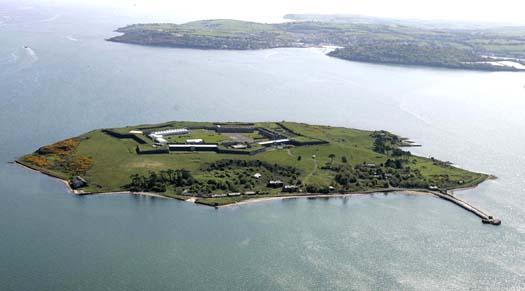
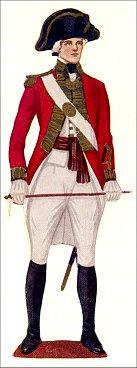
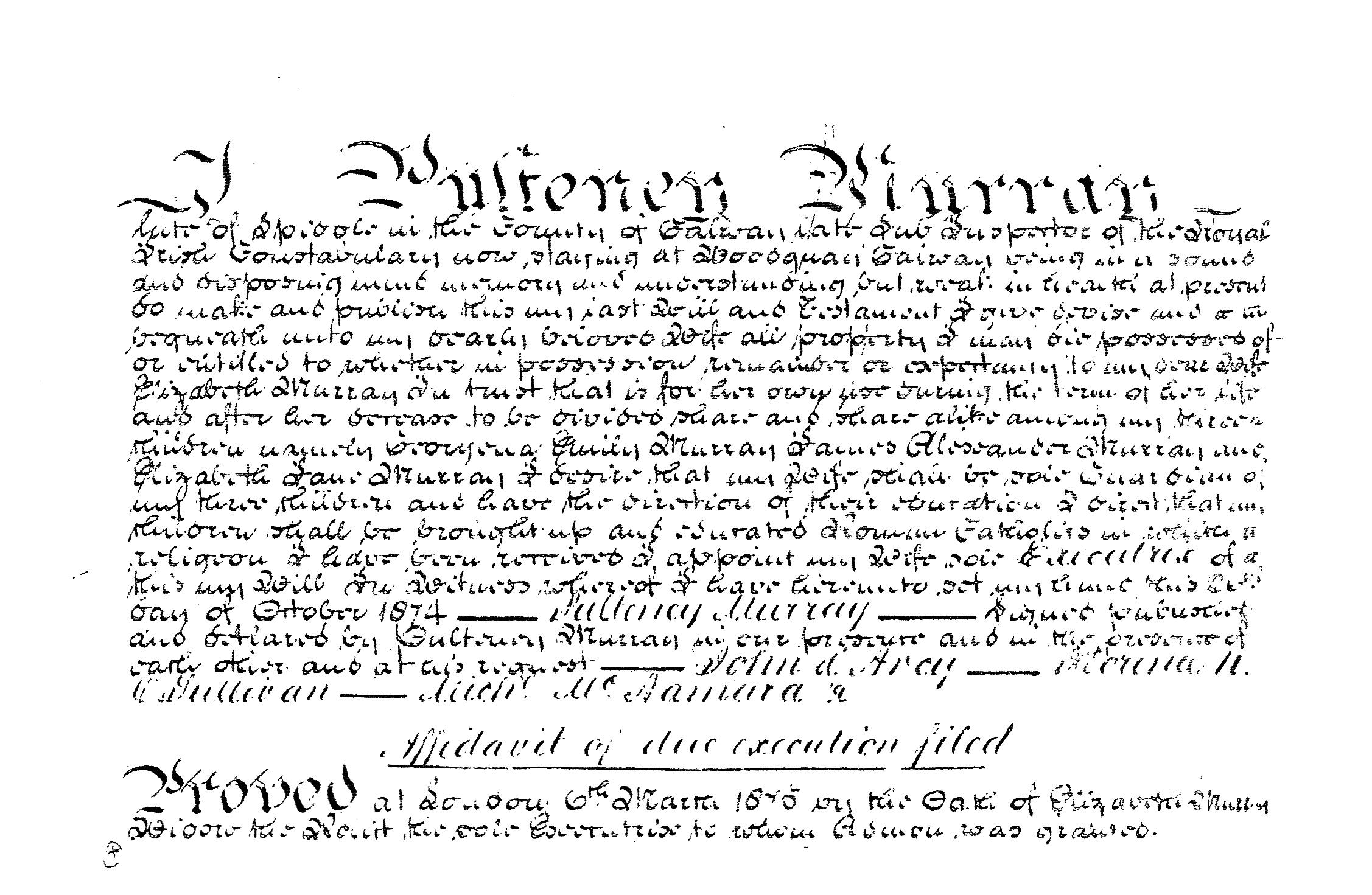
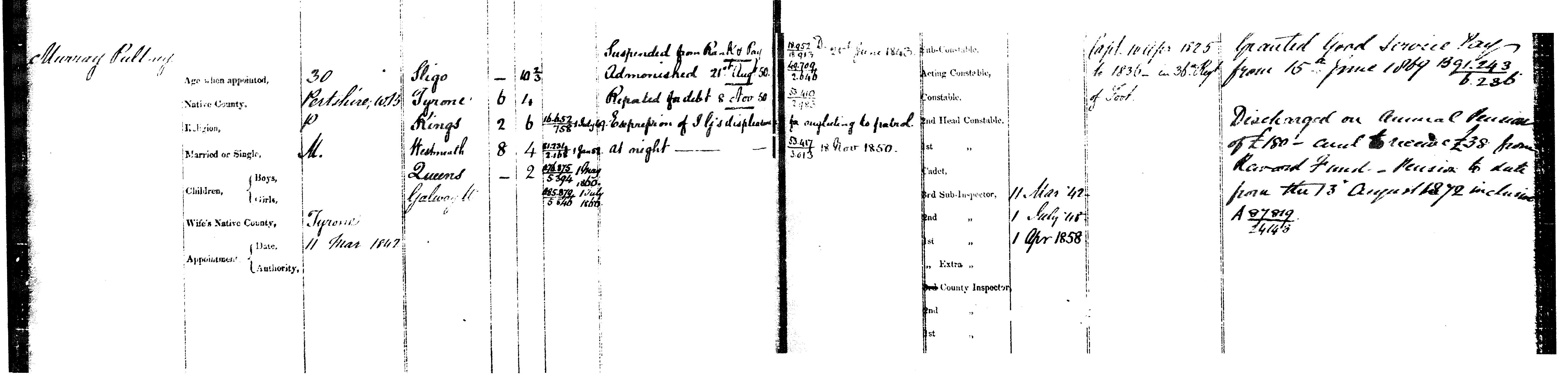
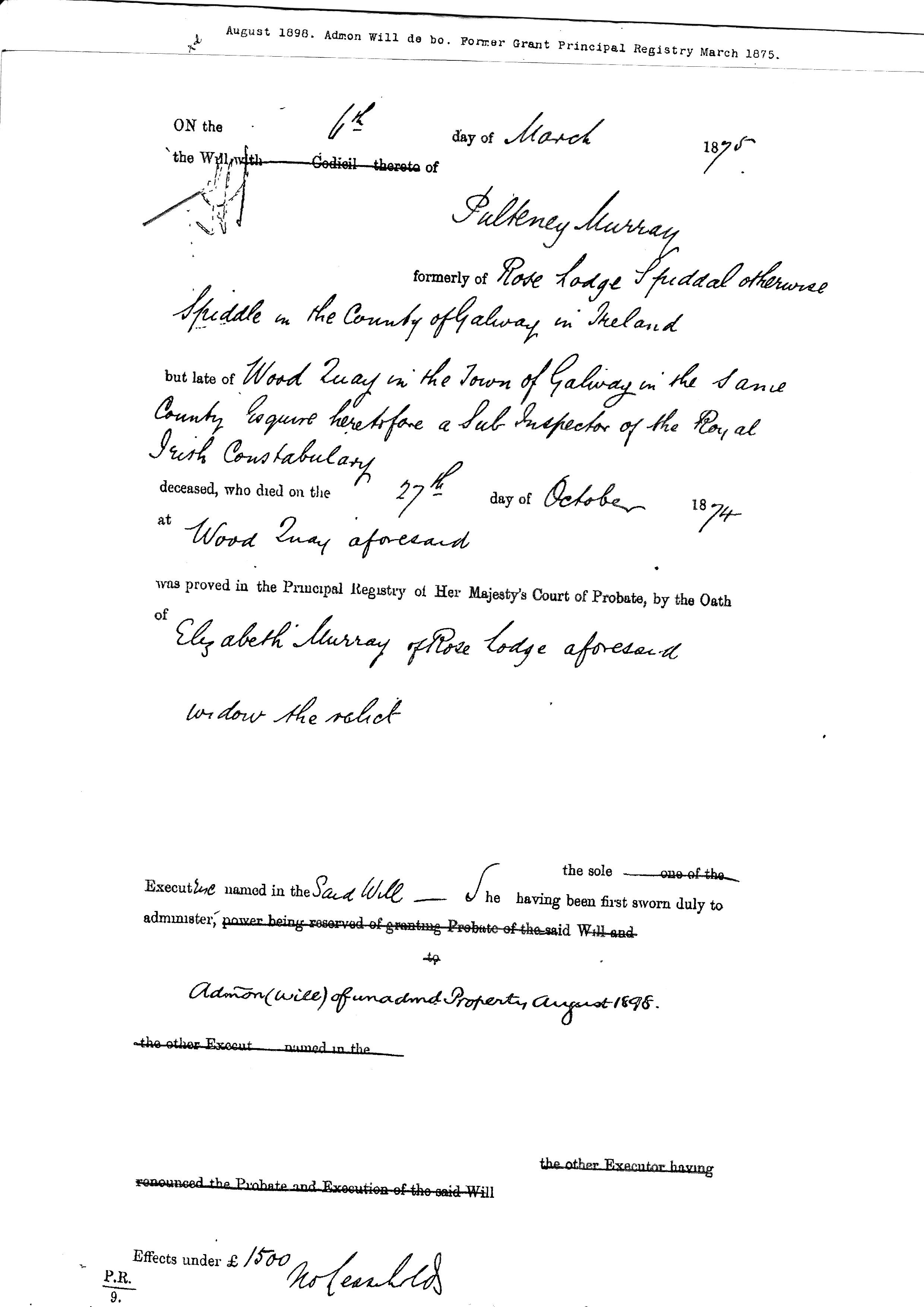
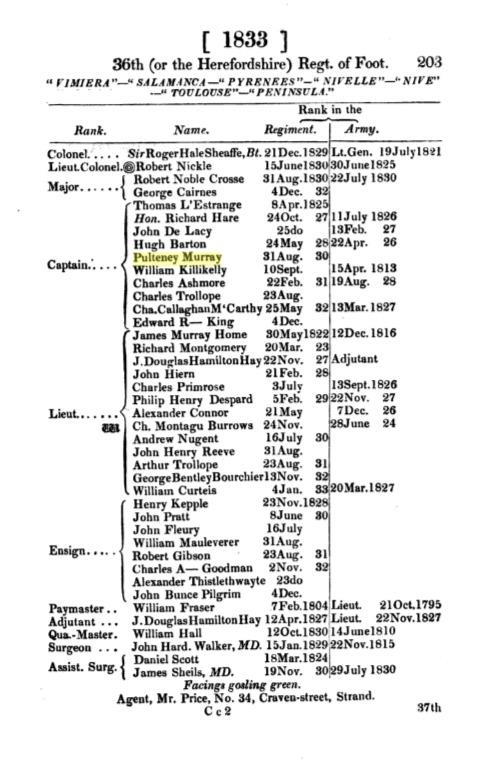
4. Pulteney MURRAY, son of Major General James Patrick 2 MURRAY and Elizabeth RUSHWORTH, was born on 9 July 1807 in Galway, Ireland. He was born in 1807 in Perth. He was baptised on 20 December 1809 in Freshwater Church. He was a Major in the Army + Sub Inspector of the Royal Irish Constabulary. He had 1 child. He married Jane MACKENNY on 23 May 1848. He died on 20 September 1875 in Galway. He married Elizabeth UNK.
According to Pulteney's great great niece Pamela Churcher he was known to the family as the man who should have been, but never was, "the third General". This referred to the military success of his father and grandfather, the military traditions of the Murray family, and the disappointment with Pulteney's lack of success in this field. What Pulteney did after he left the army is unknown - it was not thought worth recording by the family, who could only think that he had failed by not remaining a military man.
Pulteney was probably named after Lt. General Sir J. Pulteney, to whom Pulteney's father served when Lt. Gen. Pulteney was Aide de Camp in the 9th Regiment around 1800.
Pulteney Murray was born on 9th July 1807, the third of twelve children of James Patrick Murray and Elizabeth nee Rushworth, the latter from an important and influential Isle of Wight family. The couple had met when James Patrick Murray had been stationed there as a young man. Pulteney was named after Sir James Pulteney (later Sir James Pulteney Murray), whose aid-de-camp James Patrick had been during the British campaign in North Holland a few years earlier, and who had played an important role in the furtherarance of James Patrick’s early career. James Patrick had recently resumed his military career after a short stint (seven weeks, actually) as an MP, a position obtained through his wife’s family connections: James Patrick’s second thoughts about army life were later to be mirrored in Pulteney’s abandonment of his military career shortly before his 29th birthday, a decision that resulted in the disapproval and censure of his family – his descendants learned about him as the Murray who didn’t become a general as had his father and grandfather, and the family records contained almost nothing about him, as if he were better forgotten.
Pulteney’s birth occurred at a time of big political upheavals in Ireland, especially with the Act of Union of 1801, which had brought about the end of Ireland as an independent country, forbidden Catholics (most indigenous Irish) from holding any public office, made the Anglican church the state religion and banned any free trade between Britain and Ireland bringing about a virtually total stranglehold of Ireland by Britain. Also, before the Act of Union, in 1798, there had been a (failed) uprising in support of Catholic Emancipation. Pulteney’s future life was very much shaped by these events, both in his early career in the army, before he went to the West Indies, and later, for the majority of his working life as a middle ranking officer with the newly-formed Royal Irish Constabulary, generally considered to be the world’s first police force, in the modern sense of the word. Pulteney’s work could broadly be said to be part of the vast British machine for subduing the Irish nation. In this context it is interesting to note that Pulteney converted to Catholicism on his death bed; this decision would have been coloured by the whole English/Irish issue, the relations between the two countries, the unequal power struggle between the two, and the matter of where Pulteney saw himself in relation to these political issues - in other words, did Pulteney finally decide that he wanted to be identified as Irish rather than British, did he actually change his religious views, did he make a token change to please his wife, or did he change because he knew that life for his wife and children would be easier in an Irish context if their late father/husband had been a Catholic?
Early Childhood
One of the first mentions of Pulteney is in one of a series of letters written by his father to his mother, when he was about two years old. From the letters comes an overriding sense of homesickness on the part of James Patrick, and a great affection for his children whom he misses. We also learn of the hardships and instability of military life, where soldiers were sent from place to place with almost no notice, and almost anywhere in the world. We also learn of the difficulties that Elizabeth had. She was bringing up three (later twelve) children with an absent husband, living in a place where she had no roots or friends, and also forced to move frequently on account of her husband’s career – Catherine, their first child, was born in Banagher, James, their second, in Tipperary, and Pulteney in Galway. “God Almighty bless, preserve and protect you, my dear Catherine, James and little Pulteney, and kiss them all a thousand thousand times for me and believe me to be ever your most sincerely and truly affectionate husband.” This, and countless other very emotional expressions of affection, testify to his longing for home and real love for his family.
At the age of three, Pulteney experienced the tragedy of his father losing the use of his right arm in the battle of Douro in Portugal, in a campaign run by Arthur Wellesley, future Duke of Wellington. Could the remembrance, at such a young age, of seeing his father return home with a completely shattered arm have influenced his later decision to leave the army? James Patrick, however, continued undaunted with his military life, though not to the same extent as might have been, in charge of the 5th Garrison Battalion (a veteran’s battalion rather than a proper regiment). Yet for his service and undoubted qualities, he was eventually made a major general and created a Companion of the Bath (on the first occasion that that honour was given). So Pulteney, like his numerous siblings, was brought up in a distinctly military ambience, and naturally sought to join the army himself at the earliest age, like the rest of his brothers: of the six of them, three (James, Pulteney and Charles), subsequently had army careers, two (James and George Don) had navy careers, and it is not known want Henry Patrick did. However, the shortness of their lives bears eloquent witness to the hardships of the military life in those days. James died at 28, Charles 34, Henry 36, Douglas 42 and George 31. Pulteney alone, having left the army at the tender age of 29 and joined the Royal Irish Constabulary, in which he served for the rest of his life, lived beyond 50, dying at the (for then) respectable age of 68. In contrast, all but one of his sisters lived to a good old age, with two of them (Catherine and Elizabeth) living until 91 and 87 years respectively! Actually, this was not entirely usual for these times, as often it was the women (as, in all likelihood, Pulteney’s first wife Jane) who died young in childbirth.
Pulteney’s childhood was characterized by the constant growing in size of his family. As the third of twelve children, the last of whom was born when he was nineteen, he cannot have had a great deal of individual attention: maybe he longed for his childhood again, when he was adored as “pretty Pulteney” and when his family had such high hopes for him to follow in the family line.
The Army
It is not known where Pulteney went to school, but at the age of seventeen he joined the army, becoming an Ensign with the 36th Foot. In 1826 he joined the 36th Foot (with purchase) as a lieutenant, in 1830 became a captain, and, when he sold his commission and left the army in May 1836, was a major. His rise had been steady rather than meteoric, but the ten or so years he had in the army had taken him to most parts of Ireland, Gibraltar, Barbados, Spike Island, St. Kitts, St. Christopher, Antigua and St. Lucia.
A personal connection enabled Pulteney to join the 36th Foot: General George Don was a friend of Pulteney’s father and in fact was responsible for a series of paintings of the latter which still exist in the family, showing James Patrick, with his identifying injured arm, with his regiment. In fact, James Patrick’s 12th child was christened George Don Murray, with General George Don himself acting as sponsor (godfather) and the then 19-year old Pulteney acting as the other sponsor - clearly the family were by that time finding it hard to find sponsors for such a large family. Spike Island, just off the coast at Cork, where Pulteney was stationed with his regiment in 1830, was used as the British Arsenal at the time. During the following decade it became a centre for convicts prior to their departation to Australia and other places. Pulteney also spent time in Fermoy, which was the principal British military base in Co. Cork (In 1806 the first permanent barracks had been built there providing accommodation for 112 officers and 1478 men, as well as 24 cavalry officers, 120 cavalry men and 112 horses). At this time, only 42% of the army in Ireland were Irish, and in fact this reduced in the next thirty years to only 25% - the army was serving British interests. For men (as opposed to officers) in the army, life was very bleak. Marriage was strongly discouraged, and could only take place with the permission of the commanding officer, and in only a few cases would a wife be given permission to be with her husband; in all other cases the army did not even acknowledge the existence of wife or family. Living conditions were sqaulid and cramped, food was bad and insufficient, pay was poor and sanitation almost non-existent (for example, soldiers were expected to wash in their own urine tub). Once a soldier had paid the necessary costs of living and feeding from their pay there was usually little to nothing remaining. It is a little puzzling to wonder why there was a need for the formation of a Royal Commission in 1860 to consider why the army had a recruitment problem!! Life was somewhat better for officers, who were drawn from the upper classes exclusively, through the system of “purchase”. This system ensured the continuation of the “old boy network” but ensured the absolute loyalty of the armed forces, because they were drawn from the ruling classes; the system of purchase of rank did not disappear from the army until the end of the century, and not without a lot of resistance.
Conditions for the Irish civilians were even worse - a visitor to Ireland in the early nineteenth century declared: “now I have seen Ireland, it seems to me that hte poorest among the Letts, Estonians and Finlanders lead a life of comparative luxury”. Even the Duke of Wellington said “There never was a country in which poverty existed to the extent that it exists in Ireland”. The population at this time was growing fast, which was connected to the influence of the Catholic church, and the potato became more and more the staple on which ordinary Irish depended; however, the potato crops were often blighted, leading to hunger and shortages, culminating in the famous and catastrophic famine of 1845. British treatment of the Irish was justified by their view of them as lesser human beings than the Anglo-Saxons. In fact, later in the century, when Darwinian views were hijacked by racial supremacists, pseudo-scientific theories abounded about the Irish being “white negros”, which view reveals the double prejudice against both black and Irish. Pulteney grew up with this background, and would have viewed, along with his British contemporaries, his task as that of controlling the Irish, and would not have encountered views discussing their rights.
From 1832 to about 1836 Pulteney was with his regiment in the West Indies. By this time, it should be noted that Sir George Don had retired from the regiment. One of the places visited by the regiment was Antigua. Here is a description of the Antigua of 1832, the year Pulteney was there: “In 1832, there were exported from the colony equal to 11,010 hogsheads of sugar, 7342 puncheons of molasses, and 1238 puncheons of rum. A considerable quantity of cotton was formerly produced, but its cultivation is now discontinued. Two descriptions of soil are prevalent in the island: one a rich black mould on a substratum of clay, the other a stiff clay on a substratum of marl, which is not so fertile a* the former description of soil. It contains a large proportion of level land, and is not in any part mountainous. The shore is in general rocky, and surrounded by dangerous reefs, which make it difficult to approach, but there are several excellent harbours, in one of which—English Harbour, situated on the south side of the island—is a dock-yard belonging to government, with every convenience for careening and repairing vessels: this harbour is capable of receiving the largest ships in the British navy, and here, during the war, the king's ships on the West India station were usually moored during the hurricane mouths.” What the description does not mention is the matter of slavery, and how the British Army’s role was to protect the huge trade made possible by the free labour provided by the slaves. “In Antigua/Barbuda slavery was abolished in 1834 but it did not “free” the slaves as we understand freedom today, Antiguans continued to be scarred from the colonial experience. Emancipation perpetrated further the hierarchy of colour and race that the British had established at the start of the colonial period. Stringent Acts were passed to ensure that the planters had a constant labour supply”
[http://www.antiguamuseums.org/Historical.htm]. Much of the British Army’s role in the West Indies in the first half of the nineteenth century was to protect the islands and their trade from the French, with whom there were many military and naval encounters. St. Lucia, another place that Pulteney went with his regiment, had been alternately French and British for many years until finally it became permanently British in 1815. In 1836 Pulteney left the army. It is not known whether he came back to Ireland with the regiment first, or whether he stayed in the West Indies until the end of his commission; in any case, it is possibly significant that he left the army just over a year after the tragic and untimely death of his father: perhaps the event made him realize that he was not made for a life in the army; perhaps his father’s death made him wish to return to Ireland and a more settled life; this wish might have been prompted by a wish to be there for his siblings and mother, or simply because he desired it for himself. However, the next chapter of his life, with the newly formed Royal Irish Constabulary, was far from settled, although it did mean that he stayed in Ireland.
Paradoxically, four years after Pulteney left the army, his younger brother (by 17 years) Douglas Alexander Murray was being helped by his by then destitute and desperate mother Elizabeth to join the army. She and Douglas were both writing to everyone she knew in influential circles within the army, using her late husband and late husband’s father’s reputations to beg for a commission for Douglas without purchase (because the family had no money). Finally, in 1841, this was granted, and Douglas started in the .... The letters Elizabeth and Douglas wrote, and their replies, are held in the National Archives in Kew, and provide a poignant reminder of the position of the families of soldiers who have died, and how little help they got from the army. Elizabeth also mentions her oldest son, who had joined the navy, and who had died, and whose wife had also died, leaving their children in her care. “Five years ago he was deprived, by death, of his father who lost his life in consequence of a cold taken in the vain attempt to save the lives of two officers of the Royal Regiment...” One wonders what the effect on his mother was of Pulteney leaving the army, when she had to go to such inordinate lengths of begging to ensure a place in it for her younger son? And one wonders where Pulteney was in all this. It is not entirely clear from the records when Pulteney started with the RIC: his record notes that he was appointed on 11 March 1842 at the age of 30. Actually he would have been 35 at this time. There is further no record of what he did between 1836, when he sold his commission in the army, and 1842: did he undergo training, did he do nothing, or did he do something else; or was the date 1842 incorrect but the age 30 correct, in which case there would have been little or no gap between the two careers.
The Royal Irish Constabulary
A short time after leaving the army Pulteney joined the Royal Irish Constabulary; it seems likely he had a training as a cadet first, and was then posted to the first of six places, Sligo, for a period of just under a year. After this he spent the next six years in Tyrone, then, after a couple of years at Kings, eight and a half years in Westmeath (near to the place where he was brought up), and then finally, after a couple of months at Queens, finished his career in Galway.
Early on in his career with the RIC Pulteney got into a fair amount of trouble. For example, the records show that in 1843 he was “suspended from rank and pay”, though the reason is not given. At this time Pulteney was still a single man. More interestingly, the second half of 1850 was clearly a bad one for Pulteney. In August he was “admonished” (again no reason is stated), in November he is “reported for debt” and again, in the same month, receives an “expression of displeasure for neglecting to patrol at night”. What is most odd is that Pulteney had at this time been married for only two years, to Jane (neé McKenny), about whom nothing is known, and that they had a one-year-old baby, Pulteney Henry. Were the family in genuine hardship, was family life just too much for Pulteney, or did he drink; maybe his wife Jane, who was to die in less than a year, was already ill, and Pulteney could not face it, or did his actions precipitate her ill-health?
After Jane’s death, little Pulteney Henry was sent to live with his Aunt Donny, and it seems likely that Pulteney had no further part in his upbringing. Sadly, he is not even mentioned in his father’s will, made after he had remarried. Pulteney Henry’s descendants, who thorougly documented the family tree and history, pointedly omitted any reference to Pulteney’s second wife, Elizabeth, who was from Tyrone, which is just about all that is known about her. Pulteney and Elizabeth had three children, Georgina Emily, James Alexander and Elizabeth Jane: this is the order in which they are listed in Pulteney’s will, and so is likely to be in chronological order of age.
Despite Pulteney’s earlier admonishments from his superiors in the Royal Irish Constabulary, he was, on 15th Jue 1869, granted good service pay; on retirement he was discharged with an annual pension of £180 and a lump sum of £38. He had risen gradually through the ranks of RIC officers, being made a 3rd sub-inspector in March 1842, second sub-inspector in July 1848 and first sub-inspector in April 1858.
Conclusion
It is interesting to note that Elizabeth, at the time of her death in 1898 is stated as being “of Rose Lodge”; yet Pulteney, at his death twenty years earlier is stated as being “of Wood Quay, formerly of Rose Lodge”. This seems to imply that the couple separated, unless Elizabeth moved away from Rose Lodge with Pulteney, but moved back after his death.
Another document exists which is supplemental to Pulteney Murray’s will, and which dates from 1898, just after Elizabeth’s death. This states that the will was not administered, or at least not fully administered, after Pulteney’s death, and provides for the remaining £1350 left by him to be divided between his two daughters “in the United States”. It also gives the names of their respective husbands, Colman Flaridy (who married Georgina), and Michael McCarthy (who married Elizabeth Jane). The questions remain as to why the money was not released earlier, and also what happened to James Alexander Murray, their brother.
36th (Herefordshire) Regt. of Foot
Regimental Notes: Born at Perth on 9 July 1807. 5 April 1825 Ens 36th Ft without purchase. Taken on Depot strength at IOW in Apr 1825, on leave. Shown in May 1825 to Half-Pay List Infantry unattached; however in the 1st Battalion return (Feb 1826) after its return to England he is shown as on leave (private affairs) from 8 April 1825 to 24th May 1826 by permission of C in C so the HP unattached list probably wrong. An entry elsewhere shows him in Gibraltar from 5 June 1825 to 3 May 1826. He joined Bn in May 1826 in England. - 29th August 1826 Lieutenant 36th Ft with purchase. - Moved to Ireland (Mullingar) with Bn in Apr 1827, Dublin (Sep) Philipston (May 1828), Limerick (Oct). Birr (Aug 1829), Banagher (Feb 1830), Birr (Apr), Fermoy (Jun). Stayed with his Coy at Fermoy, as part of Depot, when Bn (6 service Coys) sailed for Barbados in Oct 1830. 31 Aug 1830 Capt. 36th Foot, with purchase. - Still with Depot in Dec. 1830 at Spike Island - Took draft to Bn in Barbados on 29 Dec 1831 arrived Feb 1832, St Kitts (Feb 1833), St Christopher (Mar), Antigua (Jul), St. Lucia (Nov), until he retired on 6 May 1836 by sale of his commission.
He was a Major on retirement.
From: Historical Record of the 36th, or the Herefordshire Regiment of Foot [eyre & Spottiswoode, 1853]
(whilst Pulteney Murray was serving in the regiment)
On the lst of February 1823, the detachment which was stationed at Cerigo arrived at Corfu, and joined the headquarters of the regiment.
In the year 1825, the establishment of the regiment was augmented from eight to ten companies, and formed into six service and four depot companies, consisting of forty-two serjeants, fourteen drummers, and seven hundred and forty rank and file.
The regiment remained in the Ionian Islands until the 2d of December 1825, when it embarked at Santa Maura for England.
On the 18th of February 1826, the regiment disembarked at Chatham; in the spring it proceeded to Colchester, afterwards to Macclesfield, Stockport, Manchester, and Bolton.
During the early part of the year 1827, the regiment remained at Bolton, in Lancashire, and in April it proceeded to Liverpool, from which place it embarked for Ireland on the 14th of that month. The regiment arrived at Dublin on the following day, proceeded from thence to Mullingar, and returned to Dublin in August following, where it was stationed during the remainder of the year.
In May 1828, the regiment proceeded from Dublin to Naas, and in October it was removed to Limerick.
The regiment remained at Limerick until August 1829, when it proceeded to Birr, and continued during the rest of the year at that station. Lieut.-General Sir Roger Hale Sheaffe, Bart, was appointed Colonel of the THIRTY-SIXTH regiment on the 21st of December 1829, in succession to General Sir George Don, G.C.B. and G.C.H., removed to the Third foot, or the Buffs.
In June 1830, the THIRTY-SIXTH regiment proceeded from Birr to Fermoy, and was formed into six service and four depot companies. The service companies embarked at Cork on the 11th, 13th, and 14th of October for the West Indies. The depot companies remained at Fermoy for a short time, and were afterwards stationed at Spike Island. The service companies disembarked at Barbadoes on the 20th, 21st, and 28th of November.
The service companies suffered severely during the great hurricane in Barbadoes in 1831, having eleven men killed, and several severely injured.
The depot companies were removed from Spike Island to Charles Fort, Kinsale, in October 1831, and continued there during 1832.
The service companies which had, since their arrival in the West Indies, remained at Barbadoes, were removed to Antigua in February 1833. The depot companies proceeded from Charles Fort to Ballincollig in January 1833; to Cork in February; to Templemore in August, and to Nenagh in October following.
During the year 1834, the service companies remained at Antigua. The depot companies were removed in October from Nenagh to Limerick.
In November 1835 the service companies proceeded from Antigua to St. Lucia. The depot companies quitted Limerick for Galway in May 1835, and marched for Cork in June following, where they embarked for Plymouth on the '14th of September; during the remainder of the year they were stationed at Devonport.
During the year 1836, the service companies remained at St. Lucia, and the depot at Devonport.
In February 1837 the service companies proceeded from St. Lucia to Barbadoes. The depot companies were removed from Devonport to Kinsale in June 1838. On the 10th of November 1838, the service companies embarked at Barbadoes for Nova Scotia, and arrived at Halifax on the 8th of December.
From Pulteney's will it is now known that he lived first at Rose Lodge, Spiddal/Spiddle and subsequently moved to Wood Quay, Galway, and that he worked as a sub inspector in the Royal Irish Constabulary. It is also now known that he remarried and had two daughters and one son; both duaghters subsequently moved to the United States. It is interesting to note that the family of his first wife made no record of Pulteney's remarriage and the children therefrom, despite thorough records otherwise being kept.
Furthermore, although no record has yet been found of the birth dates of the three children, the order given here is the order given in Pulteney's will. Given that the son is listed in the middle, it is more than possible that the order is that of age. In addition, when the will was properly administered in August 1898 (obviously some unfinished business in 1875), on the occasion of the death of Pulteney's wife Elizabeth, James Alexander Murray (Pulteney's son) was not mentioned, perhaps impyling that he had died. It is also worth noting that Pulteney's will makes no provision whatsoever for his son by his first marriage, Pulteney Henry Murray.
Lastly, in 1895, at her death, Elizabeth Murray is stated as being "of Rose Lodge", and yet her late husband Pulteney, at his death in 1875, was said to be "of Wood Quay, formerly of Rose Lodge", seeming to imply that the couple had separated before his death.
The question remains why the will was not administered in 1875, but had to wait a full twenty years, when the two daughters in America laid claim to the relatively small sum of £1350 left by Pulteney (that part of the will which was left unadminstered until 1898).
Notes on the Royal Irish Constabulary, in which Pulteney Murray pursued a career after leaving the army.
The first organised police force in Ireland came about through the Peace Preservation Act of 1814 but the Irish Constabulary Act of 1822 marked the true beginning of the Irish Constabulary. Among its first duties was the forcible seizure of tithes during the "Tithe War" on behalf of the Anglican clergy from the mainly Catholic population as well as the Presbyterian minority. The act established a force in each barony with chief constables and inspectors general under the control of the civil administration at Dublin Castle. By 1841 this force numbered over 8,600 men. The force had been rationalised and reorganised in an 1836 act and the first constabulary code of regulations was published in 1837. The discipline was tough and the pay poor. The police also faced unrest among the Irish rural poor, manifested in organisations like the Ribbonmen, which attacked landlords and their property.
The new constabulary demonstrated their efficiency against Irish separatism with the putting down of the Young Ireland uprising led by William Smith O'Brien in 1848. There then followed a spell of relative calm. However, the Irish Republican Brotherhood, founded in 1858, planned an armed uprising against British rule. This rose into direct action in with the Fenian Rising of 1867, marked by attacks on the more isolated police stations. This rebellion was also put down fairly easily, as the police had infiltrated the Fenians with spies and informers. The loyalty of the constabulary during the rising was rewarded by Queen Victoria granting the force the prefix 'royal' and the right to use the insignia of the Most Illustrious Order of St Patrick. The Royal Irish Constabulary (RIC) presided over a marked decline in crime in the country with the rural unrest of the early nineteenth century (characterised by secret organizations and crimes such as unlawful armed assembly) being replaced by relative misdemeanors such as public drunkenness and minor property crimes.
By 1836 this force had grown to around 5,000 men and by 1841 this had risen to a total of over 8,600. and from its inception the Irish constabulary was a barracked force. It was spread thinly throughout the country, with four or five policemen living in each barrack the norm.
Ireland in the first half of the nineteenth century was the pioneer for policing, acting almost as a laboratory for its development. With Irish society volatile, disordered and disorderly, the establishment of a uniformed, professional police force for the maintenance of law and order was an absolute necessity. It was the nature of collective violence and the weakness of previously existing forces for social control that led successive governments, from the early 1800's on, to press ahead with the establishment of a centrally controlled armed constabulary. The constabulary in Ireland served as a model for the establishment of a policing system in the rest of the British Isles, and ultimately even further afield in the developing colonies of the Empire. Throughout the 19th century the constabulary continued to develop as a police force. The evolution of the force was characterised by improvements in rank structure, training, and the rules and regulations governing the duties, conduct and discipline expected of the men. One of the most significant developments in the history of the constabulary during the 19th century was its redesignation as the Royal Irish Constabulary, making it the first 'Royal' police force in the British Empire.
Life in the constabulary during the 19th century could certainly, on occasions, be difficult. There was periodic agrarian unrest and constant simmering discontent in relation to the land question, particularly in the south and west. Indeed the dominant image of the R.I.C. for many people often stems from its responsibility to give protection to bailiffs executing distress warrants and evicting tenants, an unpleasant duty that was greatly disliked by members of the force (most of whom were themselves from a rural background). Nevertheless, the duties of the averagepoliceman were otherwise usually varied and uncontroversial.
These extensive civil and local government duties as well as routine patrolling in their districts ensured that the police constable was a very familiar part of daily life, someone with whom people would expect to have regular contact. It was the constable's job to acquire a thorough knowledge of his district and good relations with the local community made this easier. Indeed, good community relations, then as now, were essential for effective policing.
By the end of the 19th century there was a total of around 1,600 barracks dotted around the Irish countryside and some 11,000 constables. The territorial division of county and district on which the command structure had been based since the 1836 reorganization continued throughout the life of the R.I.C. Each county was supervised by a county inspector, with the counties sub-divided into a number of districts, each headed by a district inspector. They in turn were assisted by a head constable based at the district headquarters, on whom rested the main responsibility for operational policing and the conduct of the men in the barracks. There were a number of barracks in each district, usually with a sergeant and four constables.
The R.I.C. was characterised by a strict code of discipline. There was no official system of duty, rest days or annual leave, and in the interests of political impartiality members were even banned from voting at parliamentary elections. There were strict instructions laid down in police regulations concerning standards of conduct and appearance (for example, at one time police were absolutely prohibited from entering a public house socially). Other regulations were principally designed to maintain the standing of the police within the community. Members were forbidden to marry until they had at least seven years service and any potential bride had to be vetted by the constabulary authorities to ensure her social suitability. It was forbidden for policemen and their wives to sell produce, take lodgers or engage in certain forms of trade (for example, wives could be dressmakers but could not employ apprentices).
Jane MACKENNY, daughter of J MACKENNY ( - ), died on 19 October 1851. She and Pulteney MURRAY had the following children:
| +17 |
Elizabeth UNK died on 4 January 1898. She and Pulteney MURRAY had the following children:
| +18 | |
| +19 | |
| +20 |
5. Harriet Elizabeth MURRAY, daughter of Major General James Patrick 2 MURRAY and Elizabeth RUSHWORTH, was born on 6 April 1809 in Co. Cork, Ireland. She was baptised on 20 December 1809 in Freshwater Church. She married Henry HODGES on 14 July 1834 in Benowen. She died on 29 June 1882.
Harriet Elizabeth was born at Cork, Ireland on 6th April 1809, but was also baptised at Freshwater Church on 20th December 1809 (same day as her brother). She married her first cousin the Rev Henry Hodges ( son of her aunt Cordelia). She died on 29th June 1882.
Henry HODGES, son of Rev. Henry HODGES ( -1837) and Cordelia MURRAY (1781-1849), was born circa 1808 in Blackheath. He was a Rector of Alphamstone. He died on 1 September 1870. He and Harriet Elizabeth MURRAY had the following children:
| +21 | |
| +22 | |
| +23 | |
| +24 | |
| +25 |
6. Mary Johanna MURRAY, daughter of Major General James Patrick 2 MURRAY and Elizabeth RUSHWORTH, was born on 5 January 1810 in Merrion, Dublin. She married Andrew NEWTON on 14 July 1834 in Benowen. She married William Francis HARVEY on 13 February 1849. She died on 31 March 1875 in Purbrook.
Mary Joanna was born at Merrion nr. Dublin on 5th January 1811. One of her godfathers was Sir John Pringle Dalrymple (see notes on picture). She married twice, firstly on 10th July 1834 to Andrew Newton MD who died on 1st December 1837. They had a son James P. Murray Newton who died young and childless.
Secondly she married on 13th February 1849 Wm. F. Harvey of Purbrook Heath House in Hants. They had two children: the elder was Elizabeth Maria Harvey (known as 'Cousin Lizzie') born 1850 and died in 1941, and the younger Thomas William Harvey ( known as 'Cousin Tom') born 1852 and died 1905. Both lived together at Purbrook and when Lizzie died in1941, as they had no heirs the house and its contents were left to their cousin Edward 'Ted' Murray. (see story of Purbrook).
She died on 31st March 1875 at Purbrook and her husband died on 23rd April 1893. Both are buried in Christchurch cemetery, Portsdown.
She made the tapestry which survives and left a large book of franked envelopes which she collected from her Father's mail as a girl in Ireland, and which were signed by quite a few famous people of the day.
Andrew NEWTON and Mary Johanna MURRAY had the following children:
| +26 |
William Francis HARVEY was born on 8 March 1805 in Portland Place, London. He died on 23 April 1893 in Purbrook, Hants.. He and Mary Johanna MURRAY had the following children:
| +27 | |
| +28 |
7. Jane Susan MURRAY, daughter of Major General James Patrick 2 MURRAY and Elizabeth RUSHWORTH, was born on 13 October 1810 in Athlone. She died on 3 August 1841 in Benowen.
His fourth sister Jane Susan born 13th October 1812 at Athlone, Ireland and died at Athlone on 3rd August 1841 aged 29 without issue.
8. Charles MURRAY, son of Major General James Patrick 2 MURRAY and Elizabeth RUSHWORTH, was born on 30 December 1814 in Athlone. He was a Soldier. He married Anne Mitchell SCOTT on 12 October 1844. He died on 6 April 1848 in West Indies.
He joined the Army and was an ensign in the 76th Regiment of Foot. Later he was promoted Captain in the same regiment. They had no children.
Anne Mitchell SCOTT, daughter of Robert SCOTT ( - ), died on 6 April 1848.
9. Elizabeth MURRAY, daughter of Major General James Patrick 2 MURRAY and Elizabeth RUSHWORTH, was born on 6 February 1817 in Athlone. She died on 10 December 1904.
She was unmarried.
10. Henry Patrick MURRAY, son of Major General James Patrick 2 MURRAY and Elizabeth RUSHWORTH, was born on 19 February 1819 in Athlone. He died on 29 June 1855 in Benowen.
Was unmarried.
11. Lady Cordelia Maria MURRAY, daughter of Major General James Patrick 2 MURRAY and Elizabeth RUSHWORTH, was born on 27 February 1822 in Westmeath, Ireland. She married Charles TROLLOPPE on 30 March 1864 in St. George, Hanover Square. She married Edmond BOWER in 1892. She died on 3 December 1909.
Cordelia Maria born at Killinure House, Co. Westmeath, on 27th February 1822. She married on 31st March 1864 General Sir Charles Trollope. His first wife Frances Lord died in 1862 and they had three children. Cordelia had one child born in 1866, a daughter Elizabeth Wilhelmina (known as Cousin Betsy). Betsy married Capt. Edmond Bower in1892 and they had two daughters Denise born 1896 died 1980 and Delia who became a nun. Denise Married Claude Hollies in 1944 but they had no issue. Because they had no heirs, Denise Hollies kept in touch with J.P.Murray and gave several family papers and possessions to him. Betsy also kept in touch and gave several of the family miniatures to Elizabeth Murray. Capt. Bower was very interested in family history and labelled many of the miniatures as well as doing research.
Cordelia was known in the family as 'Aunt Delia' and she went to live with her Aunt William Mina (Lady Douglas) in Grosvenor Square . Because they were close she named her own daughter after her Aunt and when her Aunt died she was left the Grosvenor Square property. She died at 21 Grosvenor Square on 3rd December 1909 and was buried in the Trollope family vault at Liffington.
Despite Cordelia's marriage in 1892 (information from within the family), she was still referred to as Lady Cordelia M Trollope in the 1901 census, and living in Hanover Square.
General Sir Charles TROLLOPPE KCB had the title 'General Sir'. He died in 1888. He and Cordelia Maria MURRAY had the following children:
| +29 |
Edmond BOWER and Cordelia Maria MURRAY had the following children:
| +30 | |
| +31 |
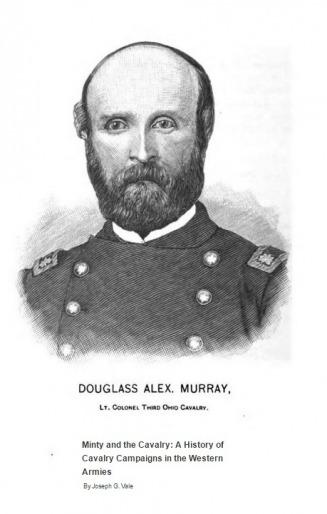
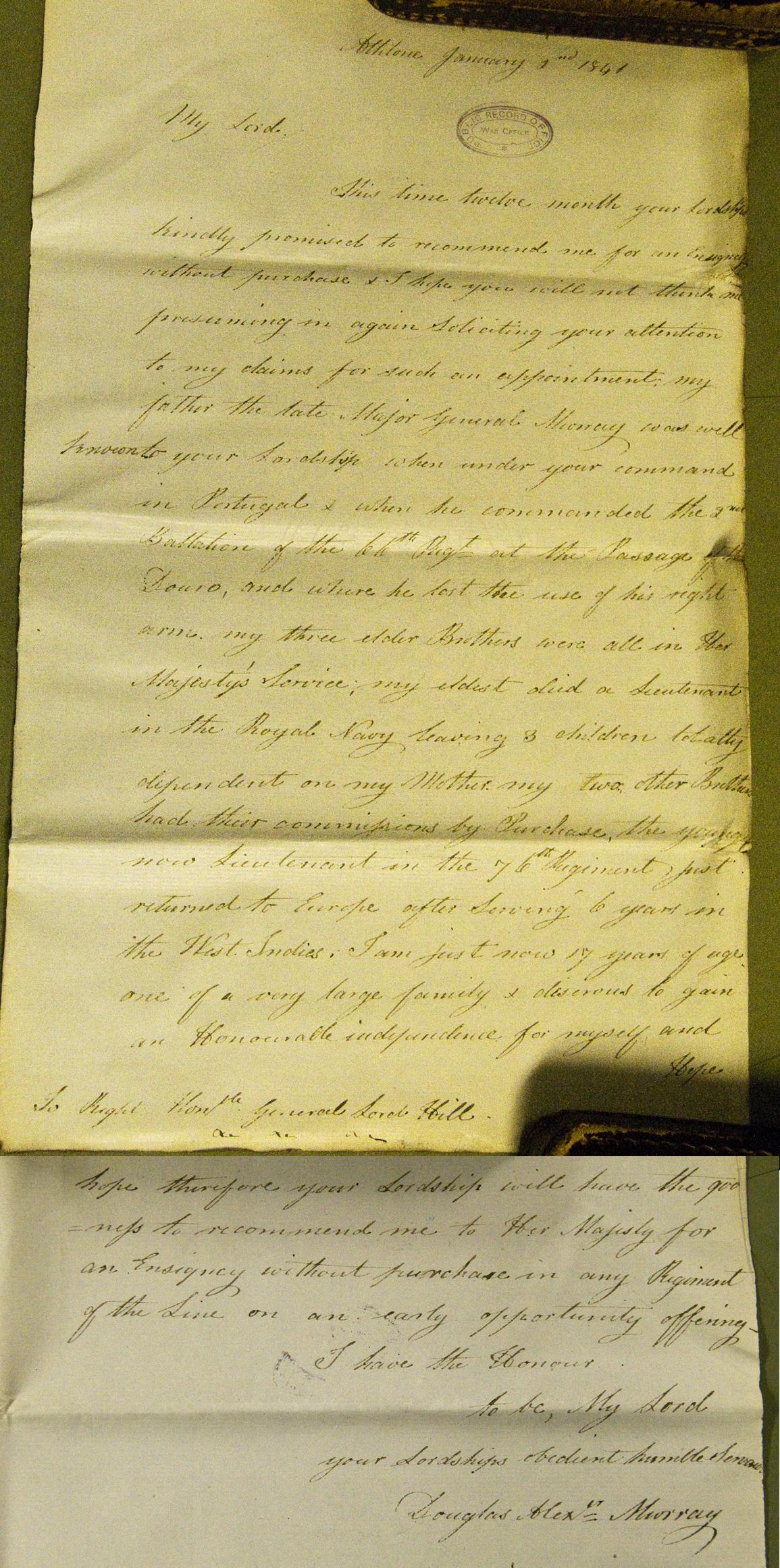
12. Lieutenant Colonel Douglas Alexander MURRAY, son of Major General James Patrick 2 MURRAY and Elizabeth RUSHWORTH, was born on 2 January 1824 in Killinure House, Westmeath, Ireland. He married Mary Anne MURPHY on 10 November 1848 in St. Louis, Missouri. He married Mary Ann BELTZHOOVER on 8 November 1855 in (First Evangelical Lutheran Church) Carlyle, Pennsylvania. He died on 19 July 1866 in Washington DC. He was buried in Carlyle, Pennsylvania.
From Heitman's "Historical Register and Dictionary of the United States Army" (1886), page 738:
Born in England, appointed an officer from the Army. Served as a private, corporal, and sergeant in Company F, 1st US Artillery from November 23, 1850 to March 23, 1855. Served as a private in Company F, 1st US Artillery and in General Service from October 7, 1856 to October 10, 1861. Appointed Lieutenant Colonel, 3rd Ohio Cavalry on October 10, 1861. resigned this position on June 7, 1863. In the meantime had been appointed a 2nd Lieutenant in the 4th US Cavalry in the regular army on July 17, 1862, but never served with the regiment. He resigned this commission on June 18, 1863.
1850:
Born Wickham, England. Age 27, blue eyes, brown hair, ruddy complexion, 5'9" tall. Occupation: clerk. Enlisted in New Orleans, Louisiana by Lieutenant David on November 23, 1850 into Company F, 1st U S Artillery. Discharged at Fort McIntosh, Texas at the expiration of his term of service as a sergeant on November 23, 1855.
1856:
Born Farsham (or Farnham) in Wickham, England. Age 33, grey eyes, brown hair, fair complexion, 5'8" tall. Occupation: soldier. Enlisted in Philadelphia, Pennsylvania by Lieutenant Bootes on October 7, 1856 into Company F, 1st US Artillery. Discharged on August 7, 1861 upon his re-enlistment, no location or rank listed.
1861:
Born Wickham, England. Age 36, grey eyes, brown hair, ruddy complexion, 5'9" tall. Enlisted at Carlisle Barracks, Pennsylvania by Captain Jonas P. Holliday of the 2nd US Cavalry on August 7, 1861 into service at the "Cavalry Depot." Discharged on october 11, 1861 by Special Order 267, Adjutant General's Office, dated October 3, 1861, at carlisle Barracks, Pennsylvania as a sergeant.
].
Douglas joined the U.S. Army and commanded the 3rd Ohio Cavalry.He fought in several battles of the Civil War and was severely wounded, losing his left arm. He received the rank of Lieutenant Colonel on October 10, 1861. He resigned June 7th, 1863, but it is not known whether this was on account of his injuries.
Freemason
Just previous to the battle of Shiloh, the 3rd. Ohio cavalry, commanded at the time by Lt. Col. Murray, took possession of Lawrenceburgh, Tennessee. The people of the place were understood to be all Secessionists, and the Lt. Col. Ordered his men to search all the houses, arrest all the men, and take possession of all guns and other arms…being careful to protect the women and children from all harm and insult. While this was going on, Col. Murray rode down the street, and while in front of the Masonic Hall, noticed that some of his men had been in the Lodge-room and taken possession of some articles belonging to the Lodge. Immediately ordered them to return every article to its place, and then placed a guard at the door to protect the hall from future violation.
During the Battle of Shiloh, the Third Ohio Cavalry captured a Confederate Surgeon. The Surgeon asked Lieutenant Colonel Murray if he was not the officer who had saved the Masonic Lodge at Lawrenceburgh, TN from being ransacked and was informed that he was. The doctor then told Lieutenant Colonel Murray that it was that fact alone that had saved him from being ambushed. A Confederate Mason who had witnessed his generous act at Lawrenceburgh had recognized him and ordered his men to lower their guns and let him pass.
Battle of the Right Wing - Murray making a "handsome dash"
Rosecrans' Campaign with the Fourteenth Army Corps, Or, the Army of the ...
By William Denison Bickham
BATTLE OF THE RIGHT WING...
The Third Ohio, Lieutenant Colonel D. H. Murray, when the Right broke, also made a handsome dash, and drove the enemy from McCook's ammunition train. Subsequently they charged, saved the train of the Center, drove off the rebels, recaptured a hospital, and captured many prisoners under Colonel Eennett's eye. Two companies of this regiment were rallied by Colonel Eennett, who carried them into action, driving the enemy from the pike, recapturing a gun by a dashing charge, saving a train, and rescuing many of our men. Lieutenant Murray distiaguished himself in this affair. Colonel Kennett himself had a hand to hand encounter with a rebel horseman. The result was doubtful. The rebel had leveled his carbine, the Colonel had his pistol leveled, and both were about to fire, when Farrish, an orderly of Kennett, threw his revolving ,rifie into the scale. The rebel delivered his arms and himself. In the charge of the Third Ohio, Farrish killed two rebels, and Jaggers, another orderly, rode down two gray-jackets, and released two of the Fourth Ohio Cavalry who had surrendered. Colonel Zahn, of the Third Ohio Cavalry, commanding brigade, had been fighting incessantly from the beginning of the disaster up to this period. He was compelled to retire before the rebel infantry, but a charge of rebel cavalry was handsomely repulsed by the First Ohio Cavalry, Colonel Minor Millikin, and the Third Ohio Cavalry. Major A. B. Moore, of the former regiment, fell mortally wounded in this charge. The enemy charged Zahn twice in succession, and were again and again repelled, Zahn now went to the rescue of McCook's ammunition train, which was again in jeopardy. The enemy appeared in heavy force. After a gallant stand by the First, Third, and Fourth Ohio Cavalry, Zahn was compelled to retire, the dashing Colonel Millikin and his Adjutant, Lieutenant Condit, being fatally hurt. Millikin had been surrounded, but by his courage and his prowess with his saber, he cut his way through, and was escaping, when a rebel sharpshooter brought him down. There was no more gallant rider in that field. His sorrowing soldiers bore him to the rear, where he soon breathed his last, lamented by hosts of friends.
D. A. MURRAY,
Lieutenant-Colonel Third Ohio Cavalry, Commanding.
P. S.--Since writing the above Private Steckel has recognized Lewis Turner, another of the prisoners, also John Peters, as being two that were of the party. Private William Smith, Company C, recognizes one of the prisoners, Fletcher, as being one that fired upon him a few days since; Private Smith is now lying in hospital from wounds received, he states, by his hands.
Respectfully, yours,
D. A. MURRAY,
Lieutenant-Colonel Third Ohio Cavalry, Commanding.
(Col. J. B. FRY, Chief of Staff, Army of the Ohio.)
HEADQUARTERS THIRD OHIO CAVALRY, In Camp, Woodville, Ala., August 7, 1862.
COLONEL: I have the honor to report for your information that the squadron of the Third Ohio Cavalry that left these headquarters on the morning of the 5th instant on a reconnaissance to the river opposite to Guntersville returned this day at noon.
The officer in command of the squadron reports that the encampment of the enemy has been moved back from the river about 2 miles, and there appears to be a larger force there now than when our troops, accompanied by artillery and infantry, were there. The enemy have dug rifle pits, and have also mounted two pieces of artillery to command the old ferries at that point. The ferry-boats destroyed by our troops are being repaired, and I have heard from good authority will be ready for use this day or to-morrow. It is rumored that they, the enemy, will cross with the intention of destroying the bridges on the railroad as soon as they possibly can. If not too great a liberty, might I suggest that two pieces of artillery may be sent to this point or the bridge near by. I have no doubt if artillery were here and could be spared they would render good service. The country being so miserably adapted for cavalry being as effectual as they otherwise would be on more suitable ground might be obviated by having the assistance of artillery. If artillery cannot be spared, two companies of infantry would, I have no doubt, prevent any damage being done to railroad in our vicinity.
The squadron arrested Mr. Hornbuckle, a noted bushwhacker, who attempted after his arrest to escape, and did succeed in getting off some distance; would have made good his escape but for the steps taken to prevent it.
Very respectfully, I have the honor to be, your obedient servant,
D. A. MURRAY,
Lieutenant-Colonel Third Ohio Cavalry, Commanding.
(Col. J. B. FRY, Chief of Staff.)
O.R.-- SERIES I--VOLUME XX/1 [S# 29]
DECEMBER 26, 1862-JANUARY 5, 1863.--The Stone's River or Murfreesborough, Tenn., Campaign.
No. 178.--Report of Lieut. Col. Douglas A. Murray, Third Ohio Cavalry, including skirmishes at Franklin, December 26-27, and Overall's Creek, December 31.
HEADQUARTERS THIRD OHIO CAVALRY,
In Camp near Murfreesborough, Tenn., January 6, 1863.
COLONEL: In compliance with instructions received from your head quarters, I have the honor to report, for your information, the part taken by the Third Ohio Cavalry in the several engagements in which the regiment was engaged since leaving Nashville, Tenn., on December 26 last, on which day we proceeded to Franklin, driving the enemy therefrom and taking possession of the town; took some 10 prisoners. Remaining in town some time, we recrossed the river, and marched across the country to Wilson Creek pike, about 14 miles from Nashville, and encamped, arriving in camp at about 10 p.m.
On the 27th, the Third Battalion of the regiment moved toward Franklin, and found that the enemy had in strong force again taken possession of the town; the battalion drove in their pickets under a heavy fire, killing 3 of them. Seeing that the enemy were in such force, the commander deemed it prudent to retire, and rejoined the regiment, which picketed the roads, &c., in the vicinity of its camp.
On the 28th ultimo, proceeded to Triune and encamped, leaving early next morning across the country toward Murfreesborough, proceeding about 5 miles in that direction, when attacked by the enemy's pickets in force, which we drove, skirmishing, they frequently making a stand, which we each time broke, and still drove them about 5 miles.
The 30th ultimo, ordered to proceed to Stone's River; proceeded but a short distance when attacked by the enemy's pickets; the enemy were in force in our front with artillery. We therefore retired, forming on the high ground in our rear to receive them, their pickets, or patrol, advancing, which we repulsed. In the evening our brigade was re-enforced by one battery of artillery and three regiments of infantry, and proceeded in reconnaissance to the left of the enemy's lines, where we found General Hardee's corps d'armée ready, in line of battle, to receive us. We retired, and encamped in the woods, about 2 miles in front of the enemy's lines.
On the morning of the 31st we formed; shortly after the enemy appeared in large force, both on our left, center, and right, evidently endeavoring to cut us off. The brigade of infantry to our left gave way, retreating in confusion through our lines, letting the whole force of the enemy's artillery, cavalry, and infantry fall upon us, which compelled us gradually to retire toward the main body of our army. The regiment covering the entire rear of the brigade, supporting one infantry regiment on our right, drove back, with heavy loss, a large force of cavalry which charged upon us, under cover of a piece of artillery, firing well-directed shells, which passed over us. The enemy being in such force, we had to retire about three-fourths of a mile, when an aide-de-camp of General McCook rode Up, informing us that the train close by was General McCook's entire ammunition train, which must be saved at all hazards; on intimation of which the regiment was immediately formed for its protection, holding the enemy in check until the entire train, with the exception of a few disabled wagons that could not be moved, was safely withdrawn. The regiment then moved between the enemy and train as far as the Murfreesborough pike, where we found the enemy making a fierce attack upon General Thomas' train, when we again repulsed them at several points, taking many prisoners and saving that entire portion of the train. The attack of the enemy was furious and desperate, which required the greatest firmness and bravery to resist. Colonel Kennett was an eye-witness to the determined bravery of a portion of the regiment rescuing the train from the enemy, which were in force at the hospital on the Murfreesborough pike. The regiment then formed in the field near the hospital, where the brigade soon assembled and reformed, and advanced toward the enemy's left. Soon came up to the enemy's cavalry, supported by artillery, when several other skirmishes ensued during the evening, the enemy's entire object seeming to be to take the train.
On the 1st instant, received orders to proceed to Nashville in charge of train, consisting of some 200 or 300 wagons. When about 2 miles on the Nashville side of La Vergne, we were attacked by General Wheeler's brigade of cavalry, which made several dashes on the train, and were repulsed. They then attacked our rear in force. After a well-contested fight, our regiment put them to flight in disorder, killing 9 of them and wounding several, and arrived in Nashville at 9 p.m. and encamped.
The 2d instant, remained in Nashville and procured forage for our horses, furnishing working party and escort to forage train.
The 3d instant, left Nashville for Murfreesborough in charge of hospital and ammunition trains. Attacked again in force by Wheeler's brigade of cavalry on the Nashville side of La Vergne, which was repulsed with a loss of 15 on their side and some 8 or 9 prisoners taken; among the latter the adjutant of the Third Alabama Cavalry. Two of our non-commissioned officers, I regret to inform you, were severely and dangerously wounded, whom we had to leave in a house on the roadside.
Arrived at camp, near Murfreesborough, at I a.m., 4th instant, with the train all safe, with the exception of one wagon of the regiment that was cut off by the enemy, and is now supposed to have returned to Nashville.
On the evening of the 4th, proceeded with brigade toward Murfreesborough as far as Stone's River, and returned to camp.
On the 5th instant, proceeded again with brigade to Murfreesborough, and beyond it about 4½ miles, where we halted, taking several prisoners, and returning to camp about 7 p.m.
I have much pleasure in informing you that the conduct and behavior of both officers, non-commissioned officers, and privates of the regiment have been highly creditable, with not a single instance to the contrary in the regiment.
Inclosed please find list of casualties that have occurred since December 26, 1862, to January 5, 1863.(*)
I have the honor to be, very respectfully, your obedient servant,
D. A. MURRAY,
Lieutenant-Colonel Third Ohio Cavalry, Comdg. Regiment.
Email From DC Caughey: From Heitman's "Historical Register and Dictionary of the United States Army" (1886), page 738:
Born in England, appointed an officer from the Army. Served as a private, corporal, and sergeant in Company F, 1st US Artillery from November 23, 1850 to March 23, 1855. Served as a private in Company F, 1st US Artillery and in General Service from October 7, 1856 to October 10, 1861. Appointed Lieutenant Colonel, 3rd Ohio Cavalry on October 10, 1861. resigned this position on June 7, 1863. In the meantime had been appointed a 2nd Lieutenant in the 4th US Cavalry in the regular army on July 17, 1862, but never served with the regiment. He resigned this commission on June 18, 1863.
I'll forward copies of his enlistment papers for each enlistment from ancestry.com, but here are the highlights:
1850:
Born Wickham, England. Age 27, blue eyes, brown hair, ruddy complexion, 5'9" tall. Occupation: clerk. Enlisted in New Orleans, Louisiana by Lieutenant David on November 23, 1850 into Company F, 1st U S Artillery. Discharged at Fort McIntosh, Texas at the expiration of his term of service as a sergeant on November 23, 1855.
1856:
Born Farsham (or Farnham) in Wickham, England. Age 33, grey eyes, brown hair, fair complexion, 5'8" tall. Occupation: soldier. Enlisted in Philadelphia, Pennsylvania by Lieutenant Bootes on October 7, 1856 into Company F, 1st US Artillery. Discharged on August 7, 1861 upon his re-enlistment, no location or rank listed.
1861:
Born Wickham, England. Age 36, grey eyes, brown hair, ruddy complexion, 5'9" tall. Enlisted at Carlisle Barracks, Pennsylvania by Captain Jonas P. Holliday of the 2nd US Cavalry on August 7, 1861 into service at the "Cavalry Depot." Discharged on october 11, 1861 by Special Order 267, Adjutant General's Office, dated October 3, 1861, at carlisle Barracks, Pennsylvania as a sergeant.
Mary Anne MURPHY died on 10 May 1851 in the Mississippi.
Mary Ann BELTZHOOVER, daughter of Samuel BELTZHOOVER (1803-c. 1836) and Susan RHERER (1812-1885), was born on 15 October 1830 in Big Springs. Cumberland Co., PA, USA. She was christened "24/3/1833 or 35" in United Presbyterian Church, Big Spring, Cumberland Co., Pennsylvania. She married John Auguste SIMMS circa 1849 in Gillespie, Texas. She died after 1880. She and Douglas Alexander MURRAY had the following children:
| +32 | |
| +33 | |
| +34 | |
| +35 |
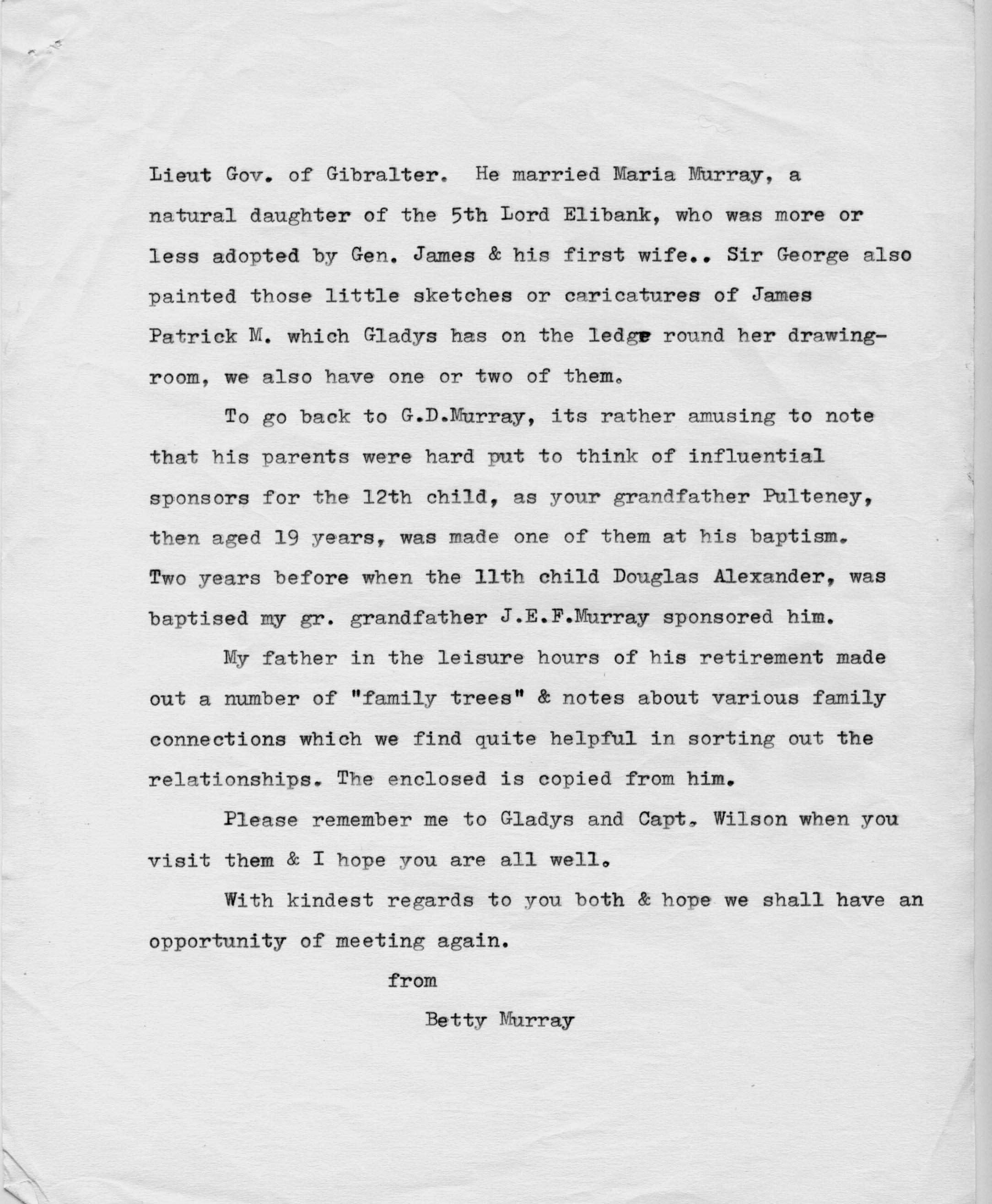
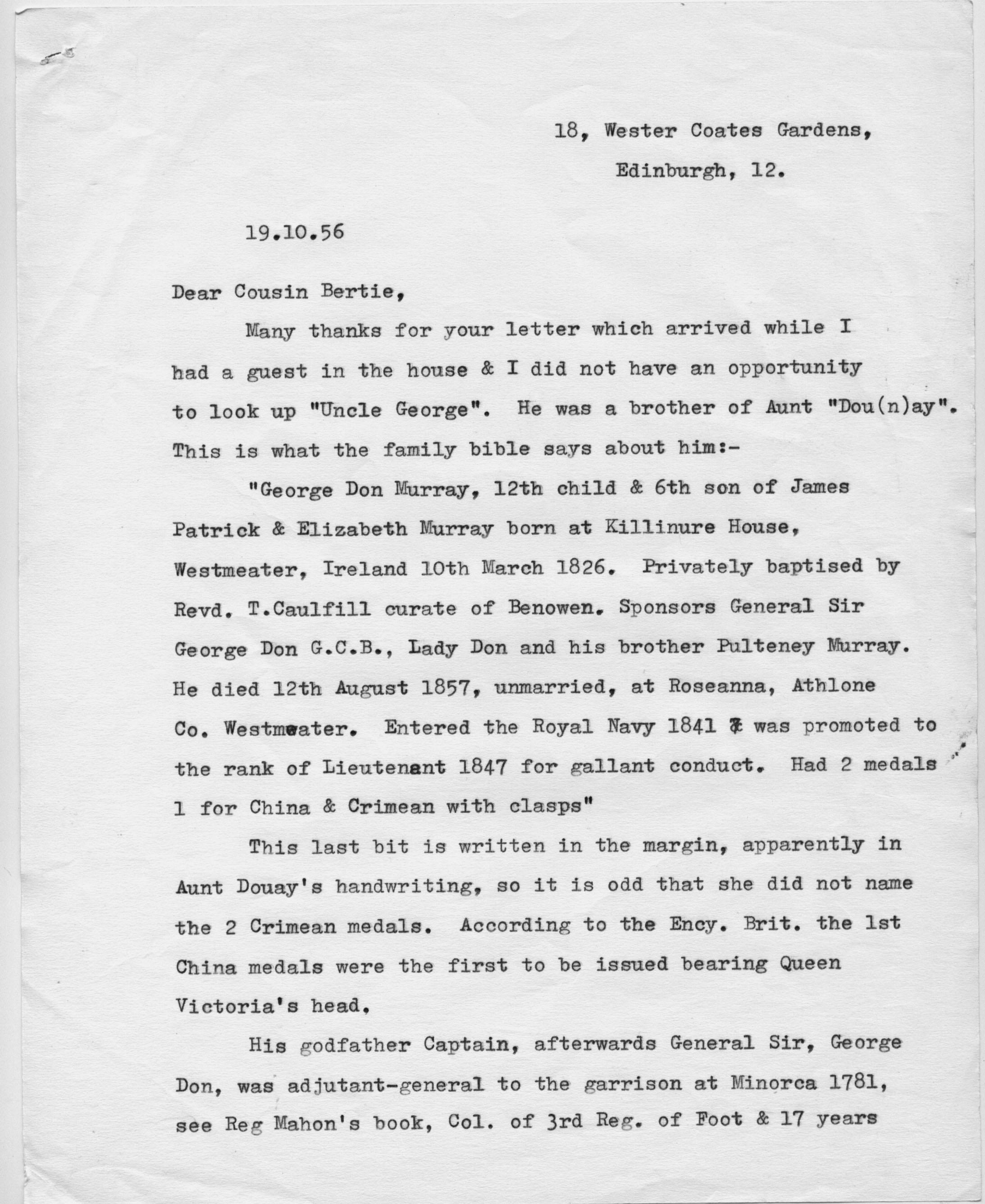
13. George Don MURRAY, son of Major General James Patrick 2 MURRAY and Elizabeth RUSHWORTH, was born on 10 March 1826 in Westmeath. He was a Sailor. He died on 12 August 1857 in Athlone.
His youngest brother George Don was born at Killinure House on 10th March 1826. He entered the Royal Navy and was promoted Lieutenant after an unusual act of bravery in New Zealand. The citation read " while serving as a midshipman of the North Star commanded a subdivision of seamen and was severely wounded in an attack made in January 1846 on a pah belonging to a rebel chief named Kawati at Ruapikapita in New Zealand, which was assaulted and carried in a most gallant manner after a severe action of four hours" He served on the Prince Regent, the Neptune and the Vengeance. He saw service in China and the Crimea and won medals in both campaigns. These medals survive in the family possessions. He died at Rossanna House 12th August 1857 unmarried and without issue. He was buried in Benowen Churchyard.
George was given his second name, Don, after his godfather, Gen. Sir George Don GCB who was the husband of Maria, Gen. James' niece. (see separate story). JPM had been an ADC to Gen Don at one stage in his career.
His sponsors were Sir George Don, his wife and also his 19 year old brother Pulteney (Showing that they were hard pressed to find sponsors for him after so many siblings!) - see letter.
Third Generation
14. Georgina Maria MURRAY, daughter of James Edward Ferguson MURRAY and Katherine Jane SLAUGHTER, was born on 14 October 1831 in Kent, England. She married unk YOUNG on 15 January 1854 in Kilkenny. She died on 16 December 1855 in Ireland.
"dsp". GEORGINA died of scarlet fever six days after giving birth to a girl. The girl was christened Catherine Grace Georgina but died on 12/4/1856,aged four months.
15. James Pulteney MURRAY, son of James Edward Ferguson MURRAY and Katherine Jane SLAUGHTER, was born on 8 June 1833. He married Henrietta Victoria BLAKISTON on 11 September 1862 in Paddington, London. He died on 21 August 1874.
Henrietta Victoria BLAKISTON was born on 24 June 1837. She died on 14 February 1918 in Bath. She and James Pulteney MURRAY had the following children:
| 36 | Georgina Maria MURRAY (1864-1939). Georgina was born on 23 April 1864 in Barnstaple. She died on 15 August 1939 in Leamington Spa. |
| 37 | James Arthur MURRAY (1865-1940). James was born on 16 October 1865 in Gosport, Hants. He had the title 'Rev'. He was a Priest. He died on 21 December 1940 in Leamington Spa. |
| 38 | William Harry Elibank MURRAY (1866-1937). William was born on 5 December 1866 in Gosport. He was a Merchant, Seaman. He married Bertha Delamore BROUGHAM on 14 December 1892. He died on 28 September 1937 in New South Wales, Australia. |
| 39 | Edward Rushforth Blakiston MURRAY (1868-1942). Edward was born on 7 December 1868 in Kingstown, Dublin. He was a Soldier. He married Hilda Dorothea PAUL on 15 August 1905 in Loughborough. He died on 27 April 1942 in Bath. |
| 40 | Henrietta MURRAY (1870-1959). Henrietta was born on 18 April 1870 in Castleknock, Ireland. She died on 28 January 1959 in Burnham on Sea. |
16. Katherine Elizabeth MURRAY, daughter of James Edward Ferguson MURRAY and Katherine Jane SLAUGHTER, was born on 6 December 1834 in Donegal, Ireland. She married Thomas MAHON on 30 August 1855 in Kilkenny. She died on 20 March 1893 in South Brent, Devon.
Lt-Col Thomas MAHON RA died on 22 August 1879 in Castleknock.
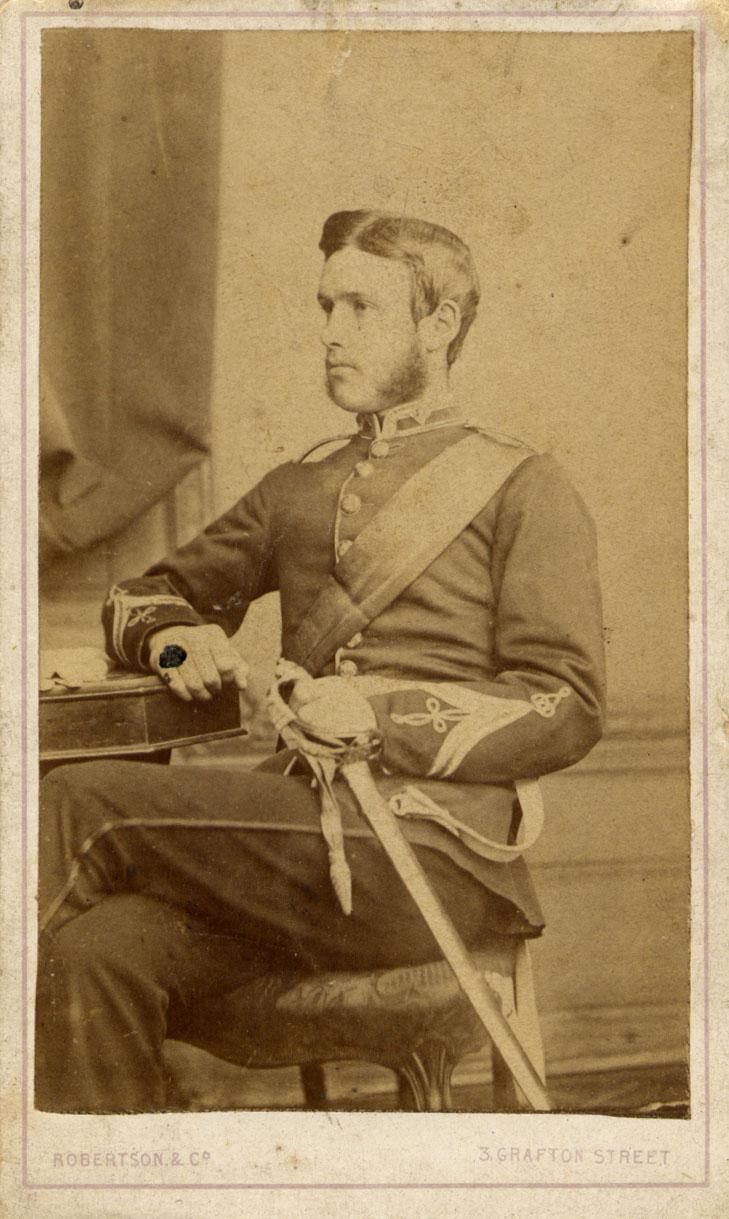
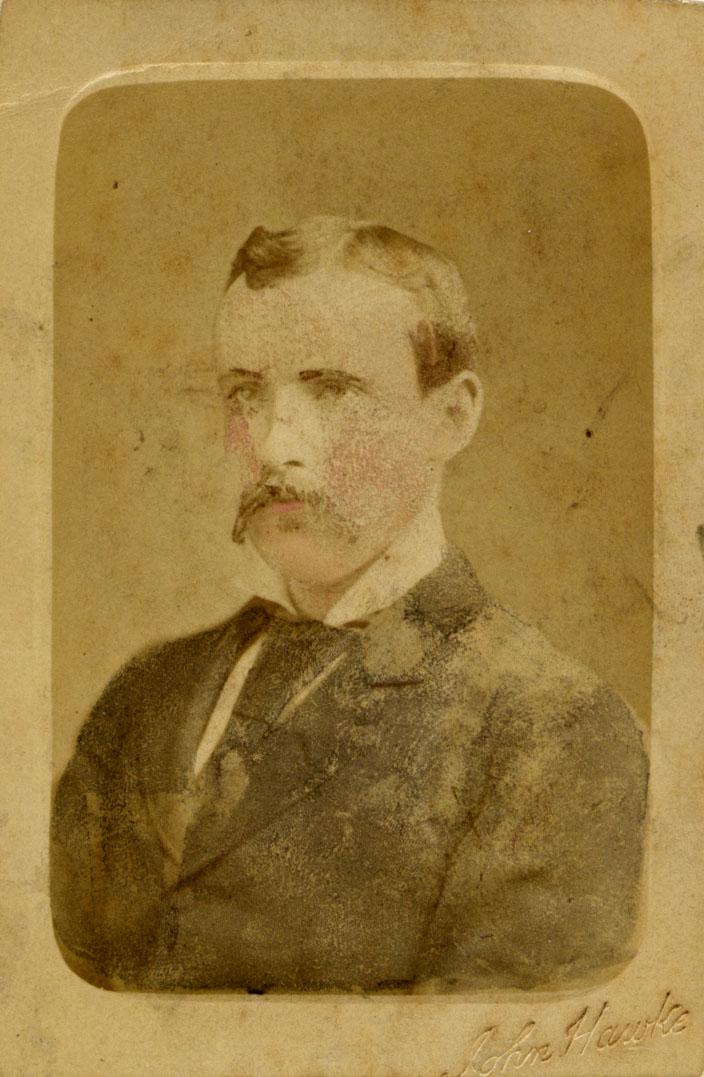
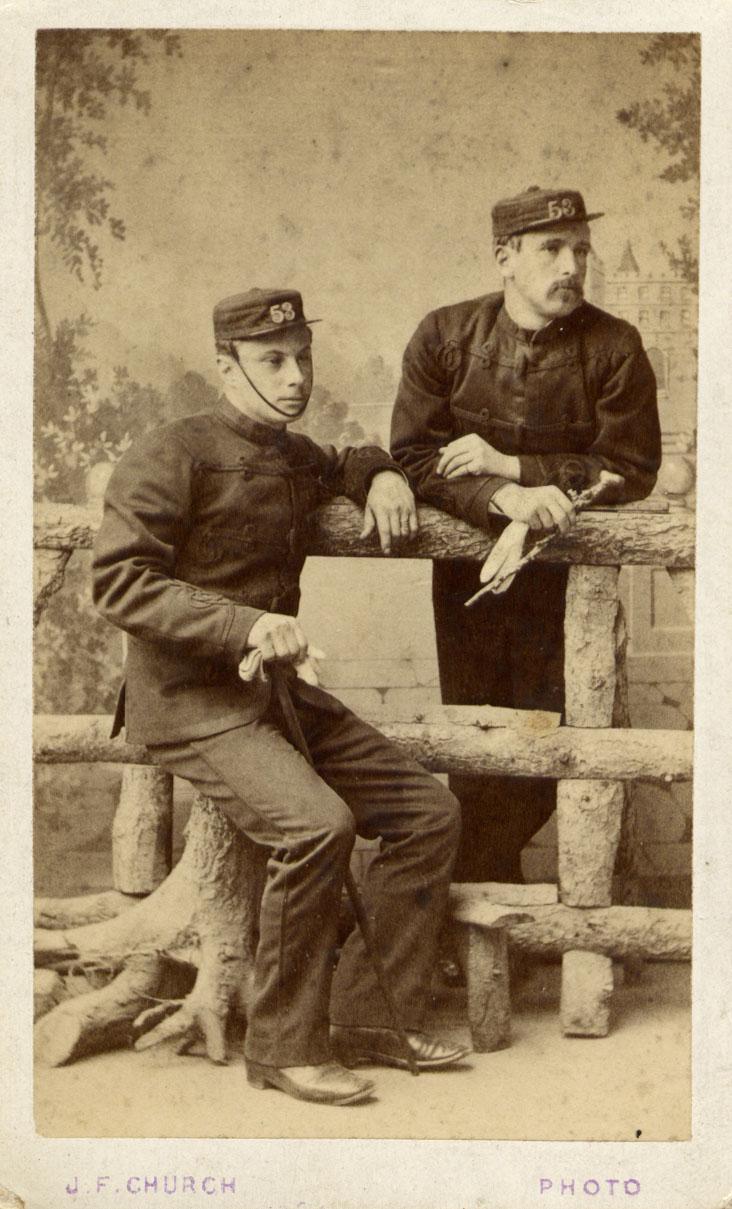
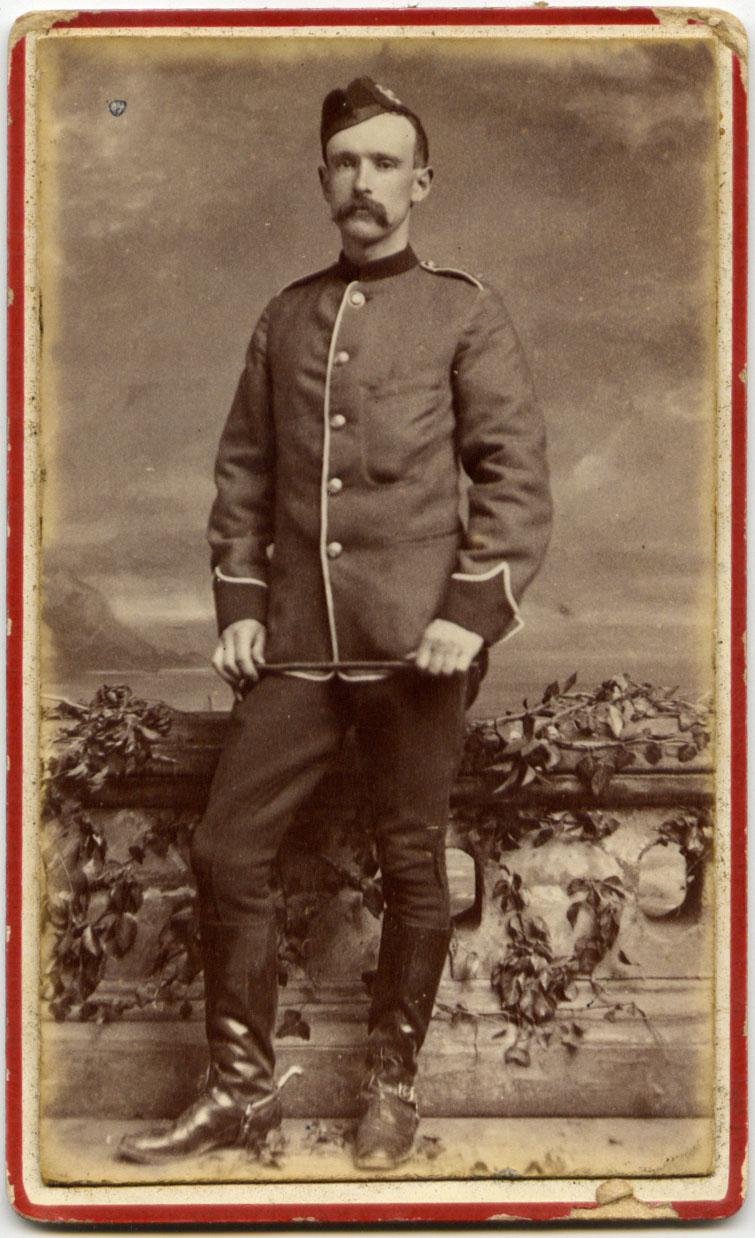
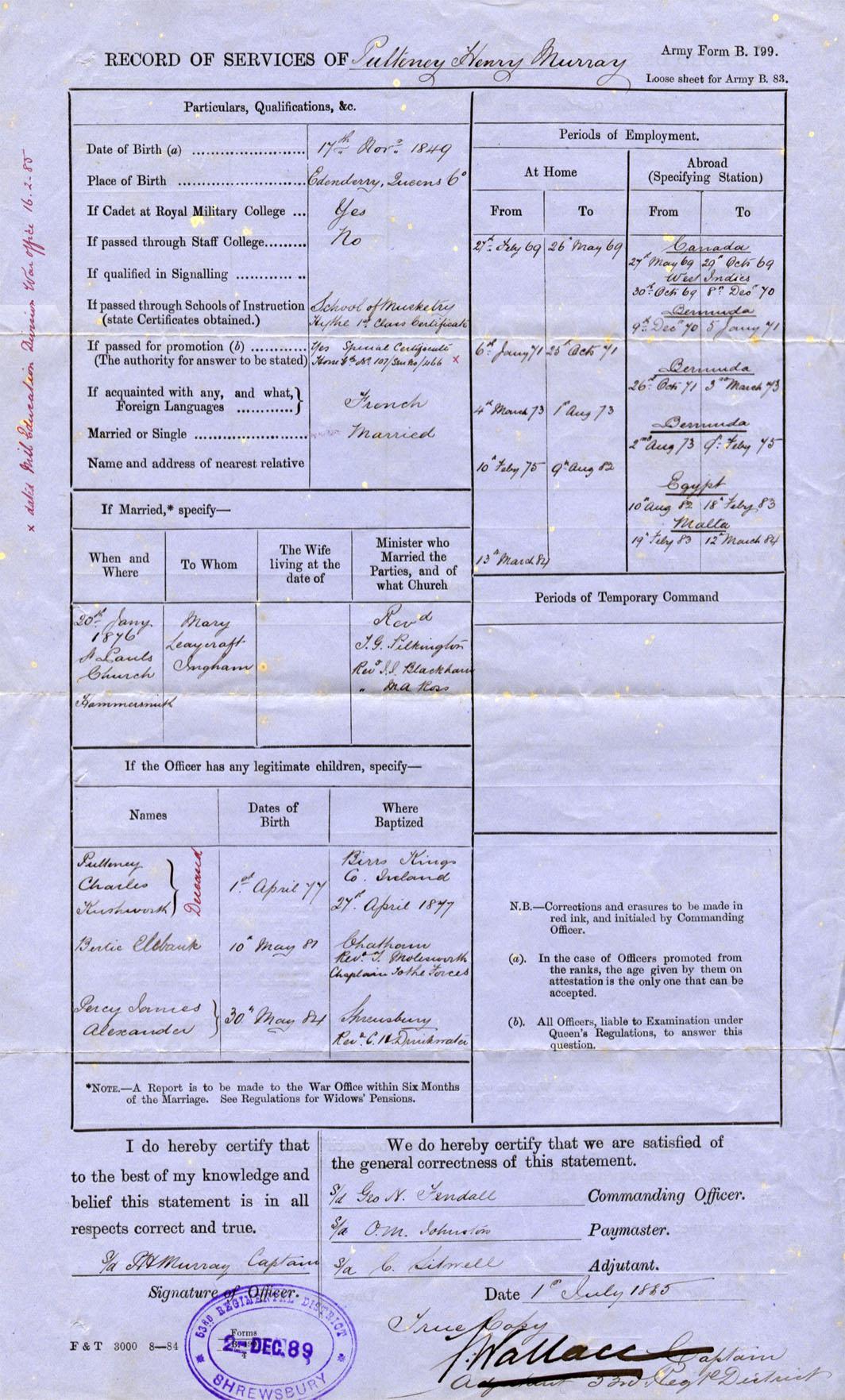
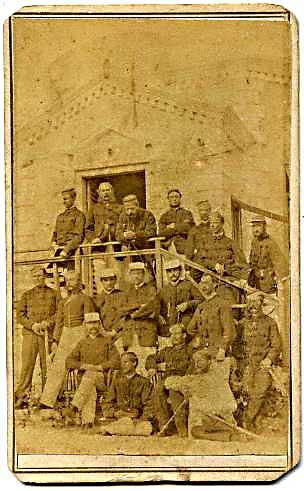
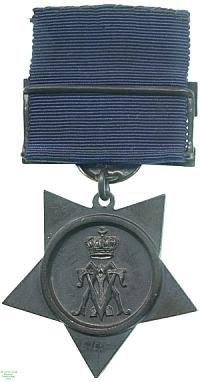
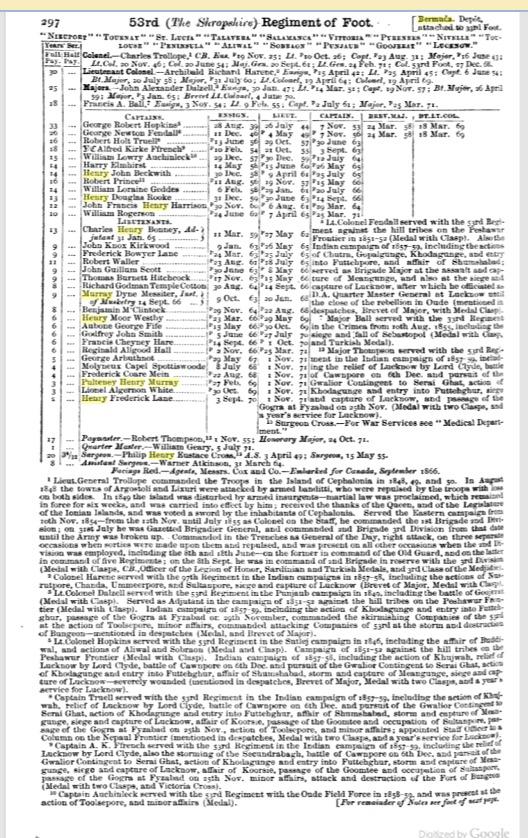
17. Colonel Pulteney Henry MURRAY, son of Pulteney MURRAY and Jane MACKENNY, was born on 17 November 1849 in Edenderry, Queens County, Ireland. He was a Colonel in the Army. He married Mary Leaycraft INGHAM on 20 January 1876 in Hammersmith Ch., London, England. He died on 15 September 1912 in "Mangroville", Paget, Bermuda. He died in November 1912.
1849-1912. Only child of Pulteney Murray and Jane MacKenny, who died when he way about two. He was brought up by his aunt Catherine Anne - "Aunt Donny", whilst his father remarried and had three children. Before any of these children appeared his father had joined the Royal Irish Constabulary - on the official documents for the RIC he left the space for information about any children blank. It paints a rather bleak picture of his childhood that his mother had died and his father wanted nothing to do with him. (17/11/1849 Edenderry, Queens County - 1912) (1877 lived in Parsonstown. in 1901 lived at The Grove, Lancaster. Married Mary Leaycroft Ingham 20/1/1876, St. Paul's Hammersmith; lived at 2 Adelaide Road, Hammersmith at time of marriage). Military career with 1st Shropshire Light Infantry. Its Commanding Officer 1894. Ensign 53rd, February. 1869. Musketry-Instructor,1877 to 1880. Adjutant. 1881 to 1883, including the Egyptian War. Commanded 2nd Battalion, February, 1894, to 1898. Worked in Canada, West Indies, Bermuda, Egypt and Malta. 5' 8 ?"! (85th Regiment (2nd KSLI)).
The Obituary of Pulteney Henry Murray:
"The death took place on Sunday at Southsea of Colonel Henry Murray. Colonel Murray served through the Egyptian War of 1882 as captain and adjutant in the King's Own Shropshire Light Infantry, and was awarded the medal and Khedive's Bronze Star. In 1900 he was appointed to the command of the 4th Regimental District, and afterwards he held the command of the North-Western District at Chester."
Despite this obit. Murray actually died in Bermuda, at his wife's family home, according to various other sources.
In Bermuda - 1870 to 1875. 53rd (Shropshire) Regiment. (later, King's Shropshire Light Infantry).
A note on Khedive's Bronze Star, which was awarded to PHM
The Khedive of Egypt presented a bronze star to all Officers and men of the Navy and Army who were engaged in the suppression of the rebellion of Egypt in 1882. The Star was re-issued for 1884, 1885-6, 1886-9 and 1890. One clasp was issued with an Arabic inscription to those who fought at Tokar on Feb 19th 1901.
Most of the battles in the final years of British influence in Egypt were rewarded with issues of the Egyptian Medal, but the Egyptian Khedive Tewfik Pasha showed his gratitude for British help with issues of his own bronze star for the campaigns in his kingdom.
One of these, the siege and capture of the Mahdist stronghold of Tokar in the Sudan, was unusual in that no British award was made for it, although the Khedive's Star could be worn in uniform. Tokar had since 1883 been the seat of the Beja leader Usman Dinga, and the 1891 campaign resulted in his briefly being captured.
Those who had already been awarded a Khedive's Star for earlier Egyptian campaigns were awarded only the bar for the Tokar campaign; issues of new undated stars with this bar are comparatively rare, therefore, as they went only to the newest soldiers in the forces involved. One such must have received this medal, but as it is unnamed, we do not know who he was. Lester Watson acquired the medal at some point before 1928. (see illustration).
Mary Leaycraft INGHAM, daughter of Hon. Samuel Saltus INGHAM (1816-1900) and Margaret Richardson LEAYCRAFT (1821-1880), was born on 22 June 1848 in Paget, Bermuda. She was born on 22 June 1848 in Paget, Bermuda. She was baptised on 1 October 1848 in Paget Bermuda. She was christened on 1 October 1848 in Paget. She died on 30 April 1890 in "Mangroville". She and Pulteney Henry MURRAY had the following children:
| 41 | Pulteney Charles Rushworth MURRAY (1877-1882). Pulteney was born on 1 April 1877. He died on 3 May 1882. |
| 42 | Bertie Elibank MURRAY (1881-1960). Bertie was born on 10 May 1881 in Chatham. He was a Soldier. He married Agnes Letitia BARRINGTON on 30 June 1927. He died on 14 September 1960. |
| 43 | Percy James Alexander MURRAY (1884-1920). Percy was born on 30 May 1884. He was a Soldier. He died in 1920 in Australia. |
| 44 | Catherine Gladys MURRAY (1886-1958) (known as 'Gladys'). Gladys was born on 18 January 1886 in Oswestry (registered). She was born on 18 January 1886 in Oswestry. She married Maurice Fiennes Fitzgerald WILSON on 4 August 1914 in St Judes, Portsea, Portsmouth, England. She died on 12 April 1958. |
| 45 | Gerald Graham MURRAY-MOORE (1888-1949). Gerald was born on 17 September 1888. He was a Soldier. He married Lilian Julietta MOORE on 13 March 1922. He died on 8 July 1949. |
18. Georgina Emily MURRAY, daughter of Pulteney MURRAY and Elizabeth UNK, died in USA. She married Colman FLARIDY.
Colman FLARIDY died in USA.
19. James Alexander MURRAY was the son of Pulteney MURRAY and Elizabeth UNK.
20. Elizabeth Jane MURRAY, daughter of Pulteney MURRAY and Elizabeth UNK, died in USA. She married Michael MCCARTHY.
21. Harriet Elizabeth Cordelia HODGES, daughter of Henry HODGES and Harriet Elizabeth MURRAY, was born circa 1836 in Beckley, Sussex.
22. Frederick Owen Douglas HODGES, son of Henry HODGES and Harriet Elizabeth MURRAY, was born circa 1839 in Alphamstone.
Both boys in the family were listed as being at Elizabeth College (Guernsey?) in the Trinity term of 1856.
23. George Hugh Cartwright HODGES, son of Henry HODGES and Harriet Elizabeth MURRAY, was born circa November 1841 in Alphamstone.
24. Mary Beatrice (Ann?) HODGES, daughter of Henry HODGES and Harriet Elizabeth MURRAY, was born circa 1848 in Alphamstone.
In the 1871 census she is shown to be, at the age of 23, still unmarried, and visiting an address in Paddington, where a couple and their one year old daughter live with 5 servants; the man is a partner in a London brewery!
25. Julia HODGES, daughter of Henry HODGES and Harriet Elizabeth MURRAY, was born circa 1854.
26. Murray NEWTON was the child of Andrew NEWTON MD and Mary Johanna MURRAY.
27. Elizabeth Maria HARVEY, daughter of William Francis HARVEY and Mary Johanna MURRAY, was born in 1850. She died in 1941.
Mary Johanna married (for the second time) on 13th February 1849 Wm. F. Harvey of Purbrook Heath House in Hants. They had two children: the elder was Elizabeth Maria Harvey (known as 'Cousin Lizzie') born 1850 and died in 1941, and the younger Thomas William Harvey ( known as 'Cousin Tom') born 1852 and died 1905. Both lived together at Purbrook and when Lizzie died in1941, as they had no heirs, the house and its contents were left to their cousin Edward 'Ted' Murray.
In the Second World War Purbrook was requisitioned by the army who later introduced piped water and electricity. Fortunately for old cousin Lizzie she died in 1941 (at the age of 91) before she was forcibly made to move out of the house by the military. That would have broken her heart. The property played a small but important part in the planning of the 'D' Day landings. The adjoining larger property of Southwick House, owned by the Thistlethwaites family became General Eisenhower's headquarters and Purbrook Heath House was the signals head-quarters.
On her death, Lizzie left Purbrook and its contents in her will to Edward Rushforth Blakiston Murray. As it was wartime, he never took up residence, intending to move in after the war was over. Tragically he was killed in the air raids on Bath in 1942 . He in turn left the property to his elder son James Patrick Murray, with a smaller part of the cash equally to his other children Thomas and Elizabeth.
28. Thomas William HARVEY, son of William Francis HARVEY and Mary Johanna MURRAY, was born on 3 July 1852. He died on 19 March 1905 in Purbrook, Hants..
29. Betsy TROLLOPPE was the daughter of General Sir Charles TROLLOPPE KCB and Lady Cordelia Maria MURRAY.
30. Denise BOWER, daughter of Edmond BOWER and Lady Cordelia Maria MURRAY, was born in 1896. She married Claude HOLLIES in 1944. She died in 1980.
They had no children.
31. Delia BOWER was the daughter of Edmond BOWER and Lady Cordelia Maria MURRAY.
She became a nun.
32. James Patrick MURRAY, son of Lieutenant Colonel Douglas Alexander MURRAY and Mary Ann BELTZHOOVER, was born in 1856.
33. Catherine Beltzhoover MURRAY, daughter of Lieutenant Colonel Douglas Alexander MURRAY and Mary Ann BELTZHOOVER, was born in 1857.
34. Elizabeth Rushworth MURRAY, daughter of Lieutenant Colonel Douglas Alexander MURRAY and Mary Ann BELTZHOOVER, was born in 1859. She died in 1949. She married Robert Allan MCLEOD.
Elizabeth and Robert lived in Cleveland, Ohio and upon his passing, Elizabeth lived with her daughter, Katherine Elizabeth Neuman, until her passing in 1949. Elizabeth was "of Carlisle, PA".
Robert Allan MCLEOD was born circa 1853. He died in 1933. He and Elizabeth Rushworth MURRAY had the following children:
| 46 | Marion Murray MCLEOD (1882-1927). Marion was born on 8 July 1882. She died in 1927. |
| 47 | Catherine Morrison MCLEOD (1883-1983). Catherine was born on 6 December 1883 in Cleveland, Ohio. She died in November 1983. |
35. Susan Douglas MURRAY, daughter of Lieutenant Colonel Douglas Alexander MURRAY and Mary Ann BELTZHOOVER, was born in 1861.